About That Season Premiere…

WARNING! WALKING DEAD SPOILERS!


There, now that I got the spoiler warning out of the way, I can write about the season 7 premiere of The Walking Dead. After months and months of waiting, we finally know who Negan killed: Abraham and Glenn. The Glenn kill was lifted nearly panel by panel from the comic, including the scene where his eyeball pops out of his head and Negan makes fun of it. The Abe kill is different. In the comics, he dies at the hands of Dwight, before Negan shows up. Abe’s death is essentially the introduction to the Saviors. For me, his comic death was more meaningful because it occurs out of nowhere and it occurs as he is having a heartfelt talk with Eugene, after their friendship was on the rocks. His death also comes at at time when the group of survivors found a safe space and started to rebuild again after the fall of the prison.

The season premiere tonight left me uneasy. Even after the brutal death of Glenn in issue 100, which was stretched over several panels, thus making it quite graphic for the reader, there was STILL some sense of hope. Rick Grimes threatens retaliation against Negan, so after losing such a major character, readers have faith that Glenn’s death will be avenged. That wasn’t the case at all during the season 7 premiere. The episode centered around the breaking of Rick Grimes, starting with the symbolic gesture of kneeling in gravel as the group is lined up and Abe and Glenned are Lucilled, to Negan telling Rick he wants him to cut Carl’s hand off with an ax. At that moment, on his knees, Rick begs and pleads with Negan. Carl’s hand is spared, thankfully, but not before Rick repeats Negan’s line that he essentially owns the group now.

None of that happens in the comic. The Walking Dead, both the show and comics, have always been so popular because they focused on those rays of hope in a zombie apocalypse, how communities rebuild when everything collapses. In a prison they turned into a home, the group was able to garden and begin life anew. After the prison falls, they find a safe zone, a gated community where they come together with a broad group of survivors. For the first time, however, there was no hope offered at the end of tonight’s episode. The TV adaptation of Negan lacks the absurdity and comedic aspect he has in the comics, which provides some levity to the horror he inflicts upon the group. When he killed Abe in tonight’s episode, the blood splattered on Rick’s cheek. Negan then points the blood-drenched Lucille at Abe’s ex-lover, Rosita. And in the final scene, it is unclear how the group is going to pull together. Rick is utterly shattered, no longer a man with a plan.

Perhaps it’s important to note that Maggie, pregnant with Glenn’s kid, is the one who first  rises to her knees. In the comics, following Glenn’s death, she has a lot of character development and becomes the leader of the Hilltop Community. Maybe she, in her grief, will provide the hope the show desperately needs after a brutally graphic season premiere.  The Walking Dead has always focused on humanity, even in the bleakest of the circumstances, so if the show snuffs that out during the Saviors arc, I will keep reading the comics, but tune out the TV adaption.


So what next?

I am writing this post a few hours before the third and final presidential debate. I watched the other debates at watch parties, surrounded by friends and other volunteers. Being around them made it easier to watch. It is likely that this debate will be the nastiest yet. Clinton is ahead in most of the swing states, and over the last two weeks or so, Trump has unveiled a new strategy: claim the election is going to be rigged. To their credit, a lot of mainstream Republicans, including House Speaker Paul Ryan, have pushed back against such claims. Trump’s claims are dangerous because they dig at the fabric of our democracy and the voting process in general. Voting should be seen as sacred, but knowing he is probably going to lose, and possibly lose big, Trump is now trying to undercut the legitimacy of our election. We have never seen anything like this in past elections.

It is now possible that the Democrats can win back the Senate and the House. The Clinton campaign is pushing into red states and now spending money in AZ, which is a virtual tie, according to latest polls, and Georgia, Texas, and Utah. It’s not likely that Clinton will win all of these states. She may not even  win any of them, but the spending could have a serious down ballot effect that benefits Democrats. Even if this turns out to be a wave election, what will the aftermath be? If Trumpism is repudiated big time at the ballot box on Nov. 8, will he go away? Will he stop having meltdowns on Twitter? Will he stop claiming the election is rigged and there is some vast conspiracy going on between the Clinton campaign and the mainstream media? Will the nastiness and xenophobic rhetoric go away, or will his supporters, who feel totally alienated by the political process, become even bolder?

I hope that the Democrats, even if they win big, take a long, hard look at what caused Trumpism in the first place. Why is it that the media mogul, or even Bernie Sanders, resonated so deeply with a chunk of the electorate? What will the Democratic Party do to address the concerns of the white working-class? This isn’t solely a U.S. issue, either. The New Yorker published a story a few weeks ago about the rise of far-right, nationalist parties in Germany, France, and Austria, caused by the Syrian refugee crisis. Here, our electorate is much broader and more diverse, so it doesn’t seem likely that Trump will win the White House. That said, his nationalist rhetoric and the concerns of his supporters need to be addressed. Clinton is going to have a massive burden to try to soothe and heal this country post-election.

My fear, however, is that the GOP may try to obstruct Democrats at every turn, like they did with Obama over the last 8 years. Already, John McCain has stated that anyone Clinton puts up for the Supreme Court will be stymied by the GOP.

Tonight, I will be watching the debate with friends and other volunteers, for the third and final time. I am ready for this election season to conclude, and I hope that Trump/Trumpism is retired to the dustbin of our history, just like McCarthy and George Wallace. The question is, what happens after election day?

Yes, Dylan Is a Poet

Yesterday, it was announced that Bob Dylan  won the Pulitzer Prize in Literature. Shorty after the news broke, social media responded. President Obama tweeted congrats to one of his “favorite poets.” Springsteen said, “Bob Dylan is the father of my country: ‘Highway 61 Revisited and ‘Bringing It All Back Home’ were not only great records, but they were the first time I can remember being exposed to a truthful vision of the place I lived.”

Some writers also came out in favor of the decision. Joyce Carol Oates said that Dylan’s haunting music and lyrics always seemed “literary” to her. Salmon Rushdie also praised the choice. Other reactions, however, were less kind. Novelist Irving Welsh said, “I’m a Dylan fan, but this is an ill-conceived nostalgia award wrenched from the rancid prostates of senile, gibbering hippies.”

For a more complete round-up of reactions, click here.

My Facebook feed yesterday was filled with mixed reactions. However, I was especially surprised to see some of my poet friends claim that Dylan isn’t a “writer.” One poet even labeled Dylan a “pop star,” and a very good one at that, but not a writer. To me, this reaction reeked of high-brow snobbery and reminded me of people who immediately dismiss hip-hop as non-music and its lyrics as non-poetry, despite its use of carefully constructed meters and complex rhyme schemes. Others have already pointed out a number of reasons why Dylan is a writer, and I don’t have much to add. I will state, however, that Dylan’s literary influences, especially in poetry, are well-known. He grew up reading everyone from Rumi to Pound to Ginsberg. He is also the author of a best-selling memoir from a few years ago, Chronicles.  If anyone doubts his talents as a writer, then they need to listen to and read the lyrics to a number of his songs. I personally recommend “Desolation Row,” “Visions of Johanna,” “Song to Woody,” or “Ballad of a Thin Man.”

Upon making the announcement, the Nobel Prize committee noted that Dylan has opened up new forms and pathways in terms of lyrics. This is certainly true. At first, Dylan penned protest songs in the vein of Pete Seeger and gave the Civil Rights/anti-war movement some of its most important anthems, including “Blowin’ in the Wind,” “Masters of War,” and “A Hard Rain’s a Gonna Fall,” which is perhaps his greatest achievement lyrically from his early-mid 60s folk/acoustic period. The song samples a number of biblical passages and paints in surreal, apocalyptic imagery suited for 1960s America. By the time he went electric and plugged in at the NewPort Folk Festival, Dylan’s lyrics had changed, especially on his first electric albums Bringing It All Back Home, Highway 61 Revisited, and Blonde on Blonde.  His use of sampling classic and religious texts grew, as did his ability to juxtapose images and create non-linear song structures.

As a poet, I agree with those who say Dylan is deserving of the Nobel Prize in Literature. I understand the arguments that a lesser-known writer should have received the prize, but in response to some of the reactions I’ve seen on social media, I say this: let’s broaden our notions of poetry and not dismiss an artist simply because he is immensely popular on a global scale. We should also ask why American poets are rarely even considered for the prize anymore. What does that say about the current state of contemporary American poetry and its place and influence?


A Whole Lot of Thank Yous and Appreciation

It’s been a whirlwind last few days, after a reading in Reading, PA on Thursday, the book launch for Waiting for the Dead to Speak Friday, and a second book launch in Boston on Sunday. This book has put me back in touch with a lot of old friends, and venturing to different cities has allowed me to step into other literary scenes and communities to see and support what they’re doing. It reaffirmed for me that poetry is alive and well, due to the time and energy people are willing to invest in it and in their community spaces. I’ve been thrilled to celebrate poetry with a wide range of friends. Over the last 72 hours, the news cycle has been depressing and disgusting, to the point where I almost didn’t tune into the second presidential debate, even as a politico. But the poetry readings/events have been such a positive contrast. I am so grateful for these types of communities that exist and to everyone who came out to these readings over the last few days.

I also want to note that I will be reading at the KGB Bar in NYC this Wednesday at 7 p.m.

In addition, I want to share some links to various interviews I’ve done over the last few weeks. I meant to share these earlier but had little time between teaching, writing, and readings for the book.

Thanks to The Scranton Times-Tribune/570 for this article. 

Thank you to Erika Funke and WVIA Radio for this interview on ArtScene, which aired a few days ago.

Thank you to E.W. Conundrum for this podcast.


Separating Art from Reality/The Birth of a Nation (2016)

I was torn about whether or not to see Birth of a Nation (2016), after the controversy surrounding its director/screenwriter/star Nate Parker. Part of me wanted to side with my girlfriend, who refuses to see it due to allegations women have made against Parker and his refusal to show any remorse or apologize for his past. However, due to my deep interest in American Studies, I did see it, and when I saw it, I had a hard time separating art from reality, especially in the scenes that depict violence against women to illustrate the brutality of the institution of slavery. If I can separate the director/screenwriter/star from the work of art itself, I will say it has some haunting scenes and good character development, especially the evolution of Nat Turner’s character and what led to his 48-hour slave rebellion in Virginia. Furthermore, Turner’s evolution as a preacher is just as fascinating. He was initially used by white plantation owners/slave owners to preach the word of God and make slaves fearful of rebellion, quoting passages in the Bible to keep them in line. However, as he travels from plantation to plantation and witnesses the horror of slavery first hand, including one owner who uses a tool to knock out the teeth of a slave who refuses to eat, he eventually uses the Bible as a means to support a slave rebellion, especially after his wife is raped is left for dead. One of my favorite scenes i is when Turner goes toe to toe with a white preacher who tries to use the Bible to reinforce the institution of slavery. Turner refutes the white preacher’s passages with other verses that support equality and freedom for all.

There are other scenes worth noting. The way “Strange Fruit” is used in one of the final scenes is one of the most chilling and memorable scenes that I’ve viewed in a while. I disagree with some reviews, including The New Yorker’s, that said too much of the film is action-packed and feels like a Marvel movie. The actual rebellion involves a lot of blood and violence, but that’s only about the last 30 minutes of the film, maybe even less. I do agree with both The New Yorker and The Nation’s reviews, however, that the role of women in the film is pretty diminished, which is important to note considering the controversy surrounding Parker. This isn’t the case in other recent films that address similar parts of American history. In 12 Years a Slave, we have Patsy, a full-developed character who endures some pretty awful violence but maintains her spirit, for the most part. Patsy also has a large chunk of screen time. In Selma, Coretta Scott King plays an important, behind-the-scenes role, even meeting with Malcolm X to determine how both sides can work together to get a Voting Rights Act. It’s also important to note that The Nation’s review lists some major historical inaccuracies, including the fact Nat Turner never killed his owner, nor was the rebellion betrayed by a young slave boy. That said, there are plenty of haunting, powerful scenes. When I left the theater, however, I felt queasy, still thinking about the controversy surrounding the one responsible for retelling/rewriting The Birth of a Nation film and for witnessing a few graphic scenes that do their best to show the brutality of slavery.

Billy Collins on the Mind

I have Billy Collins on the mind today, and I admit this isn’t a typical thing. I haven’t taught his work in at least five years, since I last taught Intro to Poetry and used his collection Sailing Around the Room as a means to show students that poetry can indeed be accessible, even funny. I have Billy Collins on my mind, though, because of an interview I heard yesterday that he did with Diane Rehm of NPR. He was there to discuss his new book, The Rain in Portugal. For a moment, I almost shrugged and shut off the interview, but then I pondered why I didn’t want to listen to him. He is, after all, a former U.S. Poet Laureate and someone whose work often made me laugh in the past. Yet, as one of the callers noted, there has long been a backlash against Collins’ work. For some, his work isn’t academic enough. For others, his poetry doesn’t follow any conventional forms (which certainly isn’t true). And yet, he, along with Mary Oliver, who also faces similar criticism, are probably the two most well-known living American poets in existence, other than maybe W.S. Merwi or Sharon Olds. How many other poets even get an interview on one of NPR’s most well known programs?

I’m glad I kept the interview on because there are several points Collins made about poetry that could be seen as a reflection of his own work. He noted that when he gave a reading in a rural community years ago, one of the attendees called his work “prose.” But as Collins noted, anyone who has been paying attention to poetry since Modernism in the early 20th Century will know that poetry moved away from fixed forms about 100 years ago. If  we want to be really picky, we can go back to Whitman, a few decades before Modernism. The attendee’s comment, however, speaks to the fact that many American don’t pay that much attention to modern poetry and therefore believe it should operate in fixed forms and employ tight meters and end rhymes. Even the title of Collins new book challenges that notion. It isn’t titled the Rain in Spain, but rather, the Rain in Portugal, challenging expectations of what poetry should be. Collins probably has the biggest audience of readers than any current living American poet. I am certain, in fact, that his new book, published by Random House, one of the largest existing publishing houses, will earn him even more readers. I’m sure, too, that when some of them open the book, they may be surprised how Collins is able to write about ordinary things (which also became more accepted under the guise of Modernism nearly), and that he rarely writes formalist verse.

There is something to be said, too, for the fact that Collins work is SO accessible. That’s not to say it doesn’t have punch or that he’s not capable of writing about serious subjects, but Collins is a far cry from John Ashbery or any of the other New York School poets that are still all the rage in a number of well-known lit mags. (When is this imitation going to end?) I found myself really agreeing with Collins on one point during the interview. He doesn’t like poems that start with the obscure. For him, that violates the trust of the reader. He stated that it’s okay for a poem to eventually become difficult and obscure, but only after the reader’s trust has been earned. That’s something to ponder.

Billy Collins may be a celebrity in poetry, but widening the audience for the genre is a good thing. I think we should be a little easier on Collins and at least be happy that someone with such a large profile is out here as  a poetry advocate.


New Review/Upcoming Readings

I want to thank fellow poet Matthew Hamilton for this new review of Waiting for the Dead to Speak. Since Matthew is a vet, I appreciate his close analysis of some of my poems that deal with war from the perspective of a civilian who had friends that had to do two or three tours in Iraq. I am also grateful for the closing words of his review:

I admire Fanelli’s bravery enormously. This is not an arrogant poet seeking recognition. Fanelli writes from a sympathetic and forgiving heart. He encourages us to stand fast, to claw our way out of the disillusioned and absurd world of the rabbit hole.

I also want to note that the Scranton book launch is coming up this Friday, Oct. 7 at 7 p.m. at the Olde Brick Theatre. This month, specifically within the next two weeks, I have readings in Reading, Scranton, Boston, and NYC. Here are the dates and info:

Thursday, October 6 2016 6-8 p.m.

First Thursday Poetry Night

GoggleWorks Center for the Arts, Reading, PA

Friday, October 7 2016 7-9 p.m.

Scranton Launch Party for Waiting for the Dead to Speak

Old Bricke Theatre, 126 W. Market Street, Scranton, PA

Sunday, October 9, 2016

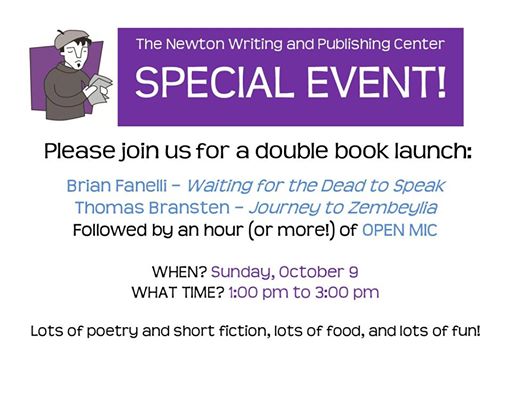
Newtown Publishing Center Showcase

289 Elliott Street,  Newtown Upper Falls, MA

Thursday, October 12 2016 7-9 p.m.

Poetry Night at the KGB Bar

KGB Bar, New York, New York

I will be one of the featured poets this evening.

Here is a flyer for the reading in Boston. I’m grateful to have two book launches within one weekend!

bostonreading


Thinking of NEPA, Thinking of Its Poets

Thursday evening was a celebration of the northeast, Pennsylvania literary community. The evening marked the release of an anthology I had opportunity to co-edit, Down the Dog Hole: 11 Poets on Northeast PennsylvaniaWe gathered at Keystone College in La Plume to read from the book, but also to mark the relaunch of Nightshade Press. An English professor at Lackawanna College, I was happy to see folks from other local colleges present, including Penn State Worthington-Scranton and Wilkes University. My hope is to continue to see this community grow among the colleges because we do far better when we support each other.

I’ve always struggled with my identity as it pertains to NEPA. As a teen, I couldn’t wait to get out of here, especially when the punk rock venues I hung out in  high school closed. They were my only refuge in the area, places I could go where I didn’t feel like an outcast. They got me interested in writing, music, and art. I escaped to college outside Philly and spent most of my weekends hanging in the city, record shopping, book shopping, and reading some of my first poems (very bad drafts) at the Philly area open mics. I cut my teeth in the poetry community in Philly and still keep close connections to that area today. Graduate school brought me back here, and I stayed. At this point, I’m grateful for the chance to teach what I love at Lackawanna College and to help foster the growing literary community here.

As I listened to nine other poets read from the anthology the other night, I was reminded how much there is to mine in this area. One of the poems in the book references John Mitchell, the labor leader who lead mining strikes in the early 20th century and met with Teddy Roosevelt for labor negotiations. Other poems celebrate the natural beauty of this area. Now that I’m older, I’m more comfortable with my place as a poet as it pertains to my native area. As I joined friends the other evening to celebrate this literary community, I was reminded how much has yet to be written about this area. The anthology is a nice start.


Thinking of Asbury Park, Thinking of Springsteen

I can scratch one thing off my bucket list. Last Friday, I saw Springsteen and the E Street Band rock First Citizens Bank in Philly. For nearly four hours, against record-breaking  heat, the band ripped through song after song spanning The Boss’ long career. The set was a mix of hits, including “Out on the Streets,” “Badlands,” “Born to Run,” and “Dancing in the Dark,” juxtaposed with deeper cuts, including “Loose Ends” and “American Skin.” The band was relentless, barely resting between songs. Early in the set, Springsteen picked out signs in the crowd and honored some fan requests, including a moving, even slower rendition of “Racing in the Street” from Darkness on the Edge of Town. I was more surprised, however, that the set, especially the first half, contained so many tracks from Springsteen’s earliest albums, Greetings from Asbury Park and The Wild, the Innocent, and the E Street Shuffle. His last few albums, Magic, Wrecking Ball, and Working on a Dream, got no love in the set, even though they are rockers, especially Magic and Wrecking Ball. I would have liked to hear a few tracks from them. However, they are albums so rooted in the times in which they were written. Magic is a response to the Bush years, and Wrecking Ball plays like a 45-minute anthem for Occupy Wall Street.

Later this month, Springsteen’s memoir, Born to Run, will be released. Perhaps his set was so loaded with early tracks because he’s been reflecting on where he’s been and what remains of his career. Maybe, while playing two shows in Philly last week, he recalled playing those small dive bars in Asbury Park and other seaside towns nearby.

I was also struck by the fact that in an election year, Springsteen avoided political stage banter. He didn’t tell anyone who to vote for, though anyone who has followed him knows about his liberal politics. To his credit, he did have an organization on hand collecting donations to fight poverty and hunger in Philly. However, about mid-way through the set, Springsteen played a quiet, subdued version of “American Skin,” a song he wrote in the early 2000s in response to the  police shooting of Amadou Diallo in NYC. The constant refrain of “41 shots” and “No secret my friend/You can get killed just for living in your American skin” was the most haunting part of the concert, considering we’re living in a post-Ferguson America. Springsteen followed that with “The Promised Land” and “My City of Ruins,” a three-song part of the set that contained some of the Boss’ most socially conscious tracks. We didn’t need any political banter. The music spoke for itself, organized the way it was in the set.

Since the concert, I keep thinking of Springsteen’s long career and how much energy he has, nearing 70. I have Jersey on my mind too, since I’ll be reading from my new book of poems at the Belmar Arts Center, right outside Asbury Park on Sunday, Sept. 25. I’m sure I’ll hang out in Asbury for a while, walk the board walk across from the Stone Pony, a bar Springsteen owns, and the Wonder Bar. I’ll think of the places where he got his start and all of those tracks from the first two albums that he played in the early 70s, before Born to Run hit.

Springsteen’s set in Philly last week was very much a reflection of his long and storied career, a tale of two sets that contained deeper tracks, early tracks, and a barrage of hits that has made him a staple of rock radio all of these years. I am eager to walk the streets of Asbury Park in a few weeks, and maybe, I’ll read my poem “Listening to Springsteen on I-81” at the Belmar Arts Center.


jerseyflyer