Occupy Boston/Occupy Wall Street Movement

This weekend, I visited Boston to see friends, and while there, we checked out the   Occupy Boston rally, located in Dewey Square, the heart of the city’s financial district. Occupy Boston is an off-shoot of Occupy Wall Street, the movement that has formed to protest corporate greed, bank bailouts, and budget cuts, especially to education and other domestic issues.

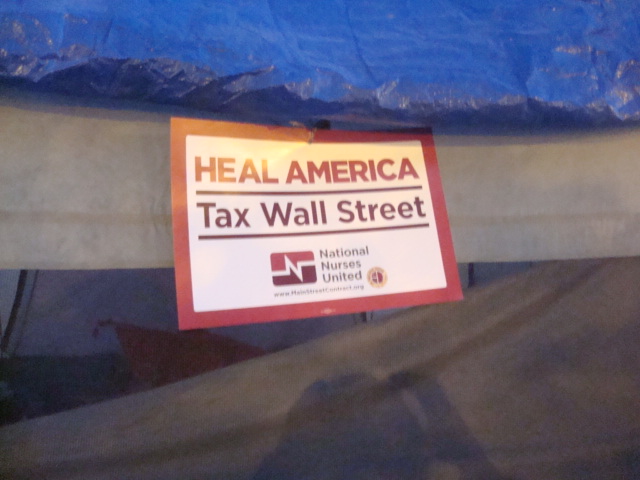
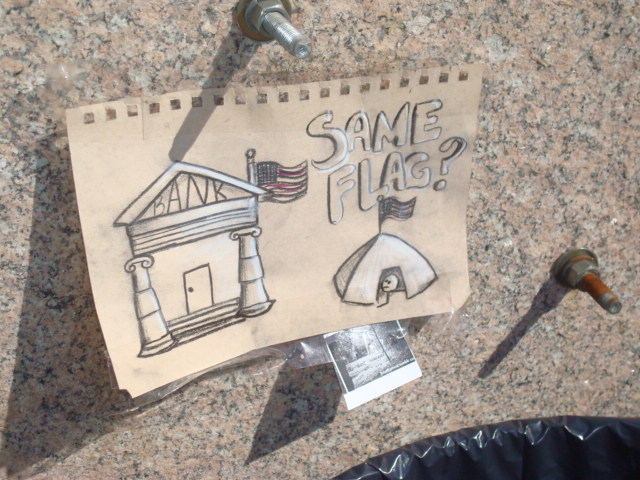
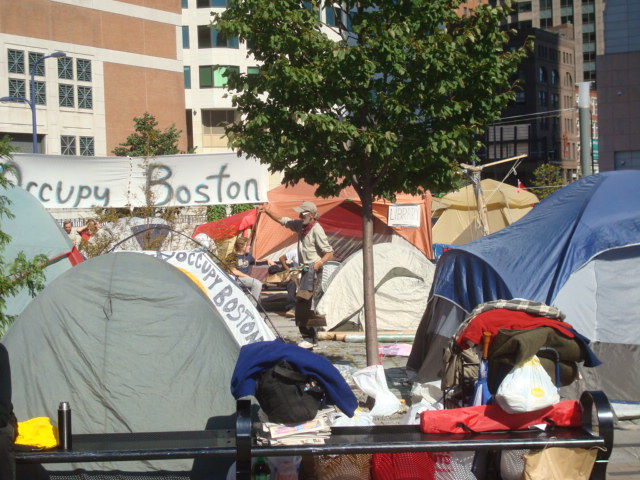
Upon arriving at the scene, we saw a sea of tents and a huge Occupy Boston banner, as shown in the picture above. The tents had various signs that read “Main Street,” “We are the 99 %,” and “Tax Wall Street.” The population of the crowd was pretty diverse and included the good, the bad, and the ugly. There were some teachers and nurses there, as well as representatives from local unions. There were also folks in tie dyed shirts and dreadlocks, and some punk rockers with black bandanas over their faces. It was also  a mix of young and old.
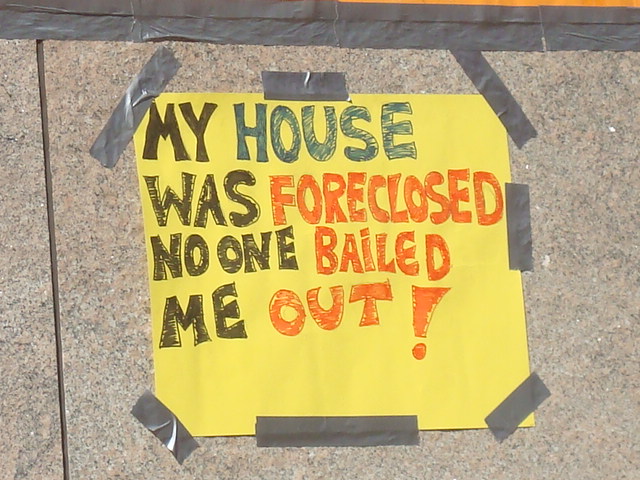
I was especially surprised at the organization. Occupy Wall Street is now in its fourth week, but Occupy Boston is younger than that. But already,  Occupy Boston has a detailed schedule of events for each week, major union backing, and tents set up marked media, medical, food, logistics, and legal.  They’re also conducting marches through the downtown, which we took part in, teach-ins, and media training.

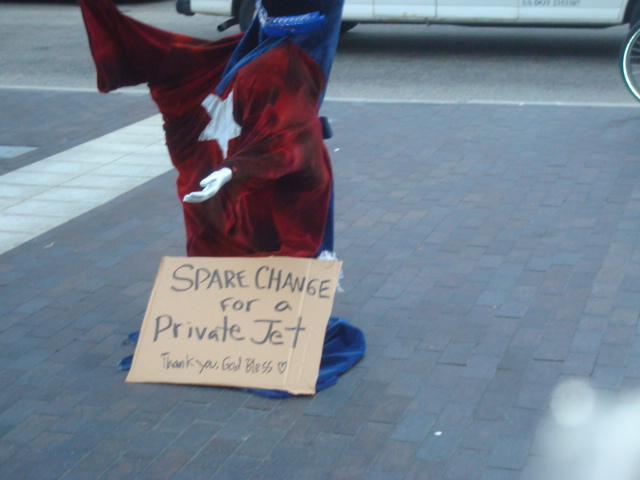
The movement is also doing a good job keeping itself unaffiliated with either political party. I didn’t see a sign for Obama or the Democratic Party. I did see a Ron Paul campaign worker handing out literature, but that was it. All of the signs were aimed at the abuse of corporate power and the high unemployment rate.

It has yet to be seen the effect this movement will have. I hope it produces some kind of effective legislation to regulate Wall Street more and prevent corporate bailouts that are used to give bonuses to CEOs or buy corporate jets. I also hope it encourages Congress and the president to produce a broad jobs plan that will lower the unemployment rate.  But movements take time to coalesce and produce results. Civil Rights and pro-labor legislation took a while to happen after those movements formed. But it’s clear the Occupy Wall Street folks aren’t going anywhere. This movement has now spread to several cities. There’s even an Occupy Scranton movement, and the Facebook page has over 600 likes. The leaders of this movement need to ensure that as it grows, it stays non-violent and focused. One brick through  a window will generate a swarm of bad press and end this.

A New Movement Taking Shape

I’m sharing yet another post about politics/social issues. I promise I’ll do something on writing again soon. 

Anyone that has been paying attention to the news lately has probably heard about the Occupy Wall Street Movement. Over the last two weeks or so, protestors have come to NYC’s financial district to protest the growing income disparity in the U.S.  What intrigues me about this movement is that it considers itself “leaderless,” and so far, it hasn’t designated a spokesperson, unlike the Civil Rights and anti-war movements of the 1960s, or even the more recent Tea Party Movement. According to the movement’s website, what the protestors have in common is that they are “the 99 % that will no longer tolerate the greed and corruption of the 1 %.”

Coverage of the movement was slow at first, but after a NYC police officer pepper sprayed some of the protestors, the video was seen all over the web and gained national media attention. “The Daily Show” even spoofed the incident. You can see that video here.  

Now, the movement is spreading to other parts of the country. It’s already started in Boston, according to a recent blog post at Forbes, and it also spread to San Francisco, according to a Huffington Post article.  

Furthermore, the protestors in NYC may soon have a powerful ally. According to another article, some NYC-based unions are considering teaming up with the grassroots movement. If this happens, the numbers on the streets could swell, especially in NYC.

What surprises me about this movement is that it didn’t happen a few years ago when the economy nearly crashed, and then Congress bailed out the banks and Wall Street, yet the same problems still persist. But maybe all of the union busting in Wisconsin, Ohio, and other states finally sparked this, as well as the daunting 9.1 percent unemployment number, which is even higher for young people and the black community.

There are still a lot of questions surrounding the movement, including its general list of demands. But the fact this movement is so organic and grassroots is exciting. It hasn’t been co-opted by either political party or  a single politican, at least not yet.

I will be in Boston next weekend visiting friends, and we plan to stop by one of the protests to check it out. I’ll probably blog something about that when I get back.

The President’s New Tone

I’m taking a break from blogging about poetry/writing to address politics again. A few weeks ago, after a Republican won  a House seat in a deep blue NY district during a special election, I said here that Obama is going to have a tough time seeking re-election in 2012. As someone who worked on his campaign in 2008,  I have been disappointed in his lack of willingness to stand up to Republicans and fight for key Democratic principles. I wondered what direction the president would take heading into 2012 and whose re-election campaigns he would try to emulate. Over the last few weeks, we have started to see how he plans to run for re-election. His new tone just may rally his alienated base.

Despite being surrounded by a bunch of former Clinton advisors, Obama doesn’t seem to be following Clinton’s path to re-election from 1996. Clinton moved to the center, as opposed to the left, and pushed bills that reformed Welfare and won over more independents and even some conservatives.  Recently, Obama has channeled two other Democratic presidents more so than Bill Clinton- Franklin Roosevelt and Harry Truman.

I say Obama is channeling FDR because of his newly released jobs bill, which calls for higher taxes on the wealthy and a lot of infrastructure programs, including the creation of a high-speed rail system and the rebuilding of America’s crumbling schools.   Like FDR, Obama has been arguing lately that in times of high unemployment, the government should act and pass a jobs bill to put people back to work. FDR did this successfully through the New Deal programs. This idea is the total opposite of the current GOP platform. The Republican leadership does not believe in a comprehensive jobs bill or further stimulus spending to put people back to work. They have been pushing greater austerity measures.

It has yet to be seen if Obama’s job bill will pass the GOP-controlled House. Republicans don’t seem likely to hand Obama a victory,even if parts of his job bill are popular with the public.  Still, though, the president has been pushing the jobs bill day in and day out, and while doing so, he’s been channeling another Democratic president– Harry Truman. When Truman was re-elected, he ran against a very unpopular Congress. As I said in a previous post, Obama’s job performance numbers are low,  in the 40s, but Congress’ overall approval number is even lower, historic lows. Some polls have Congress at 19 percent approval; other polls have Congress at 22 or 23 percent approval.  Obama knows this, and he’s taken the gloves off to go on the offensive against GOP leadership in the House and Senate. He’ s also been pushing the plan in the districts of his opposition. He did a speech last week at a bridge in Ohio that links the Congressional district of House speaker John Boehner with Senate Minority Leader Mitch McConnell’s state of Kentucky. The president slammed both leaders for the gridlock in Washington.

The president has also been quicker to counter GOP attacks. When he stated recently he wants a higher tax rate for millionaires, GOP leadership cried class warfare. Obama countered that it’s not class warfare, just simple math.

Obama’s new populist tone should rally his base. This is the president  a lot of supporters thought they voted for in 2008, someone willing to stand up for the middle class and jumpstart the economy.  Still, though, Obama is going to face daunting unemployment numbers heading into 2012 and skepticism by some voters that he can fix the economy. It’s not likely the unemployment  number of 9.1 percent will come down much between now and next November, and even if parts of the jobs bill pass Congress, their effects on unemployment may take time.  But if Obama runs against the unpopular Congress, continues his populist tone, and points out how  far to the right the current GOP presidential candidates are, he does have a better chance of winning a second term.

What a Wonderful Scene

This past weekend, I was reminded how wonderful a creative community the Scranton/Wilkes-Barre area has. On Friday, I took part in a fundraiser/Equinox party for the Vintage Theater.  I was happy to share the stage with friend and fellow writer Amye Archer and share a few poems, and I got to hear some new talent in the area. I was especially impressed with the music of Katie Kelly, a 26-year-old from Wilkes-Barre. She fronts the band Ashes for Trees, but she played solo at this event.  She has quite a soulful voice, and when she first leaned over her guitar, I didn’t think such a powerful voice would come out of her!  At times, her vocal style also reminded me of Tori Amos. If you get a chance to see her solo or with her band, you should check it out.

The weekend concluded with Prose and Pubs on Sunday night. I had the pleasure of reading at one of these about two months ago,and it seems each one grows bigger and bigger. This month’s line-up included local writers Bryne Lewis, Kate Burrier, and Amye Archer. The feature was Jason Carney, a Texas-based slam/performance poet, whose work addresses everything from southern racism to being a dad. Each piece, including a memoir that he’s currently drafting, drew raucous applause from the audience, and it was great to see that many people so riled up over poetry and writing. The next Prose in Pubs will be sometime in late November, and you should come.

 Here’s one of the pieces Carney performed:

Poets on Stamps

The United States Postal Service has decided to create stamps in honor of some of some of the most influential 20th Century American poets. The list includes Sylvia Plath, William Carlos Williams, Wallace Stevens, E.E. Cummings, Elizabeth Bishop, Gwendolyn Brooks, Robert Hayden, Theodore Roethke, Denise Levertov, and Joseph Brodsky (who was actually born in Russia, but moved to the U.S. in the 1970s, after he was exiled by the Soviet government). If you like poetry and haven’t heard of most of these names, pick up a contemporary American poetry anthology or their collections. A lot of them shaped and influenced the genre not only through their poems, but also through their essays on craft.


As is, this list stands as a pretty good representation of some of the most influential poets of the last century. I did wonder why some names were left off, though. It’s funny to see William Carlos Williams and Wallace Stevens pictured on stamps, but not T.S. Eliot and Ezra Pound, the other two godfathers of Modernism. Sure Pound and Eliot spent part or even most of their careers oversees, but they were born in America. I also wonder why Langston Hughes, Edna St. Vincent Millay, Robert Frost, Allen Ginsberg, Robert Lowell (Sylvia Plath’s early mentor), don’t get a stamp. And what about Whitman and Dickinson?  I’m hoping there will be another set of stamps to feature some more poets. But it’s cool the USPS is even releasing this set, which I’ll buy and save once it’s released.

General Updates

Here’s a quick update of some fall events/readings I’m participating in.

This Friday, Sept. 23, I’ll be reading at the Vintage Theater with Amye Archer. Doors open at 6 p.m. There will also be art and music featured. Tickets are $10, and all money benefits the venue, which is located at 119 Penn Ave. in Scranton.

On Friday,  Oct. 14 at the Century Club in Scranton, I’m reading with other writers from the Mulberry Poets and Writers Association. The event starts at 6 pm.

On Saturday, Oct. 22 at Sellers Books in Jim Thorpe, I’m the featured reader for the evening. I’ll also share the stage with poet Dawn Leas.  The event starts at 7 pm. The bookstore is located at 101 Broadwy.

And on Saturday, Nov. 12, I’m reading and hosting an event for local writers at New Visions Art Gallery, located at 201 Vine Street in Scranton. I’m in the process now of finalizing the list of readers.

Finally, I also have a poem, “How She Hides Her Age,” in the new fall issue of  San Pedro River Review.  If interested, you can order a copy here.

So far, it’s shaping up to be a busy fall, and I like that!

Preview of 2012?

I’m taking a break from blogging about poetry  to write about politics. Last night, a  special election was held in New York State’s 9th District to replace disgraced Congressman Anthony Weiner, who had to resign over a sex scandal. Months ago, Dems thought for sure they’d keep the seat. After all, Dems have kept that seat for nearly a century, and it’s in a deep blue district, mostly in Queens and the Bronx. But last night, Republican Bob Turner defeated Democrat David Weprin. As soon as victory was declared, Turner said that this message will resound all year and into the presidential election in 2012.

Most mainstream papers/websites are saying that this GOP upset is  referendum against Obama. A lot of Obama supporters still think he’s going to win, especially since the GOP has moved so far to the right. However, it’s clear Obama is not going to win as easily as he did in 2008, due to the economy. Even officials in his administration don’t believe the economy will improve much between now and next November. Right now, unemployment is at about 9 percent, and in August, there was not a net gain of jobs. It seems the economy has stalled. The last president to win re-election with unemployment this high was FDR, and frankly, FDR was a lot more popular than Obama is. FDR had a larger vision for economic recovery through the New Deal programs, and he had more fire in the belly, a willingness to take on the GOP and big business. So far, Obama hasn’t really demonstrated that, thus alienating much of his core base.

This election should also worry Democrats because it served as a first test of one of the party’s key election strategies for 2012. Back in the spring, the GOP voted in the House and Senate for Republican Congressman Paul Ryan’s budget, which would basically end Medicare and Social Security as we know it– programs most Americans really like. Though the plan didn’t pass the Democratic-controlled Senate, every Republican is still on record as voting for the plan, and the Dems hoped to use that as a major issue in 2012. Weprin did use that as an issue over and over again in the special election, but he still lost. So what will Dems run on in 2012 if that strategy doesn’t work?

It’s also a folly to think that if the GOP nominates someone pretty conservatve like Rick Perry that they will automatically lose the presidential election. The Democrats thought they would easily defeat Reagan because he was considered too consevative, but Reagan won twice, easily.

A lot can still happen between now and the next election cycle. Right now, the county is in an anti-incumbant mood, and Congress’ approval numbers are even lower than the president’s. A path to re-election for Obama can be to run against the Republican-controlled Congress, like Harry Truman did, when he refered to them as the “do nothing Congress.”  If Congress refuses to pass even parts of the president’s new job bill, he can state over and over again during the election cycle that he tried to get the economy moving, but the GOP obstructed and blocked the bill.

Whatever happens in 2012, it’s likely this country is going to keep having change elections. Democrats made major gains in 2006 and 2008, and the GOP made major gains in 2010 and seems poised to make more in 2012. The pendulum keeps swinging back and forth, due to the poor economy and uncertain future of this country.

Writing Process/Writing Habits

Last week, I attended a free poetry workshop at the Osterhout Free Library in Wilkes-Barre led by friend and fellow writer Rachael Goetzke. This workshop focused on writing habits/the writing process. I enjoyed the workshop for several reasons, including the fact that it was a workshop I could just sit back and enjoy and not teach.  What I took from it is that I am indeed a creature of habit and do have a strict writing process. For me, writing in the early morning works best, before I leave for work. Later in the day, my mind is simply too clogged to write. I also have a specific place I like to write– at the kitchen table, with notebook if I’m drafting, or my laptop if I’m revising.

After I was uprooted this weekend, due to the evacuation in Kingston from the flood of 2011, I struggled to write. But now we’re safe and not flooded, thank God!  I’m back to my normal writing routine.

The other poetry workshops, including the one I’m teaching, will take place throughout the fall months. All are free, so why not attend? I know I posted this before, but here’s the list again:

September 20–Dawn Leas “Channeling Memories.”

October 4–Amye Archer “Language Poems”

October 18–”Performance Poetry”  Not sure who’s teaching this section.

November 1–Alexis Czencz Belluzi Not sure what her focus will be.

November 15–Jenny Hill “Heavy Metaphor.”
We’ll explore the use of metaphor in prose and poetry and use the library resources to write our own extended metaphors.

November 29–Brian Fanelli will focus on writing about home/place in poetry. We will look at how certain poets depict home/place in their work, and do some writing prompts that tie into home/place.

All sessions held in the Gates Lab.

Final workshop/oration/open mic December 13 (Reading Room)


Update

This is probably the longest I’ve gone without updating my blog. I try to update it every few days, and it’s been about a week or so. Due to major flooding in parts of northeastern, Pennsylvania, I’ve been stranded at my brother’s house in Exeter Borough since Thursday.

I’m in the process of moving in with my girlfriend in Kingston, a town that had to evacuate, due to the uncanny rainfall that caused the Susquehanna River to swell and exceed the level it reached during Hurricane Agnes in 1972- a natural disaster that wiped out several houses and businesses in this area. However, since then, there’s been a levee system built in this area, and it’s held.

We’re hoping to get back into our apartment later today or tomorrow at the latest.  We look forward to getting our home back in order and unpacking all of the boxes we took when we had to evacuate. But we’re just thankful we didn’t get flooded.

Unfortunately, several other towns around here did have major flooding, as shown on local and national news. I hope they have a quick recovery. We’ll probably buy some cleaning supplies and donate them at a center later today to help out the flood victims.

If you’re interested in helping our victims, you can find info by clicking here, WNEP’s website.

New Review

Another review I did for PANK was published online yesterday. This one is on David Wojahn’s new collection of poems, World Tree. You can read the review here. Wojahn remains one of my favorite contemporary America poets. I’m always impressed by his wide range of forms that includes everything from lyric poems to long poetic sequences. He’s also brilliant at injecting rock ‘n roll history, pop culture, and politics into his work. For more on his new book, check out the review.