Steven Soderbergh has dozens of film credits to his name. Yet, he’s never tackled a proper horror film, that is, until his latest feature, Presence. However, for those seeking a good old-fashioned ghost story or haunted house tale, this isn’t quite it. In true Soderbergh fashion, Presence does something slightly different with the genre, while offering a meditation on grief.
The film follows a family who moves into a new suburban home. Lucy Liu plays the mom Rebekah. Chris Sullivan stars as dad Chris, while Eddy Maday plays their son Tyler, and Callina Liang plays their troubled daughter Chloe, who lost two of her best friends, Nadia and Simone. The parents hope that the move will spark a fresh start and help their troubled daughter’s mental health.
The haunted house film has long served as a vehicle to address deeper issues. The Amityville Horror, for instance, deals with the Lutz family’s financial woes at the end of the 1970s. They purchase a house that needs major renovations they can’t quite afford. The Haunting of Hill House is a story about its protagonist Eleanor’s grief and loneliness. She wants so badly to fit in, to have a family that accepts her.
In that regard, Presence works well when it focuses on the family’s tension, be it Chloe’s justified pain, or Chris’ stress and feeling that his family is coming undone. In fact, I wish that the film focused more on this and fleshed out its central cast more.
Presence veers from the genre’s typical formula by often showing the POV of the ghost(s). Convinced the spirits of her friends followed her, Chloe never feels right in the house. Objects suddenly move in her bedroom. The dresser shakes, and the ghosts bang on the walls. Yet, none of this is all that frightening. However, that’s not really the point of this movie. It’s more about the family’s struggles and Chloe’s grief especially.
The film takes another turn when Ryan (West Muholland) is introduced and acts like he has a general interest in Chloe. This leads to a major twist in the last act, but like the rest of the film, this plot point feels a bit too rushed and never fully realized.
I have to give credit to Soderbergh for upending the haunted house genre and showing us the POV of ghost(s). Though the film never reaches its full potential, and the last act especially feels too abrupt, at least Presence offers a different kind of ghost story.
Let me preface this by stating that I’m never a fan of tearing down movies. A lot of time, work, and money goes into filmmaking. The intention of this post isn’t to shred the latest reimagining of a classic Universal Monster, that being The Wolf Man, directed by Leigh Whannell. Rather, I’m more interested in exploring why Whannell’s film just didn’t work for me, especially when compared to his 2020 remake of The Invisible Man. While The Wolf Man certainly maintained the tragic aspect of the character, especially through the earnest performance of Christopher Abbott, who plays Blake, the film falls flat because, well, it doesn’t respond to anything. It’s a major missed opportunity to tap into at least some deeper cultural and social anxieties.
Whannell’s film is set in Oregon, and Abbott stars alongside Julia Garner, who plays his wife Charlotte, and Matilda Firth, who plays their daughter Ginger. Oregon, with its deep forests and lush greenery, is the perfect setting for this film. The state, especially its natural landscapes, just has a strangeness to it. Heck, think of the opening credits of “Twin Peaks.” It’s a great setting for a werewolf movie.
Initially, the film sets up a promising concept, that of generational trauma. The opening introduces us to a very young Blake and his domineering father, Grady (Sam Jaeger). Grady frequently snaps at his son, all in the name of protecting him from what’s essentially a werewolf lurking in the woods, which, for whatever reason, can also attack and lurk during the day, without a full moon. Yes, Whannell changes up some of the werewolf lure, but that’s fine. Let him do his own thing.
This interesting opening, however, never fully blooms into a more interesting storyline. In the present day, 30 years after the opening scene, Blake and his family leave NYC and trek to his father’s farm, after Blake receives notice that his father is likely dead. Blake does exhibit flashes of his dad’s anger and temper, lashing out at Ginger and Charlotte a few times, but again, this is an underutilized character point. There are hints that Blake’s dad was at least verbally and mentally abusive, and we do see some of that in the opening, but again, it’s never fleshed out.
What I had really hoped for, and what the trailer sort of hinted at, was a deeper exploration of masculinity. There are shades of it with the poor relationship between father and son, but it’s terribly underwritten. We’re currently living in a time where everyone is asking what’s wrong with young men, why they’re socially isolated, why they’ve drifted hard right, why they helped propel Trump back to the White House, etc., etc. The werewolf is a great metaphor and vehicle to explore this very issue, but Whannell doesn’t do much of anything with it.
This marks quite a contrast from his take on The Invisible Man, a film that fully tapped into the anxieties of the #MeToo/Women’s March era, a film that also addresses rapid advances in technology, much like James Whale’s 1933 film. In contrast, The Wolf Man just feels so culturally and socially impotent.
Even the toxic father/son dynamic is weak. The father/son werewolves even come to blows at one point, but that’s another part of the script that feels way too undercooked. I don’t blame any of the actors in this film. As already stated, Abbott does a fine job in the lead role, giving his character the sort of pathos and tragedy that Lon Chaney J. had in the 1941 film. There’s a sense that Garner wanted to give more to her character, but there’s just not much in the script.
The initial Wolf Man holds up for so many reasons, including Chaney Jr.’s performance, the awesome Gothic set designs, and most importantly, because it’s a response to the anxieties of WW II. I just wrote about this for 1428 Elm, but the film’s writer, Curt Siodmak, was a Jewish man, forced to flee Germany in the 1930s to escape the Nazis. The parallels between his story and Larry Talbot’s (Chaney Jr.) are obvious. Even the werewolf mark that afflicts Talbot resembles the Star of David.
While Whannell’s Wolf Man is a decent monster movie, it’s just not much more than that. It falls flat because it doesn’t respond to anything, be it otherness, masculinity, or any other issue, really. It feels like a rushed script with too many underbaked elements.
The Damned is such a fitting movie for the beginning of January. Inspired by Icelandic folklore and featuring countless snowy backdrops, the film is a frigid slow burn that truly creates a sense of dread. It also addresses the consequences of decisions rendered.
Set in a remote fishing outpost during the 19th Century, the film stars Odessa Young as a widow named Eva. In charge of the outpost, she has to make a decision after a shipwreck close to the crew’s shoreline. She can either allow her fishermen to risk venturing out into the choppy waters to try to save some of the ship’s men, or she can opt to do nothing and preserve what limited supplies the group has during an especially harsh winter. She decides to do nothing.
Eva’s decision haunts the crew for the rest of the runtime. More specifically, director Thordur Palsson’s debut draws on the Norse myth of the Draugur, a creature that’s like a part-ghost, part-zombie. As one character describes it, the Draugur is like a returned person with flesh and blood. It torments every character in the film, causing them to hear voices, turn on each other, and commit horrid acts of violence. The creature is shown a few times and feels omnipresent. I actually think the film would have worked slightly better if the monster was shown a bit less, creating greater ambiguity and mystery.
The Draugur functions as an unshakeable curse that befalls the characters due to their decision not to save the men, lost to the frigid ocean’s depths. Meanwhile, Young gives a memorable performance, especially through the expressive look of her eyes and the way she conveys her character’s breaking point, caused by the curse and the weight of her decision. She’s really at the front and center of this movie and outshines just about all of the men. In fact, too many of the fisherman feel like background characters, without their own storylines.
While this film certainly works as an eerie morality tale, the visuals really make The Damned stand out. Thordur grew up in the Icelandic landscapes, and it really shows. Everything about this movie feels cold. The wind howls. Eva constantly treks through snow. The sea looks inky and menacing. Yet, the visuals stun at times, thanks, in part, to the film’s director of photography, Eli Arenson, who previously worked on Lamb, another visually rich film. The Damned lends itself well to the big screen, and the striking natural landscape becomes a character.
There does come a point where questions about the plot and direction arise. For instance, if the group has such limited supplies, why do they bother building coffins for the drowned? Where are they getting the wood and nails? However, a startling moment in the last act saves the narrative. It makes the rest of the pieces fit, and it’s one heck of a pay-off.
The Damned is an unsettling period piece with awe-striking landscapes and a performance by Young that shines against the bleak and isolated setting. This is a perfect film to watch in winter because it evokes such an icy sense of dread.
Since the recent U.S. election, I’ve been struggling how to process the result. I don’t know what shape a “resistance” will take this time. I was at the Women’s March in 2017 and organized near- weekly visits to the local offices of our two PA senators to oppose the worst of the initial Trump cabinet picks and policies. As a whole, the groundswell of activism that occurred in 2017 likely stopped the worst of it, but this feels different. The cabinet picks are most definitely worse, and the incoming far-right government trifecta seems more intent on passing sweeping legislation, at least within the first year, before they campaign for the 2026 midterms.
We also have the issue of billionaires like Elon Musk spending unlimited funds to influence an outcome. I don’t know how we deal with that, but I’m turning to writing both as a solace and maybe as a means to offer some paths forward.
In that regard, my first post-election piece is on John Carpenter’s 1988 political satire They Live. There’s a lot of lessons to learn from it, including the power of worker organization. This article was initially published at 1428 Elm this week, and I am reposting it here.
While John Carpenter’s 1988 political satire They Live may have been a response to Ronald Reagan’s America, with direct references to his campaign slogan “morning in America,” the film feels increasingly timely now. Considering the involvement of billionaires in the recent presidential election, with Elon Musk playing an outsized role, Carpenter’s critique of capitalism makes They Live the most relevant of his films for this precarious moment.
Set in LA in the late 1980s, They Live follows a drifter named Nada (Roddy Piper). Within the first 15 minutes, he ends up in a shantytown. Skyscrapers loom in the distance, drawing his gaze and underscoring a setting that shows the divide between the haves and the haves-nots. Initially, Nada isn’t bothered by this. He’s simply looking for work and believes in the promise of America.
At the shantytown, Nada encounters Frank (Keith David). During their first conversation, their differing views on class become apparent. Frank, like the countless working-class voters from PA, MI, and WI interviewed in 2016 and then again in 2024, laments the loss of well-paying factory jobs. He’s hardened and ready for action, but even more importantly, desperate for a job. He’s ready to tear down the system if he doesn’t find one.
During this first exchange between the men, we learn a lot about Frank and his challenging plight. He tells Nada, “We gave the steel companies a break when they needed it. Know what they gave themselves? Raises,” before reciting one of the film’s most famous lines about the golden rule, “He who has the gold, makes the rules.”
Frank’s justified anger is the most relevant of the two characters. It’s palpable. He, like too many other workers, has been stiffed. Following an election that hinged, at least in part, on economic issues, such as the cost of housing and the skyrocketing cost of everyday goods post-COVID, Frank’s rage feels righteous and warranted. He’s prepared to take a sledgehammer to the whole system.
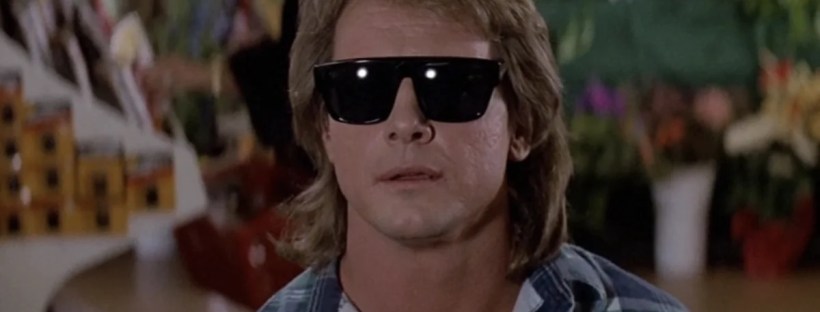
Nada’s response to Frank’s simmering anger feels naïve at best. He says, “You know, you ought to have a little more patience with life.” With his blue jeans, flannel shirt, and mullet, Nada looks ready to recite a Bruce Springsteen or John Mellencamp song without really listening to the lyrics.
It would likely have been easier for Nada to brush off Frank’s gripes and maintain his simplistic worldview. However, his character evolves the moment riot police and bulldozers utterly obliterate the shantytown. The scene is one of the film’s most harrowing. Nada looks on in shock and horror as this occurs seemingly for no good reason. He evades the police, only to find a pair of sunglasses that allow him to see the world as it truly is. Thus begins Nada’s political and social awakening.
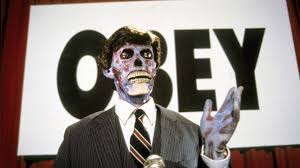
The glasses empower Nada, making him less susceptible to hyper-consumerism and control. When he puts them on, he sees aliens determined to keep people asleep in a fog of consumerism as they overtake Earth. With the glasses on, Nada sees billboards that say Obey, Consume, and other slogans. When he fixes his gaze on money, he encounters the phrase, “This is your god.”
Carpenter’s political critique isn’t exactly subtle, but it’s incredibly effective. When you have Musk paling around with the new president-elect or the barrage of celebrity endorsements secured by VP Kamala Harris, They Live’s over-the-top political satire speaks to the moment. In 2017, speaking out against a bizarre Neo-Nazi claim that the film traffics in stereotypes, Carpenter made clear that’s not the point of the film, tweeting that it is about “yuppies and unrestrained capitalism.”
Besides the blatant critique of consumerism and capitalism, They Live offers a more subtle message, that of worker power and organizing. For at least half the film, Frank and Nada, two men with working-class backgrounds, stand at a divide. Nada initially dismisses Frank’s anger with a dose of foolish optimism. Later in the film, Frank does the same to Nada, though for different reasons.
When Nada encounters Frank much later in the film, he implores him to try on the glasses and see the world as it truly is. However, Frank landed a job in construction. With Nada’s face plastered all over the news, after killing a few of the aliens, he wants nothing to do with him. Frank wants to protect his job. He has no choice.
The men brawl with each other in an alley. The scene is absurd and also plays up Piper’s wrestling background. However, the sequence, silly as it is, highlights the divide between the men, specifically between different members of the working class. As long as they remain divided, those in power maintain and accumulate wealth. This class division is also maintained because the aliens continually promise workers that they can advance up the social and economic ladder if they submit and assist with the takeover.
Eventually, Frank and Nada, along with other members of a pocket resistance, come together to fight the aliens. This underscores the power of organizing, perhaps as the only means to create a more equitable society.
Now that the year is at its halfway point, I’m already pondering what some of my favorite films of 2024 are, and yes, I know there’s still plenty of films yet to be released. Still, there are a few movies that I’m sure will top my year-end list. One of those films is Tiger Stripes, by Amanda Nell Eu. The Malaysian feature debut combines several genres, including body horror, coming-of-age drama, and even possession, with a dash of Mean Girls influence on the side.
I first screened and reviewed the film at the Jim Thorpe Independent Film Festival back in April. While I probably screened 50 films at the JTIFF this year, Tiger Stripes is one that stood out for the way it used body horror to address marginalization, puberty, and especially gender. It also has one heck of a performance by Zafreen Zairizal, who stars as Zaffan. She’s shunned by society, including her home and school and finds refuge in the jungle.
I had the pleasure of recently interviewing director Amanda Nell Eu for 1428 Elm. We discussed the movie’s influences, censorship it faced in her home country of Malaysia, and some of those very tough bullying scenes. It was a delight chatting with her and getting more insight into this unique film. You can read the interview by clicking here.
Tiger Stripes is now available globally on VOD, and I highly recommend it.
Recently, for 1428 Elm, I made a list of my favorite John Carpenter films in honor of his star on the Hollywood Walk of Fame, coming next year. This got me thinking a lot about Carpenter, who has pretty much stopped directing (I don’t really count that Suburban Screams episode last fall as a proper return) to record music and still score some films. He also plays a lot of video games now, apparently. Still, I’d be hard-pressed to think of a director who has had more impact on the horror genre than Carpenter, other than maybe James Whale, Wes Craven, and Hitchcock.
If you asked me, I couldn’t tell you which Carpenter film I saw first. Was it Halloween? Was it The Thing? Was it The Fog? Most likely, I first viewed his work with my dad, who made a habit of renting horror movies with me when I was a kid, and I’m fairly certain that’s when I first encountered the maestro’s work, likely when I was 10, 11, or 12. Years later, in college, my friends and I had horror movie marathons at least once a month. Carpenter’s work factored heavily into our screenings, and it’s then I encountered some of his lesser-known work, like Princess of Darkness and Assault on Precinct 13.
The older I get, the more I’m drawn to some of these less-revered films, especially the later parts of what Carpenter described as his “apocalypse” trilogy. This trilogy began with The Thing in 1982, but I find myself rewatching Prince of Darkness (1987) and In the Mouth of Madness (1994) more. Because I’ve taught Halloween so many times in my horror film/literature class and because The Thing is so revered, and rightfully so, I’ve taken a pause from those classics in part because they feel so inescapable.
Prince of Darkness caught my attention in the last year or two because that film, while incredibly eerie, also has such a profound sense of dread to it. In short, there’s nothing optimistic about Prince of Darkness. It’s incredibly freakin’ bleak. Even though Childs or MacReady may be infected at the end of The Thing, the last shot shows them sitting around a fire, trading a bottle of whiskey back and forth. You hold out hope one of them will survive the night. There’s no chance for that at the conclusion of Prince of Darkness and you start to think that yes, the world may end, after graduate students and scientist unleash a strange goop from an ancient canister that ushers in Satan. Hey, I didn’t say the plot was perfect. Oh, and did I mention that Donald Pleasance plays a priest, and there’s a cameo by Alice Cooper?!
In the Mouth of Madness is Carpenter’s last truly big film, and he really went crazy with it. The film stars Sam Neill, who plays an insurance investigator sent to solve the mystery of Sutter Cane’s disappearance. Cane is a horror novelist whose work is similar to Lovecraft and whose pages start to become real. This film is all out bonkers, and it’s so much fun to see Neill return to the horror genre after the massive success of Jurassic Park. For me, this one has plenty of rewatch value because of Neill’s performance and for what it has to say about mass marketing, consumption, and even the publishing industry itself. It’s also a fitting conclusion to the apocalypse trilogy. It’s also a thrill ride to see a Lovecraftian Carpenter film.
It’s unclear if Carpenter will ever direct a full-length feature again. He’s stated in the past he wants to, but regardless, his legacy is secured. Halloween and The Thing especially are essentially inescapable classics at this point, referenced in countless other films. Yet, for as much as I love those two works, I find myself returning to Carpenter’s mid-career films much more, appreciating them years later.
Let me preface this post by stating if you want a more detailed analysis of the Nosferatu trailer from me, then read the piece I wrote a few days ago over at 1428 Elm. I did a pretty comprehensive breakdown of the trailer, including the characters, the comparisons to Bram Stoker’s text, and comparisons to the original film. I’m using this post to talk about why I have a lot of faith in Robert Eggers’ take on Nosferatu and why he may be the only contemporary genre director who can handle the monumental task of remaking this film, like Werner Herzog did in 1979.
I’ll also state that I have a deep love of F.W. Murnau’s original 1922 film, and I’ve written about it and presented on it more than a few times. In fact, every fall, when I teach my Horror Literature and Film class, the very first film we watch is Nosferatu, as an introduction to German Expressionism and the foundations of the genre. It’s a heck of a lot of fun discussing that movie with the class. Many students, even the horror hounds, haven’t seen it before, at least not in full.
I’m hard-pressed to think of a director better suited to remake this classic than Eggers. His entire body of work has been period pieces, starting with The Witch, then The Lighthouse, and lastly, The Northman. He likes period pieces, and it’s clear from the trailer he’s sticking with the Victorian era for this remake. Not only that, but he’s clearly influenced by German Expressionism. This is most evident in The Lighthouse, a film set in 1905 and shot in black and white, very much reliant on light and shadow and strange camera angles, like Murnau’s work. Nosferatu has been Eggers’ dream project for years, and if you watch The Lighthouse specifically and even The Witch, to a lesser extent, it’s clear why.
The trailer, even if it’s about 90 seconds long, makes clear that Eggers is sticking to the general story of Stoker’s text and Murnau’s very loose adaptation of it. As I wrote in my piece for 1428 Elm, the trailer does a good job establishing the main characters, including Count Orlok’s prey. This includes Nicholas Hoult as Thomas Hutter, Lily-Rose Deep as Ellen Hutter, Thomas’ wife who comes under Orlok’s attacks, and Emma Corrin as Anna Harding, likely Ellen’s best friend who stands in for the Lucy character in Stoker’s book. Willem Dafoe stars as the Van Helsing-type character.
There also a refrain that’s repeated, and it’s simple, but effective. “He is coming.” The trailer barely shows Bill Skarsgård in the make-up, but it does present Orlok as an apocalyptic threat to the New World, who will not only attack Thomas, Ellen, and Emma, but also unleash plague, famine, and death. We see the rats. We see the coffins carried through the streets of (London maybe? It’s hard to tell). He is coming indeed, and I have faith Eggers is going to make this Gothic film frightening, especially when you consider he told Empire magazine, “It’s a horror movie. It’s a Gothic horror movie. And I do think that there hasn’t been an old-school Gothic movie that’s actually scary in a while. And I think that the majority of audiences will find this one to be the case.”
Eggers’ movie, like the other Nosferatu films, appears to make the vampire predatory and scary again. It also aligns Orlok with predatory animals again, including the wolf. I’m all for it! There’s no director I can think of who better understands the source material or who’s been influenced by German Expressionism more than Eggers. The trailer is extremely promising, and I can’t wait for the film’s release on Christmas day. Until then, check out the original if you haven’t watched it yet. It’s public domain and free to stream online.
It pains me to say this, but we’re not getting a new Friday the 13th film anytime soon, even if there are plans to launch a “Jason universe,” which basically just means more merch and video games. Recently, series creator Sean S. Cunninham, who also directed the first film, went on record and said a new film isn’t happening in the near future. Most likely, it’s because the rights are so screwed up between different film companies. There was also a lengthy lawsuit between Cunningham and the OG screenwriter Victor Miller over franchise rights. In short, it’s all still a mess. Meanwhile, after Bryan Fuller pulled out of the “Crystal Lake” project, the TV series on Peacock now seems iffy at best. It’s been a frustrating ride for Jason fans, for sure.
Still, even if we won’t see Jason slice and dice Camp Crystal teens anytime soon, gore hounds have a reason to be excited. In a Violent Nature, written/directed by Chris Nash, slashes into theaters this Friday. I implore horror fans: GO see this movie. If you want to read a spoiler-free review of the film, check out my piece at Signal Horizon. I promise that I really didn’t spoil much of anything.
In a Violent Nature upends the slasher formula by showing everything from the POV of Johnny the killer. During the second half of this film, which features two of the gnarliest kills I’ve seen in a long time, this technique really, really works. I will admit that the pacing in the first half is a bit of a slog, with lots and lots of walking around in the woods. Still, In a Violent Nature does something remarkably different and it’s likely that future creatives will perfect what Nash attempts.
In a Violent Nature is probably the closest thing we’ll get to a new F13 film without it being a F13 film. It’s largely set in the woods and features a mad man picking off naive 20-somethings who step into his territory. Again, two of the kills especially are brutal and relentless. Those two sequences alone are worth the price of admission for horror fans. Though I had a screener for this, I plan to buy a ticket just to see how the audience reacts to a few of the grisly scenes.
It’s refreshing to see a slasher that’s not part of a long-running franchise. Do we really need another Scream entry, for instance? While In a Violent Nature didn’t work for me on all levels, I still very much enjoyed it and what the filmmaker tried to do. It’s important to support original horror instead of waiting around for familiar 80s slasher icons to return to the big screen. This film feels like a creative burst of energy that a well-worn subgenre desperately needs.
In a Violent Nature bleeds into theaters this Friday. It’ll hit Shudder at a later date. If you want more recommendations for summer slashers, check out my list of favorite summer slashers I wrote for 1428 Elm.
I’ve always been perplexed that Flannery O’Connor, or her haunting novels and short stories for that matter, were never really given proper cinematic treatment. I understand why there’s so much focus on the Lost Generation or even the Beat generation, but O’Connor sort of exists between those two literary movements. writing a flurry of work in the 1950s and very early 60s. Still, there’s a lot to mine in terms of her life story, including her close friendship with Pulitzer Prize-winning poet Robert “Cal” Lowell, who was her teacher at the Iowa Writers’ Workshop, or her battle with Lupus, which took her life in 1964, or even her devout Catholicism. For the most part, other than a PBS documentary from a few years ago, O’Connor’s life and work have largely been ignored by filmmakers.
Again, I find this baffling. I’ve taught O’Connor’s work nearly every semester, though not always the same short stories. I teach her in American literature and often, Intro to Creative Writing. Students tend to really dig her, be it the Southern Gothic undertones, or even the sardonic statements in some of her lectures and essays. They like her, and her themes are incredibly resonant today, especially her address of the shifting views in the South and tension brought by the Civil Rights Movement. We’re rehashing those very debates today.
Finally, O’Connor gets the proper treatment in film at the hands of Ethan and Maya Hawke. He directs and she stars both as O’Connor and various characters from her story in the film Wildcat, which is one part biopic and one part literary adaptation of about half a dozen of her stories, including “Parker’s Back,” “The Life You Save May Be Your Own,” “Good Country People,” among a few others. The film also tackles O’Connor’s time at the Iowa Writers’ Workshop, her personal faith, and her illness. It’s a beautiful testament to her art and life. I suspect fans of her work will enjoy it. Maya Hawke especially gives a heck of a performance, showing what she’s capable of post-Stranger Things. I’m confident she’ll have a long career.
If you want to read my full thoughts on the film, you can check out my review for 1428 Elm. Wildcat is getting a very limited theatrical release on May 3, before expanding to more theaters.
I wanted to share a few pieces that I’ve had published recently. The first is an article about Promising Young Woman, a film that I keep thinking about days after I’ve seen it, especially its haunting and (maybe?) problematic ending. The film stars Carey Mulligan as Cassandra, a med school drop-out who seeks vengeance against men from a traumatic event in her past. We’ve seen plenty of female revenge films prior, but there’s something about this film and Mulligan’s performance that stands out. My article for Signal Horizon explores toxic masculinity and trauma in the film. You can read it here.
Additionally, I wrote about one of my favorite films from last year, After Midnight, for Signal Horizon. You can read that article here. After Midnight is set to drop on Shudder in the coming weeks. Make sure to see it if you have that streaming service.