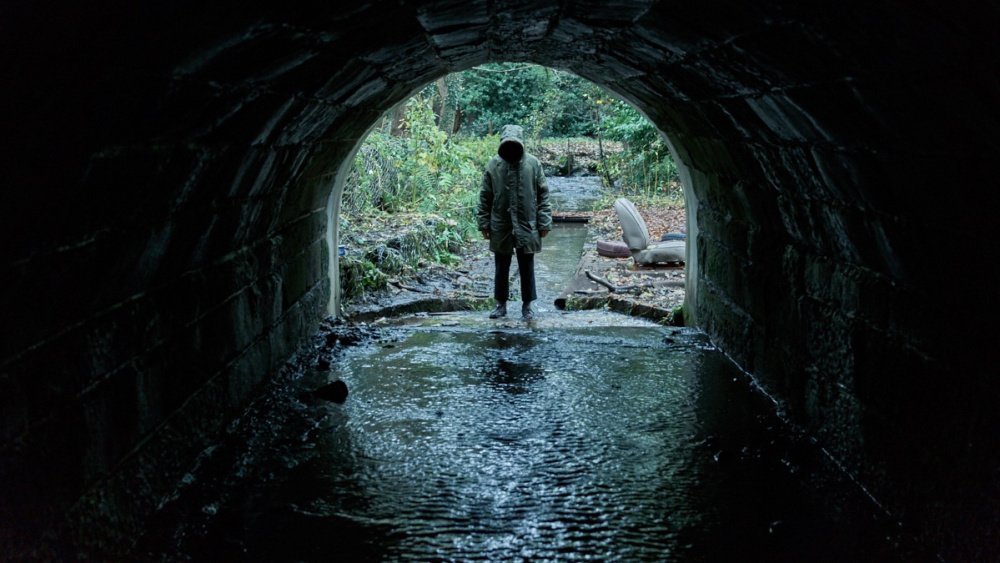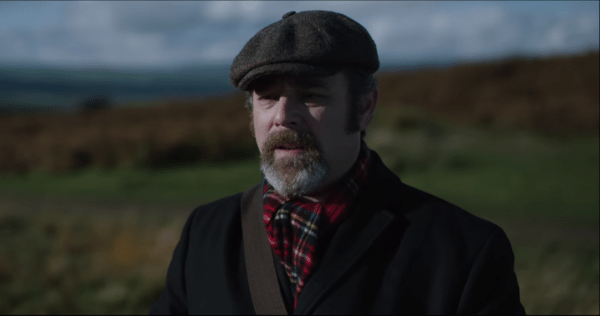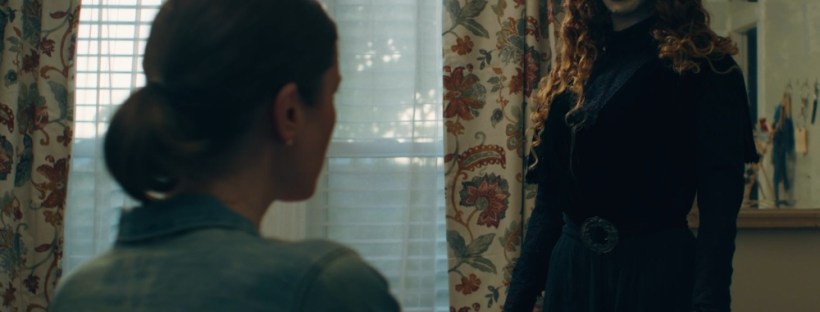
825 Forest Road Production Still

Hell House Creator Stephen Cognetti Dishes on His New FIlm 825 Forest Road

For HorrorBuz.com, I recently interviewed Hell House LLC series creator Stephen Cognetti about his latest film, 825 Forest Road, debuting on Shudder this Friday. We chatted about the film’s more traditional narrative storytelling, haunted histories, small town America, and the fact he filmed in the Victorian-looking town of Jim Thorpe, PA, localish to me.

You can read the full interview here. I also included some of it below.

825 Forest Road stars Joe Falcone as Chuck Wilson, who, after a family tragedy, moves to the sleepy town of Ashland Falls with his little sister, Isabelle (Kathryn Miller), and his wife, Maria (Elizabeth Vermilyea). Yet, as the family soon finds out, the town harbors a dark secret.

What was your experience like transitioning from the found footage genre to more traditional narrative storytelling?

Stephen Cognetti: It was a great transition for me to leave found footage behind. I shot this right after Hell House 3. It was in between Hell House 3 and Hell House: Origins, so this happened between two found footage films. It was great to step away from found footage and do a traditional narrative. That’s the style of filmmaking I like doing in production, but I also love found footage horror, as a consumer of it and making it as well. I had fun making the Hell House movies, and I have fun watching found footage movies myself. But I had already done three found footage movies and I wanted to do something else. It’s a specific kind of filmmaking. It’s fun to do, but it’s not a kind of filmmaking to always live in. It’s good to try other styles of filmmaking.

How did you come up with the mythos surrounding Helen Foster and her ghost? Is she based on any specific local folklore?

 Stephen Cognetti: She, specifically, is not based on any folklore. The whole story is based on any small town America folklore. I left New York City and moved to a small town in the Scranton [Pennsylvania] area. This town has its history. Everyone I met always had a story to tell about the town’s history. I imagined, what if one of these stories is about a ghost? I wanted to create my own fictional small town folklore and small town legend. What if it wasn’t a legend but something still affecting the town to this day? If you talked about it, you’d talk about it while looking over your shoulder because you don’t want to bring too much attention to yourself by talking too much about it. If you talk about it to a newbie, it’s a secret warning.

The truth of it came from my own move from New York City to small town Pennsylvania and learning about the history. It didn’t have any ghosts in it, so I created my own.

The idea of locations with haunted histories factors heavily in this film and even the Hell House series. Can you comment on that aspect of your work?

Stephen Cognetti: I can’t actually answer that because I think it’s organic and comes with each story. I’m a history guy. I love history. I was a film major and history minor in college. I took every history class that I could. I love history as a story. There might be, in the back of my head, a story that derives from some place. I think that goes to Hell House and 825 as well, along with films coming up in the pipeline that haven’t been announced yet. It’s always been of interest to me. I don’t know why that is, other than I have a love of history itself.

Speaking of small towns, you filmed this in Jim Thorpe, PA. For anyone who’s never been there, it looks like a Victorian town. What factored into your decision to film there?

Stephen Cognetti: I started exploring towns all around Northeastern Pennsylvania, Southeastern Pennsylvania, Central Pennsylvania, and everywhere. I drove into New York, too. I spent a lot of time driving. Jim Thorpe had a bit of everything. It already had that whole look, that look like it has history. Every building looks like that. The town is cool. The people are great, and it’s a good town to shoot in. It was accessible for me and everyone working on the film coming in from New York. It fit the accessibility, and it had the look.

825 Forest Road is also about loss and family dynamics. Can you touch upon the relationships in this film, especially between Chuck and his sister Isabelle?

Stephen Cognetti: I think Chuck starts out as a sympathetic character and a central character in the film. That’s how the first act is presented to us. As the film goes on, especially as we see Isabelle and Maria’s stories, Chuck can be considered an antagonist in this. He’s not actually any hero at all. I love that development of him and when you see him from a different perspective than his own. When you see him from a different perspective, he’s aloof and has a poor way of dealing with people going through something. I think everyone knows a person like that. Chuck is the kind of person that’s only there to lend very broad support but doesn’t understand it. He thinks he does, but he doesn’t really understand it. Therefore, he can’t really offer any help. He thinks he knows everything. When you see Chuck in other perspectives, you see he’s not the guy presented in the first act. His personality has a lot of flaws

825 Forest Road haunts Shudder beginning Friday, April 4 as part of their Halfway to Halloween celebration.

Steven Soderbergh Attempts to Upend the Haunted House Genre

Steven Soderbergh has dozens of film credits to his name. Yet, he’s never tackled a proper horror film, that is, until his latest feature, Presence. However, for those seeking a good old-fashioned ghost story or haunted house tale, this isn’t quite it. In true Soderbergh fashion, Presence does something slightly different with the genre, while offering a meditation on grief.

The film follows a family who moves into a new suburban home. Lucy Liu plays the mom Rebekah. Chris Sullivan stars as dad Chris, while Eddy Maday plays their son Tyler, and Callina Liang plays their troubled daughter Chloe, who lost two of her best friends, Nadia and Simone. The parents hope that the move will spark a fresh start and help their troubled daughter’s mental health.

The haunted house film has long served as a vehicle to address deeper issues. The Amityville Horror, for instance, deals with the Lutz family’s financial woes at the end of the 1970s. They purchase a house that needs major renovations they can’t quite afford. The Haunting of Hill House is a story about its protagonist Eleanor’s grief and loneliness. She wants so badly to fit in, to have a family that accepts her.

In that regard, Presence works well when it focuses on the family’s tension, be it Chloe’s justified pain, or Chris’ stress and feeling that his family is coming undone. In fact, I wish that the film focused more on this and fleshed out its central cast more.

Presence veers from the genre’s typical formula by often showing the POV of the ghost(s). Convinced the spirits of her friends followed her, Chloe never feels right in the house. Objects suddenly move in her bedroom. The dresser shakes, and the ghosts bang on the walls. Yet, none of this is all that frightening. However, that’s not really the point of this movie. It’s more about the family’s struggles and Chloe’s grief especially.

The film takes another turn when Ryan (West Muholland) is introduced and acts like he has a general interest in Chloe. This leads to a major twist in the last act, but like the rest of the film, this plot point feels a bit too rushed and never fully realized.

I have to give credit to Soderbergh for upending the haunted house genre and showing us the POV of ghost(s). Though the film never reaches its full potential, and the last act especially feels too abrupt, at least Presence offers a different kind of ghost story.

Presence releases in theaters today.

Some Thoughts on “The Haunting of Bly Manor”

Photo Courtesy of Netflix

First, let me apologize for not updating this blog as much as I used to. The sudden shift to teaching virtually has consumed a lot of my time over the last several months. Additionally, I’ve been writing a lot of reviews for HorrOrigins and Signal Horizon Magazine when I can spare a moment, so that’s kept me busy. That said, I’d like to get back to updating this blog as regularly as I can!

With theaters still shut down for the most part, or limited to retro films, streaming services are the only option for new content. With most of 2020’s bigger horror productions, including Halloween Kills and Candyman, pushed back to at least 2021, that’s given more attention to the already highly anticipated “The Haunting of Bly Manor,” Netflix’s 9-episode take on Henry James’ Gothic ghost stories, especially his novella The Turn of the Screw.

After finishing “Bly Manor” a few days ago, I’m still thinking about it, and I’m still undecided regarding how I feel about it as a whole. I thought Mike Flanagan’s reimagining of Shirley Jackson’s novel The Haunting of Hill House was quite strong. The fifth and sixth episodes specifically were some of the best examples of horror on the small screen that I’ve ever seen. The bent-neck lady was terrifying, and Flanagan did an excellent job diverging a bit from Jackson’s narrative, while still keeping most of her key ideas and themes in tact.

“Bly Manor,” however, is short on scares, at least compared to “Hill House.” Instead, the series is more of a Gothic Romance. The basic, and I mean VERY basic plot of The Turn of the Screw is introduced in the first episode. A young American, Dani Clayton (Victoria Pedretti), takes a job as a governess at Bly Manor, where she keeps watch over young Miles (Benjamin Evan Ainsworth) and Flora (Amelie Bea Smith). The first few episodes explore Clayton’s trauma, specifically the tragic death of her boyfriend, thus the reason she fled the states and takes the job at the British estate. Yet, she can’t escape the past, and her boyfriend appears to her as a ghost with shiny golden glasses, to boot.

The kids are one of the highlights of the series, nearly matching what James penned. Miles is both devious and charming. Flora runs around saying “perfectly splendid,” as if she’s practicing to be a 19th Century aristocrat. Though the series takes place in the 1980s, it very much feels like a 19th Century Gothic tale, due largely to Maxime Alexandre and James Kniest’s cinematography. Fog rolls off the pond near the castle-like estate. Night time shots create a sense of foreboding. Darkened corridors and long hallways feel menacing.

Photo Courtesy of Netflix

Yet, the ghosts in “Bly Manor” just aren’t that scary. The two main spirits featured in The Turn of the Screw, Peter Quint, played by Oliver Jackson-Cohen, and Miss Jessel, played by Tahirah Sharif, aren’t very threatening. Quint is abusive in a totally different way in “Bly Manor,” but he’s never…. that terrifying. Quint is a violent drunk in the novella. When Miss Clayton sees his ghost throughout the estate, he’s horrifying. The recounting of his death is also hair-raising. With “Bly Manor,” even the scenes directly adapted from James’ work, like an image of Quint’s face in a mirror or window, just aren’t that spooky.

Additionally, “Bly Manor” adds a storyline about possession (I think?) and time skipping that just don’t work quite well. “Hill House” toyed with a non-linear timeline in regards to ghosts, but it worked better in that series. In “Bly Manor,” it’s rather confusing. There is also a brief storyline about Miles and Flora’s uncle, Henry Wingrave (Henry Thomas), and his devious double. But that’s equally confounding..

All of that said, the eighth episode is a fantastic ghost story that provides context and background for the Lady in the Lake, a chilling spectral presence who haunts the residents at Bly. This episode is adapted from James’ story “The Romance of Old Clothes.” Once upon a time, the Lady in the Lake wasn’t faceless and water-logged. She was Viola, a wealthy woman with extravagant taste. Eventually, she marries, but she’s betrayed by her sister, Perdita (Daniela Dib), who moves in on her hubby when Viola falls ill. Viola is played by Kate Siegel, Flanagan’s wife who also played Theodora in “Hill House.” Siegel’s entrance to “Bly Manor” comes near the end of the series, but it’s worth the wait. The single episode contains nearly every trope of Gothic literature, including family betrayal, an ugly history that haunts the present, a failing English manor descending into financial ruin, and a vengeful ghost. It also sets up the finale quite well.

Overall, I need a few days to think about “Bly Manor” some more. Right now, the images and the cinematography stick with me most, especially shots of the foggy pond at night. But the ambiguity of James’ novella and some of its most terrifying scenes seem lost in this recent adaptation. There’s commentary about how ghosts and memories fade with time, hence the faceless Lady in the Lake. I’m afraid “Bly Manor” has that potential. I’m unsure what I’ll remember of the series months from now. I don’t know if this will stay with me the way “Hill House” did, but that’s okay. At least a 19th Century ghost story lives on for modern audiences.

If you want to check out another adaptation of The Turn of the Screw, I highly recommend The Innocents (1961).

Review: Ghost Stories (2018)

Ghost Stories, written and directed by Jeremy Dyson and Andy Nyman, is a British anthology horror film based on their stage production, but the narrative outside of the three tales is the real highlight. The film poses questions about how society views those who claim to have supernatural experiences and why we sometimes turn to the belief in the paranormal while grieving. In questioning reality, the film makes the statement, the brain sees what it wants to see.

ghost-stories-cropped

The film’s storyteller, so to speak, is the pompous Professor Goodman (Andy Nyman), who hosts a show called “Psychic Cheats” and discounts stories of the supernatural. After exposing a psychic as a fake, Goodman is summoned by his idol, reformed debunker Charles Cameron (Leonard Byrne), who hands him three case files and urges him to reconsider his world view.

ghost stories 2

Professor Goodman (Andy Wyman)

Accepting the offer, Goodman first interviews Tony (Paul Whitehouse), a former night watchman of an asylum who is haunted by what he saw one shift. This first story is a slow burn, one that relies on elements of a traditional ghost story, including late night bumps and sounds, shadows, and a gradual build-up to Tony’s encounter of a creepy ghost girl.

Tony’s character is one of the most interesting. In the story’s wrap-around, he expresses disdain towards Goodman and mocks his professor title. He also mentions that he’s been jobless, due to immigration, and eventually, he confesses that he’s suffered personal tragedy. Rather than really listen to Tony, Goodman is quick to discount his experience and blame it on his personal grief and unstable life.

The second story, “Simon Rifkind,” is similar to the first tale, meaning that it takes its time building to its final scare. Simon (Alex Lawther) claims to have seen an apparition late one night while driving home from a party. Simon’s performance makes up for the generally weak story, especially when he cries into a crumbled tissue and tells Goodman that he doesn’t want people to think there’s anything wrong with him. The final tale, “Mike Priddle,” is generally subdued and focuses on a rather mild poltergeist that knocks over knick-knacks in Priddle’s (Martin Freeman) home. The story concludes with an unsatisfying jump scare.

The three stories, overall, are mild and it’s the in-between that’s the most interesting, the blurring of reality with the supernatural. After the first tale, Goodman interviews Tony’s priest, who tells him, “How unfashionable it has become to believe in anything other than our personal gains.” This is a personal jab at Goodman who makes a living tearing apart people’s beliefs that can’t be reduced to quantifiable evidence.

The conclusion of the film takes a reality-bending turn, and we’re suddenly thrust into Goodman’s past, presented with a childhood memory of bullies who tormented him and called him “Jew face” before inflicting even worse torment upon another child who they lure into a cave and leave for dead. At its core, Ghost Stories poses questions about reality, while relying on one key element of traditional Gothic literature: the past’s influence on the present. Goodman is haunted by his childhood memory and the boy left for dead in the cave, and as a result, he spends his life denying that the supernatural can be plausible or even that the past can have serious baring on our present actions.

The film’s wrap-around is its real strength, specifically when Goodman’s cocksure reasoning is challenged. The three tales aren’t that scary. Rather, they serve and advance the interspersed, more interesting narrative surrounding Goodman’s beliefs. Unlike other anthology films, such as Creepshow, The ABC’s of Death, and Tales from the Darkside, Ghost Stories makes its storyteller the real focus, and his journey should be considered the fourth tale. It is the most engaging and most substantive aspect of the film.