Writer/director Guillermo del Toro has declared himself a proud monster kid over the years in a number of interviews. His obsession with classic monsters and their representation of the “other” is well-known. He even has a massive collection of props from the films that influenced his career, including James Whale’s iconic 1931 take on Mary Shelley’s Frankenstein for Universal.
With this in mind, it’s no surprise that he’s finally adapted Shelley’s novel. This is the movie he always wanted to make. For the most part, and for better or worse, del Toro remains incredibly faithful to Shelley’s text, including the shifting narrations between Victor Frankenstein (Oscar Isaac) and the Monster (Jacob Elordi). Yet, he does make some radical changes to the book, especially regarding Elizabeth (Mia Goth) and the final face-off between creator and creation. Such changes, though, enhance and serve this particular adaptation.
This latest rendition of Shelley’s tale begins in the Arctic, just like the novel. Here, we find the Monster, who rages and hunts down his maker. Victor is on the cusp of death and saved by a group of explorers, led by a sympathetic Captain Anderson (Lars Mikkelsen), a stand-in for Captain Walton from the novel, who, like Victor, pushes the limits of knowledge and exploration until it nearly causes his own undoing and that of his crew.
del Toro kicks off his lengthy film with high-octane action. The Monster Hulks out, downing one man after the other, throwing them against the ship or into the ice. It looks a bit silly, but it does underscore the Monster’s rage. After that action-heavy opening, we’re introduced to Victor’s tale, which lasts for about half of the runtime.
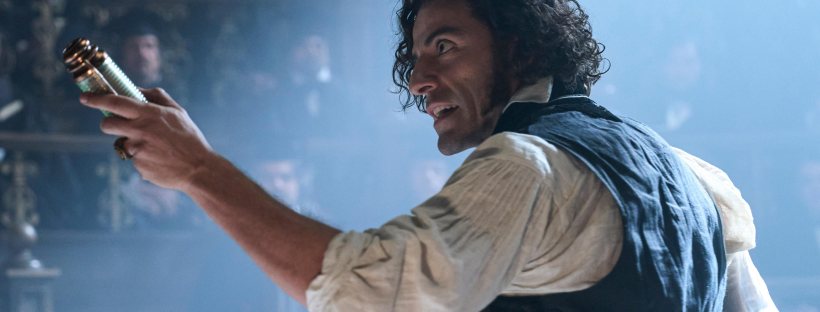
There are some high notes in the film’s first half and also some bloat. Isaac relishes playing the cocksure scientist, refusing to listen to his colleagues about the dangers of his experiments. This is most apparent during a trial among his peers when he expresses his desire to conquer death itself and unveils a half-animated corpse, a preview of his larger experiment to come. Of course, this draws disdain from his peers and his expulsion from his teaching gig. Isaac really shines in this sequence, and his eyes contain a fervency that matches Victor’s mighty ambitions. At his best moments, the actor exudes Victor’s all-consuming passion to defeat death. It wouldn’t surprise me if he earns an Oscar nomination for this performance.
Additionally, del Toro handled well the father/son thread that’s apparent in Shelley’s novel, the constant conflict between maker and son. Even at a young age, Victor wants to escape his father’s shadow and push the Frankenstein name to new heights. Later on, he separates himself from his younger and more morally-sound brother, William (Felix Kammerer), who is much older than the child William that’s strangled to death by the Monster in Shelley’s text. I do think William’s death in the novel has far more weight because by murdering a child, it shows how far the Monster will go to unleash misery upon Victor. Even today, that death remains quite shocking.
The creation scene comes a bit too late in the runtime, and the first half tends to drag, but the set designs of Victor’s laboratory are quite breathtaking and give a nice nod to some of Whale’s most iconic moments in his 1931 rendition. I have no doubt the set and costume designs will earn Oscar nominations. del Toro’s always great at making his visions come to life for the screen. The film’s first half also centers around the relationship between Victor and Elizabeth, who, in this take, is slated to marry William, not Victor.
Adorned in flowing 19th Century Gothic dresses, Goth gives Elizabeth a confidence and willingness to challenge Victor that’s not evident in the novel or earlier adaptations. Here, Elizabeth plays a much more active role. It both frustrates Victor and causes him to fall in love with her. She tries to pull him back from the brink, but we all know how the tale ends.
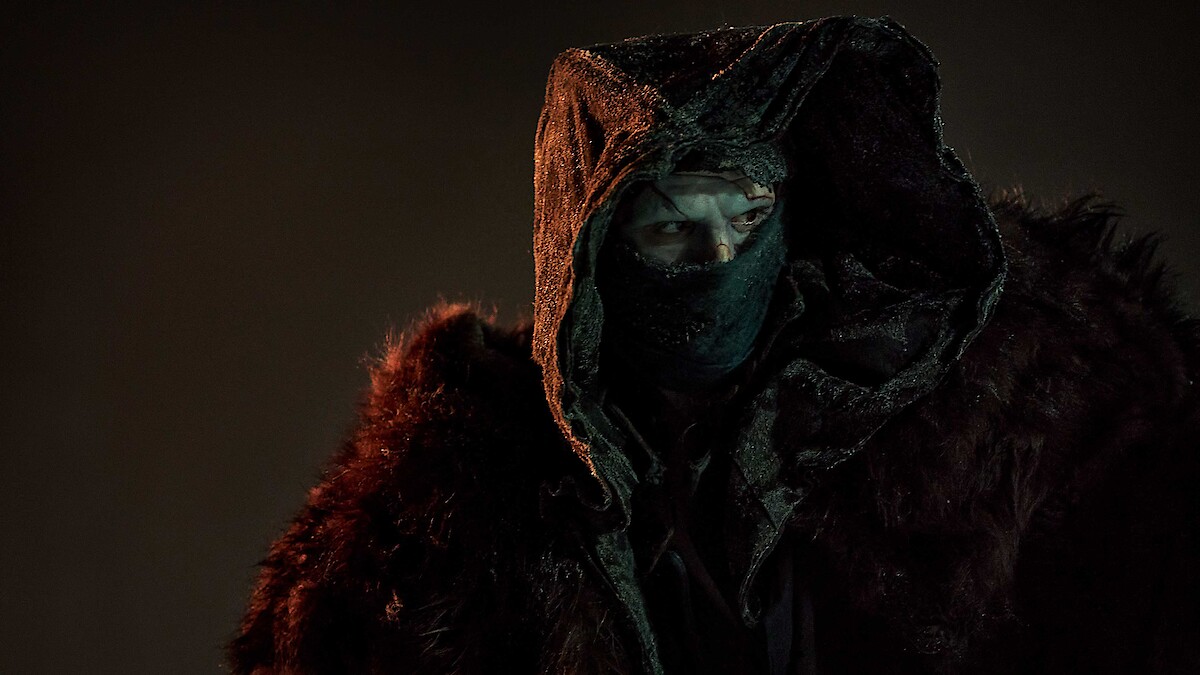
Eventually, the Captain invites the Creature to share his tale, once he boards the ship, eager to snuff out his maker’s waning breaths. The film’s second half is much more powerful and richer in terms of its storytelling. We learn why and how the Monster transformed into the raging brute seen in the first few moments of the film.
Elordi gives the Monster the complexity and knowledge that exists within Shelley’s novel. He learns language. He reads classic literature with a blind man, his only friend, but he also learns about violence and humankind’s capacity to destroy each other. Elordi really carries much of this film, and though his performance isn’t as iconic as Boris Karloff’s, it’s still quite noteworthy. He conveys the Monster’s softer side and also his rage. He also develops a touching friendship with Elizabeth, a major shift form Shelley’s novel, but one that adds more weight and stakes to del Toro’s film. Once Victor denies the Creature a mate, the Monster fully transforms into a character driven by vengeance.
All of this circles back to the Arctic, to the final confrontation between the maker and the creation. The last ten minutes mark the most radical shift from Shelley’s novel and a far more optimistic conclusion. Without spoiling anything, I will say that del Toro reminds us to lean into sunlight, appreciate natural beauty, and feel grateful for each day we’re given. This is a far softer ending than we’re given in the text, but at this moment, with the world on fire, maybe this is the ending we need. It’s a celebration of life itself, punctuated with a gorgeous and poetic final shot of the Monster.
It feels like del Toro’s entire career has led to this film. All around, Frankenstein contains strong and compelling performances. Isaac, Goth, and Elordi clearly understood the assignment of inhabiting such iconic characters and bringing the director’s passion project to life. Like all of del Toro’s work, the feature contains stunning visuals that animate the Victorian setting. The first half of the film does feel a bit too long, but it’s worth the wait for the Monster to finally tell his tale.
Frankenstein is currently playing in limited theaters and will stream on Netflix starting November 7.
 Brian Fanelli