Interview: Fear Street: Prom Queen Writer/Director Matt Palmer

Recently, I chatted with Fear Street: Prom Queen writer/director Matt Palmer for 1428 Elm about inhabiting the world of R.L. Stine’s books and ’80s slashers. You can read the interview in full here, but I posted some of it below. Fear Street: Prom Queen just dropped on Netflix. Slasher fans should enjoy it.

What was it like to step into the world of R.L. Stine and the Fear Street series?

Matt Palmer: It was exciting. Full disclosure: I think Fear Street was bigger in America than in the U.K. I’ve heard of R.L. Stine and Goosebumps, but this was my introduction to Fear Street. It was jumping into the world of R.L. Stine, but also jumping back into the world of ’80s slashers. It was a combo of those things, which was an incredibly exciting prospect.

This film has some pretty grisly kills and a lot of gore. Did you face any pushback about the level of bloodshed, or did Netflix pretty much allow you to do what you wanted in terms of the gore and the kills?

Matt Palmer: I was waiting for pushback, and then I was very surprised. As much as possible, we did practical effects. There were a few things we couldn’t do only practically. I’m a big fan of the way that Gaspar Noé does practical effects but incorporates digital effects quite seamlessly. Actually, Netflix upped our VFX budget in post-production to enhance the gore and make it more extreme. It was a fantastic moment. Not only did they allow us to do this and not ask us to cut it, but they also asked us for more.

I think there’s been a bit of a sea change in horror over the last 12 months. I think people are pushing back against the PG-13 element of it. They’re ready to go the other way. I think the horror community might be in for quite exciting times. I think things are about to get bloody. [Laughs].

Which slashers served as inspiration for the film?

Matt Palmer: I like slashers generally. My favorites are the slightly more mental ones. I’m a big fan of PiecesHappy Birthday to Me and Sleepaway Camp. I’m also a big fan of Giallo movies and Argento in particular. I feel like the shadow of Tenebrae hangs quite long over this movie. I love how in an Argento movie, there’s a ritualistic quality when a kill is coming. I thought that when we had a kill coming, we had to bring it home as far as possible and really go to town on those scenes.

I’m also really proud that all of our kill scenes are quite distinct and have quite different tones, pacing, and rhythms. Hopefully, that keeps the audience on its toes.

In terms of the soundtrack, there are some familiar ’80s bangers in the film, including Billy Idol, The Eurythmics, Tiffany, and others. How much say did you have over the soundtrack?

Matt Palmer: Some of the tracks, like Eighth Wonder’s “I’m Not Scared,” were a key track for me. The pulsating quality of that really suggested to me that it had promise visually. The prom scenes should be seen through the young people at prom, but it’s also like an idealized image of that. I felt like “I’m Not Scared” has that throbbing, pulsing quality.

The one thing that did happen is that I picked a few tracks that were very personal to me. I was happy when they came on and were in the edit for a long time. But one of the producers is younger. She’d tell me that a track sounded kind of boring. That’s when the voices were helpful. It was exciting for me because I listened to those tracks when I was 13, but we switched some of those tracks up. A lot of it was to keep the energy up. I picked some slightly down-tempo tunes. Eventually, we found that keeping the pace was the best thing for the movie.
FEAR STREET: PROM QUEEN
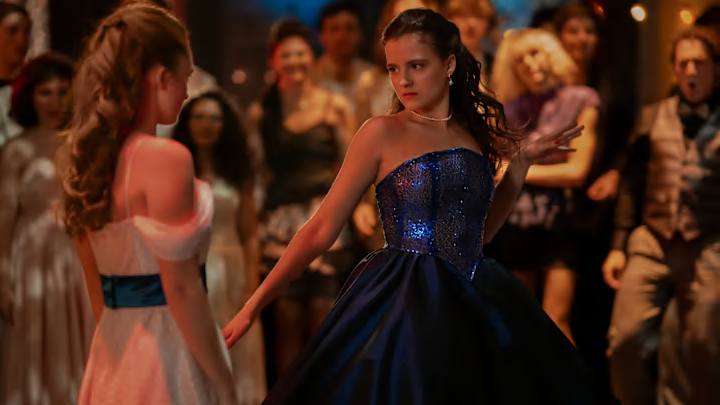
(L-R) India Fowler as Lori Granger and Fina Strazza as Tiffany Falconer in Fear Street: Prom Queen | Netflix

There’s a really great sequence where the two competing prom queens, outcast Lori (India Fowler) and popular girl Tiffany (Fina Strazza), have a dance off. That scene looked like it was a heck of a lot of fun to shoot. Can you talk about directing it?

Matt Palmer: I think it was a lot of fun for everyone, apart from the actresses [Laughs]. That was a really tough scene for India and Fina. Not only are they essentially dancing for a camera, but there were about 150 extras around them. I don’t care who you are. That’s intimidating.

Neither of them are trained dancers. We had a fantastic choreographer who worked with them. It was a tough day and more challenging than some of the elaborate kill scenes actually, but I was really, really happy with what we came out with. Fina, as she dances, her performance falls apart. It’s laugh-out-loud funny, the moves that she’s pulling. They’re all classic ’80s moves gone wrong.

Can you also talk about the dynamic between Tiffany and Lori? They make for good opposing characters and come from such different worlds in terms of their popularity, class, and even family.

Matt Palmer: The producer said it was a story about Lori and Megan (Suzanna Son), but now that I’m looking at the edit, it’s a story about Lori and Tiffany. It’s kind of both. There’s a little bit of an element of Showgirls, just in terms of the catty and camp and snarky and snide stuff.

The Tiffany character was a total joy to write. She’s just a meanie. The interesting thing about Tiffany that I’m pleased with is the moments in the film that you see underneath that front. There’s a vulnerable teenage girl who tries to find herself under that mean girl exterior.

Lori is essentially the opposite. She has that strength, but she needs to go through the grind of the narrative to come out on the other side and really exhibit that strength. There’s a real crossing over. One becomes weaker and the other becomes stronger as the movie goes on.
825 Forest Road Production Still

Hell House Creator Stephen Cognetti Dishes on His New FIlm 825 Forest Road

For HorrorBuz.com, I recently interviewed Hell House LLC series creator Stephen Cognetti about his latest film, 825 Forest Road, debuting on Shudder this Friday. We chatted about the film’s more traditional narrative storytelling, haunted histories, small town America, and the fact he filmed in the Victorian-looking town of Jim Thorpe, PA, localish to me.

You can read the full interview here. I also included some of it below.

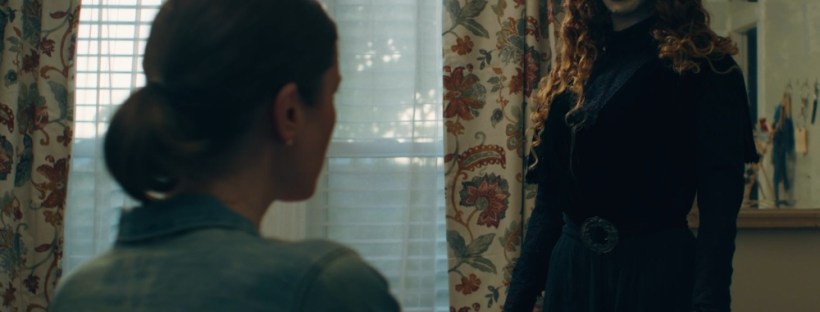
825 Forest Road stars Joe Falcone as Chuck Wilson, who, after a family tragedy, moves to the sleepy town of Ashland Falls with his little sister, Isabelle (Kathryn Miller), and his wife, Maria (Elizabeth Vermilyea). Yet, as the family soon finds out, the town harbors a dark secret.

What was your experience like transitioning from the found footage genre to more traditional narrative storytelling?

Stephen Cognetti: It was a great transition for me to leave found footage behind. I shot this right after Hell House 3. It was in between Hell House 3 and Hell House: Origins, so this happened between two found footage films. It was great to step away from found footage and do a traditional narrative. That’s the style of filmmaking I like doing in production, but I also love found footage horror, as a consumer of it and making it as well. I had fun making the Hell House movies, and I have fun watching found footage movies myself. But I had already done three found footage movies and I wanted to do something else. It’s a specific kind of filmmaking. It’s fun to do, but it’s not a kind of filmmaking to always live in. It’s good to try other styles of filmmaking.

How did you come up with the mythos surrounding Helen Foster and her ghost? Is she based on any specific local folklore?

 Stephen Cognetti: She, specifically, is not based on any folklore. The whole story is based on any small town America folklore. I left New York City and moved to a small town in the Scranton [Pennsylvania] area. This town has its history. Everyone I met always had a story to tell about the town’s history. I imagined, what if one of these stories is about a ghost? I wanted to create my own fictional small town folklore and small town legend. What if it wasn’t a legend but something still affecting the town to this day? If you talked about it, you’d talk about it while looking over your shoulder because you don’t want to bring too much attention to yourself by talking too much about it. If you talk about it to a newbie, it’s a secret warning.

The truth of it came from my own move from New York City to small town Pennsylvania and learning about the history. It didn’t have any ghosts in it, so I created my own.

The idea of locations with haunted histories factors heavily in this film and even the Hell House series. Can you comment on that aspect of your work?

Stephen Cognetti: I can’t actually answer that because I think it’s organic and comes with each story. I’m a history guy. I love history. I was a film major and history minor in college. I took every history class that I could. I love history as a story. There might be, in the back of my head, a story that derives from some place. I think that goes to Hell House and 825 as well, along with films coming up in the pipeline that haven’t been announced yet. It’s always been of interest to me. I don’t know why that is, other than I have a love of history itself.

Speaking of small towns, you filmed this in Jim Thorpe, PA. For anyone who’s never been there, it looks like a Victorian town. What factored into your decision to film there?

Stephen Cognetti: I started exploring towns all around Northeastern Pennsylvania, Southeastern Pennsylvania, Central Pennsylvania, and everywhere. I drove into New York, too. I spent a lot of time driving. Jim Thorpe had a bit of everything. It already had that whole look, that look like it has history. Every building looks like that. The town is cool. The people are great, and it’s a good town to shoot in. It was accessible for me and everyone working on the film coming in from New York. It fit the accessibility, and it had the look.

825 Forest Road is also about loss and family dynamics. Can you touch upon the relationships in this film, especially between Chuck and his sister Isabelle?

Stephen Cognetti: I think Chuck starts out as a sympathetic character and a central character in the film. That’s how the first act is presented to us. As the film goes on, especially as we see Isabelle and Maria’s stories, Chuck can be considered an antagonist in this. He’s not actually any hero at all. I love that development of him and when you see him from a different perspective than his own. When you see him from a different perspective, he’s aloof and has a poor way of dealing with people going through something. I think everyone knows a person like that. Chuck is the kind of person that’s only there to lend very broad support but doesn’t understand it. He thinks he does, but he doesn’t really understand it. Therefore, he can’t really offer any help. He thinks he knows everything. When you see Chuck in other perspectives, you see he’s not the guy presented in the first act. His personality has a lot of flaws

825 Forest Road haunts Shudder beginning Friday, April 4 as part of their Halfway to Halloween celebration.

Good Boy Production Still

Good Boy and a New Type of Haunted House Film

There’s been a trend this year within the horror genre: haunted house films told from unique perspectives. At the start of the year, we had Presence, directed by Steven Soderbergh. In this particular slow-burn feature, the film is largely shot from the POV of poltergeist(s). The spook(s) torment a grief-stricken family, especially the daughter. Though the film is pretty light on scares, it’s an interesting take on a familiar subgenre. Instead of following a family moving into a home that’s haunted, we largely see the world through the eyes of the supernatural presence.

Now along comes Good Boy, which just debuted at the South by Southwest Film Festival. In this film, we see everything through the perspective of Indy, an adorable dog who’ll do whatever it takes to protect his owner from a frightening entity. Unlike Presence, Good Boy has some really solid scares. So far, it’s my favorite horror film of the year. Here’s my review of the film, which was initially published at HorrorBuzz.

********

It’s been quite the year for animals in film. Flow, a wordless film from a cat’s perspective, won Best Animated Feature at the Oscars. Flow has plenty of endearing moments, but it’s also a nerve-rattling viewing experience because the cat must survive mass flooding and life-ending climate disasters. Now along comes Good Boy. Here, we have a haunted house movie, and really a meditation on death, told totally from a dog named Indy’s perspective. Like Flow, it’s one harrowing watch.

Directed by Ben Leonberg, the film stars Shane Jensen alongside Indy. Jensen plays Todd. In the opening minutes, we see Indy at his owner’s feet. Suddenly, Todd coughs blood, just as his sister enters the apartment in time. This opening gives away quite a bit, and Todd’s condition and what’s really going on with this film become much clearer as early as the halfway point. After the foreboding start, the film cuts to various home videos of Todd and Indy, and yes, the two are adorable together, especially the grainy footage of Indy as a puppy in Todd’s arms.

Before the film meets its conclusion, there’s a creeping sense of dread and some solidly scary scenes. Indy fears the rural house that Todd lives in. It’s a long-standing family home, but hardly anyone lasted more than a few weeks in it, including Todd’s grandfather. This is where the film flirts a lot with experimentation. Instead of the typical family haunting, here we have a haunted house movie from the dog’s point of view. We see shadows in the corner through Indy’s perspective. We hear loud thumps at night and then watch Indy’s ears perk up as he whimpers and knows that whatever’s haunting the house is inching closer and closer to his owner, no matter how badly Indy wants to keep the presence at bay.

Some of the camera shots, which sometimes focus on a snowy TV or the staircase, resemble Skinamarink. This is also why I know this film won’t be for everyone. That other film has its lovers and haters. This feature risks the same thing with some of its focused shots and emphasis on the mundane within a house. Yet, like SkinamarinkGood Boy, at some of its most frightening moments, makes familiar objects really, really creepy, creating a sense of the uncanny. Suddenly, the static noise from the TV, and other familiar sounds and images, provoke a sense of dread. There are unsettling moments in this film, especially when the scares are juxtaposed with the prolonged sound of Todd wheezing and coughing. The sicker he becomes, the more his relationship with Indy changes. The word “stay” takes on new meaning here.

This has been an interesting year for both animals in film and the haunted house movie. At the beginning of the year, Steven Soderberg’s Presence showed us the point of view of a poltergeist tormenting a family, especially the grief-stricken daughter. Now, we see everything creepy in a rural spook house from a dog’s point of view. Yet, no matter how much Indy wants to protect his owner, he can’t prevent the inevitable. Though Good Boy’s experimentation may turn off some viewers, this lean feature gets right to it and has some genuine frights. Two paws up for this chilling tale.

****

I can’t say what’s causing this new wave of haunted house films, told from creative and clever POVs, but I’m all for it. The horror genre continually finds a way to reinvent itself, while tapping into our collective anxieties and fears. Presence and Good Boy make a familiar subgenre feel new again, and Indy gives one of this year’s best performances so far!

Revisiting Horror Noire: A History of Black Horror

In honor of Black History Month, I thought I’d repost this interview that my wife and I did a few years ago with Xavier Burgin, director of the documentary Horror Noire: A History of Black Horror. If you’re a film fan of any kind, I highly recommend this documentary.

If you want to read the interview in full, initially published by HorrOrigins, click here. This is a shortened version.

Xavier Burgin’s documentary Horror Noire is a must-see not only for horror fans but film fans in general. The Shudder exclusive is based on Robin R. Means Coleman’s book of the same name. It covers over 100 years of film history, starting with Birth of a Nation and the negative stereotypes it perpetuated about black Americans. From there, it analyzes the tropes that exist within horror, while also highlighting innovative black filmmakers like Blacula director William Crain and Ganja & Hess director Bill Gunn. All of this leads to the massive success of Jordan Peele’s Get Out. Featuring interviews with Tony Todd (Candyman), Ken Foree (Dawn of the Dead), and Rachel True (The Craft), among many others, Horror Noire truly is a comprehensive doc about black horror cinema. Burgin talked to us about the success of his film and how it’s changed the conversation about black cinema, while acknowledging that the negative tropes the doc highlights still persist in Hollywood. He also chatted about some of his favorite horror flicks and his plans post-Horror Noire.


What has the past year been like for you after the success of Horror Noire?

Essentially, since finishing Horror Noire, there’s been an intersection between black horror fans and general horror fans who really love the movie. It’s opened up a lot of discussion about what it means to be black and a POC in the horror genre and how we’ve always been a part of it from the beginning. I’m really happy we put a spotlight on it and that folks are paying attention. They want more, so I’m hoping to see more. There will be another documentary on Shudder about LGBT people in horror. I think that’s awesome. I hope we see more of that regarding minority representation in genre film, especially the horror genre.

It’s still been a push to get my work off the ground. It’s absolutely amazing to have such an extremely successful documentary under my belt, but I’m also looking to do work in the narrative space. Horror Noire has gotten me into rooms, but I’m still fighting to get my first narrative project off the ground. It’s a marathon, not a race.

How do you think Horror Noire has changed the conversation about Black cinema since its release?

Horror Noire has put a spotlight on black horror. To the black people and horror fans who appreciate black cinema, they’ve already known about these amazing films we talk about. To a larger audience, this was a deep dive into a part of horror many don’t see or learn. Horror Noire has helped a large swath of horror fans (and film fans in general) understand black people have always been a part of your favorite genre. It’s just that our contributions are not always recognized. 

I think our documentary is important in terms of teaching and reaching people, but I’m not sure if the people who have the infrastructural power and money were very much swayed by it. Unfortunately, Hollywood is very stubborn when it comes to giving black and brown creators chances within any genre. Horror is no different in that way. We’re still fighting to get our work out there. On an educational level, it’s made a huge difference for folks that care, but I’m not sure if the gatekeepers have paid attention in the way that’s necessary to make change.

What do you think needs to happen to change the minds of film industry gatekeepers?

The gatekeepers of Hollywood still tend to be primarily old, rich, and white. This means they usually do not have black and brown people around them. They tend not to know these individuals or understand where we’re coming from and the necessity of our stories. I want to see more black and brown folks in positions to get things off the ground, but at the same time, these individuals have to get a yes from a higher-up who tends to be white, older, and richer. The type of risk they can take, unfortunately, isn’t as big as what they would like. When I say risk, I mean taking a risk on underrepresented filmmakers who are not seen as lucrative. In my opinion, the only way we’ll see a change is if more of the direct funding comes from producers and executives who don’t have the specter of getting fired or losing their livelihood over their head. 

Out of all the films covered in Horror Noire, which is your favorite?

Blacula. For me, it’s less about the movie and more about the director, William Crain. He was a black man in his twenties, in the 70s, helming one of the biggest projects of that era. Everyone (even his own financiers and crew) were against him, so it’s a miracle he pulled this off. William didn’t get the career he deserved due to exclusion and racism, but I’m always reminded without him, the black directors of today wouldn’t have the chances they receive now. I wouldn’t be making this documentary if not for him, so that’s why Blacula is the most important topic in the documentary for me. 

Given how times have changed even since Get Out, what do you think the future of Black cinema is? What story would you like to see that hasn’t been told yet?

Every story about the black experience (both within and outside of horror) still needs to be told. When you look at the overall history of film, it’s still relatively young, and black people are still struggling to make films about us without interference. I do believe black cinema has gone through a mini renaissance recently, but there are still too many creatives fighting to make their projects to say there’s been real, significant improvement in the industry after Horror Noire

I hope that post-Get Out, we’re going to see more horror films that deal with our lived experience from black and brown directors. I also hope we get to see more films that are helmed by black and brown directors that aren’t primarily about race. We can direct anything. We just need the opportunities. 

Why do you think Get Out was able to break through in the way it did to such a large audience?

Jordan Peele is a phenomenal writer and director. That script should be taught in every single screenwriting classroom. I also think that Blumhouse and Monkeypaw made sure that Jordan had the creative control that he needed to make this in the way he felt was right to him. 

For a very long time, a running joke in the black film community is that we’re only allowed to make hood or slave movies. There’s a looming truth to this assessment. The people who hold infrastructural power in Hollywood are majority white, older people. Their idea of black people works in a binary. They love hood movies because it’s their current view of the black populace. They love slave movies because they can pat themselves on the back for not being the horrible racists their ancestors were. 

Get Out did something different. It didn’t perpetuate the idea racism was an exclusively Southern, conservative problem. It told us the white liberal who puts on a nice face, votes for Obama twice, but is still willing to exploit black people for profit is just as (if not more) dangerous. This type of message should have gotten shot down in Hollywood, but Jordan was able to make it. It felt like his full vision. We need to see more of this. 

DANIEL KALUUYA as Chris Washington in “Get Out,” a speculative thriller from Blumhouse (producers of “The Visit,” “Insidious” series and “The Gift”) and the mind of Jordan Peele, when a young African-American man visits his white girlfriend’s family estate, he becomes ensnared in a more sinister real reason for the invitation.

Which Black directors and/or writers should we be paying attention to?

Nia DaCosta, who is directing the new Candyman movie. You should keep up with Gerard McMurrary, who directed the latest Purge movie. Of course, we all know to keep up with Jordan Peele’s work within the genre. Outside and inside horror, I’m keeping up with the work of Terence Nance, Nijla Mu’min, Tananarive Due, Tina Mabry, and an assortment of talented creators who I believe will be in the industry for a long time. 

In the Horror Noire syllabus, put together by Dr. Robin R. Means Coleman, [author/educator] Tananarive Due, and Graveyard Shift Sisters’ Ashlee Blackwell, all producers for Horror Noire, there are black filmmakers listed who are doing not only short horror films but also feature-length horror. They’re also doing stuff within the written world. 

Which film covered in the documentary do you think people should immediately stream after reading this interview?

You should watch all of them, but if I had to narrow it down, I’d recommend watching BlaculaGanja & HessTales from The Hood, and Get Out.  I definitely recommend that you watch everything we cover, but not everyone has that amount of time. I won’t recommend that anyone watch Birth of a Nation. I think it’s a racist and horrible film, but I will say if you want to understand where so much of the racism and white supremacist antics we see in America comes from, that’s a film to watch. I’ll go further and say that one of the biggest problems we have in film education is that we’re so willing to talk about the technical direction of this film, but not give the context. It infuriates me whenever I hear about a class somewhere watching Birth of a Nation and the professor says how revolutionary it was as a filmmaking device. You can’t put the politics and racism aside. You need to talk about everything. That’s how you educate the next generation of filmmakers to understand what they’re making, but on a bigger level, there is no such thing as a film that isn’t political. All films are inherently political. It’s up to you as a filmmaker whether or not you acknowledge it and use it to your advantage.

Steven Soderbergh Attempts to Upend the Haunted House Genre

Steven Soderbergh has dozens of film credits to his name. Yet, he’s never tackled a proper horror film, that is, until his latest feature, Presence. However, for those seeking a good old-fashioned ghost story or haunted house tale, this isn’t quite it. In true Soderbergh fashion, Presence does something slightly different with the genre, while offering a meditation on grief.

The film follows a family who moves into a new suburban home. Lucy Liu plays the mom Rebekah. Chris Sullivan stars as dad Chris, while Eddy Maday plays their son Tyler, and Callina Liang plays their troubled daughter Chloe, who lost two of her best friends, Nadia and Simone. The parents hope that the move will spark a fresh start and help their troubled daughter’s mental health.

The haunted house film has long served as a vehicle to address deeper issues. The Amityville Horror, for instance, deals with the Lutz family’s financial woes at the end of the 1970s. They purchase a house that needs major renovations they can’t quite afford. The Haunting of Hill House is a story about its protagonist Eleanor’s grief and loneliness. She wants so badly to fit in, to have a family that accepts her.

In that regard, Presence works well when it focuses on the family’s tension, be it Chloe’s justified pain, or Chris’ stress and feeling that his family is coming undone. In fact, I wish that the film focused more on this and fleshed out its central cast more.

Presence veers from the genre’s typical formula by often showing the POV of the ghost(s). Convinced the spirits of her friends followed her, Chloe never feels right in the house. Objects suddenly move in her bedroom. The dresser shakes, and the ghosts bang on the walls. Yet, none of this is all that frightening. However, that’s not really the point of this movie. It’s more about the family’s struggles and Chloe’s grief especially.

The film takes another turn when Ryan (West Muholland) is introduced and acts like he has a general interest in Chloe. This leads to a major twist in the last act, but like the rest of the film, this plot point feels a bit too rushed and never fully realized.

I have to give credit to Soderbergh for upending the haunted house genre and showing us the POV of ghost(s). Though the film never reaches its full potential, and the last act especially feels too abrupt, at least Presence offers a different kind of ghost story.

Presence releases in theaters today.

Leigh Whannell’s Wolf Man Doesn’t Respond to Much of Anything (And That’s Its Central Flaw)

Let me preface this by stating that I’m never a fan of tearing down movies. A lot of time, work, and money goes into filmmaking. The intention of this post isn’t to shred the latest reimagining of a classic Universal Monster, that being The Wolf Man, directed by Leigh Whannell. Rather, I’m more interested in exploring why Whannell’s film just didn’t work for me, especially when compared to his 2020 remake of The Invisible Man. While The Wolf Man certainly maintained the tragic aspect of the character, especially through the earnest performance of Christopher Abbott, who plays Blake, the film falls flat because, well, it doesn’t respond to anything. It’s a major missed opportunity to tap into at least some deeper cultural and social anxieties.

Whannell’s film is set in Oregon, and Abbott stars alongside Julia Garner, who plays his wife Charlotte, and Matilda Firth, who plays their daughter Ginger. Oregon, with its deep forests and lush greenery, is the perfect setting for this film. The state, especially its natural landscapes, just has a strangeness to it. Heck, think of the opening credits of “Twin Peaks.” It’s a great setting for a werewolf movie.

Initially, the film sets up a promising concept, that of generational trauma. The opening introduces us to a very young Blake and his domineering father, Grady (Sam Jaeger). Grady frequently snaps at his son, all in the name of protecting him from what’s essentially a werewolf lurking in the woods, which, for whatever reason, can also attack and lurk during the day, without a full moon. Yes, Whannell changes up some of the werewolf lure, but that’s fine. Let him do his own thing.

This interesting opening, however, never fully blooms into a more interesting storyline. In the present day, 30 years after the opening scene, Blake and his family leave NYC and trek to his father’s farm, after Blake receives notice that his father is likely dead. Blake does exhibit flashes of his dad’s anger and temper, lashing out at Ginger and Charlotte a few times, but again, this is an underutilized character point. There are hints that Blake’s dad was at least verbally and mentally abusive, and we do see some of that in the opening, but again, it’s never fleshed out.

What I had really hoped for, and what the trailer sort of hinted at, was a deeper exploration of masculinity. There are shades of it with the poor relationship between father and son, but it’s terribly underwritten. We’re currently living in a time where everyone is asking what’s wrong with young men, why they’re socially isolated, why they’ve drifted hard right, why they helped propel Trump back to the White House, etc., etc. The werewolf is a great metaphor and vehicle to explore this very issue, but Whannell doesn’t do much of anything with it.

This marks quite a contrast from his take on The Invisible Man, a film that fully tapped into the anxieties of the #MeToo/Women’s March era, a film that also addresses rapid advances in technology, much like James Whale’s 1933 film. In contrast, The Wolf Man just feels so culturally and socially impotent.

Even the toxic father/son dynamic is weak. The father/son werewolves even come to blows at one point, but that’s another part of the script that feels way too undercooked. I don’t blame any of the actors in this film. As already stated, Abbott does a fine job in the lead role, giving his character the sort of pathos and tragedy that Lon Chaney J. had in the 1941 film. There’s a sense that Garner wanted to give more to her character, but there’s just not much in the script.

The initial Wolf Man holds up for so many reasons, including Chaney Jr.’s performance, the awesome Gothic set designs, and most importantly, because it’s a response to the anxieties of WW II. I just wrote about this for 1428 Elm, but the film’s writer, Curt Siodmak, was a Jewish man, forced to flee Germany in the 1930s to escape the Nazis. The parallels between his story and Larry Talbot’s (Chaney Jr.) are obvious. Even the werewolf mark that afflicts Talbot resembles the Star of David.

While Whannell’s Wolf Man is a decent monster movie, it’s just not much more than that. It falls flat because it doesn’t respond to anything, be it otherness, masculinity, or any other issue, really. It feels like a rushed script with too many underbaked elements.

The Damned Unleashes an Icy Sense of Dread

This review was first published over at Horror Buzz.

The Damned is such a fitting movie for the beginning of January. Inspired by Icelandic folklore and featuring countless snowy backdrops, the film is a frigid slow burn that truly creates a sense of dread. It also addresses the consequences of decisions rendered.

Set in a remote fishing outpost during the 19th Century, the film stars Odessa Young as a widow named Eva. In charge of the outpost, she has to make a decision after a shipwreck close to the crew’s shoreline. She can either allow her fishermen to risk venturing out into the choppy waters to try to save some of the ship’s men, or she can opt to do nothing and preserve what limited supplies the group has during an especially harsh winter. She decides to do nothing.

Eva’s decision haunts the crew for the rest of the runtime. More specifically, director Thordur Palsson’s debut draws on the Norse myth of the Draugur, a creature that’s like a part-ghost, part-zombie. As one character describes it, the Draugur is like a returned person with flesh and blood. It torments every character in the film, causing them to hear voices, turn on each other, and commit horrid acts of violence. The creature is shown a few times and feels omnipresent. I actually think the film would have worked slightly better if the monster was shown a bit less, creating greater ambiguity and mystery.

The Draugur functions as an unshakeable curse that befalls the characters due to their decision not to save the men, lost to the frigid ocean’s depths. Meanwhile, Young gives a memorable performance, especially through the expressive look of her eyes and the way she conveys her character’s breaking point, caused by the curse and the weight of her decision. She’s really at the front and center of this movie and outshines just about all of the men. In fact, too many of the fisherman feel like background characters, without their own storylines.

While this film certainly works as an eerie morality tale, the visuals really make The Damned stand out. Thordur grew up in the Icelandic landscapes, and it really shows. Everything about this movie feels cold. The wind howls. Eva constantly treks through snow. The sea looks inky and menacing. Yet, the visuals stun at times, thanks, in part, to the film’s director of photography, Eli Arenson, who previously worked on Lamb, another visually rich film. The Damned lends itself well to the big screen, and the striking natural landscape becomes a character.

There does come a point where questions about the plot and direction arise. For instance, if the group has such limited supplies, why do they bother building coffins for the drowned? Where are they getting the wood and nails? However, a startling moment in the last act saves the narrative. It makes the rest of the pieces fit, and it’s one heck of a pay-off.

The Damned is an unsettling period piece with awe-striking landscapes and a performance by Young that shines against the bleak and isolated setting. This is a perfect film to watch in winter because it evokes such an icy sense of dread.

The Damned releases in theaters today.

Black Christmas at 50 and Why the Film Remains So Relevant

For 1428 Elm, I penned an article sharing my love of Black Christmas, how it pioneered many of the slasher tropes, and why, in a post-Dobbs world, the film feels so relevant on its 50-year anniversary. I linked the article and pasted it below.

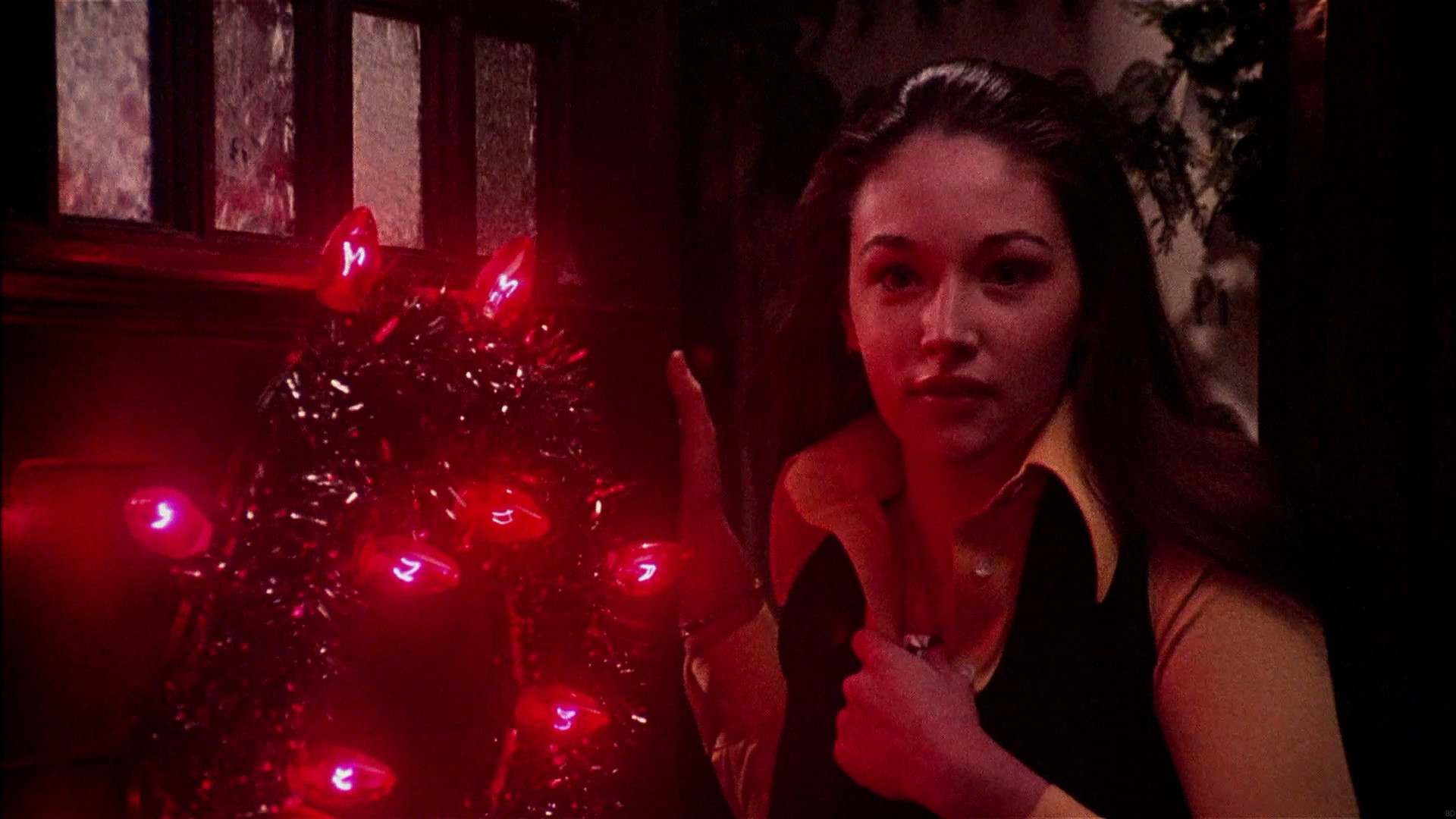
No matter how many times I’ve watched Black Christmas, the film remains chilling. Yes, it contains some dark humor that foreshadows the comedic films director Bob Clark would helm later, especially Porky’s and A Christmas Story, but the film remains a resonant and powerful slasher, and its influence stretched into the late 1970s and the 1980s slasher craze. Fifty years on, Black Christmas’ themes of female autonomy and agency, especially Jess’ (Olivia Hussey) pregnancy and her decision to abort the child, and the masculine attacks on a female sorority, feel all too relevant at the conclusion of 2024.

From the get-go, the sorority house, which should serve as a safe space for the women, comes under attack through a series of phone calls by killer Billy. Some of his calls sound like garbled, incoherent jibberish. At their core, however, the calls assault the women’s sense of safety. In some of the first calls we hear, he threatens to sexually assault the women. His words are too explicit to reprint here, but the violence stands out more than his other ramblings.

To be clear, the women don’t act defenseless against Billy. In one of the most notable early scenes, Barb, played by the wonderful Margot Kidder, responds to Billy’s threats with the famous line, “Oh, why don’t you go find a wall socket and stick your tongue in it? That’ll give you a charge.” Yes, the line draws laughs, but it also underscores these women aren’t pushovers. They’re also much stronger together, providing greater resolve and defense when united.

However, Billy picks several of them off one by one, including the alcoholic house mother Mrs. Mac (Marian Waldman). The killings start with Clare (Lynne Griffin), who Billy strangles and suffocates with a plastic bag and leaves in the attic, specifically in a rocking chair for the duration of the film. Clare’s murder triggers much of the plot and rattles the sorority sisters, who assume she’s gone missing. Suddenly, their sense of safety shatters.

Of all the deaths, though, Barb’s feels most tragic. Other than Jess, she’s the strongest of the bunch. Yes, her sisters roll their eyes at her, and yes, she boozes as much as Mrs. Mac, but she has the best, most forceful responses to Billy. She successfully rattles him over the phone to the point he threatens to kill her.

Unfortunately, this foreshadows her death a bit past the film’s halfway point. The scene guts me each time, especially since Barb feels like the black sheep of the bunch, as well as the most outspoken. There’s the feeling she’s unwanted, not only by her sisters, but by her family. Who’s coming to pick her up for the Christmas holiday? The fact she dies alone in her bedroom reinforces her isolation.

Black Christmas’ major influence on the slasher genre

Black Christmas isn’t the first slasher. That credit really goes to Psycho and Peeping Tom, both from 1960, but the killer’s POV shots certainly influenced John Carpenter’s Halloween, which released four years after Clark’s film. Just watch the first ten minutes of Black Christmas and then the first ten minutes of Halloween. In both cases, you’re placed in the killer’s POV, as he enters the house. The influence is undeniable. Like Billy, Michael Myers is rarely shown fully in frame. He lurks in the shadows. We catch glimpses and images of him. He’s there, and then he’s not, but he’s an ever-present threat.

Further, the conclusions of Halloween and Black Christmas aren’t too dissimilar. Both boogeymen survive. After Dr. Loomis (Donald Pleasence) shoots Michael several times and he falls from the second floor into the yard, he soon vanishes. Cue the famous Halloween theme, as well as several shots of everywhere Michael’s been in the film, coupled with the sound of his breathing.

At the conclusion of Black Christmas, the police leave Jess alone in the house to sleep and recover. As the credits roll, the phone rings again. It’s clear Billy’s not dead, leaving Jess’ fate uncertain. Clark refused to direct a sequel to Black Christmas, but the film still established the trope that the bad guy isn’t killed off.

Additionally, in both Halloween and Black Christmas, authority figures are pretty inept. This is true of Mrs. Mac, but also the police in both films. In fact, they dismiss the obscene phone calls initially in Black Christmas and then leave Jess alone. In Halloween, they do little to stop Michael and initially ignore Dr. Loomis’ warnings. This is even true of Haddonfield’s sherif, Leigh Brackett (Charles Cyphers). His denial of what Loomis tells him leads to the death of his daughter, Annie (Nancy Kyes). He could have stopped Michael but didn’t. Likewise, in Black Christmas, the police should have listened to the women much sooner about the calls, which could have stopped Billy.

Black Christmas and female autonomy and agency

Besides its influence on slashers, Clark’s feature was way ahead of its time because of Jess’ storyline. Like Barb, she maintains and defends her sense of agency. This is most apparent regarding her abortion storyline. She informs her boyfriend Peter (Keir Dullea) that she’s pregnant but plans to seek an abortion. Peter, who studies to become a concert pianist, freaks out and demands she keep the kid. At one point, he tells her he’s going to quit school and marry her. Of course, he thinks she should drop all her plans, too. In response, Jess maintains her resolve that she’s not getting married, she plans to finish school, and she’s moving forward with the abortion.

Though Peter doesn’t kill anyone, he’s the film’s other antagonist, a threat against Jess’ agency and dreams. His response to her decision is both childish and downright unnerving. He accuses her of being selfish and complains he hasn’t been consulted regarding the abortion. It’s no surprise that Clark uses Peter as a red herring for the killer. At one point, he smashes his piano and lurks around the sorority house. He’s a menace.

Fifty years later, Black Christmas remains as effective and timely as ever. Clark and writer Roy Moore crafted fully realized female characters, especially Jess and Barb, that do their best to defend against attacks on what should be a safe female space. It goes without saying that in a post-Dobbs era, the film feels all too relevant.

Black Christmas is currently streaming for free on Tubi and Crackle. It’s also available on Peacock, Shudder, and Prime Video.

Why John Carpenter’s They Live speaks to our current political landscape

Since the recent U.S. election, I’ve been struggling how to process the result. I don’t know what shape a “resistance” will take this time. I was at the Women’s March in 2017 and organized near- weekly visits to the local offices of our two PA senators to oppose the worst of the initial Trump cabinet picks and policies. As a whole, the groundswell of activism that occurred in 2017 likely stopped the worst of it, but this feels different. The cabinet picks are most definitely worse, and the incoming far-right government trifecta seems more intent on passing sweeping legislation, at least within the first year, before they campaign for the 2026 midterms.

We also have the issue of billionaires like Elon Musk spending unlimited funds to influence an outcome. I don’t know how we deal with that, but I’m turning to writing both as a solace and maybe as a means to offer some paths forward.

In that regard, my first post-election piece is on John Carpenter’s 1988 political satire They Live. There’s a lot of lessons to learn from it, including the power of worker organization. This article was initially published at 1428 Elm this week, and I am reposting it here.

While John Carpenter’s 1988 political satire They Live may have been a response to Ronald Reagan’s America, with direct references to his campaign slogan “morning in America,” the film feels increasingly timely now. Considering the involvement of billionaires in the recent presidential election, with Elon Musk playing an outsized role, Carpenter’s critique of capitalism makes They Live the most relevant of his films for this precarious moment.

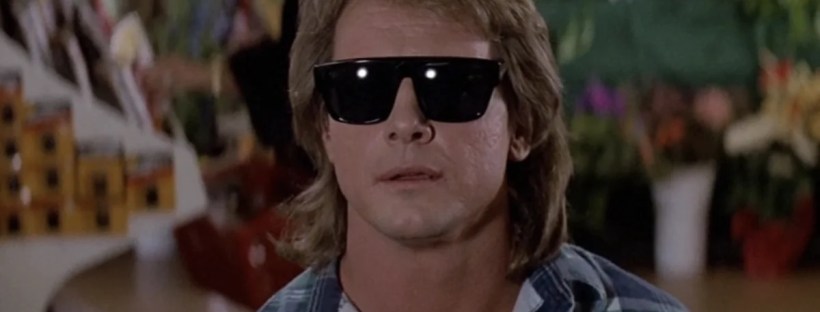
Set in LA in the late 1980s, They Live follows a drifter named Nada (Roddy Piper). Within the first 15 minutes, he ends up in a shantytown. Skyscrapers loom in the distance, drawing his gaze and underscoring a setting that shows the divide between the haves and the haves-nots. Initially, Nada isn’t bothered by this.  He’s simply looking for work and believes in the promise of America.

At the shantytown, Nada encounters Frank (Keith David). During their first conversation, their differing views on class become apparent. Frank, like the countless working-class voters from PA, MI, and WI interviewed in 2016 and then again in 2024, laments the loss of well-paying factory jobs. He’s hardened and ready for action, but even more importantly, desperate for a job. He’s ready to tear down the system if he doesn’t find one.

During this first exchange between the men, we learn a lot about Frank and his challenging plight. He tells Nada, “We gave the steel companies a break when they needed it. Know what they gave themselves? Raises,” before reciting one of the film’s most famous lines about the golden rule, “He who has the gold, makes the rules.”

Frank’s justified anger is the most relevant of the two characters. It’s palpable. He, like too many other workers, has been stiffed. Following an election that hinged, at least in part, on economic issues, such as the cost of housing and the skyrocketing cost of everyday goods post-COVID, Frank’s rage feels righteous and warranted. He’s prepared to take a sledgehammer to the whole system.

Nada’s response to Frank’s simmering anger feels naïve at best.  He says, “You know, you ought to have a little more patience with life.” With his blue jeans, flannel shirt, and mullet, Nada looks ready to recite a Bruce Springsteen or John Mellencamp song without really listening to the lyrics.

It would likely have been easier for Nada to brush off Frank’s gripes and maintain his simplistic worldview. However, his character evolves the moment riot police and bulldozers utterly obliterate the shantytown. The scene is one of the film’s most harrowing. Nada looks on in shock and horror as this occurs seemingly for no good reason. He evades the police, only to find a pair of sunglasses that allow him to see the world as it truly is. Thus begins Nada’s political and social awakening.

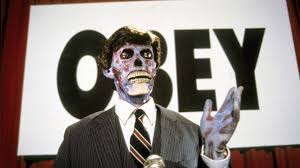
The glasses empower Nada, making him less susceptible to hyper-consumerism and control. When he puts them on, he sees aliens determined to keep people asleep in a fog of consumerism as they overtake Earth. With the glasses on, Nada sees billboards that say Obey, Consume, and other slogans. When he fixes his gaze on money, he encounters the phrase, “This is your god.”

Carpenter’s political critique isn’t exactly subtle, but it’s incredibly effective. When you have Musk paling around with the new president-elect or the barrage of celebrity endorsements secured by VP Kamala Harris, They Live’s over-the-top political satire speaks to the moment. In 2017, speaking out against a bizarre Neo-Nazi claim that the film traffics in stereotypes, Carpenter made clear that’s not the point of the film, tweeting that it is about “yuppies and unrestrained capitalism.”

Besides the blatant critique of consumerism and capitalism, They Live offers a more subtle message, that of worker power and organizing. For at least half the film, Frank and Nada, two men with working-class backgrounds, stand at a divide. Nada initially dismisses Frank’s anger with a dose of foolish optimism. Later in the film, Frank does the same to Nada, though for different reasons.

When Nada encounters Frank much later in the film, he implores him to try on the glasses and see the world as it truly is. However, Frank landed a job in construction. With Nada’s face plastered all over the news, after killing a few of the aliens, he wants nothing to do with him. Frank wants to protect his job. He has no choice.

The men brawl with each other in an alley. The scene is absurd and also plays up Piper’s wrestling background. However, the sequence, silly as it is, highlights the divide between the men, specifically between different members of the working class. As long as they remain divided, those in power maintain and accumulate wealth. This class division is also maintained because the aliens continually promise workers that they can advance up the social and economic ladder if they submit and assist with the takeover.

Eventually, Frank and Nada, along with other members of a pocket resistance, come together to fight the aliens. This underscores the power of organizing, perhaps as the only means to create a more equitable society.

Fantastic Fest Favs

Once again, I had the honor of covering Fantastic Fest for Horror Buzz. I watched and reviewed ten or so films. Here are some of my favorites.

The Remarkable Life of Ibelin

This is such a beautiful and heartbreaking documentary about a Norwegian gamer named Mats Steen. His degenerative muscular disease caused him to seek refuge in the World of Warcraft, where he played the avatar/character Ibelin. Much of this documentary is narrated through the avatars and creatures that populate WOW. During the runtime, we come to know how much Mats meant to so many of his fellow gamers and how, in turn, they provided him friendship and community. This film will stream on Netflix beginning October 25. I can’t recommend it enough. You can check out my full review over at Horror Buzz.

Touched by Eternity

At this point, there’s not much left to do that’s new with the well-worn vampire genre. Writer/director Marcis Lacis likely knows this. Hence why his film, Touched by Eternity, is a sharp horror satire more than anything else. The Latavian film stars Andriss Keiss as the unmotivated Fatso. Though he’s obsessed with podcasts and conspiracy theories about eternal life, when two vampires show up at his trailer, offering him such, he flees them. This movie is a hoot through and through, but it’s also a smart meditation on being human and mortality. Oh, and there’s a knee-slapping scene in which a vampire academic reads her paper about the fanged undead, even citing Marx! Here’s my full review.

What Happened to Dorothy Bell?

If there’s one film I can’t stop thinking about after Fantastic Fest, it’s What Happened to Dorothy Bell?, an unnerving found footage movie from writer/director Danny Villanueva Jr. His feature stars Asya Meadows as Ozzie, a deeply troubled young 20-something who makes a documentary for a school project to unpack what happened to her grandmother, Dorothy, a librarian who eventually lost her mind and attacked Ozzie. There’s a lot of creepy stuff in this one. Oh, and Nightmare on Elm Street 4 and 5’s final girl, Lisa Wilcox, also stars in this as Ozzie’s therapist. I wouldn’t be surprised if a distributor picks this one up soon. Here’s my full review.

Apartment 7A

When I first heard news that Rosemary’s Baby was getting a prequel, I was skeptical. Who would want to touch Ira Levin’s novel and Roman Polanski’s adaptation? Well, when I saw Natalie Erika James’ name attached to it, I had greater confidence in the project. I really liked her 2020 film Relic. Set in 1965 NYC, this prequel tells Terry’s story, and Julia Garner does an impressive job in the lead role. Apartment 7A is now streaming on Paramount Plus. It’s also available to purchase on other streaming outlets. Here’s my full review.

Strange Harvest: Occult Murder in the Inland Empire

Writer/director Stuart Ortiz’s (Grave Encounters 1 and 2) Strange Harvest: Occult Murder in the Inland Empire is a harrowing commentary on our culture’s obsession with true crime and serial killers. This film makes viewers question why we love serial killers and often forget about their victims. In a mock documentary style, this film contains interviews with two detectives, haunted by the murders at the hands of Mr. Shiny. The less I say about this one, the better. Likely, this film will get swooped up by a distributor. Read my full review here. You can also check out my interview with Ortiz and the cast.