Interview: Fear Street: Prom Queen Writer/Director Matt Palmer

Recently, I chatted with Fear Street: Prom Queen writer/director Matt Palmer for 1428 Elm about inhabiting the world of R.L. Stine’s books and ’80s slashers. You can read the interview in full here, but I posted some of it below. Fear Street: Prom Queen just dropped on Netflix. Slasher fans should enjoy it.

What was it like to step into the world of R.L. Stine and the Fear Street series?

Matt Palmer: It was exciting. Full disclosure: I think Fear Street was bigger in America than in the U.K. I’ve heard of R.L. Stine and Goosebumps, but this was my introduction to Fear Street. It was jumping into the world of R.L. Stine, but also jumping back into the world of ’80s slashers. It was a combo of those things, which was an incredibly exciting prospect.

This film has some pretty grisly kills and a lot of gore. Did you face any pushback about the level of bloodshed, or did Netflix pretty much allow you to do what you wanted in terms of the gore and the kills?

Matt Palmer: I was waiting for pushback, and then I was very surprised. As much as possible, we did practical effects. There were a few things we couldn’t do only practically. I’m a big fan of the way that Gaspar Noé does practical effects but incorporates digital effects quite seamlessly. Actually, Netflix upped our VFX budget in post-production to enhance the gore and make it more extreme. It was a fantastic moment. Not only did they allow us to do this and not ask us to cut it, but they also asked us for more.

I think there’s been a bit of a sea change in horror over the last 12 months. I think people are pushing back against the PG-13 element of it. They’re ready to go the other way. I think the horror community might be in for quite exciting times. I think things are about to get bloody. [Laughs].

Which slashers served as inspiration for the film?

Matt Palmer: I like slashers generally. My favorites are the slightly more mental ones. I’m a big fan of PiecesHappy Birthday to Me and Sleepaway Camp. I’m also a big fan of Giallo movies and Argento in particular. I feel like the shadow of Tenebrae hangs quite long over this movie. I love how in an Argento movie, there’s a ritualistic quality when a kill is coming. I thought that when we had a kill coming, we had to bring it home as far as possible and really go to town on those scenes.

I’m also really proud that all of our kill scenes are quite distinct and have quite different tones, pacing, and rhythms. Hopefully, that keeps the audience on its toes.

In terms of the soundtrack, there are some familiar ’80s bangers in the film, including Billy Idol, The Eurythmics, Tiffany, and others. How much say did you have over the soundtrack?

Matt Palmer: Some of the tracks, like Eighth Wonder’s “I’m Not Scared,” were a key track for me. The pulsating quality of that really suggested to me that it had promise visually. The prom scenes should be seen through the young people at prom, but it’s also like an idealized image of that. I felt like “I’m Not Scared” has that throbbing, pulsing quality.

The one thing that did happen is that I picked a few tracks that were very personal to me. I was happy when they came on and were in the edit for a long time. But one of the producers is younger. She’d tell me that a track sounded kind of boring. That’s when the voices were helpful. It was exciting for me because I listened to those tracks when I was 13, but we switched some of those tracks up. A lot of it was to keep the energy up. I picked some slightly down-tempo tunes. Eventually, we found that keeping the pace was the best thing for the movie.

FEAR STREET: PROM QUEEN
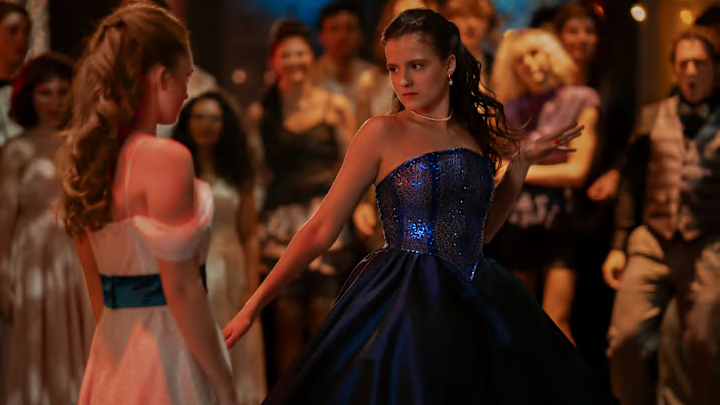
(L-R) India Fowler as Lori Granger and Fina Strazza as Tiffany Falconer in Fear Street: Prom Queen | Netflix

There’s a really great sequence where the two competing prom queens, outcast Lori (India Fowler) and popular girl Tiffany (Fina Strazza), have a dance off. That scene looked like it was a heck of a lot of fun to shoot. Can you talk about directing it?

Matt Palmer: I think it was a lot of fun for everyone, apart from the actresses [Laughs]. That was a really tough scene for India and Fina. Not only are they essentially dancing for a camera, but there were about 150 extras around them. I don’t care who you are. That’s intimidating.

Neither of them are trained dancers. We had a fantastic choreographer who worked with them. It was a tough day and more challenging than some of the elaborate kill scenes actually, but I was really, really happy with what we came out with. Fina, as she dances, her performance falls apart. It’s laugh-out-loud funny, the moves that she’s pulling. They’re all classic ’80s moves gone wrong.

Can you also talk about the dynamic between Tiffany and Lori? They make for good opposing characters and come from such different worlds in terms of their popularity, class, and even family.

Matt Palmer: The producer said it was a story about Lori and Megan (Suzanna Son), but now that I’m looking at the edit, it’s a story about Lori and Tiffany. It’s kind of both. There’s a little bit of an element of Showgirls, just in terms of the catty and camp and snarky and snide stuff.

The Tiffany character was a total joy to write. She’s just a meanie. The interesting thing about Tiffany that I’m pleased with is the moments in the film that you see underneath that front. There’s a vulnerable teenage girl who tries to find herself under that mean girl exterior.

Lori is essentially the opposite. She has that strength, but she needs to go through the grind of the narrative to come out on the other side and really exhibit that strength. There’s a real crossing over. One becomes weaker and the other becomes stronger as the movie goes on.

Portal to Hell Production Still, featuring Trey Holland and Romnia Dugo.

Slamdance Film Fest Interview: Portal to Hell Writer/Director Woody Bess & Actor Trey Holland

I’m grateful to be covering the Slamdance Film Festival again this year for HorrorBuzz. One of the highlights for me so far was an interview I did with Portal to Hell’s writer/director Woody Bess and its star Trey Holland. The horror comedy is a clever spin on the old Faustian bargain. It also stars genre icon Keith David, of They Live and The Thing fame. The interview ran in full a few days ago, and you can read it over at HorrorBuzz. I included some of it in this post, too.

Just prior to the fest, Raven Banner picked up the film for worldwide distribution and sales, so keep an eye out for it.

First, talk about how this story came together and the Faustian bargain at the center of it.

Woody Bess: I’m a huge fan of horror films and movies like Little Shop of Horrors that have a devil’s bargain. There’s Constantine from 2005, which I think is criminally underrated. I’ve always been interested in anything that deals with heaven and hell.

What was it like working with horror icon Keith David? 

Woody Bess: I’m the biggest Keith David fan. The Thing is a film I watch multiple times a year and even his work as the Arbiter in Halo. Getting him to be in our small film is really a dream come true for us. He’s such an incredible actor and actor’s actor. He was also a teacher. He had so many lessons of what to do as an actor for Trey and as a director for me. We learned so much from working with him. We’re so grateful he decided to be in our film.

Trey Holland: It was such a blessing. He elevated the tone to the point that we were able to go back and reshoot some of the teaser stuff because he grounded it in such a different place. For me, as an actor, it was so fun to know, as we were doing the scenes with Keith, that we’d have to reshoot some of the Dunn stuff because it was such a different thing. We asked him to help us, and we’re forever grateful. He influenced the tone so much. He was such a kind and generous actor. Like Woody said, he was fantastic to work with.

Dunn works as a medical debt collector, and some of the scenes when he’s on the phone are some of the funniest in the film. Where did the idea originate to make him a debt collector? Did either of you ever work a job like that?

Trey Holland: I’ve had experience on the other side of the phone call. I had to flip it around. I think we’ve all spent time on a customer service line. I tried to imagine myself in that job and then imagine Dunn in that job and how he’d do it. I never had experience doing it, but unfortunately, we can all relate to the state of the medical industry in the first place.

Woody Bess: Thematically, it fit with the notion of debt that we have in the film. Dunn collects on financial debts, but the demon is a mirror collecting on our ethical or moral debts. We all kind of have a debt to pay and our mistakes to own.

Talk about the role that LA plays in this film. 

Woody Bess: LA is such a beautiful, messy place. There’s so many colored lights and neon signs. It’s overwhelming but can be really beautiful if you kind of embrace it. It’s also a place where people go to pursue their dreams and other people take advantage of that. It really has the best and worst of us in Los Angeles. I’ve been here for ten years. Sometimes, I don’t know why I still live here. Then, I can’t live anywhere else. That’s LA in a nutshell. We tried to capture that visually and what a gorgeous mash of light LA is.

Trey Holland: It’s another character in the story. Like Woody said, the good and bad are here. That’s what this whole film is about, that fine line of morality. That can easily be found in a big city. LA is so pretty. At the same time, it can be very dark. We wanted to highlight those type of elements and then show the beautiful side as well. It’s a perfect backdrop for our film.

This film successfully combines comedy with horror. What were some of the challenges of blending those genres? Not every horror comedy works.

Woody Bess: A lot of my favorite films, including Shaun of the Dead and Get Out, fall in that line. It’s hard to hit both of those notes, of having a joke or scare land. It’s a fine line to walk. In theory, though, a joke structure and scare structure are the same. Get Out is a great example. A scene ends with a joke or something terrifying. We kind of tried to emulate that as best as we could. Jordan Peele is obviously incredible. I’m just a big horror comedy fan.

What was the inspiration for the demon Chip? Trey what was it like working with the demon?

Trey Holland: It was cool. Ideally, it’s the best thing to work with a practical effect as an actor. Everything becomes more real when your creature is right there in front of you and it’s not a tennis ball or a guy in a green suit. Trevor [Newlin] is over seven feet tall already. We put him in some backward hooves, so he was even taller. It was terrifying. It was so helpful, to me, as an actor, to have that right in front of me. I’ll never forget seeing him walk around that corner for the first time. It was great. Trevor did a fantastic job.

Here’s another fun thing, on that same thread. The way Trevor moved, we took that scene to New York. We watched [demon voice actor/human form] Richard [Kind] get into Trevor’s movement in the booth. They [Kind and Newlin] weren’t there together on that day. To watch Rich use Trevor’s acting and marry the two into one was really fun to watch. I think it turned out fantastic.

Woody Bess: Trevor Newlin also played the Xenomorph in Alien: Romulus. He’s just an incredible actor. He was a joy to work with, and he’s very tall. [Laughs].

Anything else you’d like to add?

Woody Bess: It was a joy to make the film. We hope it’s at least a fun time at the movies.

Interview: Tiger Stripes Director Amanda Nell Eu on Body Horror, Censorship, and Influences

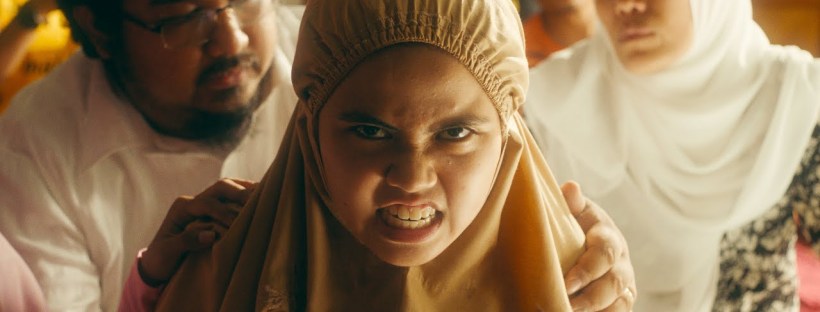
Now that the year is at its halfway point, I’m already pondering what some of my favorite films of 2024 are, and yes, I know there’s still plenty of films yet to be released. Still, there are a few movies that I’m sure will top my year-end list. One of those films is Tiger Stripes, by Amanda Nell Eu. The Malaysian feature debut combines several genres, including body horror, coming-of-age drama, and even possession, with a dash of Mean Girls influence on the side.

I first screened and reviewed the film at the Jim Thorpe Independent Film Festival back in April. While I probably screened 50 films at the JTIFF this year, Tiger Stripes is one that stood out for the way it used body horror to address marginalization, puberty, and especially gender. It also has one heck of a performance by Zafreen Zairizal, who stars as Zaffan. She’s shunned by society, including her home and school and finds refuge in the jungle.

I had the pleasure of recently interviewing director Amanda Nell Eu for 1428 Elm. We discussed the movie’s influences, censorship it faced in her home country of Malaysia, and some of those very tough bullying scenes. It was a delight chatting with her and getting more insight into this unique film. You can read the interview by clicking here.

Tiger Stripes is now available globally on VOD, and I highly recommend it.