Why John Carpenter’s They Live speaks to our current political landscape

Since the recent U.S. election, I’ve been struggling how to process the result. I don’t know what shape a “resistance” will take this time. I was at the Women’s March in 2017 and organized near- weekly visits to the local offices of our two PA senators to oppose the worst of the initial Trump cabinet picks and policies. As a whole, the groundswell of activism that occurred in 2017 likely stopped the worst of it, but this feels different. The cabinet picks are most definitely worse, and the incoming far-right government trifecta seems more intent on passing sweeping legislation, at least within the first year, before they campaign for the 2026 midterms.

We also have the issue of billionaires like Elon Musk spending unlimited funds to influence an outcome. I don’t know how we deal with that, but I’m turning to writing both as a solace and maybe as a means to offer some paths forward.

In that regard, my first post-election piece is on John Carpenter’s 1988 political satire They Live. There’s a lot of lessons to learn from it, including the power of worker organization. This article was initially published at 1428 Elm this week, and I am reposting it here.

While John Carpenter’s 1988 political satire They Live may have been a response to Ronald Reagan’s America, with direct references to his campaign slogan “morning in America,” the film feels increasingly timely now. Considering the involvement of billionaires in the recent presidential election, with Elon Musk playing an outsized role, Carpenter’s critique of capitalism makes They Live the most relevant of his films for this precarious moment.

Set in LA in the late 1980s, They Live follows a drifter named Nada (Roddy Piper). Within the first 15 minutes, he ends up in a shantytown. Skyscrapers loom in the distance, drawing his gaze and underscoring a setting that shows the divide between the haves and the haves-nots. Initially, Nada isn’t bothered by this.  He’s simply looking for work and believes in the promise of America.

At the shantytown, Nada encounters Frank (Keith David). During their first conversation, their differing views on class become apparent. Frank, like the countless working-class voters from PA, MI, and WI interviewed in 2016 and then again in 2024, laments the loss of well-paying factory jobs. He’s hardened and ready for action, but even more importantly, desperate for a job. He’s ready to tear down the system if he doesn’t find one.

During this first exchange between the men, we learn a lot about Frank and his challenging plight. He tells Nada, “We gave the steel companies a break when they needed it. Know what they gave themselves? Raises,” before reciting one of the film’s most famous lines about the golden rule, “He who has the gold, makes the rules.”

Frank’s justified anger is the most relevant of the two characters. It’s palpable. He, like too many other workers, has been stiffed. Following an election that hinged, at least in part, on economic issues, such as the cost of housing and the skyrocketing cost of everyday goods post-COVID, Frank’s rage feels righteous and warranted. He’s prepared to take a sledgehammer to the whole system.

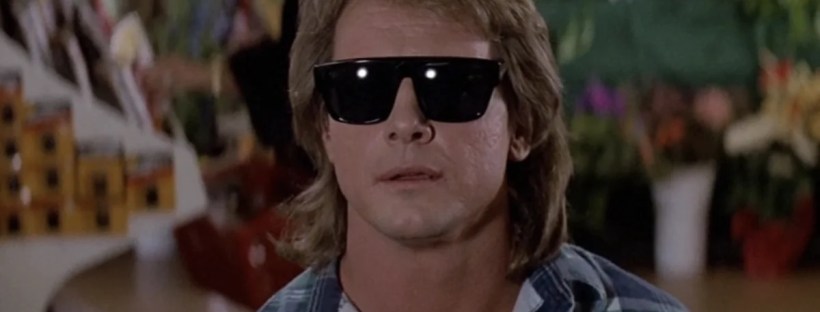
Nada’s response to Frank’s simmering anger feels naïve at best.  He says, “You know, you ought to have a little more patience with life.” With his blue jeans, flannel shirt, and mullet, Nada looks ready to recite a Bruce Springsteen or John Mellencamp song without really listening to the lyrics.

It would likely have been easier for Nada to brush off Frank’s gripes and maintain his simplistic worldview. However, his character evolves the moment riot police and bulldozers utterly obliterate the shantytown. The scene is one of the film’s most harrowing. Nada looks on in shock and horror as this occurs seemingly for no good reason. He evades the police, only to find a pair of sunglasses that allow him to see the world as it truly is. Thus begins Nada’s political and social awakening.

The glasses empower Nada, making him less susceptible to hyper-consumerism and control. When he puts them on, he sees aliens determined to keep people asleep in a fog of consumerism as they overtake Earth. With the glasses on, Nada sees billboards that say Obey, Consume, and other slogans. When he fixes his gaze on money, he encounters the phrase, “This is your god.”
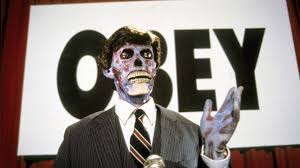
Carpenter’s political critique isn’t exactly subtle, but it’s incredibly effective. When you have Musk paling around with the new president-elect or the barrage of celebrity endorsements secured by VP Kamala Harris, They Live’s over-the-top political satire speaks to the moment. In 2017, speaking out against a bizarre Neo-Nazi claim that the film traffics in stereotypes, Carpenter made clear that’s not the point of the film, tweeting that it is about “yuppies and unrestrained capitalism.”

Besides the blatant critique of consumerism and capitalism, They Live offers a more subtle message, that of worker power and organizing. For at least half the film, Frank and Nada, two men with working-class backgrounds, stand at a divide. Nada initially dismisses Frank’s anger with a dose of foolish optimism. Later in the film, Frank does the same to Nada, though for different reasons.

When Nada encounters Frank much later in the film, he implores him to try on the glasses and see the world as it truly is. However, Frank landed a job in construction. With Nada’s face plastered all over the news, after killing a few of the aliens, he wants nothing to do with him. Frank wants to protect his job. He has no choice.

The men brawl with each other in an alley. The scene is absurd and also plays up Piper’s wrestling background. However, the sequence, silly as it is, highlights the divide between the men, specifically between different members of the working class. As long as they remain divided, those in power maintain and accumulate wealth. This class division is also maintained because the aliens continually promise workers that they can advance up the social and economic ladder if they submit and assist with the takeover.

Eventually, Frank and Nada, along with other members of a pocket resistance, come together to fight the aliens. This underscores the power of organizing, perhaps as the only means to create a more equitable society.

In Honor of John Carpenter’s Hollywood Star

Recently, for 1428 Elm, I made a list of my favorite John Carpenter films in honor of his star on the Hollywood Walk of Fame, coming next year. This got me thinking a lot about Carpenter, who has pretty much stopped directing (I don’t really count that Suburban Screams episode last fall as a proper return) to record music and still score some films. He also plays a lot of video games now, apparently. Still, I’d be hard-pressed to think of a director who has had more impact on the horror genre than Carpenter, other than maybe James Whale, Wes Craven, and Hitchcock.

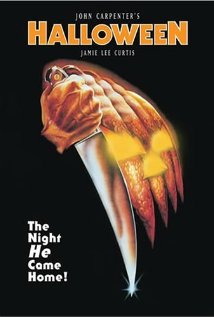
If you asked me, I couldn’t tell you which Carpenter film I saw first. Was it Halloween? Was it The Thing? Was it The Fog? Most likely, I first viewed his work with my dad, who made a habit of renting horror movies with me when I was a kid, and I’m fairly certain that’s when I first encountered the maestro’s work, likely when I was 10, 11, or 12. Years later, in college, my friends and I had horror movie marathons at least once a month. Carpenter’s work factored heavily into our screenings, and it’s then I encountered some of his lesser-known work, like Princess of Darkness and Assault on Precinct 13.

The older I get, the more I’m drawn to some of these less-revered films, especially the later parts of what Carpenter described as his “apocalypse” trilogy. This trilogy began with The Thing in 1982, but I find myself rewatching Prince of Darkness (1987) and In the Mouth of Madness (1994) more. Because I’ve taught Halloween so many times in my horror film/literature class and because The Thing is so revered, and rightfully so, I’ve taken a pause from those classics in part because they feel so inescapable.

Prince of Darkness caught my attention in the last year or two because that film, while incredibly eerie, also has such a profound sense of dread to it. In short, there’s nothing optimistic about Prince of Darkness. It’s incredibly freakin’ bleak. Even though Childs or MacReady may be infected at the end of The Thing, the last shot shows them sitting around a fire, trading a bottle of whiskey back and forth. You hold out hope one of them will survive the night. There’s no chance for that at the conclusion of Prince of Darkness and you start to think that yes, the world may end, after graduate students and scientist unleash a strange goop from an ancient canister that ushers in Satan. Hey, I didn’t say the plot was perfect. Oh, and did I mention that Donald Pleasance plays a priest, and there’s a cameo by Alice Cooper?!

In the Mouth of Madness is Carpenter’s last truly big film, and he really went crazy with it. The film stars Sam Neill, who plays an insurance investigator sent to solve the mystery of Sutter Cane’s disappearance. Cane is a horror novelist whose work is similar to Lovecraft and whose pages start to become real. This film is all out bonkers, and it’s so much fun to see Neill return to the horror genre after the massive success of Jurassic Park. For me, this one has plenty of rewatch value because of Neill’s performance and for what it has to say about mass marketing, consumption, and even the publishing industry itself. It’s also a fitting conclusion to the apocalypse trilogy. It’s also a thrill ride to see a Lovecraftian Carpenter film.

It’s unclear if Carpenter will ever direct a full-length feature again. He’s stated in the past he wants to, but regardless, his legacy is secured. Halloween and The Thing especially are essentially inescapable classics at this point, referenced in countless other films. Yet, for as much as I love those two works, I find myself returning to Carpenter’s mid-career films much more, appreciating them years later.

About The Thing/Body Horror

I’ve had John Carpenter on my mind a lot lately, maybe because he’s returning to the Halloween universe he created nearly 30 year ago to produce another Halloween film that will star Jamie Lee Curtis and ignore all of the sequels that followed the original film.  It will be just Jamie and Michael, reunited at last, no bizarre stories about Michael Myers’ bloodline, or his cult, or those awful Rob Zombie remakes that tried to give a backstory that we didn’t need.

Michael Myers is so effective in that first film because he literally could be anyone, and Haddonfield could be any tree-lined suburbia. There is one brief scene in the original film where Michael takes off his mask, after Laurie Strode (Jamie Lee) stabs him with a clothes hanger. When he unmasks, he looks rather…normal.  The boogeyman isn’t some supernatural entity, and the only thing thing that’s uncanny about him is the fact he gets up after Laurie Strode thinks she’s defeated him, and he gets up a second time after Dr. Loomis (Donald Pleasence) shoots him off a balcony.

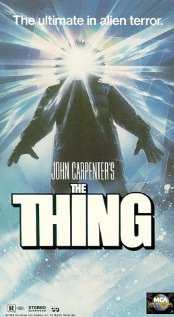
As much as I love Halloween and will always have a soft spot for Laurie Strode and Michael Myers, I’ve been more intrigued lately by Carpenter’s 1982 film The Thing. On a few levels, I find it to be a more interesting film. It has stunning, guttural visual effects that still hold up, for one, but lately, I’ve been more intrigued by the idea of body horror. Few films represent that better than The Thing and the idea that the monster could be inside everyone and will spread from person to person, host to host. On a deeper level, the film was a perfect metaphor for the AIDs epidemic in the 1980s,  and today, in a very divided America, the sweeping paranoia/don’t trust thy neighbor arc  feel even more relevant.  For anyone that ever felt different, off, or an outsider, The Thing is the perfect body horror film. Anyone that appears slightly unusual is tied to the chair, blood tested, and blowtorched if the monster is inside of them.

A few years ago, there was  remake of The Thing that I didn’t bother to see. For me, Carpenter’s remake of the 1950s The Thing from Outerspace holds up too well, especially the non-CGI effects, the pulsating soundtrack, and the acting. If the new Halloween is indeed going to  follow the original film and no sequels, then there is more story to tell. I don’t think that is true about The Thing, despite its ambiguous ending.

In a tribute to the film, here is a poem I wrote about the body horror idea that  Rockvale Review recently published. I also have an essay coming out about the film in 2018 in the anthology My Body, My Words (Big Table Publishing). Not all of Carpenter’s films have aged well, but The Thing certainly has.

It Follows and Suburban Fears of the Other

I’m straying a little bit from the usual poet-oriented posts to offer some criticism on the horror film It Follows, one of the best horror films I’ve seen in a few years. If you’ve seen the film, I hope that you enjoy this read.

John Carpenter, director of the original Halloween, The Thing, and other iconic horror movies, states in the documentary American Nightmares in Red, White, and Blue that American horror movies are very much about our fear of “the other,” something or someone different that will threaten our tribe. His own movies very much deal with this theme. In his remake of the The Thing, the monster is a shape shifter/parasite/alien that infects a group of scientists working in Alaska. In Halloween, Michael Myers terrorizes a quiet, sleepy suburban Illinois town and picks off teenagers one by one.

It Follows is very much a movie that plays with the trope that Carpenter mentioned, fears of “the other,” and like Halloween, it raises questions about where the other comes from. The opening shot establishes the setting and resembles some of the early shots in Halloween in that we see big houses and tree-lined streets, thus establishing the setting of what should be a safe suburban town. However, in both films that sense of security that suburbia should provide, specifically keeping bad things out, is shattered. In the opening scene of Halloween, the initial camera sequence is from Michael Myers’s point of view, as he roams through the rooms of his house, picks up a butcher knife and kills his sister as she’s having sex. In those first few moments of the film, however, the viewer has no idea that the killer is a child, a young Michael Myers, until a few shots later, when the camera angle shifts to third person, and we see him standing on the lawn, dressed in a clown costume, holding a bloody knife. Terror doesn’t come from the outside, but rather, it comes from the inside. About 20-30 minutes into the film, once Michael Myers is grown up and escapes from a mental hospital, he returns to his hometown to kill off teenagers.

After the opening shot of tree-lined streets and nice houses in It Follows, the viewer then sees a teenager, Annie, run out of her house, screaming, before she drives to a beach,where she leaves a panicked message for her father.  As the film progresses and moves towards the opening shot, we learn the source of her terror.

Early in the film, the protagonist, Jay, has sex in  a car with a boy older than her. He goes by the name of Hugh, but viewers later learn that his real name is Jeff. At first, little is known about him, but it can be assumes that he’s from the rougher side of the tracks, since he tells Jay that he doesn’t want to go back to his place because he doesn’t want to show her where he lives. After they have sex, he tells her that he passed on something to her, which he inherited from his last sexual partner. He then tells her that this thing can come in any form and can be someone she knows or someone she doesn’t know, but if it touches her, she’ll die.

During the rest of the film, Jay spends her time fleeing this creature in various forms, a creature that only she can see. She and her friends also visit Detroit, and in one scene, the friends chat about how their parents always told them to stay away from the city and stay in the suburbs. During their attempts to locate Jeff in the city, the viewer sees shots of bombed out buildings, which reinforces the idea of “the other,” that everything bad came from the city, including the man that Jay encountered and the sexual partner who passed down the evil to him.

However, the friends eventually learn that Jeff was not from the city, but rather, he attended high school in the suburbs, and they find him hiding out at his parents’s safe suburban home. He faked his name, though, and rented a house in the city to lure in a young woman and pass down the evil. His true identity is important, however, because it shows that the real terror lurks in the suburbs, not in the inner-city. It didn’t come from outside, but rather from within.

In this regard, the nameless, shape-shifting villain in It Follows is similar to other iconic horror movie villains, including Michael Myers, a boy from the suburbs, who, for seemingly no reason, kills his sister as a boy and returns to his hometown to commit additional murders. The evil is similar to Freddy Kreuger, a child molester who was burned to death by the townspeople and then returns as a supernatural entity to kill, in dreams, the children of the suburban parents who burned him alive. Even in Poltergeist, the evil does not come from outside, but from within. A family moves into a home in a development, and are terrorized by poltergeists. About mid-way through the film, the father learns that the development was built on an Indian burial ground, thus the cause of the haunting.

It Follows also gives a nod to another horror trope: sex and consequence. In the Friday the 13th movies, any teenagers who have sex are murdered by Jason. In American Dreams in Red, White, and Blue, Jason is even compared to a vicious, Old Testament kind of figure, eager to butcher anyone who strays from the straight and moral path. It is indeed significant that the creature in It Follows is passed down through sex. However, It Follows is a little more liberal in its treatment of teenage sex, or perhaps it lies somewhere in the middle of Friday the 13th and David Cronenberg’s 1970s film Shivers, which is about blood parasites that make their hosts hyper-sexual. There are some scenes of It Follows that resemble Shivers. In one of the final scenes, Jay and her friends hide out at a public, indoor pool. They hope to trap the creature in water and electrocute it, using lamps, TVs, and other appliances they lugged from their suburban homes. The pool itself and the colors in the shot, especially all of the yellow, resemble the closing scene in Shivers, when the creature/parasite infects the last person who doesn’t have it, and essentially, the film ends in an orgy, thus making a statement that sexual desires are impossible to avoid.

That scene in It Follows is different, however. Jay doesn’t succumb to the shape-shifting creature. Instead, she resists it, fights it, and flees from it yet again. Furthermore, throughout the film, Jay’s childhood friend, Paul, pleads with her to have sex with him to pass it on. She refuses, however, especially after she has sex with another character and the creature kills him. Ultimately, though, Jay does have sex with Paul, and the closing shot shows them walking down their suburban street, holding hands, while someone walks feet behind them. It’s not clear, however, if the person following them is the creature in yet another form, or someone normal. The viewer is left to guess.

It Follows makes a middle-ground statement regarding sex. Jay and Paul have sex and aren’t killed off Jason-style. Even Jeff doesn’t die, despite his confession that he contracted the evil after a one-night stand with a woman he met in the bar. However, it can be interpreted that only once Jay has sex that is meaningful, with someone who cares about her, is she safe. She survives and is no longer running by the closing shot.

In many ways, It Follows is about the old classic horror trope of the other. In the film, the other takes the shape of the inner-city creeping into the suburbs, an American fear that stems back to the great white flight of the 1950s and 1960s and has returned in the age of Occupy, a bankrupt Detroit, and class inequality/racial tensions. But the other also takes the shape of teenage sex. The creature literally stalks characters because it is passed down through sex. Yet, in the end, Jay has sex, and survives. So sex becomes less threatening.

There are other aspects of the film to note. Its music and even some of its set design/displays, such as the lamps, station wagons, and even a typewriter, resemble 1960s/1970s America, a time period that was iconic for American horror film. Yet, the film is supposed to be set in present day Detroit ‘burbs. There is a wonderful scene too, when Jay is sitting in a college classroom, listening to a professor read Eliot’s “The Love Song of J. Alfred Prufrock,” a poem all about “the cry of the occasion,” sex, the consequences of sex, and death. Prufrock ponders sex, women, and fears that he is getting old. Like “The Love Song of J. Alfred Prufrock,” It Follows is a film that analyzes the consequences of sex and how our past partners shape us and carry us to the present. We can’t run from it or avoid it. It follows.

They’re Coming to Get You, Barbara

When I was young, I used to watch horror movies with my father. I have memories of seeing Night of the Living Dead, Friday the 13th, Fire in the Sky, and other movies with him. Since then, I’ve always loved horror movies, specifically ones from the 1960s-1980s that offer at least some character development, interesting plot, and at times social/political commentary. As a writer, I also know how difficult it is to suspend reality and make the setting and situation work, no matter how outlandish the story may seem on paper.

Here’s an overview/commentary on some of my favorite horror movies.

George A. Romero’s Night of the Living Dead, Dawn of the Dead,  Day of the Dead, Land of the Dead

Zombies have been popular over the last few years. The high ratings of AMC’s show “The Walking Dead” prove that. But Romero’s brilliant zombie films started the trend and how we think of zombies on the big screen or TV. What separates Romero’s films from the rest, though, is his social commentary. You can view Dawn of the Dead as a statement against consumerism. The zombies do flock to the mall, after all, and wander around aimlessly. Day of the Dead warns against militarization, and one of his more recent films, Land of the Dead, highlights the growing gap between the wealthy and the poor in the U.S. My favorite, though, is still Night of the Living Dead. I love the 1968 black and white version, especially the beginning of the film where the young woman and her friend are in the graveyard and encounter a stumbling, groaning zombie. I still love the line, “They’re coming to get you, Barbara!”

John Carpenter’s Halloween

This is the film I re-watch every October, and it still holds up. I love the scenes shot from Michael Myer’s point of view, as he stalks Laurie Strode (Jamie Lee Curtis) and her friends. I love the fact there is no rational  for why Michael does what he does, other than pure evil.  None of the sequels or remakes hold up to the original.

John Carpenter’s The Thing

I just re-watched this the other day for the first time in a few years. The setting and effects are still spectacular and eerie, especially as the paranoia overtakes each of the characters in the film as they question who or who isn’t the shape-shifting alien.

Poltergeist

I also re-watched this recently. The scene where Carol Anne speaks through the TV and the white noise gives me chills. What’s especially effective about this movie is the character development. We want the family to survive, and we grow fond of them as the movie progresses.

The Exorcist

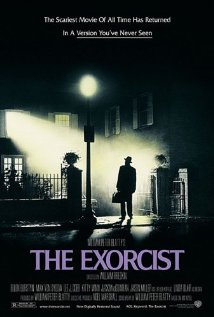
This is the only horror movie that generally scared me. A lot of the scenes stick with you after you watch it,  even the notion that a 12-year-old girl can suddenly become possessed by a demon. There’s also a lot of good points about faith and doubt raised in this film. In the extended version, the scene where a possessed Linda Blair walks up and down the stairs like a spider makes my skin crawl.

These are just some of my favorite horror films. There aren’t too many recent ones I’ve enjoyed, as it seems many of them rely on high body counts and flat characters, as opposed to rich character development, an intriguing plot, and effects that aren’t overdone.

My girlfriend and I plan to watch a few of these and some other favorites during these days leading up to Halloween.