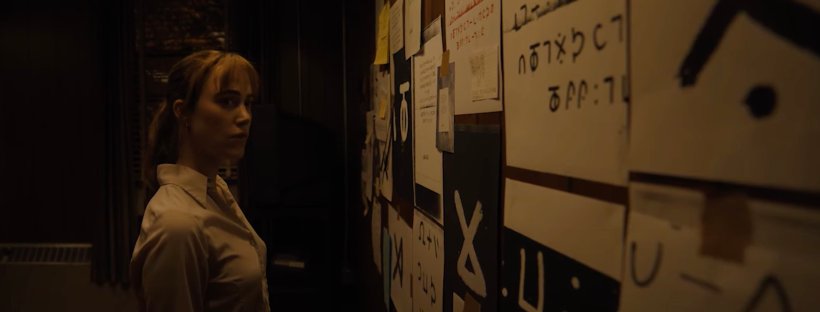
I’m not one to say such and such is the scariest movie of all time, or such and such rivals The Exorcist. I avoid those broad statements. That said, I will definitively declare that Longlegs is the creepiest movie I’ve seen all year, one that will stick with me for a long while, from its cold, immersive world, to Maika Monroe and Nic Cage’s performances, to the unsettling imagery that haunts nearly every frame. Writer/director Oz Perkins’ Longlegs is pure nightmare fuel.
Set in the 1990s, the film stars Monroe (It Follows) as FBI agent Lee Harker, who’s placed on a case to locate a serial killer and also solve why the patriarch within various families murders his loved ones. She works alongside Agent Carter (Blair Underwood), who has been on the case for years but has been running cold until Lee shows up. For whatever reason, Lee seems to possess some sort of psychic abilities and connection to Longlegs (Cage). The reasons why exactly become much clearer in the film’s final act, but the less audience members know going into the film, the better. Carter comes across as a hard-nosed skeptic, while Lee believes there’s something otherworldly possibly at play. It’s a solid dynamic at the center of the film.
Longlegs has earned some comparisons to Silence of Lambs, and they’re somewhat warranted. Monroe’s character, like Jodie Foster’s Clarice Starling, largely operates in an all-male world. This is the 90s, after all. More than one agent doubts Lee’s ability to handle such a grisly case. She has to prove herself, and prove herself she eventually does, to the point she becomes absolutely obsessed with the case. She stays up all night, trying to decipher Longlegs’ bizarre letters, which seem like they’re written in code. At one point, she tells her mom over the phone that the work she’s doing is important. She understands if she solves the case, she’ll save other families. There’s also the fact that Lee hails from a tiny unnamed town and grew up sheltered, living only with her religious mom, played by Alicia Witt. The scenes between those two are oddly unnerving as well. Something simply seems strange and uncanny about their relationship.
If I had one critique of Perkins’ other films, it’s that they too often elevated style over story and narrative. Longlegs finally feels like he got both just right- style and substance. This film is incredibly bleak aesthetically, from the snowy settings of small-town America to the dim libraries where Lee often works late into the night. Yet, Perkins creates quite a world here, with a dense narrative and several layers that eventually peel away the longer the runtime progresses. By the last act, it all gels. I also can’t understate just how hellish the imagery is, from nuns with shotguns, to maggot-covered corpses, to snakes that hiss and fill the frame. There are moments that feel like they’re statured in pure evil, meant to torment the viewer’s mind well after the credits roll.
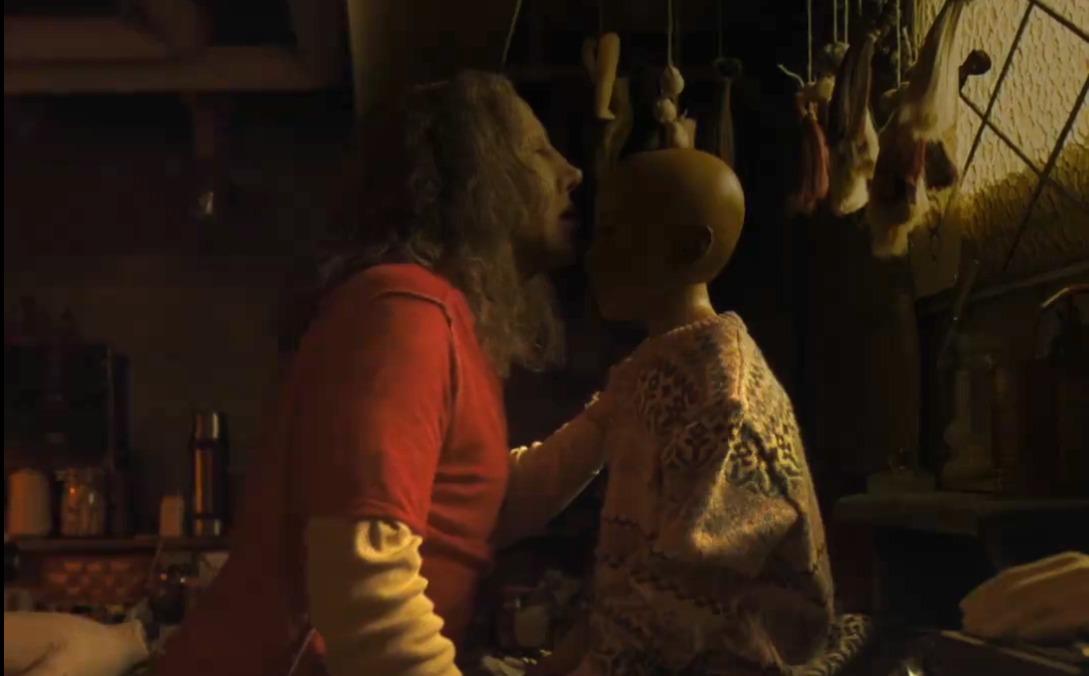
For as stylish the film looks and for as detailed the narrative is, this film works so well because of Monroe and Cage’s performances. In short, this is the most disturbing role I’ve ever seen Cage in. He’s barely recognizable when you do see him. Every moment he’s on screen is hair-raising. Monroe, meanwhile, plays a pensive, yet determined FBI agent, and one specific scene in which she confronts Longlegs drips with edge-of-your-seat suspense. It’s no wonder that the distributor, Neon, made a whole promo about Monroe’s heartbeat the first time she saw Cage in the Longlegs makeup. You feel it in that particular scene they have together.
Longlegs is a film that warrants rewatches, if audience members can handle the devilish imagery. It’s one of those films where you’ll want to reexamine nearly every frame to see what you might have missed during the first or second viewing. This is, by far, Perkins’ strongest film to date, and it’s Cage’s most unnerving performance. Meanwhile, Monroe has starred in two of the best horror films of the last decade- It Follows and Longlegs.
The film opens nationwide on Friday.


 Brian Fanelli