A production still from the movie Keeper

Keeper Plays Out as a Creepy, but Flawed Dark Fairytale (Review)

Osgood Perkins has been on a real winning streak lately, with the massive success of Longlegs and The Monkey. His multi-picture deal with NEON has paid off so far. The director’s latest, Keeper, contains some of the most chilling imagery out of any horror film this year. Perkins spins a dark fairytale and a warning about toxic relationships. Yet, for all of the frightening imagery, the movie feels a bit too paper-thin, especially in its second half.

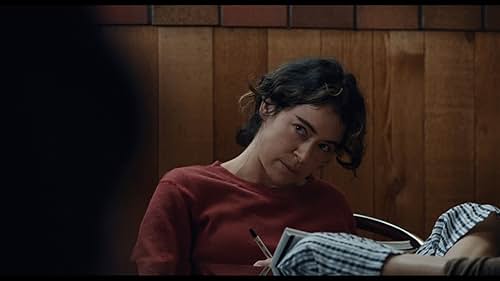
Keeper stars Tatiana Maslany as big city girl Liz and Rossif Sutherland as her boyfriend Malcolm. Hoping for a romantic weekend, Malcolm takes Liz to his remote cabin in the woods, and well, because this is a horror movie, things go horribly, horribly wrong. Before the horror kicks into overdrive, Perkins spends some time with Liz and Malcolm, and I’d argue the film’s first act may be its strongest. There’s unspoken tension between the two, though the source of it isn’t quite clear. Maybe it’s simply the different lifestyles and Liz’s love of big cities. Maybe she simply distrusts men. Regardless, she doesn’t fully embrace Malcolm, and this is most evident when they’re alone together, be it sipping wine over dinner or driving to the cabin. Something about the relationship feels off, though the source of Liz’s suspicion isn’t quite clear. Malcolm seems like a sweet enough guy.

The film enters typical Perkins territory once Malcolm’s reclusive cousin Darren (Birkett Turton) shows up, with an Eastern European girlfriend who Darren claims doesn’t speak English. This deepens Liz’s discomfort and rightfully so, especially when she warns Liz that the chocolate cake Malcolm purchased for her “tastes like shit.” Yet, once Darren and his latest arm candy leave, Liz devours the cake, even though she tells Malcolm that she hates chocolate.

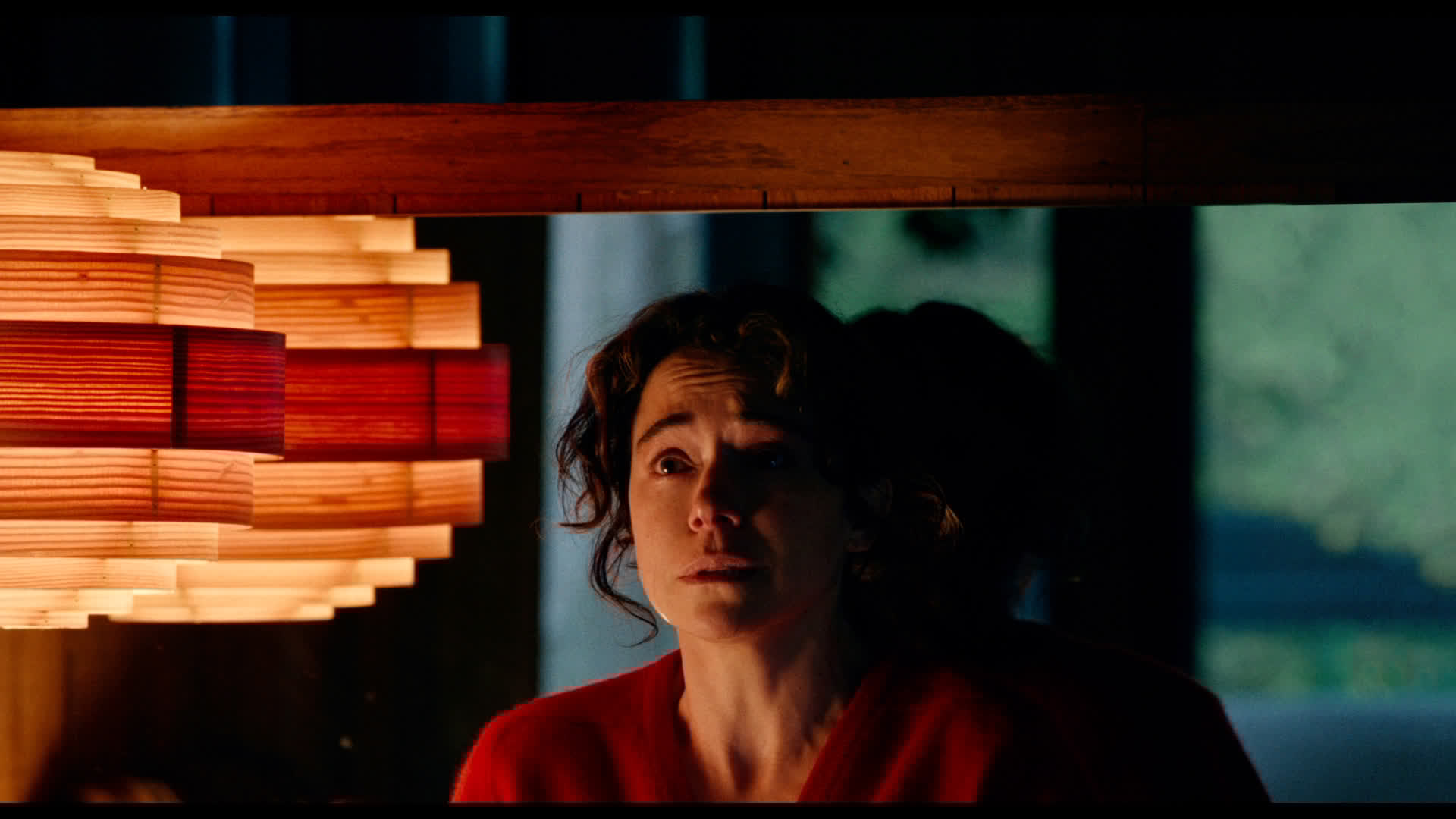
At that point, the film gets really weird, even by Perkins’ standards. It feels like a fever dream into hell, as Liz grows increasingly paranoid and continually sees strange women in the background or out of the corner of her eye. Even worse, Malcolm, a doctor, claims he has to return to the city to suddenly see a patient, leaving Liz alone with her hallucinations and creepy cousin Darren next door.
A production still from the movie Keeper

By the film’s second half, Perkins barrages viewers with a series of unsettling imagery and a brooding atmosphere. There’s even a woman with multiple faces crawling around in the basement. Trust me, you don’t want her to remove that bag from her head. The film also edges dark fairytale territory once the source of the scares is explained, all involving Malcolm. This is where the film falters. The lore isn’t built up enough and some of it comes across as too absurd, even for a horror movie. The film works better when it’s more grounded in reality and when Perkins explores the growing tension between Liz and Malcolm. The film’s main weak point is the script, penned by Nick Lepard. There’s too much explanation suddenly crammed into the film’s second half, and a lot of it is given by one of Malcolm’s monologues.

All of that aside, the film does ramp up to quite a great ending. I’ll never be able to look at honey the same way again. Overall, Keeper isn’t quite as strong as Perkins’ last few films, or even his earlier work, like The Blackcoat’s Daughter, but it continues to prove he’s one of the most effective directors at creating nightmarish sequences and atmospheres that invoke dread. Keeper succeeds when it’s more based in reality and explores a strained relationship. Its second half is hampered by poor explanation and weaker writing.

Keeper is currently playing in theaters.

The Poetry of Oz’ Perkins’ Horror Films

After learning that Oz Perkins, son of Anthony Perkins, aka Norma Bates, was tapped to direct an adaptation of Paul Tremblay’s A Head Full of Ghosts, one of my favorite contemporary horror novels, I knew that I had to finally view his two previous films, The Blackcoat’s Daughter and I Am the Pretty Thing That Lives in the House. There are aspects of both films that frustrate me, especially the pacing of the later, but both films stayed with me days after their viewings. Both are slow-burns that feel like nightmares, heavy on atmosphere, mood, and tone. Both play out as visual poetry.

The Blackcoat’s Daughter primarily centers around two teens, Kat (Kiernan Shipka) and Rose (Lucy Boynton), left behind at an all-girls boarding school during a break.  As the film progresses, Kat becomes stranger and stranger. First, she thinks that her parents are dead, though she has no evidence to support the claim. Then, she acts out towards the nuns and staff members, and she becomes obsessed with Rose. The film also follows the story of Joan (Emma Roberts), an escaped mental patient. At first, it doesn’t seem like the stories of Joan, Katm and Rose are linked, but the narrative clarifies itself in the last 20 minutes or so, and the payoff is worth it.

The Blackcoat’s Daughter has few, if any, jump scares. In fact, it has one of the most low-key, understated exorcism scenes I’ve seen in any horror film. Instead, it relies on tone and mood, a bleak Canadian winter and a mostly gray and white color palate from scene to scene. As I said earlier, visually, the film feels like a long, slow nightmare.

I Am the Pretty Thing That Lives in the House is a film that draws much more from the Gothic tropes of literature, specifically the exploration of how the dead are  not really dead and the past is not really the past. The film has very few characters and focuses on Lily (Ruth Wilson), a hospice nurse charged with tending to Iris Blum (Paula Prentiss), a horror writer. Eventually, Lily starts reading Iris’ most acclaimed novel, The Lady in the Walls, about the ghost Polly (Lucy Boynton), who also haunts Iris’ house.

The film weaves poetry into the film through monologues and some of the visuals. Just check out the opening monologue by Lily:

I have heard myself say

that a house with a death in it

can never again be bought

or sold by the living.

It can only be borrowed from the ghosts

that have stayed behind

to go back and forth,

letting out and going back in again,

worrying over the floors

in confused circles,

tending to their deaths

like patchy, withered gardens.

They have stayed

to look back for a glimpse

of the very last moments of their lives.

But the memories of their own deaths

are faces on the wrong side

of wet windows,

smeared by rain,

impossible to properly see.


From there, the rest of the film serves as a meditation on death and the way that the past influences the present. As the film progresses, at a very slow pace, I might add, Lily becomes obsessed with the story of Polly and her influence on Iris’ novel. Polly is often shown visually in the present as a face seen through the wrong side of a wet window, something blurred, but still present, looming in the house, which in itself is quite a character in the film, a living, breathing thing with groaning floorboards and wide, darkened rooms.

Lily, meanwhile, is obsessed with the color white and often wears white through the duration of the film. Early on, she says, “I’m very seldom required to wear white by my employers. But, anyway, I always do. It;s always been that wearing white reassures the sick that I can never be touched even as darkness folds in on them from every side closing, like a claw.”

That white, however, is soiled as the film moves along, especially when Lily discovers a black, moldy substance growing on the wall where Polly was killed and buried by her husband years  earlier. Like The Blackcoat’s Daughter, I Am the Pretty Thing That Lives in the House is intentional in its color palate and visuals.  The growing darkness represents death, decay, and rot. At one point, Iris, who has dementia and constantly mistakes Lily for Polly says, “Even the prettiest things rot.”

The ending, like The Blackcoat’s Daughter, is a surprise and both Iris and Lily ultimately succumb to the rot that is Polly haunting the house. My main gripe with the film is the pacing. There are only so many scenes we can take of Lily or Polly walking across creaky floors  before it grows a bit tedious. This should have been a short film as opposed to a full-length.

A Head Full of Ghosts is a book that plays with traditional narrative structure and challenges it. The novel also takes the typical story of exorcism and turns it on its head. Perkins’ first two films challenge narrative expectations and conventions of the genre, so I’m excited to see what he does with the adaptation of Tremblay’s novel.

The Blackcoat’s Daughter is streaming on Amazon Prime, and I Am the Prettiest Thing That Lives in the House is streaming on Netflix.