A Lit Mag Lives On!

A few months ago, I shared news on this blog that [PANK] was shutting down, after its editors, M. Bartley Seigel and Roxane Gay, announced the news about the cutting-edge mag via social media. The announcement sent ripples through the literary world. New York Times Magazine called PANK “a raft of experimental fiction and poetry.” Travis Kurowski, editor of Story Magazine and columnist for Poets & Writers, said, “Like McSweeney’s was nearly 20 years ago (and The Paris Review 40 years before that), PANK has been one of those lit mags that seemed to represent the zeitgeist of a generation—a literary turn towards diversity, queerness, raw authenticity.”

These quotes come from the introduction to an interview Electric Lit just published with outgoing editor M. Bartley Seigel, and the interview contains some huge news about the fate of the magazine. It’s going to live on! It has been purchased by John Gosslee of Fjords Review.

The interview features a lot of other interesting tidbits. For instance, Seigel states that he and Roxane Gay decided to step away from the magazine because they are in their mid-40s now and have too many projects happening.

Here is what he said about his time editing [PANK] and the state of American literature:

Overall, I ended my tenure at PANK in a very, positive place. American literature is robust, vibrant, and very much kicking and screaming. Reading and editing and publishing PANK only drove home for me that the foundational world of American letters, underpinning the big publishing houses, the major awards, the world of literary magazine and small and independent presses, is wide and deep and teeming with the most amazing publishers, editors, writers, writing, and readers. If I have a critique of American letters, it’s that the average American doesn’t read broadly enough, not enough work in translation, that we’re too isolated, too narrow in our reading habits, still too locked into boxes like the one built out of white male heteronormativity.

I encourage anyone to read the full interview. It provides a lot of insight into the contemporary literary landscape and the future of one of America’s most important lit mags.
Museum of Americana

If you haven’t checked out the online literary journal Museum of Americana, I encourage you to do so. The journal publishes all things Americana, hence the title. The new issue, for instance, features poems that address everything from baseball to the military. My poem, “Lady Day Sings the Blues on YouTube,” is featured in the new issue, so check it out here! Read the rest of the issue, too, as well as the archives. The editors do an excellent job maintaining the theme issue to issue and selecting fiction, essays, and poetry.

Writers on Writing, Routines, Habit

I love reading biographies about writers and interviews with writers. I love peering into their work space and coming to a greater understanding of how they operate. The current issue of The Writer’s Chronicle has an interview with one of my favorite contemporary poets, Kim Addonizzio. The interview, which is only available in print, covers a wide range of topics, and while it does not delve too much into Addonizzio’s specific writing process, it does provide some glimpses into it. For instance, she mentions listening to classical and jazz while composing new work, and maybe this shouldn’t come as surprise, since Addonizzio also plays music and frequently busts out her harmonica to play the blues after she reads a few poems or her fiction.

What’s more interesting about the interview, however, is what Addonizzio has to say about writing in different genres. She admits that some writers are purists and stick to only one genre, but she writes poetry, fiction, and essays. She is quick to note how writing poetry can help with other genres because it teaches a writer to develop precision of language and metaphorical thinking. This is why, when I used to teach creative writing, we always started with poetry, before delving into any other genre of writing. Poetry, as Addonizzio states, helps students focus on the importance of correct word choice and the weight of a single line, and though prose may be longer, those same rules should still apply. It may be typical, too, for us to start out in one genre, but there is no harm in expanding to other genres. She mentions starting out with poetry and then writing fiction when she was in her early 30s. Since then, she has published two novels and two short story collections.

It’s worth picking up the latest issue and reading the interview. It’s another window into a writer’s habits and work routine. For the teachers out there, there is good advice too, namely the importance of writing as both a teacher and a writer and always questioning the techniques a writer used and how that can be covered in the classroom, or turned into a writing prompt.


Some Props for Poetry Quarterly

Late last week, the fall 2015 issue of Poetry Quarterly arrived in my mailbox. The journal is about five years old, and I have been published in some of the earlier issues. However, the fall issue is the strongest issue I’ve read to date. It is much slimmer, only about 80 pages, and it has a guest editor, Jodie Hollander. This issue’s featured poet, Christina Pugh, is a recipient of the John Simon Guggenheim Memorial Fellowship, and her work has appeared widely, including in The Atlantic Monthly, Poetry, Ploughshares, and elsewhere.

The new issues contains a variety of forms and schools of poetic, from surrealism, to narrative, to the neoformalism of two featured Dave Mason poems. I feel fortunate that my poem, “September,” is published in this issue, and I will continue to support this journal. It’s been a pleasure watching it grow over the last five years. If you’re interested in purchasing any issue, including the new issue, you can do so here.

November Edition of The Writer’s Showcase

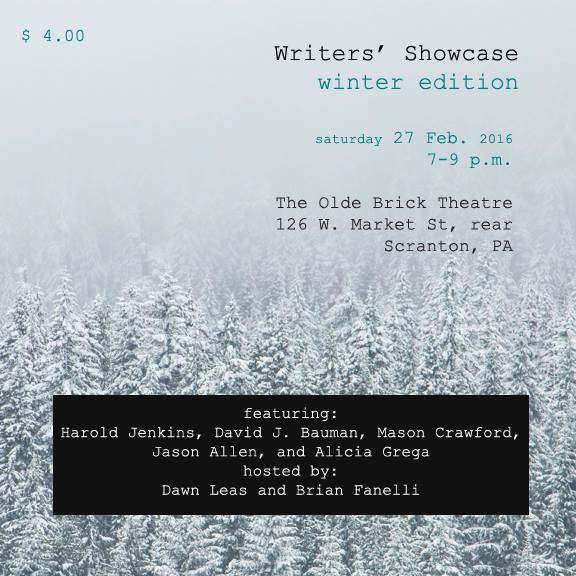
If you’re in the Scranton area this weekend and looking for a literary event, then come to the November installment of The Writer’s Showcase, held at the Old Brick Theatre in North Scranton.  To learn more about our featured authors, check out the bios I have posted below. The event runs from 7-9 p.m.

Author bios:

Ali Pica is a local writer for the arts and entertainment site, NEPA Scene. She also has her own advice column in NEPA Scene, “Yeah, Yeah, Yeah Ali.” Ali also has been a featured reader in venues such as the Vintage Theater and AfA Gallery. Ali has performed with several local jazz musicians in the Northeastern PA and New York City. Currently, Ali is working on a short fiction series and is an Adjunct Professor at Keystone College.

Maggie Gilbertson writes and performs poetry. She’s competed at the Brave New Voices competition and many local slams. She is a junior at Dallas High School, and she loves to read and climb trees.

Joan Hanna has published poetry, creative nonfiction, book reviews and essays in various online and print journals. Her forthcoming chapbook, The Miracle of Mercury, is available for order at Finishing Line Press. Hanna’s first chapbook, Threads, also published by Finishing Line Press, was named a finalist in the 2014 Next Generation Indie Book Awards. She teaches creative writing at Rowan University and is also Assistant Managing Editor for River Teeth: A Journal of Nonfiction Narrative and Assistant Editor, Nonfiction/Poetry for r.kv.r.y. Quarterly Literary Journal. Hanna holds an MFA in Creative Writing from Ashland University. Follow her at her personal blog Writing Through Quicksand. (www.writingthroughquicksand.blogspot.com)

Poet and songwriter Tom Blomain is the author of Gray Area (Nightshade Press) and Blues From Paradise (Foothills Publishing).

The Old Brick Theatre is located at 126 W. Market Street. Admission is $4.

What not to do at your featured poetry reading

I want to share this article, which came across on one of my social media feeds. It offers several tips of what to avoid when you give a featured poetry reading. The first point, about knowing your audience, is most important. Whether you are booking a reading tour for a new release, or just doing one reading a year, it is important to do your research. Know the venue. Know the crowd. What type of style/tone do they like? If they are a rowdy crowd, mostly accustomed to performance more than what’s on the page, then keep that in mind, and vice versa. The more you connect with a crowd, the more they will remember your work and perhaps buy a book.

Some of the points are key, too. Never, EVER go over your time. Be mindful that people have lives, and though they may want to hear you read, even your biggest fan does not want to sit through a three-hour set.

Check out the article for some other useful tips!

New Poem/New Community Dedicated to NEPA Writers

I’m pleased to announce that there is a new website/journal dedicated to creating  community among poets based in northeastern, Pennsylvania. The website, Poets of NEPA, is seeking submissions as a way to showcase local talent.  One of my poems, “Sipping Tea with You in September,” was published today. It is a very autumn-centered poem, and you can read it here.

If you are an NEPA-based poet, then submit your work!

New work over at The Kentucky Review

I’m pleased to say that I have a new poem, “Trying to Call Forth a Ghost,” over at The Kentucky Review, which you can read here. The poem will also appear in print in the annual issue, slated to be published in January. For now, read it online. Many thanks to Robert S. King for accepting the poem and for the wonderful work he does with the magazine.