The Damned Unleashes an Icy Sense of Dread

This review was first published over at Horror Buzz.

The Damned is such a fitting movie for the beginning of January. Inspired by Icelandic folklore and featuring countless snowy backdrops, the film is a frigid slow burn that truly creates a sense of dread. It also addresses the consequences of decisions rendered.

Set in a remote fishing outpost during the 19th Century, the film stars Odessa Young as a widow named Eva. In charge of the outpost, she has to make a decision after a shipwreck close to the crew’s shoreline. She can either allow her fishermen to risk venturing out into the choppy waters to try to save some of the ship’s men, or she can opt to do nothing and preserve what limited supplies the group has during an especially harsh winter. She decides to do nothing.

Eva’s decision haunts the crew for the rest of the runtime. More specifically, director Thordur Palsson’s debut draws on the Norse myth of the Draugur, a creature that’s like a part-ghost, part-zombie. As one character describes it, the Draugur is like a returned person with flesh and blood. It torments every character in the film, causing them to hear voices, turn on each other, and commit horrid acts of violence. The creature is shown a few times and feels omnipresent. I actually think the film would have worked slightly better if the monster was shown a bit less, creating greater ambiguity and mystery.

The Draugur functions as an unshakeable curse that befalls the characters due to their decision not to save the men, lost to the frigid ocean’s depths. Meanwhile, Young gives a memorable performance, especially through the expressive look of her eyes and the way she conveys her character’s breaking point, caused by the curse and the weight of her decision. She’s really at the front and center of this movie and outshines just about all of the men. In fact, too many of the fisherman feel like background characters, without their own storylines.

While this film certainly works as an eerie morality tale, the visuals really make The Damned stand out. Thordur grew up in the Icelandic landscapes, and it really shows. Everything about this movie feels cold. The wind howls. Eva constantly treks through snow. The sea looks inky and menacing. Yet, the visuals stun at times, thanks, in part, to the film’s director of photography, Eli Arenson, who previously worked on Lamb, another visually rich film. The Damned lends itself well to the big screen, and the striking natural landscape becomes a character.

There does come a point where questions about the plot and direction arise. For instance, if the group has such limited supplies, why do they bother building coffins for the drowned? Where are they getting the wood and nails? However, a startling moment in the last act saves the narrative. It makes the rest of the pieces fit, and it’s one heck of a pay-off.

The Damned is an unsettling period piece with awe-striking landscapes and a performance by Young that shines against the bleak and isolated setting. This is a perfect film to watch in winter because it evokes such an icy sense of dread.

The Damned releases in theaters today.
Why John Carpenter’s They Live speaks to our current political landscape

Since the recent U.S. election, I’ve been struggling how to process the result. I don’t know what shape a “resistance” will take this time. I was at the Women’s March in 2017 and organized near- weekly visits to the local offices of our two PA senators to oppose the worst of the initial Trump cabinet picks and policies. As a whole, the groundswell of activism that occurred in 2017 likely stopped the worst of it, but this feels different. The cabinet picks are most definitely worse, and the incoming far-right government trifecta seems more intent on passing sweeping legislation, at least within the first year, before they campaign for the 2026 midterms.

We also have the issue of billionaires like Elon Musk spending unlimited funds to influence an outcome. I don’t know how we deal with that, but I’m turning to writing both as a solace and maybe as a means to offer some paths forward.

In that regard, my first post-election piece is on John Carpenter’s 1988 political satire They Live. There’s a lot of lessons to learn from it, including the power of worker organization. This article was initially published at 1428 Elm this week, and I am reposting it here.

While John Carpenter’s 1988 political satire They Live may have been a response to Ronald Reagan’s America, with direct references to his campaign slogan “morning in America,” the film feels increasingly timely now. Considering the involvement of billionaires in the recent presidential election, with Elon Musk playing an outsized role, Carpenter’s critique of capitalism makes They Live the most relevant of his films for this precarious moment.

Set in LA in the late 1980s, They Live follows a drifter named Nada (Roddy Piper). Within the first 15 minutes, he ends up in a shantytown. Skyscrapers loom in the distance, drawing his gaze and underscoring a setting that shows the divide between the haves and the haves-nots. Initially, Nada isn’t bothered by this.  He’s simply looking for work and believes in the promise of America.

At the shantytown, Nada encounters Frank (Keith David). During their first conversation, their differing views on class become apparent. Frank, like the countless working-class voters from PA, MI, and WI interviewed in 2016 and then again in 2024, laments the loss of well-paying factory jobs. He’s hardened and ready for action, but even more importantly, desperate for a job. He’s ready to tear down the system if he doesn’t find one.

During this first exchange between the men, we learn a lot about Frank and his challenging plight. He tells Nada, “We gave the steel companies a break when they needed it. Know what they gave themselves? Raises,” before reciting one of the film’s most famous lines about the golden rule, “He who has the gold, makes the rules.”

Frank’s justified anger is the most relevant of the two characters. It’s palpable. He, like too many other workers, has been stiffed. Following an election that hinged, at least in part, on economic issues, such as the cost of housing and the skyrocketing cost of everyday goods post-COVID, Frank’s rage feels righteous and warranted. He’s prepared to take a sledgehammer to the whole system.

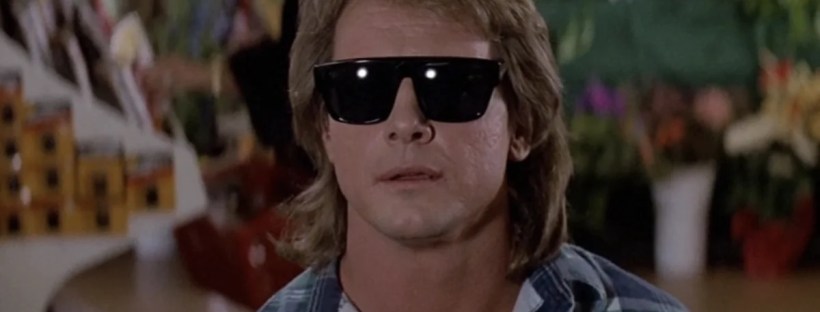
Nada’s response to Frank’s simmering anger feels naïve at best.  He says, “You know, you ought to have a little more patience with life.” With his blue jeans, flannel shirt, and mullet, Nada looks ready to recite a Bruce Springsteen or John Mellencamp song without really listening to the lyrics.

It would likely have been easier for Nada to brush off Frank’s gripes and maintain his simplistic worldview. However, his character evolves the moment riot police and bulldozers utterly obliterate the shantytown. The scene is one of the film’s most harrowing. Nada looks on in shock and horror as this occurs seemingly for no good reason. He evades the police, only to find a pair of sunglasses that allow him to see the world as it truly is. Thus begins Nada’s political and social awakening.

The glasses empower Nada, making him less susceptible to hyper-consumerism and control. When he puts them on, he sees aliens determined to keep people asleep in a fog of consumerism as they overtake Earth. With the glasses on, Nada sees billboards that say Obey, Consume, and other slogans. When he fixes his gaze on money, he encounters the phrase, “This is your god.”

Carpenter’s political critique isn’t exactly subtle, but it’s incredibly effective. When you have Musk paling around with the new president-elect or the barrage of celebrity endorsements secured by VP Kamala Harris, They Live’s over-the-top political satire speaks to the moment. In 2017, speaking out against a bizarre Neo-Nazi claim that the film traffics in stereotypes, Carpenter made clear that’s not the point of the film, tweeting that it is about “yuppies and unrestrained capitalism.”

Besides the blatant critique of consumerism and capitalism, They Live offers a more subtle message, that of worker power and organizing. For at least half the film, Frank and Nada, two men with working-class backgrounds, stand at a divide. Nada initially dismisses Frank’s anger with a dose of foolish optimism. Later in the film, Frank does the same to Nada, though for different reasons.

When Nada encounters Frank much later in the film, he implores him to try on the glasses and see the world as it truly is. However, Frank landed a job in construction. With Nada’s face plastered all over the news, after killing a few of the aliens, he wants nothing to do with him. Frank wants to protect his job. He has no choice.

The men brawl with each other in an alley. The scene is absurd and also plays up Piper’s wrestling background. However, the sequence, silly as it is, highlights the divide between the men, specifically between different members of the working class. As long as they remain divided, those in power maintain and accumulate wealth. This class division is also maintained because the aliens continually promise workers that they can advance up the social and economic ladder if they submit and assist with the takeover.

Eventually, Frank and Nada, along with other members of a pocket resistance, come together to fight the aliens. This underscores the power of organizing, perhaps as the only means to create a more equitable society.