
This fall semester, I’m fortunate to teach my Horror Literature and Film class again. Last week, one of my students asked for book recommendations, something to really scare her. Because I only have 16 weeks, I typically include 3-4 novels in the class. Mind you, we also cover films. I promised the student I’d share with the class a list of my favorite horror novels. Here’s my working list, though I’ll probably add to it.
The Haunting of Hill House by Shirley Jackson
in my opinion, Jackson’s second to last novel, The Haunting of Hill House, is a flawless novel with richly drawn characters, especially the protagonist, Eleanor, and the cultured Theo. Hill House functions as a ghost story, for sure, but it’s also about Eleanor’s increasing isolation and mental health struggles, especially the guilt she feels over her dead mother. This is also a book that I typically keep on the syllabus for my course, no matter other changes I make. Years after its publication, the scene when Eleanor wakes in the middle of the night and cries out, “Whose hand was I holding?” remains just as chilling today.
We Used to Live Here by Marcus Kliewer
Kliewer’s We Used to Live Here began as a serialized novel on Reddit before its recent publication. The story follows a young queer couple, Charlie and Eve, who flip houses. They can’t believe the deal they discover on a house in a beautiful neighborhood. Then, suddenly, a man and his family show up, knock on the door, and ask to look around. Not long after the strange family arrives, eerie occurrences transpire. Charlie suddenly goes missing and Eve questions her sanity. This is a real mind-bender of a book that buildings to a powerful and jolting conclusion. It’s one of my favorite horror novels of the last few years.
A Head Full of Ghosts by Paul Tremblay
it’s hard to pick just one Paul Tremblay novel to include on this list, but I’ll go with A Head Full of Ghosts, a book that’s very aware of exorcism tropes and references them, all while telling its own demonic possession story, or maybe, it’s simply a novel about a family rattled with economic anxiety. The book experiments with narrative and includes blog posts, as well as plenty of references to The Exorcist. After 14-year-old Majorie Barrett starts displaying signs of possession, the book ramps up the scares, but it’s also a heartfelt and emotional story about a troubled family at its breaking point.
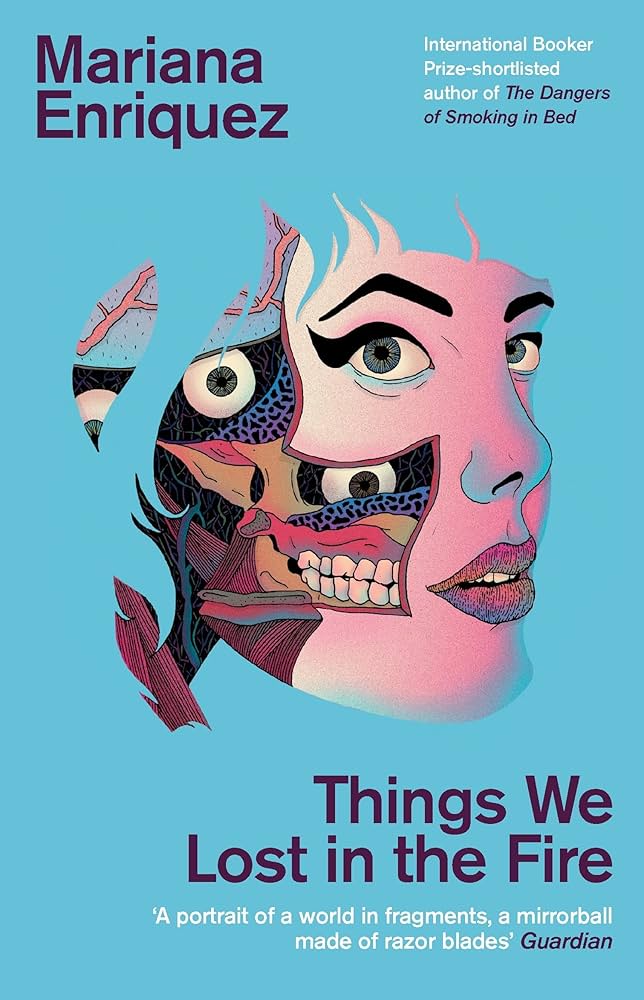
The Dangers of Smoking in Bed and Things We Lost in the Fire by Mariana Enriquez
Argentinian writer Mariana Enriquez has been compared to the likes of Shirley Jackson and Borges, and for good reason. She has quite a body of work, but I recommend starting with her short story collections The Dangers of Smoking in Bed and/or Things We Lost in the Fire. Her stories are strange, surreal, and eerie. Some of them also function well as political allegories. She’s one of my favorite contemporary genre writers and a heck of a powerful voice.
Tender is the Flesh by Agustina Bazterrica
Agustina Bazterrica is another Argentianian writer who is a must read. The less i say about Tender Is the Flesh, the better. Go into this dystopian novel totally blind. Trust me, once you finish it, you won’t be able to shake the haunting and bleak ending. This novel has lots to say about capitalism and exploitation.
Our Wives Under the Sea by Julia Armfield
This British body horror novel is as chilling and moving as any other novel on this list. Armfield’s book follows a lesbian married couple, Miri and Leah, who become distant and unmoored after one of them returns from a deeply disturbing and catastrophic deep-sea dive. The novel takes an even stranger turn when Leah starts coughing up salt water and displaying other odd symptoms. This book combines elements of body horror with Lovecraftian terror. It’s also a heartbreakingly beautiful metaphor about a troubled relationship and two people growing apart.
 Brian Fanelli