I spent the last few days in Boston for the AWP Conference. This was my third time attending; I previously went to the conference in Chicago in 2009 and Denver the following year. By far, this one was larger, and even the bitter winds and steady snowfall of the first two days didn’t keep people away. I heard estimates that ranged from 11,000-15,000 people registered and over 700 venders at the book fair. I questioned why AWP grows larger each year. Is it because of the proliferation of M.F.A. programs across the country? Is it because of the growth of small presses and journals? I would say it’s both. There’s a creative writing boom going on right now, especially with the continuous creation of low-res M.F.A. programs and undergrad B.F.A. programs. I see this even in northeastern, Pennsylvania. The Scranton/Wilkes-Barre area is not at all like Boston or other big cities, and yet there are several writing groups here and multiple reading series. The reading series are often well-attended, jammed even. I see this as only a positive thing.
During the three-day event, I saw several of my favorite contemporary poets, including Major Jackson, Seamus Heaney, Derek Walcott, Kevin Young, Tony Hoagland, Cornelius Eady, Thomas Sayer Ellis, Richard Blanco,Tracy K. Smith, Kevin Young, and others. During the Cave Canem event, Major Jackson read a poem about online dating that made me almost fall out of my chair laughing at certain points. It was a poem a lot different from anything found in his three full-length collection of poems, especially for its humor, but also the point it makes about consumerism, online dating, and making yourself a product for another’s consumption.
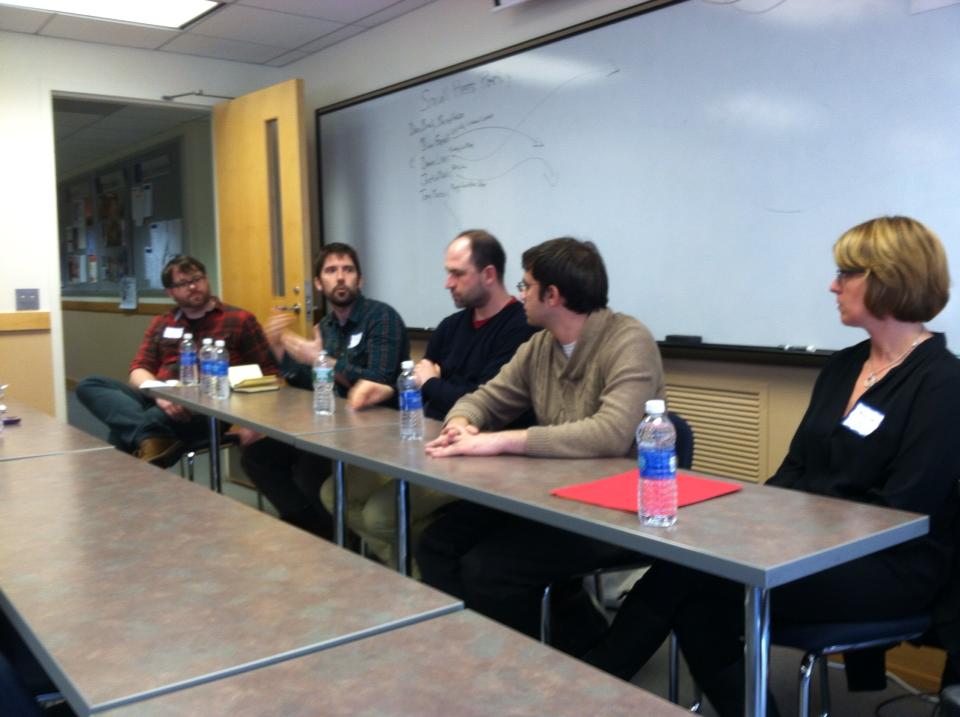
Hoagland was on a panel with Chris Campion and a few others, and he wrote an essay specifically for AWP about a theory he has regarding capitalism overtaking poetry. The thesis of his article is that the proliferation of M.F.A. programs and this increasing notion of a “professional writer” has created unhealthy competitiveness in the arts and writers more concerned with publishing than really creating good poems and building community. He blames this on market capitalism and the notion that one must get a tenure-track position to write and have a career. Furthermore, he said this has led to over-intellectualization in poetry, or rather using big words just for the sake of using big words. Hoagland made plenty of good points, and his fellow panelists had a lot of responses, some defending the M.F.A. programs by stating they can indeed build community and they can teach young writers to focus on craft and reading. However, I found myself mostly agreeing with Hoagland. There are SO many M.F.A. programs out there now and SO many M.F.A. graduates vying for very, very few academic jobs. This has indeed created a cutthroat aspect not at all healthy to community building. Yet, what does one do with an M.F.A.? Most programs stress teaching, but maybe it’s time to have a conversation about career alternatives, such as public relations work, editing, publishing, journalism, or teaching community workshops, as opposed to teaching in a college classroom.
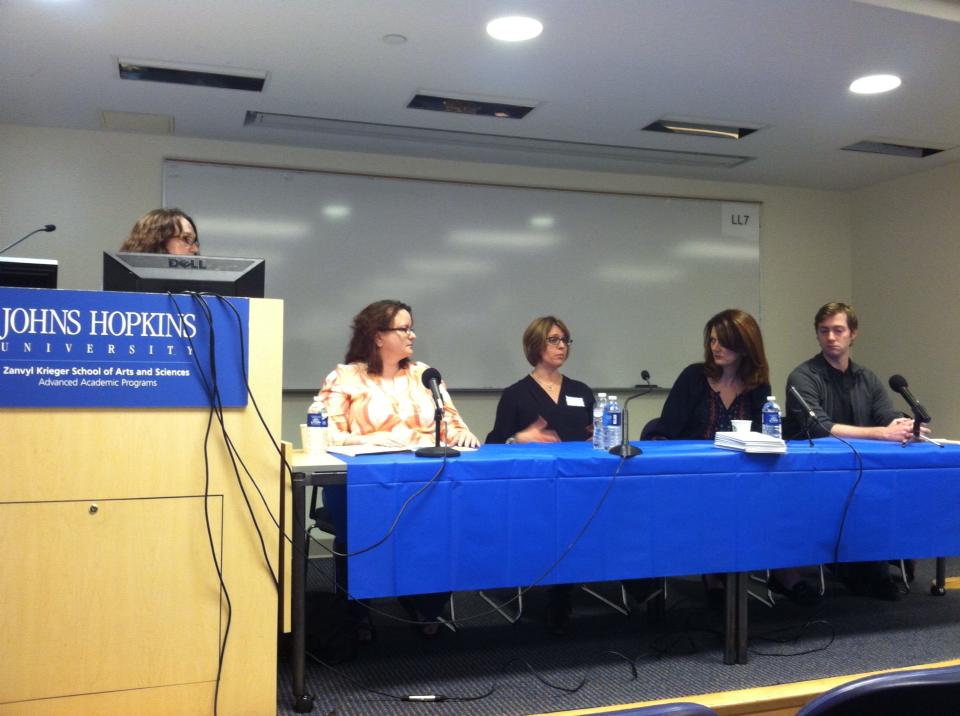
During another panel, I listened to Charles Bernstein defend poetry as a political act when a fellow panelist claimed poetry should not at all be political and instead be about truth and beauty because a political poem makes no difference at all because “nobody reads poetry.” Bernstein said that poetry is inherently political because it often questions what is truth or beauty. He added that even the notion of publishing writing online and through small presses is political because it creates information sharing and makes literature available to more people for free or a low price.
Now that I’m back from the conference, I’m glad to be on spring break. I have a stack of new books to read, poems to revise, and new poems to draft.
 Brian Fanelli