My full article can be read here.
After directors Christopher Nolan and Takashi Yamazaki won Academy Awards in 2024 for their huge movies Oppenheimer and Godzilla Minus One, Takashi had a chance to speak with Nolan when Oppenheimer premiered in Japan. He told Nolan that he’d one day like to make a response to his film. Recently, Takashi told Time, “In my mind, I was thinking I’d develop a film that looks directly at Hiroshima. But then I began thinking, ‘Wait – Godzilla is itself a metaphor for nuclear war. Maybe I can combine the two and make a Godzilla movie that is also an answer to Oppenheimer.”
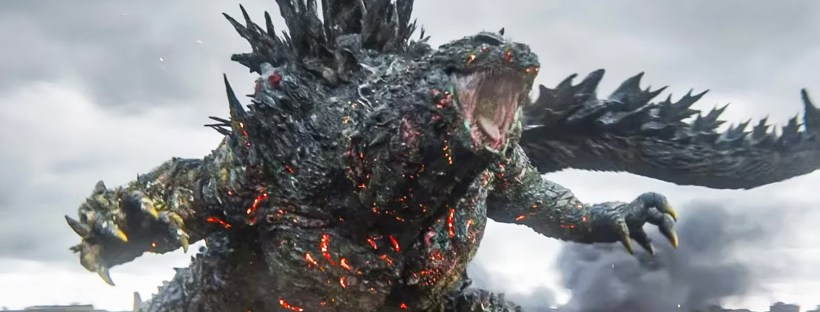
Godzilla Minus Zero is an absolutely terrifying and unflinching look at the human cost of war, four years after the U.S. dropped the bomb on Nagasaki and Hiroshima. Through its visuals and some of its characterization, Yamazaki did indeed make a film that responds to Oppenheimer.
There are major spoilers ahead for Godzilla Minus Zero.
Unlike Oppenheimer, Godzilla Minus Zero focuses on the human cost of war and its traumatic aftermath
Nolan’s Oppenheimer largely deals with some of the ethical issues surrounding the creation of the atom bomb and the political stakes. The film was rightfully criticized for not showing the effects of the bomb on the Japanese people, or really the Japanese perspective more broadly. There are no causalities in Nolan’s version of this monumental historical 1945 event, and the Japanese presence is largely absent.
Godzilla Minus Zero, however, shows the effects in brutal detail. Set in 1949, a mere four years after the bombs fell, the blockbuster opens with one of Godzilla’s arch rivals, King Ghidorah, a winged beast, leveling another Japanese city. This triggers traumatic responses from the core survivors from the last movie, specifically kamikaze pilot Koichi Shikishima (Ryunosuke Kamiki), his wife Noriko Oishi (Minami Hamabe), and their adopted daughter, Akiko (Sae Nagatani). The consequences of Godzilla’s last rampage and the history of Godzilla as a metaphor for nuclear war resonates with the each member of the family unit differently.
Koichi has profound mental wounds from his last mission, in which he helped defeat Godzilla. The last thing he wants to do is get in a plane and this time, fight another monster, King Ghidorah. Noriko pleads with him not to do so, but of course, he feels the pull to join the fight. Meanwhile, the effects of war/Godzilla’s devastation manifest via a mutation Noriko undergoes. Infected with Godzilla’s cells from the aftermath of the last movie, her body starts to mutate and grow scales. She even has a yellow, Godzilla-like eye she keeps hidden behind an eye patch. The metaphor here regarding mutations caused by nuclear war aren’t exactly subtle.
One of the most poignant scenes that illustrates post-war trauma comes when Akiko freezes in the kitchen and screams and wails that something bad is going to happen. She’s still shellshocked from the last kaiju rampage and the fact that her biological parents were killed during the fire bombings and air raids over Tokyo at the end of World War II. While some audience members may find a child crying to be annoying, it’s effective in the context of the film’s darker themes and the fact that these characters’ scars from World War II haven’t healed.
Godzilla Minus Zero introduces a new character to further explore post-war trauma
Godzilla Minus Zero has a few new characters, and one of them is Jun Kunimura’s Dr. Ogata, a scientist who lost his daughter and granddaughter in Hiroshima. In a flashback, he discovers their charred bodies in the dust and the rubble. This movie is filled with bleak landscapes, and this is one of the grimmest set designs. He’s one of the many survivors attempting to find remains of their loved ones during the flashback. A few years later, Dr. Ogata launches a plan to entice Godzilla and King Ghidorah to fight each other, but he has ulterior motives. He envisions unleashing Godzilla upon New York City as payback for the Americans dropping the bomb.
In one of the movie’s most brutal scenes, Ogata has a fantasy of Godzilla knocking over the Statue of Liberty and then unleashing his atomic breath upon Manhattan. The movie then switches to a slow-motion shot of skin peeling off faces. For this sequence alone, the movie earned its R rating. Ogata’s trauma plays out in the form of fantasized revenge.
In Godzilla Minus One, the Americans aren’t the good guys
Though Nolan doesn’t exactly make Americas out to be heroes in Oppenheimer, Godzilla Minus Zero makes them a clear villain alongside the monsters. Early in the movie, the American military gives occupied Japan a massive weapon to drop on Ghidorah. However, the Americans insist the Japanese fly the planes, thus putting their lives in danger. Those who fly the planes are veterans who barely survived World War II and aren’t exactly thrilled to suit up and go on another suicide mission.
Additionally, we later learn that the Americans also have an ulterior motive and want to harness and steal Dr. Ogata’s monster-luring technology to add Godzilla to their nuclear arsenal, as absurd as it may sound. The Americans certainly can’t be trusted, and beyond that, they have the hubris to think they can control a force of nature as massive and powerful as Godzilla.
Here’s a major spoiler: Godzilla ultimately defeats Ghidorah, but the Japanese decide to leave him be. They accept that he’s part of their history, and thus, watch him return to the sea, an ever-present part of the Japan’s national consciousness and post-war scars.
Through its war-ravaged set designs, bloody body count, and exploration of its characters’ emotional and physical wounds, Godzilla Minus Zero responds to Nolan’s Oppenheimer by showing the aftermath of nuclear war and centering the Japanese perspective. In doing so, the film maintains Godzilla’s status as a walking metaphor for post-war trauma and nuclear devastation. Yamazaki does all of this while featuring one hell of a kaiju battle at the climax, too.

