Why last night’s election results matter

Democrats are waking up this morning, one year after Trump’s election, feeling ecstatic. They have reason to celebrate. They swept the governor’s races in New Jersey and Virginia and won a slew of down ballot races across the country. In short, yesterday was a blue wave, one that might be an early indication of how 2018 will go.

The biggest headline is that Democrat Ralph Northam cruised to victory over Republican Ed Gillespie for the VA governor’s race. Over the last few weeks, this race tightened, but current results show that Northam beat Gillespie by about 8 percentage points, more than anyone expected. This race was given so much national attention because over the last month, Gillespie ran a very Trump-like campaign, accusing Northam of being soft on immigration. Gillespie even brought up the NFL/kneeling issue. Last night, Trump tweeted that Gillespie did not embrace him, and Breitbart accused Gillespie of being an establishment Republican. While Gillespie may have been that in the past, the campaign he ran was Trump-like, and it failed. This should make Republicans consider how they run in 2018, especially with the House now in play, based on the wave of GOP incumbent retirements, many in swing districts, and Trump’s toxic poll numbers.

Even more impressive is the number of VA State Assembly seats the Dems flipped last night, the biggest gain in over 100 years for the party. When the dust settles and everything is counted, the Dems very well may have control of the State Assembly, or inch close enough to ensure victory in 2020. Their gains  last night prove that Dems should compete in EVERY race, even in rural pockets of the country. Furthermore, the VA races were so important because it will allow the Dems to undo the gerrymandering in VA after 2020.

In NJ, Democrat Phil Murphy easily won the governor’s race and will succeed Republican Chris Christie. Murphy was always the favorite in this race, but it should be noted that he ran on a rather progressive platform, including raising the minimum wage to $15 an hour and pushing for tighter gun control laws. In addition, his victory gives the Dems full control of the state government.

Here are some other races of note from last night: Maine approved a ballot measure to expand Medicaid under the Affordable Care Act. VA elected its first openly trans state lawmaker yesterday, Danica Roem. She unseated Republican Bob Marshall, who pushed a bathroom bill similar to the one in NC. Transgender activist Andrea Jenkins was elected to the Minneapolis City Council, becoming the first openly trans African American woman elected to the city council of a major U.S. city. Democrat Justin Fairfax was elected VA’s next Lt. Gov, and he is only the second African American to win statewide office in VA. NJ elected Shelia Oliver as its first African American Lt. Gov. Democrat Vi Lyes was elected as Charlotte, NC’s first African American mayor. I could go on and on, but this is a brief snapshot of last night. This very much looks like a rebuke of Trump’s white nationalism.

In my state of PA, there was good news for Dems, too. Democratic Supreme Court Justice Debra Todd was retained, meaning Dems will keep the majority on the state Supreme Court, and she will become the first female PA Supreme Court Chief Justice in a few centuries, yes centuries. Philly elected an uber progressive DA in Larry Krasner.  Last but not least, in my county, Lackawanna County, voters elected the first Democratic DA since the Nixon administration. While Dems have always swept the county row offices here, they’ve always failed to win the DA race. Mark Powell’s election changed that.

As a political junkie, I’m now paying careful attention to the Senate race in Alabama, Jeff Sessions’ former seat. Weeks ago, I didn’t think it would be possible that a Democrat could win that deep-red seat, but recent polling has Democrat Doug Jones pulling even with far-right candidate Roy Moore. The DNC should invest money into that race, as they did with the VA governor’s race. They should also compete in the TX and AZ Senate races next year because what was once out of reach is no longer out of reach. Last night proved that, especially in the VA State Assembly.

I’m also paying close attention to 2020 and Terry McAuliffe. He has reason to be ecstatic that Northam, his Lt. Gov., won the race to succeed him in VA. It will only raise his national profile, and it is likely that he was already considering running for the president in the Dem primary. He will probably make a case that as governor, he worked to protect gay rights and expand voting rights. That will play well with the base. He is also from a state that Dems need to win in 2020.

Heading into 2018, the Democratic Party needs to formulate a concise message, especially for some of the bigger Senate races. They can’t just be anti-Trump. They still need to counter Trump’s faux-populism with a clearer economic message. They have time to do so. That said,  Paul Ryan should be especially worried. While the Democrats path to the Senate majority is much harder, the House is now within reach, especially as more and more Republicans in swing districts announce that they’re not seeking re-election. Last night was a blue wave. Next year could be a blue tsunami.


About The Thing/Body Horror

I’ve had John Carpenter on my mind a lot lately, maybe because he’s returning to the Halloween universe he created nearly 30 year ago to produce another Halloween film that will star Jamie Lee Curtis and ignore all of the sequels that followed the original film.  It will be just Jamie and Michael, reunited at last, no bizarre stories about Michael Myers’ bloodline, or his cult, or those awful Rob Zombie remakes that tried to give a backstory that we didn’t need.

Michael Myers is so effective in that first film because he literally could be anyone, and Haddonfield could be any tree-lined suburbia. There is one brief scene in the original film where Michael takes off his mask, after Laurie Strode (Jamie Lee) stabs him with a clothes hanger. When he unmasks, he looks rather…normal.  The boogeyman isn’t some supernatural entity, and the only thing thing that’s uncanny about him is the fact he gets up after Laurie Strode thinks she’s defeated him, and he gets up a second time after Dr. Loomis (Donald Pleasence) shoots him off a balcony.

As much as I love Halloween and will always have a soft spot for Laurie Strode and Michael Myers, I’ve been more intrigued lately by Carpenter’s 1982 film The Thing. On a few levels, I find it to be a more interesting film. It has stunning, guttural visual effects that still hold up, for one, but lately, I’ve been more intrigued by the idea of body horror. Few films represent that better than The Thing and the idea that the monster could be inside everyone and will spread from person to person, host to host. On a deeper level, the film was a perfect metaphor for the AIDs epidemic in the 1980s,  and today, in a very divided America, the sweeping paranoia/don’t trust thy neighbor arc  feel even more relevant.  For anyone that ever felt different, off, or an outsider, The Thing is the perfect body horror film. Anyone that appears slightly unusual is tied to the chair, blood tested, and blowtorched if the monster is inside of them.

A few years ago, there was  remake of The Thing that I didn’t bother to see. For me, Carpenter’s remake of the 1950s The Thing from Outerspace holds up too well, especially the non-CGI effects, the pulsating soundtrack, and the acting. If the new Halloween is indeed going to  follow the original film and no sequels, then there is more story to tell. I don’t think that is true about The Thing, despite its ambiguous ending.

In a tribute to the film, here is a poem I wrote about the body horror idea that  Rockvale Review recently published. I also have an essay coming out about the film in 2018 in the anthology My Body, My Words (Big Table Publishing). Not all of Carpenter’s films have aged well, but The Thing certainly has.

In the spirit of Halloween

If you want to get yourself in the Halloween spirit, then check out these three poems that I have in the new issue of The Horror Zine. These will also appear in the print edition at the end of this year. The issue is also packed with horror fiction and interviews with other writers about the genre. Check it out!

Here is one of my favorite autumn/Halloween poems, “All Hallow’s Eve” by Louise Glück. Enjoy, and Happy Halloween!

What Happens after All Out War? Some Thoughts on TWD


This post is going to contain some spoilers about The Walking Dead, so if you’re reading the comic and not yet past the All Out War story arc, or if you haven’t seen last night’s season 8 premiere, then you may want to read this later.

I have to confess that for the first time since TWD has aired, I was not excited about the season premiere. For the last few seasons, the show has moved at a sluggish pace, perhaps because they don’t want to outpace the comics. Only one book is released per month, and after one more major story arc, the show will be caught up to the comic.  Last year’s season premiere was memorable, for better or worse, after Negan (Jeffrey Dean Morgan) bashed Glenn (Steven Yeun) and Abraham’s (Michael Cudlitz) face with his beloved barbed wire baseball bat Lucille. This happened to Glenn in issue 100 of the comic, and it was far more brutal on TV, to the point where it drew a fair amount of criticism. This is a show where zombies devour people, but the prolonged head bashing did seem gratuitous and even senseless.

My waning interest in the show, though, started before the infamous Negan/Lucille scene. Episodes prior to that, the script writers decided to make everyone think that Glenn was dead, devoured by zombies after getting trapped near a dumpster, only to bring him back a few episodes later and have him brutally killed. The season 6 finale teased who would be killed by Lucille, and it wasn’t revealed until the season 7 premiere, which, like Glenn’s fake death, felt cheap and gimmicky, a plot device whose only purpose was to maintain viewers.

Last night’s season 8 premiere, the start of the All Out War arc in the comic, when communities of survivors fight against Negan and the Saviors, felt dull, uninspired, and painfully slow. Sure, there were some cool shots of Daryl (Norman Reedus) riding a motorcycle and blowing stuff up to attract a massive horde of zombies to the Sanctuary, the Saviors hideout. However, about half of the episode included Daryl and friends trying to lure the horde to the Sanctuary. The rest of the episode included speechifying. The best scene included a verbal face-off between Rick (Andrew Lincoln) and Negan, before Rick starts firing at the Saviors. Nothing else happened in the entire episode, though, and it seems clear that the All Out War arc, which should be exciting on the small screen, will drag on for several episodes, thus worsening the show’s pacing problem.

The comic also faces a problem. It has recycled the same storyline time and time again. Rick and company find a community, only to be confronted by a group of humans worse than the zombies, the community falls, and then they eventually find a new community, only to encounter another villain again. This story has reoccurred since the prison arc. I had hoped that Robert Kirkman would break this after the All Out War art concluded, but soon after the dust settles on that arc, the group meets Alpha, Beta, and the Whisperers, engaging in yet another war.

Robert Kirkman recently teased that no one is safe and Rick could die at any time. The season 8 premiere hinted that. On the one hand, the show flashed forward to Old Man Rick, post-All Out War, similar to the time jump that happens in the comic. He was happy, surrounded by his children and Michonne (Dania Gurira). In other scenes, which seemed like a much nearer  future, he was shaky, sweaty, and red-eyed, probably infected by the virus. That possibility is far more interesting and maybe where the show or comic are going. If Rick does indeed die, then it would allow greater character development from the fairly major cast that still occupies both show and comic.

Either way, the season 8 premiere provided a different possibility than the comic: the good guys could lose, and the Old Man Rick storyline is not guaranteed.

This would be a huge departure from the comic and maybe the type of shake-up the show needs to partially reinvent itself and allow stronger character development. The comic has been dancing with the Negan/Rick storylines for so long now, but maybe the show is willing to do something different. We’ll have to see…


Horror Movie Recommendations (Netflix Streaming)

Since October is already halfway over, I wanted to share my recommendations for horror movies streaming on Netflix. It took me a while to put this list together, but I feel confident that these are my favorites.

It Follows (2015) This is one of my favorite horror films of the last few years. One the one hand, this movie is a major tribute to 1970s horror flicks like David Cronenberg’s Shivers, especially visually, but the story rewrites the classic trope of teenage sexuality/fear of teenage sexuality and creates a truly terrifying monster that passes on from person to person through sex. It also employs the most haunting use of T.S. Eliot’s “The Love Song of J. Alfred Prufrock” that I’ve ever seen on screen. It must be said that A24 Studios is currently producing some of the most arresting American horror films. Pay attention to what they do.

Hush (2016) Directed by Mike Flannigan, this film does something unique with the home invasion and slasher tropes. The film centers around Maddie (Kate Siegel), a deaf mute who has to protect herself against a masked home invader. The use of sound in this film is especially nail-biting.

Raw (2016). This French film, directed by Julia Ducournau, is my favorite horror film of last year. It has a lot working for it: well-developed characters, strong visuals, unnerving scenes, and oh, cannibalism.

Creep (2014) This low-budget horror flick, directed by Patrick Brice, only features two characters: Josef (Mark Duplass) and Aaron (Patrick Brice). The film is haunting for the ways that it explores loneliness, social interaction, and what can happen when we respond to a Craigs List posting.

The Babadook (2014) What can I say that hasn’t already been said about this film? Memorable horror literature and films stand as allegories for our deepest anxieties, and I can think of few films in recent memory that explore the anxieties of child-rearing and motherhood as well as The Babadook.

Honeymoon (2014). I LOVE this film! The first time I watched this, it left me unsettled for days, and because I consume so many horror films, it is VERY rare that a film does that to me. This is another low-budget indie film, one that centers around a newly married couple who slowly learn that there is a lot they don’t know about each other. This film has prefect pacing, chilling scenes, well-written dialogue, and engaging characters. Check it out.

Hellraiser (1987) I had to include one classic on the list, and unfortunately, Netflix doesn’t have a lot of classic horror stock. This is the best Hellraiser film. Based on Clive Barker’s novella, The Hellbound Heart, this is the only Hellraiser film that he wrote and directed, and it maintains his exploration of sex, violence, pain, and pleasure that can be found in the novella. Pinhead and his merry crew of Cenobites are only in this for about the last 20 minutes, but the payoff is worth it. The humans are far more monstrous in this film, anyways.

Corporate power, crisis identity, and environmental devestation in Blade Runner 2049

Releasing a sequel 35 years after the original is a risky move, especially a sequel to a film with the cult following that Blade Runner has, and yet, Blade Runner 2049, directed by Denis Villenueve, not only matches some of the stunning visuals of the original film, but it also expands upon some of the philosophical questions of the original, especially what it means to be human in the age of the smart phone. It also warns about the effects of corporate dominance.

The sequel follows the story of  LAPD Officer K (Ryan Gosling), a blade runner who unearths a secret that can thrust what little remains of society into chaos.  The original film was gritty in setting and depicted the 1 percent living in towers, while replicants (AI, human-like beings) and actual humans fought for scraps on the streets of Chinatown. The gray reality of the working-class was juxtaposed with stylish advertisements for Coca-Cola and other products. The new film depicts an even more fractured society in which corporate power rules all and feeds off of division and wall-building. Sound familiar? Throughout most of the film, there is constant heavy rain, contrasted by even more big screen advertisements. The other cities depicted are either dry and barren, think of California after being engulfed by wildfires, or radiation-heavy, perhaps from a nuclear war. While the initial film showed how trickle down economics could lead to corporate overrule, the new film shows the consequences of oligarchy. The cities are barely habitable. Food is genetically modified. One of the main villains, Niander Wallace (Jared Leto), is a heartless corporate master who wants to breed a race of slaves/replicants, no matter the costs, including the loss of human and non-human lives. For him, the only purpose of life, artificial or otherwise, is to serve corporate interests.

The original film raised questions about what it means to be human, especially through the relationship of blade runner Rick Deckard (Harrison Ford) and replicant Rachael (Sean Young). Deckard could at least touch and make love to Rachael, even if she was technically non-human. K’s girlfriend, Joi (Ana de Armas) is a projection, a hologram that dies when a smart phone-like device that contains her is stomped on by one of the film’s villains. All of the memories are stored on that device, much like pictures on our IPhones, so when it’s smashed, so is K’s fantasy of a meaningful relationship. This particular aspect of the story reminded me of Spike Jonze’s 2013 film Her, which also warned of a not-too-distant future in which humans fall in love with a technological projection, rather than seek out authentic human connection and physical touch. Joi is not that different from Samantha (Scarlett Johansson) in Her, in that both characters are not real. They are mere projections of the sexualized and idealized female. They can be whatever the male protagonist wants them to be. The difference between the characters, however, is that Samantha shows agency in Her and ends up dating thousands of other apps and AI. She eventually does what she wants.

The initial Blade Runner warned about the impact of trickle-down economics, consumerism, and the rapid advances of technology, especially AI. The new film is even bleaker in the world it depicts. The only hope that K clings to is  merely a hologram projection to cure his loneliness, some façade of normalcy and a world long gone. Right now, I’m hard pressed to find a film that better represents 2017. This powerful sequel also reminds us what it means to be human and the power of real, lived experience and connection, which stands in stark contrast and opposition to the world that corporate masters like Niander Wallace want to create and rule over.


A Few Thoughts After Gettysburg

Being a PA resident, I’ve been to Gettysburg three or four times, including on a few school trips as a boy.  This weekend, I drove two and a half hours to return to the city for a poetry reading at the Ragged Edge Cafe. I’ve traveled all around the northeast, U.S. for various poetry readings, but this trip felt especially meaningful in the context of our current moment in history.

Gettysburg is a town that makes so much of its money recounting and re-enacting those three days in July of 1863, from the ghost tours and battlefield tours, to the countless gift shops  selling everything from pocket-sized copies of the Gettysburg address to toy cannons. There was something especially noticeable to me upon this visit regarding the shops on Baltimore Street. They had more Confederate memorabilia than anything else, including shirts with large Confederate flag images that read, “If at first you don’t secede, try again,” and “Heritage Not Hate.” This was especially striking to me, considering the thousands of men that died in Gettysburg and the fact that the battle was a turning point for the Union. I don’t know enough about the politics of Adams County, PA to say if the town swings conservative or liberal, but I assume the merch is selling, or, otherwise, the shop owners would not stock it. There were moments walking those cobblestone streets when it felt like the South actually won the war and was not driven out after three bloody days. Perhaps, though, the national debates about the Confederate flag have merely spread to Gettysburg, but the Confederate memorabilia did seem more visible since I was last there in 2013 for another reading.

The countless ghost tours are nothing new, and one historian who attended the poetry reading commented to me, “There were no ghosts in Gettysburg until 1985,” citing the proliferation of  interest in the paranormal. She admitted that she doesn’t disbelieve in ghosts, but she does have a problem with the monetary aspect of the paranormal tours. I have to confess that the last two times I was in Gettysburg, I went on ghost tours. This time, however, my girlfriend and I researched tours and found one that was praised by historians for being accurate and not relying on gimmicks and cheap tricks. Our tour guide used the idea of being “haunted” to frame the tour and confessed to us that he was an ex-NY firefighter who witnessed 9/11. He recounted the stench of rotting flesh and compared it to the millions of pounds of flesh that rotted on the Gettysburg battlefields. 9/11 is what haunted him, just as civilians who witnessed the battle would always be haunted by it. He told us stories of real people killed in war and showed us the famous bullet-marked brick facade of the Dobbins Inn. People on our tour drifted towards the building to touch it, closing their eyes and breathing deep while doing so, as if they could inhale the gunpowder. He then showed us one of the only still living trees on Baltimore Street that was there during Lincoln’s procession to dedicate the National Cemetary and give the Gettysburg’s Address.

My trip to Gettysburg this time was more profound and certainly more haunting. The town’s history is impossible to escape. It stares at you on every corner and in every gift shop. To quote Faulkner, “The past is never dead. It’s not even past.” This country’s long-standing ghosts are still haunting us and very much still shaping our politics.


In Praise of October

Happy October! So begins the 31 days of my favorite month. I like to make an argument that October is one of the best months of the year, at least if you live in the tri-state area in the U.S. The temperature has yet to sink low enough to crank on the heat. There is a crispness, sure, especially in the mornings, but you can still have sunny 70-degree days. Summer flowers still have a little life left in them, at least for the first half of the month. Wilted summer flowers are then replaced by mums, which are just as gorgeous and can withstand the first few frosts, sometimes surviving until Thanksgiving. Then, of course, there is the brilliant foliage, which is at its peak this month. Lastly, it is the one time of year when people don’t mind indulging my love of horror movies, and increasingly, I see posts on social media for horror movie recommendations.

Soon, I am going to make a list: my top horror movie recommendations on Netflix and Amazon Prime (which has far more options). I’ll try to include some indies mixed with canon.

For now, here is a poem in celebration of autumn, “An Autumn Prayer.” Thanks to The West Texas Literary Review for publishing this.

Upcoming Literary Events

To anyone local who reads this blog, here are some announcements about upcoming literary events.

Friday, Sept. 29 at 7 p.m.

Open Mic Night for Writers

Cafe Sevda, Scranton

FREE, though it is encouraged you purchase a drink or snack.

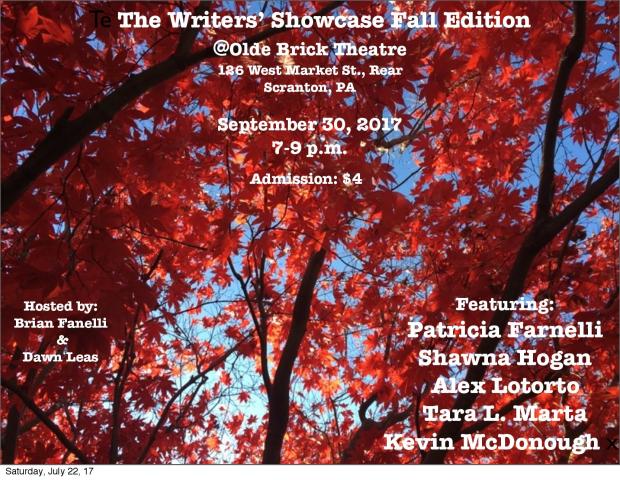
Saturday, Sept. 30, 7-9 p.m.

Writers Showcase Fall Edition

Olde Brick Theatre, Scranton

Featuring: Pat Farnelli, Tara L. Marta, Shawna Hogan, Alex Lotorto, and Kevin McDonough

$4 at the door

Writers  Showcase September  2017-page-001.jpg


Mother, Mother, Mother

I assume that I’m not the only one whose social media feeds included conversation, anger, praise, or all out confusion about the latest Darren Aronofsky film, Mother! The film first generated buzz when reports surfaced that it was booed at the Cannes Film Festival weeks ago. After seeing it over the weekend, my reactions to it are still mixed.

First, let me state that there are aspects of the film I liked a lot, including its dream-like quality that reminded me of much of Aronofsky’s work, especially Black Swan, but more so, I really enjoyed the use of the classic Gothic tropes, specially the setting, a run-down house in which every floor board creaks and light bulbs fill with blood (Amityville Horror, anyone?). I also related to Jennifer Lawrence’s nameless character, a woman who painstakingly tries to make her husband (Javier Bardem) love her, including painting and renovating his former home, which burned down years ago. The house is a nice representation of the strain in their relationship and the female protagonist’s ultimate descent into madness (again, another classic Gothic/horror trope).

Generally, I think, audience members will probably root for Lawrence’s character to resist her domineering partner, especially as he invites more and more people over, against her wishes, beginning with a nameless couple played by Michelle Pfeiffer and Ed Harris.

Harris and Pfeiffer’s acting is solid, but some of the dialogue is just too heavy handed, especially when Pfeiffer’s character asks Lawrence’s character why she doesn’t want kids.  At times, I felt like I was hit over the head through the not-so-subtle symbolism and dialogue. Leaving the theater, I thought of films that handle some of the same topics better, namely Repulsion, Rosemary’s Baby, and, more recently, The Witch. The exploration of male dominance and feminist resistance are a centerpiece of those films, but more artfully explored.

The film can also be viewed as an allegory about the creative process. Without spoiling too much of the film, especially the ending, I will merely state that Lawrence and Bardem’s characters each create something. The film is an exploration of what people endure, especially a couple, during the creative process.

What irked me most about the film, however, is the fact that Lawrence, generally someone who plays a tough, inspiring female lead (Think Silver Linings Playbook or The Hunger Games), isn’t given enough moments of resistance in the film. It does come, but it is too short-lived. It is not even clear why she fawns over her partner so much. His character is not given much story. All we really know is that he’s a writer whose house burned down.

Mother! is a polarizing film,  but, at the very least, the film is generating a lot of discussion and debate. Give it a viewing and see what you think.