About 10 years ago, Boston Literary Magazine was one of the first magazines to publish any of my work. Prior to the acceptance, I had a few rejections but remained persistent and kept writing and revising, spurred on by editor Robin Stratton’s encouragement. Over the last few years, the magazine was on hiatus, but recently, it returned with a lengthy comeback issue. I’m deeply appreciative that my poem “The First Time I Watched a Friday the 13th” was included. I’ll forever be grateful to BLM for taking a chance on my work years ago, and I’m thrilled to have a new piece in the comeback issue. You can read it here or read it below.
The First Time I Watched a Friday the 13th
My mom kept watch on the sunflower recliner,
her brown eyes peering over pages of a paperback,
while I leaned towards the TV, inserted a VHS—
Friday the 13th Pt. 4.
I ran my hands over the sleeve—
the black holes of Jason’s hockey mask,
the silver knife that gleamed like moonlight
over Camp Crystal Lake.
I clapped at the first appearance of hulking Jason
power walking through the woods, stalking
first victims, camp counselors that guzzled beers,
traded joints back and forth like secret notes.
My mother said nothing about first kills—
a machete to the head, an arrow between the eyes,
the gasps of victims before the camera pulled away
and Jason dragged their bodies to the woods.
It wasn’t until two counselors disrobed,
reached for the buttons of each other’s shorts
that mom rose from her chair, stormed towards the TV,
seized the tape, clicked her tongue in disgust.
For months I searched for the VHS, like goods
thieved from me I wanted to reclaim. I never finished
that scene, the kill that always follows sex in slasher flicks.
My mother, too,was a moral judge,
wanting to shield my eyes from the female form,
from the mysteries of sex a 10-year-old wanted to ask.
Typically, January is the month when a lot of big studios dump projects into theaters and don’t expect a big return. In other words, it’s the doldrums. For the last few years, the deep sea creature feature Underwater has languished on the shelf, but finally, 20th Century Fox, which recently merged with Disney, has released the film. Director William Eubank’s aquatic horror movie is generally flat on character development, but it does have some high tension scares that make it a fun popcorn flick if you’re looking for a way to pass a cold January day.
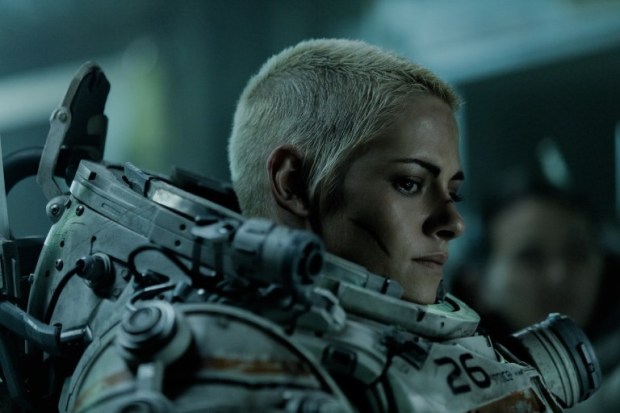
Kristen Stewart as Norah/Photo Courtesy of 20th Century Fox
The film stars Kristen Stewart as Norah, who is part of an aquatic research crew who must get to safety after an earthquake devastates their subterranean laboratory. Throughout the film, a short, blonde-haired Stewart channels Sigourney Weaver’s Ripley in the Alien franchise, including adapting some of her high-action type sequences and masculine characteristics, to the point that one crew member calls her flat-chested. In fact, Stewart is the only semi-memorable character in the film, probably because she’s given the most screen time. Her crew members have little to no character development, and when they’re offed by slimy, prickly deep sea monsters, it’s hard to care about their demise. None of them have much to do, and even Norah is given no backstory. At the beginning of the film, she comments how time becomes meaningless when submerged nearly seven miles undersea, but at no point is it clear how long the crew have been underwater or what their lives were like prior. One of them comments about a dog, but that’s about it.
That said, the film does have a few high-tension moments, including the earthquake and the crew’s struggle for oxygen at various points. Underwater’s other positive factor is the monsters, especially the massive, Cthulu-like creature who is surrounded by deep sea blackness and is generally terrifying. The other monsters are much smaller, but still squirmy, slimy, and creepy. They slap upon the windows of various labs and thump upon the ceilings. One resembles the face sucker in Alien.
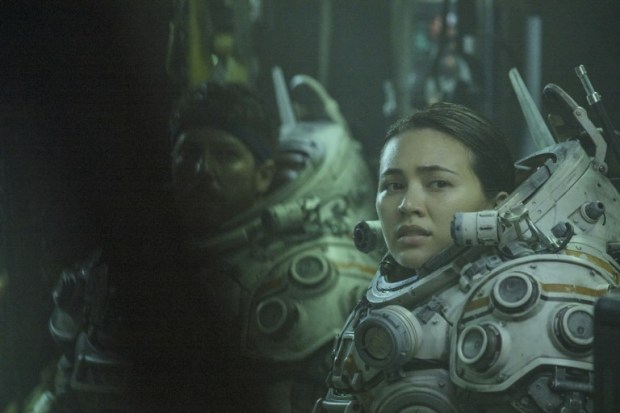
Photo Courtesy of 20th Century Fox
Underwater is a film that wears its influences on its sleeves, from the Alien-like shots of the laboratory’s long hallways to the Lovecraftian monsters that feel ancient and show just how indifferent the deep sea is towards human life. In one bit of cliched dialogue, a crew member comments that humans have mined the ocean and taken more than they needed, so now it’s the ocean’s turn to take back. Believe it or not, that’s one of the only memorable lines of dialogue throughout the film, as corny as it is.
After spending an hour and a half with the crew in dark, deep waters, it’s hard not to leave the theater feeling a general sense of dread, which is similar to the feeling a reader has at the end of a Lovecraft story. The depths of the ocean are an unforgiving place, best left unexplored. The monsters don’t care who they kill, since the crew is essentially impinging upon their territory. The crew stares into the abyss, and the abyss bites back.
As the year progresses, it’s most likely that Underwater will be forgotten. It’s difficult to even recall the names of the crew members. The monsters are the real stars of this film, and they’re the only aspect that make it worth watching. Final verdict: if you’re looking for something to do to pass a cold January day, then purchase a matinee ticket; otherwise, wait for this to arrive on VOD.
How do you make Bram Stoker’s 19th Century Dracula relevant for the 21st Century? How do you tell a vampire story post-Twilight and make the classic monster threatening? The three-part BBC/Netflix adaptation tries to do both with mixed results. Its first episode is reminiscent of early Dracula Hammer films, while drawing fairly heavily from the source material. The second two episodes take bold risks with Stoker’s novel, while trying to maintain the general story-line and characterization. At certain points, the series succeeds in making the vampire relevant in 2020, while at other times, namely in the third episode, there are too many poorly executed leaps.
In terms of the building slow dread and genuine scares, the first episode is the most effective, and it generally follows the beginning of the novel when lawyer Jonathan Harker (John Heffernan) treks to the Count’s Gothic estate to complete a real estate transaction, only to fall prey to the monster, while his fiance Mina (Morfydd Clark) frets over his whereabouts. The challenge of adapting Stoker’s novel is the epistolary form. To handle this, show creators Mark Gatiss and Steven Mofatt still give Harker’s account of his time under the Count’s spell, but they do so by having nuns/vampire hunters (yes, you read that correctly) interview him. Oddly enough, it works. We’re introduced to a pale, badly scarred Harker, and in one of the most effective scares, a fly crawls along and under his eyeball. The presence and stench of death is a reoccurring motif in the novel, and the first episode uses the constant image of flies to reinforce this. It is unnerving and haunting, underscoring the power that the monster still has over Harker. His wounds are both physical and mental.
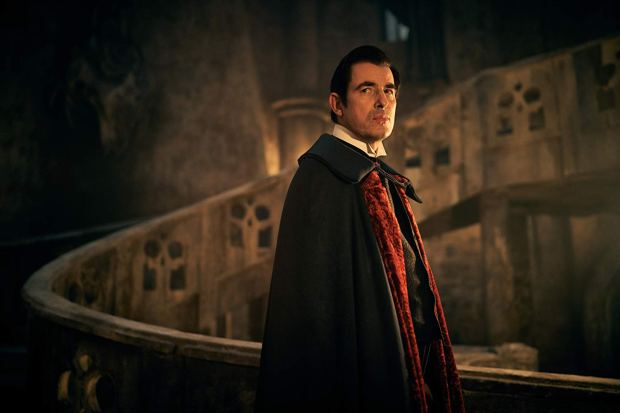
(Photo Courtesy of the BBC)
Claes Bang is generally a captivating Dracula as his power grows over the young Harker. He is suave and handsome once he feeds. His hair darkens. His wrinkles disappear, but the fact his first appearance depicts him as a scraggly-haired, sharp-toothed fiend compounds the point Stoker emphasizes in the novel that no matter how alluring, Count Dracula is a monster who only unleashes death. Throughout the rest of the series, however, Dracula resembles a caped Christopher Lee and Bela Lugosi more than he does Max Schreck/Noseratu. Additionally, the influence of the Lee-era Hammer Films is apparent in the first episode, with several close-up shots of the castle and fog rolling beneath looming spires. The episode leans heavily into the Gothic elements and creates a mesmerizing atmosphere.
Sister Agatha Van Helsing (Dolly Wells) also elevates the first episode, specifically when she encounters the Count for the first time and taunts him, calling him nothing but a beast who driven by sheer hunger at the sight of blood. Some may gripe that Van Helsing was changed to a woman for this series, but in the first episode, she gives one of the strongest performances. Her intellect and confidence match Dracula’s.
The second episode takes place on the Demeter, a ship set for the New World/England, as the Count stalks victim after victim and hides the bodies. The gore here is as effective as the use of flies in episode one, but after spending an hour and a half on a ship, you just want the Count to reach London already. Additionally, too many of the characters in the second chapter are too hollow and serve as little more than vampire bait. The third episode is the shakiest in the series and has drawn the most complaints from viewers. There are great leaps in the narrative and major characters from the novel, namely Lucy (Lydia West) and Renfield (Gattis), who feel shoehorned into the final chapter. The most brazen move entails setting Dracula in the present day. How he ended up in the present is absurd and laughable from a narrative standpoint and comes across as lazy writing. There are plot points regarding the Van Helsing family that also don’t quite stick. Yet, I couldn’t stop laughing (in a good way) each time Dracula checked email and Skyped.
Overall, the series is uneven. Its first episode is the strongest. Its visuals, story line, and acting all cohere to create an engaging first chapter that stays true to the source material while making changes that make sense for the TV format. The third episode is by far the riskiest and has drawn the most ire from fans. Too many major characters from the novel are stuffed into the conclusion and not given enough time to breathe. All of that said, at least the vampire doesn’t sparkle. On the one hand, he’s attractive and intellectual, and on the other hand, when his mouth is covered with blood, or when he visits Jonathan’s dreams as an aged demonic figure, he’s quite terrifying. Final verdict: watch the series with an open mind and enjoy it for what it is.
With 2019 officially in the rear-view (check out my best-of list), it’s time to start focusing on the new year. Below, I’ve included a list of some horror films I’m looking forward to, and as you can see, the trend of remakes and “smart horror” that dominated the first two decades of the 2000s doesn’t appear to be slowing down as we start the 2020s.
1. The Grudge January 3/Directed by Nicolas Pesce
I’ve made it known before that I’m not a big fan of remakes, and there’s been an onslaught of them over the last 10-15 years. I’m including this one on this list, however, because Pesce’s other movies, Piercing and The Eyes of My Mother are interesting, so I’m cautiously optimistic about this.
2. Underwater January 10/Directed by William Eubank
I don’t know much about this one, other than the fact that it’s a deep-sea horror flick about a research crew who struggles to get to safety after an earthquake destroys their underwater station. Something monstrous lurks on the ocean floor. I’m intrigued.
3. Color Out of Space January 24/Directed by Richard Stanley
This is an adaptation of one of H.P. Lovecraft’s most popular stories, and it stars Nicolas Cage, fresh off his performance in Mandy. Need I say more about this one?
4. Gretel & Hansel January 31/Directed by Oz Perkins
I have to confess that when I first saw the trailer for this, I wasn’t that interested. However, when I learned that Oz Perkins was behind the camera on this one, my interest was peaked. If I made a list of my favorite horror films of the last decade, Perkins’ The Blackcoat’s Daughter would be on it. Now, I’m curious as to what he’ll do with this classic tale.
5. The Lodge February 7/Directed by Veronika Franz and Severin Fiala
This is one of the film’s I’m most excited to see, especially after it generated buzz on the festival circuit and earned the cover of the most recent issue of Rue Morgue. It also seems like the perfect mid-winter horror film, based on the synopsis: during a family retreat to a remote winter cabin over the holidays, the father is forced to abruptly depart for work, leaving his two children in the care of his new girlfriend, Grace. Isolated and alone, a blizzard traps them inside the lodge as terrifying events summon specters from Grace’s dark past.
6. The Invisible Man February 28/Directed by Leigh Whannell
This is Universal’s attempt to yet again reboot/revamp their classic monsters. Based on the trailer, however, this looks like an interesting take on the classic H.G. Wells’ story, one that focuses on abuse and trauma. It appears that Elisabeth Moss may give one barn-burning performance in this.
7. A Quiet Place II March 20/ Directed by John Krasinski
A Quiet Place was one of the biggest surprises of 2018 and a box office hit, so, of course there had to be a sequel. Based on the trailer, which dropped on New Years Day, it looks like the second chapter expands upon the world established in the first film.
8. Antlers April 17/Directed by Scott Cooper
I don’t know much about this one, but ever since I saw the trailer, and after I found out this one is being produced by Guillermo del Toro, I’ve been intrigued.
9. Candyman June 12/ directed by Nia Dacosta
There is no trailer for this one yet, and yes, it’s another reboot/remake, but it was written by Jordan Peele, who also produced it. It will also be interesting to have a woman behind the camera for this one. Additionally, this one, like the original, was filmed at Chicago’s Cabrini-Heights neighborhood, which has since been gentrified. Oh, and Tony Todd is returning! Whether or not he’ll play Candyman, that has yet to be seen. This should be a big one.
10. Halloween Kills October 16/Directed by David Gordon Green
You can’t kill the Boogeyman, and you can’t kill Laurie Strode, either! Get ready for more and more Michael, with another sequel set to be released in 2021.
I will note that most of these films are pretty mainstream, and in past years, my favorite movies of the year slipped under the radar until they streamed on places like Hulu or Shudder or were lucky enough to find larger distribution after building buzz. Expect some sleeper hits as we head into the new year. How many people were talking about Hereditary at this point in 2018 or The Witch months before its release? That said, 2020 looks to be a good year for horror with some well-known entities making a return to the big screen alongside some innovative stories that are lucky enough to get wider distribution.
Are there any films you’re most looking forward to this year? Feel free to comment below.
I have no doubt that when we look back on this decade, we’ll consider it to be a horror renaissance. Films like The Conjuring and Insidious spawned entire franchises. Sleeper hits like It Follows, The Witch, Get Out, and Hereditary sparked the “elevated horror” debate, which I still despise, but I suspect may come to define the decade in horror. Even in TV, horror reigned supreme, with shows like “American Horror Story” and “The Walking Dead” killing ratings and spawning massive fan bases. Furthermore, streaming services like Hulu, Netflix, Shudder, and Amazon Prime brought horror to even larger audiences and made the genre that much more international. The final year of the decade and my best-of list largely reflects these trends. My entries include work by directors who avoided the sophomore slump and created solid second feature-length films that I suspect we’ll still be talking about heading into the new decade. Like last year’s list, this one includes plenty of work by international directors who found a platform for their work thanks to streaming services. Additionally, more and more women are getting behind the camera, and that’s a good thing. There’s plenty of female representation on this list, and the horror genre is all all the better for it. Without further ado, here’s my best-of horror list for 2019!
Runner-ups
Scary Stories to Tell in the Darkdirected by André Øvredal. This popular book series finally came to life on the big screen, and Øvredal did a good job establishing a frightful Halloween atmosphere and bringing some of the books’ most famous monsters to life, including the Pale Lady and Harold the Scarecrow. This film, and the director’s previous work, Troll Hunter and The Autopsy of Jane Doe (one of my favorite films of the decade), prove that Øvredal is one of the best directors currently working in the genre, especially when it comes to establishing mood and tone.
Child’s Playdirected by Lars Klevberg. I can’t tell you why this remake of the 1988 classic underperformed so much at the box office when compared to last year’s record-breaking Halloween reboot. Maybe Michael Myers is just more popular, and maybe Halloween grossed millions upon millions because it brought back so many familiar names, specifically Jamie Lee Curtis. Child’s Play did something drastically different and made Chucky a large-eyed AI doll. Yet, the movie fit for our time period, and the way that Chucky evolves after witnessing violence was a fascinating take on the iconic Good Guy. Mark Hamill gave the doll surprising characterization and pathos, and his voice work alone makes this one of the better horror films of the year.
The Nightingaledirected Jennifer Kent. Kent is the first director on this list whose highly anticipated second film came out this year. The Nightingale is a drastic departure from her debut film, The Babadook (also one of my favorite films of the decade). Her sophomore feature is a revenge flick that is incredibly hard to watch, especially the first 20-25 minutes. It has some of the most intense violence that I’ve ever witnessed on screen. In short, the film follows Clare (Aisling Franciosi), a young Irish convict, who chases a British officer through rugged Tasmanian wilderness, hell-bent on revenge for the terrible violence he inflicted upon her family. The film has stunning cinematography and much to say about colonialism, gender, and race. This film is NOT for the squeamish.
Now, on to the top 10:
10. Little Monsters directed by Abe Forsythe. At the beginning of the decade, “The Walking Dead” reinvigorated the zombie genre, but at the end of the decade, its formula has grown stale and its weekly viewership has declined. Though Little Monsters isn’t the first movie to inject horror comedy into the zombie genre, it does so with gusto, thanks in part to the stellar performance by Lupita Nyong’o, who plays Miss Caroline, a teacher who does what she has to do to keep her kids safe, be it playing a song to calm their nerves or slaying zombies.
9. Doctor Sleep directed by Mike Flanagan. Fresh of the success of Netflix’s “The Haunting of Hill House,” Flanagan had the difficult task of being the man behind the camera for Doctor Sleep and trying to please the fan bases of Kubrick’s initial masterpiece and both of Stephen King’s novels. Largely, he succeeded. As I noted in my review for Signal Horizon, Doctor Sleep is a film that acknowledges the past, specifically the legacy of The Shining, but is not trapped by it. At its core, the movie is about addiction, be it the monstrous True Knot or a grown-up Danny Torrance, played superbly by Ewan McGregor. This is an intertextual film that’s also not afraid to make changes when they’re warranted.
8. Midsomar directed by Ari Aster. How do you follow-up the craziness and heaviness that was Hereditary? The answer: create a folk-horror film set in broad daylight that follows American college friends as they get swept up in a Swedish cult. If you haven’t seen it, see it. Then watch it again. There’s not much else I can say about this one that hasn’t been said already this year. Aster is yet another director on this list whose sophomore effort really came through.
7. Into the Dark: Culture Shockdirected by Gigi Saul Guerrero. I’d be hard-pressed to find a film on this list, other than the top slot, that better defines the times we live in. Hulu/Blumhouse’s holiday horror anthology series “Into the Dark” has really been hit or miss so far, but Guerrero’s July 4th entry may be the best one yet. The film follows the journey of Marisol, a Mexican woman (Martha Higareda) who pursues the American dream, crosses illegally into the United States, and wakes to an American nightmare. This film is so rich in visuals, especially its use of the July 4th imagery, that the cinematography alone makes it worth the watch. Keep your eye on Guerrero. She’s poised to do great things in the genre, I suspect.
6. Crawl directed by Alexandre Aja. I can’t think of a film that kept me more on the edge of my seat this year than Crawl. If you know Aja’s work, then you know the film will have a lot of gore. In short, the flick is about crocodiles and a few survivors just trying to overcome the gators. Do I really need to say more? Order a pizza, buy a six-pack, and watch this one with some friends. If you want to read more, then check out the review I wrote for Horror Homeroom.
5. Us by Jordan Peele. The tethered, like the sunken place, may now be part of the lexicon, thanks to Peele, whose sophomore effort will make you think about who or what lurks underground. You’ll never look at Hands Across America the same way again. Watch this and then watch it again because like Aster, Peele is a meticulous filmmaker. There are loads of references to other horror films in this, and Nyong’o gives one heck of a performance. The dance sequence in the last 20 minutes is one of my favorite scenes of the year.
4. Ready or Not directed by Matt Bettinelli-Olpin and Tyler Gillett. For me, this film was the surprise hit of the year, and not only because it did well at the box office, but because I enjoyed it far more than I thought I would. It’s campy. It’s funny. It’s gory. It has a social-political undertone that doesn’t whack you over the head. Samara Weaving plays one heck of a final girl in Grace, whose rich boyfriend lures her into some sick game where the rich hunt the lower-class bride. Believe me, you’ll root for Grace the moment she picks up the shotgun and does what she has to do in order to survive, wearing blood-splattered Chucks and a shredded wedding dress to boot.
3. Horror Noire: A History of Black Horrordirected by Xavier Burgin. This horror doc is a must-see for any fan of the genre, or anyone interested in film history in general. It features countless interviews with actors and directors and looks at the history of the genre through the lens of race. If you don’t have a Shudder subscription yet, get it for this film alone and for my final two entries.
3 (also) The Lighthouse directed by Robert Eggers, Eggers proved with his debut The Witch that he can make one fine period piece. The Lighthouse is set in the late 19th Century, and it was shot using some of the same lenses from that time period. This film’s ratio and shooting techniques means it really should be seen on the big screen. Williem Dafoe and Robert Pattison play off each other SO well in this film as they slowly descend into madness and their truths/narratives never quite match up. Oh, major props to the seagull, too. Give that bird an Oscar!
2. One Cut of the Dead directed by Shin’ichirô Ueda. Simply put, One Cut of the Dead is one of the most innovative films I have seen in a long time. It features a nearly 30-minute continuous shot as the opening scene, and from there, it’s one big love letter to indie film making, as a crew tries to complete a zombie film on time. This Japanese film will make you laugh, make you cry, and most importantly, endear you. Again, if you don’t have Shudder, what are you waiting for?
1. Tigers Are Not Afraid directed by Issa López. This isn’t just one of my favorite films of the year, it’s one of my favorite of the decade. This is an incredibly beautiful and tragic film that calls to mind the early work of Guillermo del Toro, specifically The Devil’s Backbone and Pan’s Labyrinth. Like those films, López created a fairy-tale like story to address a much deeper issue, in this case the Mexican drug cartel and a group of five children trying to survive amidst the violence after losing their parents. This film is visually stunning, heart-wrenching, and powerful. López is another director to watch. She’s already received high accolades from del Toro, who produced this film, and Stephen King, who raved about it on Twitter. Watch this, but not without a box of tissues nearby.
Finally, I want to add that I considered adding Parasite to the list, in part because it has some light horror elements and its director, Bong Joon-Ho has created horror films in the past, most notable The Host, but the film is more of a drama comedy than anything else, and it’s already on a number of best-of 2019 lists. It very well may snag some Oscar nominations, deservedly so. I tried to stick to the horror and offer a few films that deserve more attention.
In the coming days/weeks, I’ll post about which horror films I’m most excited about in 2020, as we enter a new decade. Have a wonderful holiday season and happy new year! Please feel free to share your own favorite films of 2019 by commenting below.
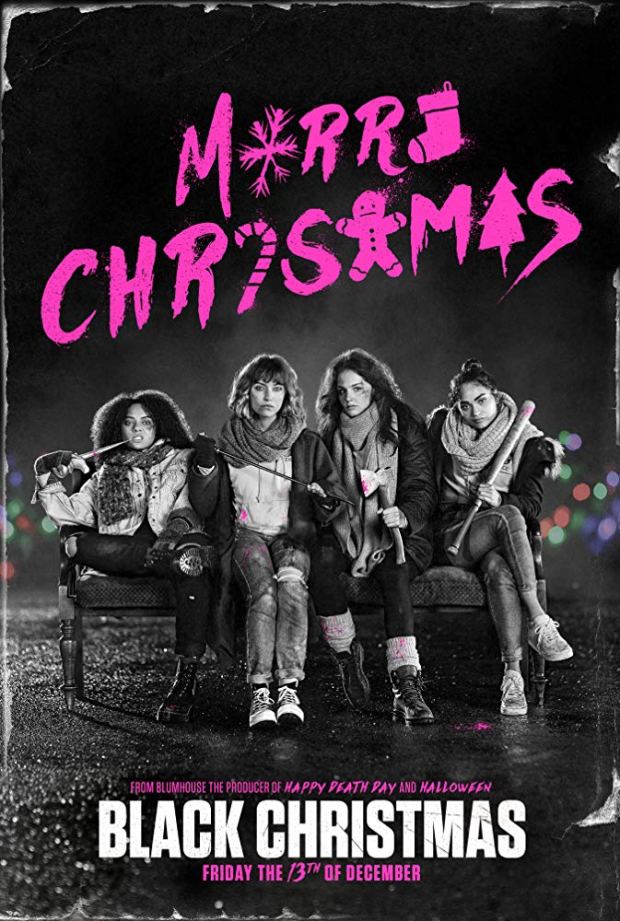
There’s no doubt the remake/reimagining of Black Christmas is going to have some haters. Sophia Takal’s film is a fiercely feminist work that’s a call to action in the wake of the #MeToo era. For my full review, check out my piece over at Signal Horizon Magazine. If you’ve seen the film, please share your thoughts on it.
Tis the season for spiced eggnog, candy canes, and of course, Christmas horror movies. Compared to Halloween, there aren’t as many options, but with multiple streaming services now available, there a few gems worth checking out this year. So warm yourself by a yule log and spend the month of December checking out some of my recommendations below.
Black Christmas (1974/Directed by Bob Clark) This Canadian film about a group of sorority girls stalked by a stranger is a sheer classic. Many slashers that followed this, especially John Carpenter’s Halloween, owe a debt to Black Christmas for some of the techniques it used, namely the killer’s POV. Before you see the remake later this month, watch the original. A special yuletide kudos goes to Margot Kidder for playing Barb, the sorority sister who drinks and swears with the best of them.
Deadly Games (aka Dial Code Santa Clause/1990/directed by Renee Manzor) This bonkers French film deserves to be seen, and now that it’s available on Shudder, it should find a wider audience. Its 9-year-old protagonist Thomas (Alain Lalanne) is reminiscent of a certain blonde-haired kid from Home Alone because of the way he booby traps his house against a crazed Santa Clause, but make no mistake, this is NOT a kid-friendly movie. This movie features one terrifying Jolly O’ St. Nick whose facial expressions alone will give you nightmares long after the credits roll.
Better Watch Out (2017/directed by Chris Peckover) It’s best if I don’t spill too much about this film because it has a lot of turns. In short, the film follows 12-year-old Luke (Levi Miller), who has a crush on his 17-year-old babysitter Ashley (Olivia DeJonge). After she rebuffs him as he tries to make a move as they watch a horror movie, strange things start to happen, indicating there’s someone who has a sinister motive. This one, especially its ending, is not for the squeamish.
Silent Night, Deadly Night (1984/Directed by Charles E. Sellier Jr). Are there any horror fans who haven’t seen this popular holiday slasher about little Billy who grows up to be a murderous Santa? If not, what are you waiting for? Stream this one and its first sequel. Skip the later movies.
Gremlins (1984/Directed by Joe Dante) This is another one that most folks have probably seen, but it’s my favorite Christmas movie. Is there anything cuter than Gizmo wearing a Santa hat and playing the keyboard in Billy’s (Zach Galligan) bedroom? I don’t think so! Even if you’ve seen this movie 100 times, it’s always worth a re-watch. Fun fact: Joe Dante wanted the film to lean into its horror elements more. One of the initial scripts called for the Gremlins to behead the mother and bounce her head down the stairs like a basketball. What could have been….
I desperately wanted Mike Flanagan’s adaptation of Doctor Sleep to do well, not only because it’s a good movie, it is (read my review of it over at Signal Horizon), but because its box office success could have meant that big studios like Warner Brothers would take a chance on fresh, character-driven horror films. Its opening weekend earlier this month grossed about $14 million dollars, which is not terrible, but certainly below expectations when you consider all of the marketing that was pumped into the film. On the other hand, when you compare Doctor Sleep’s opening to that of Halloween 2018, which grossed about $78 billion during its opening weekend, it’s likely that big studios are going to support more remakes and reboots of well-known franchises. Recent news stories over the last few weeks confirm this.
I can only speculate why Doctor Sleep is not drawing more people to the theater. It has a stellar performance by Ewan McGregor as a grown-up Danny Torrance, battling demons and struggling to not repeat the sins of his alcoholic, abusive father. Rebecca Ferguson commands every scene she’s in as the terrifying vampire Rose the Hat. Still, even though it’s a sequel to The Shining, and even though Stephen King is undergoing yet another renaissance right now, Doctor Sleep doesn’t have a franchise icon associated with it as recognizable as Michael Myers. The Overlook Hotel is in the film but only in the final act. Maybe Warner Brothers should have released the film during October or even late September, instead of waiting until Nov. 8.
One thing is certain, though, we vote with our dollars, and as Halloween 2018 has proved, if a studio realizes a reboot or sequel makes money, they will continue making more of them. Halloween 2018 is getting two more sequels, Halloween Kills and Halloween Ends, to be released in October 2020 and October 2021.
Meanwhile, a slasher film that heavily influenced John Carpenter’s Halloween, 1974’s Black Christmas, is getting a reboot set to open on Friday, Dec. 13. I assume that its studio, Blumhouse, which helped produce Halloween 2018 in partnership with Universal, suspects there are dollars to be made rehashing some of these well-known slasher films. Judging from a recent TV spot (see below), this very much looks like a film for the “woke” era.
In the TV spot, you see a group of sorority women fending off a black-robed, masked killer, and in one scene, a character who appears to be the head of a fraternity questions one of the women about power. My real question about this film is why now? The film was already remade in 2006 and was panned, especially by the horror community. There are several more interesting films that have come out in the last few years that deal with female power, be it The Witch, The Nightingale, or Revenge. Why doesn’t Blumhouse and Universal invest their dollars into an original script? Furthermore, for its time, Black Christmas was innovative. It featured a killer inside of the house, which was one of the most terrifying twists in horror history. It established the killer’s POV shot, which was used by Carpenter and others, and it generally had strong, forceful women who drank, smoke, cursed, and generally held their own. What new is a remake going to add?
Shortly after the release of Black Christmas, Universal/Blumhouse is set to relaunch the classic Universal Monsters in hopes of establishing a Dark Universe (yet again). The remake of The Invisible Man is set to drop in February. See below.
Now, I will admit this remake looks much more interesting than Black Christmas, especially because of Elisabeth Moss’performance and the theme of abuse that is so evident in the trailer,especially when Moss’ character says, “He said that wherever I went, he would find me.” That said, this film looks like it has little in common with H.G. Wells’ novel and James Whale’s classic 1934 adaptation. The Invisible Man looks like a totally different character in this, not a mad scientist. The name was kept, most likely, in hopes that it will attract viewers and make money, thus creating a Dark Universe that Universal has wanted and has so far failed to launch after the remake of The Mummy totally bombed.
These remakes/reboots by Universal/Blumhouse aren’t the only ones on the horizon. It was reported recently that there is going to be another Scream movie that operates within the universe Wes Craven established. Speaking of Wes Craven, his estate is apparently listening to pitches for a new Nightmare on Elm Street. You can’t blame these studios for moving forward with these projects after they saw the immense amount of money that Halloween 2018 grossed. With all of that said, there are plenty of young, innovative directors out there doing great things, like Robert Eggers, Jordan Peele, Jennifer Kent, and Coralie Fargeat, and thanks to streaming services like Shudder, horror is now an international market.
Still, though, I’m upset that Doctor Sleep isn’t making more money at the box office. It’s poor showing is going to encourage studios to keep making remake after remake. Meanwhile, unique stories won’t be seen by as wide of an audience and a good script may get passed over. We vote with our dollars, and when an interesting horror movie comes along, we need to support it, see it, and talk about it.
It’s hard to define which genre best fits Joon-hon Bong’s latest feature, Parasite, a story about the unemployed Ki-taek family that takes interest in the glamorous lifestyle of the Parks. There are elements of drama, comedy, and horror, especially within the final act, and beneath all of the genre-bending scenes, there’s a message paramount to the film about the class divide that is especially resonant. Bong has created a layered film that makes the audience laugh in one scene, before sympathizing with characters who literally live underground. Parasite is a prefect film for this moment.
As the film opens, we’re introduced to the Ki-Taek family, who live in a cramped semi-basement and devour snacks and soda for dinner. The character presented first is the son, Kim Ki-woo (Woo-sik Choi), who roams from tiny room to tiny room, searching for a free wifi signal, until he finally secures one in the corner of the open bathroom. Desperate for cash, the mom, Kim-Chung-sook (Hye-jin Jang), instructs her children to check Whatsapp so the family can take work folding pizza boxes. Not long after, trucks roar by, pumping chemicals into the air to kill off stink bugs. The fumes waft into the home, and the living conditions feel especially dire and squalid, as the family coughs in a cloud of chemicals.
The Ki-Taek Family
Kim Ki-woo is soon tapped by his friend Min (Seo-joon Park) to tutor the daughter of the wealthy Park family. He questions why Min would ask him and not one of his university buddies, but essentially Min sees him as a place holder, someone who can keep an eye on her until he returns from studying abroad and can date her when she’s old enough. Kim Ki-woo forges his credentials, and one by one, helps the family ease their way into the Park residence by booting out the rest of the help, including the driver and housekeeper.
It’s during these scenes of chicanery and masks that Bong builds some of the film’s most comedic scenes, especially when daughter Kim Ki-jung (So-dam Park) fools the Park matriarch, Park Yeon-kyo (Yeo-jeong Jo), into thinking that her son has a mental disorder that shows up in his art. At the same time, she humors the mother into thinking he’s some prodigy, especially after the mom compares him to Basquiat, despite the fact he spends most of the film running around, shooting arrows, and pretending to be an Indian. According to the mother, however, he’s destined for greatness, even if he comes across to everyone else as a typical, high-energy kid.
Watch the trailer below:
Around the midway point, the Ki-taek clan fully occupies the Park living room after they depart for a camping trip. They load the coffee table with fancy snacks and suck down shots of alcohol, while the dad muses that it’s their house now and they’re already living in it. Here, they dream about power and wealth, which forever seemed out of their reach, until they schemed and eased their way into the Park residence by forcing out the rest of the help. They also comment on the Parks, calling them naive, free of creases because their wealth is like a iron that keeps them stress and wrinkle-free. This scene portrays best the class conflicts woven throughout the film. Of course, this dream can’t last because the Park family returns prematurely due heavy rain. The thunderclaps mark a darker turning point within the film’s last act, when it really leans into elements of horror.
The turn occurs when the Ki-taek family learns that the former house keeper, Moon-gwang (Jeong-eun Lee), kept her husband in a bunker accessible via a secret passageway in the Park’s basement. She and her hubby are a class level below the Ki-taek family, literally hidden away in a bunker, invisible from the world. At one point, the husband confesses he doesn’t qualify for the national healthcare system, and he can’t ever remember a time when he didn’t live underground.This idea of layers, lines, and people living beneath each other is reinforced throughout the film. Moon-gwang’s husband hides out in a bunker. The Ki-taeks live in a semi-basement, and the Parks live in a spacious home with open rooms and large windows with a wooded view. They can move around freely, unlike the other two families. At one point, Park Yeon-kyo comments that having a ghost in the house is lucky because it brings wealthy. This one line gives the audience much to ponder. Are Moon-gwang and her hubby ghosts, especially because he’s SO invisible? Do the upper class exist by living on top of those beneath them? The film seems to imply as much.
The class tensions escalate after the Ki-taek’s patriarch, Kim (Kang-ho Song), overhears Mr. Park (Sun-kyun Lee), comment on his smell, comparing it to an old radish and then a boiled rag. Any further summary would spoil the film too much, especially the stunning last 30 minutes or so, but needless to say, Mr. Park comes across as a grade-A prick. Kim is useful to him in that he never “crosses the line,” and probably never can class-wise, but it’s the smell that perturbs him, the constant reminder of people different than him, without the luxuries that he can afford.
All of this is contrasted by the young Kim-ki woo, who, despite his family’s status living in a semi-basement, believes that if he has the right plan, he can get ahead. He thinks that if he goes to college, gets a job, and marries, he can buy the Park home if it’s ever on the market. Yet, at the same time, as he looks upon the Parks and their wealthy friends during a birthday party, he questions if he fits into such a scene. Still, he remains optimistic, trapped by his youthful idealism.
Bong has created an film of divides, layers, and divisions, one in which everyone is wearing a mask. The Ki-taeks pretend to be more credentialed than they are to move into a home they desire. The Parks act friendly on the surface, but the parents especially reserve their true feelings about people like the Ki-taeks for private conversations. At the same time, Parasite is a genre-bending film very much rooted in the idea of ghosts, of those we don’t see even though they exist all around us. They are drivers, tutors, and housekeepers. Yet, below those jobs, there’s a class we hardly acknowledge or discuss, best exemplified by a bunker-bound husband who has no health insurance and is only comforted by the love of his wife. Parasite is a film that truly exemplifies 2019, when the world constantly feels like its on the brink of collapse, driven, in large part, by a yawning class divide, and controlled by families like the Parks who don’t want anyone else “crossing” that invisible line.




 Brian Fanelli