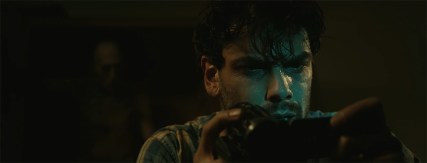
A Look Back at Xavier Gens’ Frontier(s)

It’s been over a decade since the emergence and popularity of the French Extremity horror films.  Today, films like High Tension, Martyrs, and Inside are generally considered classics of the 21st Century by horror fans, and the directors, especially Alexandre Aja and Pascal Laugier, have gone on to have successful careers as  directors. When looking back on the last decade and the success of these films, there should be more attention given to Xavier Gens’ 2007 film Frontier(s), which accurately predicted and responded to the rise of right-wing populism in Europe.

The term the New French Extremity was first coined by Artforum critic James Quandt, and while it may be impossible to fully define the term or this particular style of cinema, film blogger Matt Smith once said that this wave of films does have two common themes: home invasion and/or fear of the Other.

The second theme is especially applicable to Frontier(s), which opens in Paris, torn apart by riots due to the election of a far-right candidate to the presidency. The rest of the film focuses on a group of four Muslim teens who plan to run away from Paris to Amsterdam with a bag full of robbed money.  Two of them, Tom (David Saracino) and Farid (Chems Dahmani), decide to stop in a b & b, where they encounter neo-Nazis/cannibals. Eventually, the remaining teens, Alex (Aurelien Wiik) and Yasmine (Karina Testa), go looking for their missing friends at the b & b, and from there, things don’t go well. More specifically, the cannibal family’s patriarch and former SS officer, Le Von Geisler, wants to make Yasmine a mother for the new Aryan race.

Like other French Extremity films, Frontier(s) is seeped in heavy gore and violence, similar to some of the American horror films of the early 2000s, such as Saw and Hostel. The cannibal Nazis, meanwhile, are Gens’ nod to The Texas Chainsaw Massacre and grindhouse films of the 1970s, especially some of the dinner scenes.

Yet, looking back at the film over a decade later, it’s the political backdrop that stands out. In an interview with the website Horror Pilot, Gems described his influence for the film, stating, “I started to think about the story in 2002 during the presidential elections in France. When the extreme right arrive in the second turn, I got really scared. And that gave me the idea of the film.”

This fear is obvious in the opening minutes, which features cops dressed in riot gear, protestors flooding the streets of Paris, and sheer chaos of tear gas and bullets that forces the group of four Muslim friends to flee the country. The sadistic cannibals are a reminder of how the old ghosts and ideas of white supremacy still linger, to the point that a living  Nazi war criminal is the one who orchestrates the events, including the severe torture that occurs in underground chambers. The film features other torture too, including a scene in which the family feeds pork to Tom and Farid, suspecting that they are Muslim.
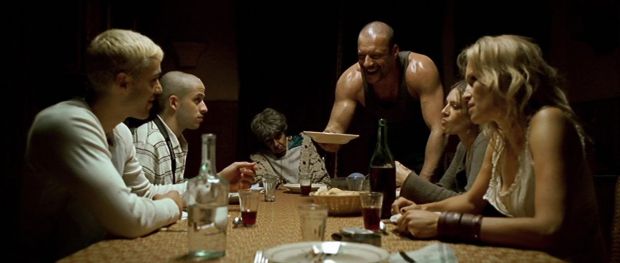
Frontiers1.jpg

Tom (David Saracino) and Farid (Chems Dahmani) sitting down for dinner with the Nazi cannibals

When the film was released, the reviews were mixed. Writing for Slant Magazine, Ed Gonzalez had this to say:

The film unspools as a seizure-inducing succession of nonstop screaming, references to horror-film freakouts old and new, and slick market-tested shocks, beginning with a protest rally in the wake of the election of a French right-wing nut and ending with Karina Testa’s Last Girl Standing “escaping” from an inn where a deranged posse of cannibalistic neo-Nazis is trying to renew the blood of their family. It sounds enticing, but Gens’s engagement with the contemporary racial discord currently tearing at France’s bowels isn’t sincere but rather a transparent ploy to give the film a sense of gravitas.

Looking back, the political turmoil evident in Gems’ film, especially the opening sequence, does seem sincere. As he said in the interview with Horror Pilot, he was inspired to create the film after the election results of 2002 and the rise of the far-right. Beyond that, the film’s opening predicted the turmoil that would consume Europe over the next several years and the rise of the AdF Party in Germany, Marine Le Pen’s National Front Party in France, and the authoritarian regimes that have swept power in Poland, Hungary, and most recently, Italy. The fear of the Other by white Europeans, underscored to the extreme by the cannibalistic neo-Nazis, foreshadowed the immigration crisis that would consume the EU for the next decade.

The power that Le Von Geisler  wields over the family is also built on abuse towards women. Two of the family’s members, Gilberte (Estelle Lefebure) and Klaudia (Amelie Daure), are forced to offer sex to any brown-skinned newcomers that stumble upon their b & b. This is a way to convince them to stay, and early in the film, the friends discover several passports belonging to others that were kidnapped, tortured, and cooked. Yasmina, meanwhile, is only spared when it’s discovered she’s pregnant and the Nazis find a use for her in their desire to create the master race. It should be noted that Yasmina is one of the strongest Final Girls in any of the French Extremity films, enduring countless waves of torture, including watching her friends and boyfriend die, and yet enduring and resisting such a brutal form of patriarchy.
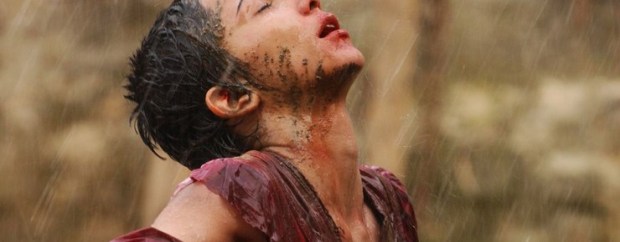
yasmina2.jpg

Frontier(s) feels eerily relevant a decade after its release. From the opening scenes of unrest in Europe, to the female protagonist’s survival against a relentless patriarchy, the film is one of the real standouts of the French Extremity films from the last decade. It was speaking to issues that would only become more prevalent in the years following its release.


No Oscar Nomination for Toni Collette/The Horror Genre?

2018 was another strong year for horror. There were several indie films that made waves, such as Mandy, Terrified, and Revenge, but two films specifically broke into the mainstream, generated buzz and conversation, and were deserving of the Academy’s attention.  I am talking about A Quiet Place and Hereditary. Both films were snubbed, though A Quiet Place did earn a nomination for Sound Editing. That said, I’m not surprised that the horror genre has once again been shut out of the awards season, even if the genre has been earning more and more attention over the last five years or so. Last year, I argued that Get Out deserved Oscar nominations, and it did receive a few, including Best Picture. Jordan Peele, meanwhile, won an Oscar for the screenplay. When writing about Get Out, I noted that very, very few horror films have ever won an Oscar. The Silence of the Lambs won Best Picture in 1992. The Exorcist was nominated for several Oscars, but only scored two for Best Adapted Screenplay and Best Sound Mixing.

A Quiet Place is at least deserving of a nomination for Best Original Screenplay, which was penned by John Krasinski. The film is one of the most innovative horror movies of the last decade, a metaphor on grief and losing a child. While the film may not be the first to use sound, or a lack of sound, so effectively in the genre (think Hush or Don’t Breathe), it does so in a way that makes us really feel for the family, especially after the tragedy that occurs within the first fifteen minutes. Additionally, the film contains strong performances by Krasinski and Emily Blunt, who do everything they can as parents to keep their children safe and alive. We generally want them to survive, especially after they endure one calamity after another.

collette

(Toni Collette as Annie in Hereditary)

Hereditary is a much more difficult film to watch. It begins with a funeral for the family’s matriarch, and within the first half an hour, it takes a sudden twist with the loss of another major character. Yet, it’s one of the strongest portrayals of grief that I’ve ever seen on film, let alone the horror genre. Furthermore, Toni Collette’s performance as Annie is never-jangling. Her facial expressions alone are powerful and unnerving. She is a mother who can’t take anymore loss. Additionally, I think the film should have received nominations for Best Director (Ari Aster), Best Original Screenplay, and perhaps, maybe even Best Picture. Yet, it was totally shut out…

So, after giving a single Oscar to Jordan Peele last year, which was well-deserved, it looks like the Academy is back to ignoring the horror genre. Meanwhile, fans can continue enjoying the state of horror right now because there’s a lot to be excited about, even if the Academy doesn’t think so. Horror is having a moment.

What do you think about the Oscar nominations? Were A Quiet Place and Hereditary deserving of the Academy’s attention? Feel free to let me know what you think.

List of Oscar nominees.


Writer’s Showcase: All-Female/Winter Edition

The next installment of the Writer’s Showcase at the Olde Brick Theater in Scranton will take place on Saturday, Feb. 9 at 7 p.m. This one will be the annual all-female Showcase, featuring live readings of poetry and prose by Kimberly Boland, Aurora Bonner, Rachael Hughes, Laurel Radzieski, and Alyssa Waugh.

Writers  Showcase Winter 2019-page-001.jpg


Author bios:

Kimberly Boland writes poetry, prose, and drama. She is a recent graduate of Keystone College, where she received her bachelor’s of arts degree in Communication Arts and Humanities, and she’s continuing her studies at Gonzaga University where she has just begun her master’s of arts degree in Communication and Leadership Studies. She lives in North Abington Township in her beloved farmhouse home with her cherished, loving family, and her hobbies include tabletop board gaming, swing dancing, listening to audio dramas, and being active in her synagogue’s community. Her first prose poetry chapbook, titled Maybe This Is It, an analysis and reflection on overcoming destruction, told through a feminist lens, came out in 2017 and she hopes to follow it up with a sequel of equally autobiographical poems soon.

Aurora D. Bonner is an environmentally driven writer and artist living in the Endless Mountains of Pennsylvania. She is a regular review contributor for the Colorado Review and her writing has appeared or is forthcoming in Brevity, Assay: Journal of Nonfiction, Under the Gum Tree, and Hippocampus Magazine. She holds an MFA in Creative Writing from Wilkes University. Follow her @aurora_bonner or aurorabonner.com for more information.

Rachael J. Hughes writes with retractable, comfort-grip PaperMate Ink Joy pens in groovy hues. She was founder of Word Fountain and earned her Creative Writing MFA at the Maslow Family Graduate Program in Creative Writing at Wilkes University. She strives to make the world laugh, heal, and love books. She is the author of Us Girls: My Life Without a Uterus. She writes and resides in Central Pennsylvania with her family, including four cats. Check out her musical musings at: http://kindalikeapoet.wordpress.com.

Laurel Radzieski’s debut poetry collection, Red Mother, was published by NYQ Books in 2018. She earned her MFA in Creative Writing from Goddard College and her BA from Keystone College. She has been a Writer-in-Residence at the Wormfarm Institute and is a poetry editor for Clockhouse. Laurel’s poems has appeared in The Golden Key, Really System, The Slag Review and elsewhere, including on roadsides in rural Wisconsin. She has worn many hats in the theatre and can often be found writing on-the-spot poems for strangers at local events. Laurel lives in Scranton with her husband and a fish named Buddy.

Alyssa Waugh is the editor of I AM STRENGTH: True Stories of Everyday Superwomen and the author of Hell’s Laughter and Other Spooky Tales. Her short stories have been published in Beyond Science Fiction Literary Magazine, her poetry has been featured on Writing in a Woman’s Voice, and she won first place in Inkitt’s Running Scared Horror Writing Contest. She is a manuscript reader for the James Jones Novel Writing Competition, a copy editor for Etruscan Press, and teaches creative writing classes at King’s College and fiction workshops at Wilkes University where she received her M.F.A. These days she spends most of her time as the Editor in Chief of Blind Faith Books and trying to write without her cats stealing her pens. You can learn more about her at alyssawaugh.com and blindfaithbooks.com.

Check out the Facebook event page for additional info.

Horror in 2019

Happy 2019!

With 2018 behind us, let’s look at some of the horror films dropping in 2019.

US

Slated for release on March 15, this is probably the year’s most anticipated horror film, especially after the success of 2017’s Get Out, which earned Jordan Peele an Oscar. While Get Out had some comedic beats, especially in the first half, US looks more like a straight-up horror film, with echoes of The Strangers and Funny Games, at least judging from the trailer.


A few weeks ago, it was reported that Peele had US star Lupita Nyong’o watch a list of horror films to prepare for her role. This list only adds to the excitement and features pretty diverse selections, everything from Let the Right One In to The Birds.

Pet Cemetery

The last few years have featured a serious resurgence of interest and fandom in Stephen King, both on the big and small screens, so it’s no surprise that one of King’s most popular novels is getting another adaptation. The latest  is directed by Kevin Kölsch and Dennis Widmyer and written by Jeff Buhler. It stars Jason Clarke, Amy Seimetz, and John Lithgow. The trailer looks promising, and the film will be out in April.


The Prodigy

I’m unsure what to think about this film. Based on the trailer, it looks like it could be decent. Director Nicholas McCarthy does have experience in the horror genre. He was a writer for 2012’s The Pact and 2014’s At the Devil’s Door, and he directed a segment for 2016’s horror anthology Holidays. Maybe The Prodigy will be another solid entry into the creepy kid subgenre of horror,  a la The Omen. Who knows, but we’ll see once the film drops in February.


The Curse of La Llorona

This is another film that I think has potential. This supernatural horror film, directed by Michael Chaves,  is based on a Mexican folk tale about a legendary ghost called La Llorona. The film will be released in April.

It: Chapter 2

While I wasn’t a huge fan of the first installment of this remake, the second chapter is supposed to be darker and will feature members of the Loser’s Club all grown up, battling Pennywise one last time. I predict this will be the highest-grossing horror film of 2019. It comes out in early September. No trailer has been released yet.

The Lighthouse

Directed by Robert Eggers (The Witch), The Lighthouse is currently in post-production and was shot in black and white 35 mm. The film stars Willem Dafoe and Robert Pattinson. Not much is listed on the IMDB page, other than this brief synopsis: “The story of an aging lighthouse keeper named Old who lives in early 20th-century Maine.” The Witch was one of the most atmospheric horror films of the last several years, so I’m excited to see Eggers’ latest effort, which will also be distributed by A24 films.

The Nightingale This film is currently making its round at the festivals, and I’m including it because it’s by The Babadook’s director Jennifer Kent. Here is the synopsis, “Set in 1825, Clare, a young Irish convict woman, chases a British officer through the rugged Tasmanian wilderness, bent on revenge for a terrible act of violence he committed against her family. On the way she enlists the services of an Aboriginal tracker named Billy, who is also marked by trauma from his own violence-filled past.”

I am sure there will be several films that make my year-end of list for 2019 that currently aren’t gaining much attention. Who heard of Revenge, Terrified, or Apostle a year ago?

TV:

In terms of TV, Shudder has green lighted Greg Nicotero’s (executive producer of “The Walking Dead”) reboot of Creepshow.  Nicotero promises the show will honor the legacy of Stephen King and George A. Romero’s original film. We’ll see. Speaking of Shudder, one of the highlights of 2018 for horror fans was the return of Joe Bob Briggs, who hosted three horror movie marathons dubbed “The Last Drive-in” for the streaming service. In 2019, he’ll be hosting a regular series. Long live Joe Bob!

Meanwhile, Jordan Peele is hosting a rebooted version of “The Twilight Zone” for CBS.  AMC has renewed the criminally underrated “The Terror” for a second season, though the new season won’t have anything to do with Dan Simmon’s novel. Season 2 will be set during WWII. Lastly, let’s hope that “Channel Zero” has at least one new season this year. Based on Creepy Pasta stories, “Channel Zero” is one of the most innovative horror television shows in years.

Happy New Year, and please feel free to comment about your predictions, hopes, or horror movies for 2019!


Best of 2018: Horror Films

2018 has been another strong year for horror, and frankly, narrowing this list down to just 10 films was hard. Horror still has work to do in terms of becoming more inclusive, but it’s gradually getting there. Many of the films on my list feature female and foreign directors. Horror always serves as a reflection of our deeper anxieties, and many of the films  I picked  deal with the very personal, be it grief, skepticism, economic distress, or merely trying to keep your family together in the face of daunting circumstances.

10. Ghost Stories (Directed by Andy Nyman and Jeremy Dyson)

ghost-stories-cropped

This British anthology film, based on a play written by its directors, is a quiet, slow creep, ultimately about skepticism versus belief. It has an ending that blends reality and the paranormal and is worth a watch for that segment alone. Watch the trailer by clicking here. Read my review by clicking here.

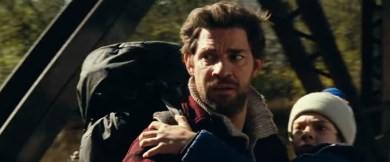
9. A Quiet Place (Directed by John Krasinski)

A-quiet-place-super-bowl

Who knew that John Krasinski would direct such an inspired, creative horror film? The first 15 minutes of this film alone make the viewing experience worthwhile. What this creature feature does with sensory deprivation echoes other films like Hush and Don’t Breathe, while still featuring several nail-biting moments. You generally care for this family and their struggle to survive against creatures that are drawn to sound. This was one of horror’s biggest box office successes in 2018, so, of course, Krasinski is already writing the sequel. Watch the trailer by clicking here. Read my review by clicking here.

8. Veronica (Directed by Paco Plaza)

veronica.jpg

This Spanish film by Rec director Paca Plaza is based on a true story about a teen, Veronica (Sandra Escacena), who was allegedly possessed. This film takes its time building its characters, especially the female lead and her responsibilities taking care of her younger siblings. There are so many scenes in this that are unsettling and downright spooky, so it would be difficult to mention just one. Watch the trailer by clicking here. Side note: I know this film was technically released in 2017, but it was distributed in the states via Netflix over the summer, hence my inclusion of it on this list.

7. Halloween (Directed by David Gordan Green)

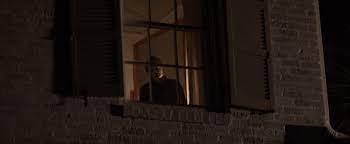
window

This is the Halloween film for the #MeToo era, featuring Jamie Lee Curtis reprising her role as final girl Laurie Strode. Curtis steals the show here, but Michael Myers is once again brutal, a force of nature, killing without reason. John Carpenter returned to the franchise to produce and score the film with his son. Recently, he said that he’s willing to help again with the inevitable sequel to David Gordan Green’s film, at least in terms of scoring it. Halloween was a blockbuster, one that may revive other horror slasher icons. Click here for the trailer. Click here to read my essay on the new Halloween and evolution of the final girl. Long live Michael Myers!

6. Cam (Directed by Daniel Goldhaber)

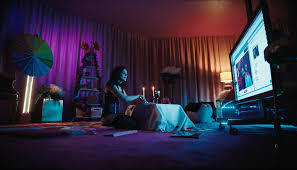
cam.jpg

Simply put, this is one of the best Internet horror films yet, one that illustrates how our online persona overtakes our life and causes us to always perform and always think about likes and Internet reaction. The film draws on the real life experience of writer Isa Mazze’s experience working as a cam girl. This story is both terrifying and sad. The duo of Mazze and Goldhaber said they plan to work together on another social horror film, so we’ll be hearing from them again soon. Watch the trailer for Cam by clicking here.

5. Apostle (Directed by Gareth Evans)

apostle.jpg

This film about religious fanaticism is not for the faint of heart. It is brutal and gory, featuring a violence that matches the type of religious extremism showcased. For fans of folk horror, like The Wicker Man, this is a must watch. Watch the trailer here. Read my mini essay on Apostle, masculinity, and folk horror by clicking here.

4. Revenge (Directed Coralie Fargeat)

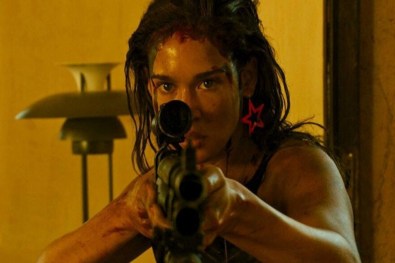
RevengeR-3-cropped.jpg

I usually can’t stomach rape/revenge films, but this one is so  stylish, powerful, and gory, in the vein of the French extremity films from the previous decade. Director Coralie Fargeat reverses the narrative gaze here and clearly is aware of horror film tropes, including in the rape/revenge ones. She’s another young director to watch. Watch the trailer here. Read my essay on Revenge and its reversal of the gaze over at Horror Homeroom here.

3. Terrified/Aterrados (Directed by Demián Rugna)

Aterrados

It was hard not to place this film on the top of the list. It is probably the most unnerving horror film I watched all year, other than my #1 pick. In the first 15 minutes, a woman is thrashed around a bathroom. In another scene, a little boy, back from the dead somehow, sits at this kitchen table, his skin brown and decayed, leaving police and paranormal investigators befuddled. Recently, Guillermo del Toro said he is interested in creating an American version of this Argentinean film, with Rugna set to direct. Here’s to hoping that happens and that any remake keeps the creepiness factor of this brilliant original. Watch the trailer by clicking here .  Read my review by clicking here.

2. Mandy (Directed by Panos Casmatos)

mandy-cage

I never liked Nicolas Cage, and then I saw Mandy. Cage plays Red, who sets out to avenge his wife after she’s killed by a Manson-like cult. This film is awash in red tones and at times, it feels like a fever dream through the various layers of hell. Cage is stellar, even when he’s chugging vodka and screaming alone in a bathroom. If you haven’t seen Mandy yet, do it! Watch the trailer by clicking here. Read my review here.

1. Hereditary (Directed by Ari Aster)

collette.jpg

How could this not make the #1 spot? This is a film worth re-watching and re-watching for the cinematography and clues laced throughout each frame. Toni Collette deserves an Oscar nomination for her performance in this. She is outstanding, playing a mother dealing with one loss after another. This is one of the rare films that lived up to the hype. Watch the trailer here.Read my review over at Horror Homeroom here.

Honorable Mentions: Annihilation, The Ritual, Upgrade, Overlord, The Witch in the Window, Summer of 84

Horror TV I binged in 2018: “The Terror,”  “Channel Zero,” and even “The Walking Dead,” which has found some new life under Angela Kang’s direction

Looking ahead to 2019: Next year should be another big year for horror. Jordan Peele is releasing his next  film entitled Us. Not much is known about this film yet, but it stars Lupita Nyong’o, Winston Duke, Elisabeth Moss, and Tim Heidecke.  Robert Eggers is set to release his follow-up to 2015’s The Witch. The Lighthouse is another horror film, this one shot in black and white, starring Willem Dafoe and Robert Pattinson. Like The Witch, The Lighthouse will be released and distributed by A24. The likely blockbusters will be the remake of Stephen King’s Pet Cemetery and the second chapter of It, set for release in October.  Keep an eye out for French director Alexandre Aje’s latest film entitled Crawl, set to be released by Paramount Pictures. Meanwhile, as my list for 2018 shows, there should be several films worth watching from  young,  innovative directors as well as foreign directors. Those films will probably fly under the radar for now, so keep your eyes peeled.

Bring on 2019!


New Horror Essay Published by SVJ

I am fortunate and grateful to have an essay on early horror cinema published by The Schuylkill Valley Journal, both print an online. The essay, entitled “The Progressive Politics of Early Horror Cinema: Gender, Female Empowerment, and Sexuality,” looks at Nosferatu and James Whale’s Frankenstein and Bride of Frankenstein. You can read a version of the essay by clicking here.

A Look Back at A Girl Walks Home Alone at Night (2014)

Over the last decade, the vampire has evolved on film. What I’m namely talking about is  Let the Right One In (2008), an adaptation of John Ajvide Lindqvist’s brilliant novel, What We Do in the Shadows (2014), a hilarious spoof, and The Transfiguration (2016). All of these films take the vampire away from the image of a Bela Lugosi or Christopher Lee-type fanged, cape-wearing monster. Let the Right One In features a beautiful friendship between its child-like vampire and a bullied boy named Oskar. The Transfiguration has much in common with George A. Romero’s brilliant vampire flick Martin, in that you’re never fully sure if the protagonists are a vampire or not, but each is obsessed with the idea of being a vampire  the vampire mythos.

Classic monsters, such as vampires, need to change with the times, and their ability to do so is why they’ve been around for hundreds of years. One of the most innovative vampire films of this decade is A Girl Walks Home Alone at Night (2014), a genre-bender by Iranian director Ana Lily Amirpour, who was transplanted to the states with her parent as a kid.

The plot of the film is simple. It takes place in a fictional town called Dead City, and it features a female vampire simply named Girl (Shelia Vand), who feeds to live and ultimately falls in love with a James Dean-type character, Arash (Arash Marandi). The black and white film is a lot of things- noirish, a western, horror, incredibly sleek, stylized, and subversive.  It also features one of the coolest vampire figures ever seen on screen. She skateboards,  steals jewelry from deserving victims, murders abusers and pimps, and dances around her apartment to indie pop. She warns Arash that to love her is to know and accept all of the bad things that she does. She is endearing but also terrifying, telling a young boy in one scene that if he doesn’t behave, she’ll rip out of his eyes and feed them to dogs.


In an interview with Wired back in 2014,  Amirpour didn’t downplay the feminist underpinnings of the film, saying,  “I think [the film] can be feminist if that’s what people think,” adding, “People also say, ‘Is it political? Are you making a political statement?’ I just know what I am; I don’t know what everyone else is.”

It’s hard not to acknowledge some of the feminist undertones of the film, especially if you accept that Dead City is supposed to be in Iran, a county not exactly known for women’s rights. Even the title and the fact the female vampire skateboards or walks alone at night is significant. Furthermore, Girl dances and wears eye-shadow and  lipstick. Some of her victims are so ridiculously masculine that it’s hard not to laugh at their absurdity. For instance, one of her first victims, Saeed (Dominic Rains), invites her to his pad, which looks like a scene from Scarface, including a coffee table dusted with cocaine and a gun. He dances in front of the mirror to thumping techno music, gazing at his muscular body, before advancing on Girl, who gives him what he deserves.

In another scene, Girl avenges Atti (Mozahn Marno), a prostitute who is shot up with heroin by Arash’s father, Hossein (Marshall Manesh), a junkie. Besides Arash, Atti is one of the only relationships that Girl has  and admits that she watches her and notices her sadness.  Girl says to her, “You’re sad. You don’t remember what you want. You don’t remember wanting. It passed long ago. And nothing ever changes,” to which Atti responds, “Idiots and rich people are the only ones who think things can change.”

a_girl_walks_home_alone_at_night

Girl (Shelia Vand) and Atti (Mozahn Marno)

While Atti’s dialogue fits her character, someone hardened from a life on the streets, the actions of Girl  as both a female avenger and subversive portrayal of feminine power in a restrictive culture, show that resistance can exist, even in the most oppressive societies. Furthermore, A Girl Walks Home Alone at Night takes the image of the vampire, traditionally masculine, and subverts it as much as Let the Right One In did. This is probably why when Girl first meets Arash he’s wearing a cape and vampire fangs, stumbling home from a costume party. He’s a parody of the male vampire figure in that scene, in such a drunken state that he can’t even find his home, say his name without slurring, or cause any harm to Girl. He is totally powerless.

Since the release of A Girl Walks Home Alone at Night, Amirpour already has another film under her belt, The Bad Batch, and she directed an episode of “Castle Rock.” Here’s hoping that she continues directing horror films because the genre, and film in general, needs more women behind the camera, especially ones like Amirpour, willing to make previous horror staples, like the vampire, unique and interesting.


,


My 2018 Zombie Film Recommendation

Confession: I am tired of the zombie subgenre of horror. I think that “The Walking Dead” should have been canceled at least 2-3 seasons ago. I can’t think of a zombie film I watched all that recently that I found that innovative or attention-worthy, other than Cargo (2017), available to stream on Netlflix. Most of the more interesting zombie films, such as 28 Days Later or Shaun of the Dead, belong to the previous decade. Zombie films tend to come in waves, but this most recent wave has limped along for far too long, like a  corpse waiting to be put out of its misery.

With all of that said however, there is one zombie film released this year that warrants viewing, Night Eats the World by French director Dominique Rocher, an adaptation of Pit Agarmen’s novel. Sure, the film checks off a lot of the cliches, including a sudden outbreak and loose social commentary, but more than anything else, the film is a meditation on loneliness. It begins when moody protagonist Sam (Anders Danielsen Lie) attends a party hosted by an ex. He heads into an empty bedroom by himself, falls asleep, and wakes up to a zombified world, including the apartment caked in blood. He sees some of the party’s stragglers wandering outside, roaming the streets, hungry for human meat.  Suddenly, he realizes that he’s trapped in a building alone with little possibility of escape.

The rest of the film mostly includes quiet scenes, including shots of Sam running around the mostly vacant building to stay in shape. Days, weeks, and possibly months pass. Sometimes, Sam ventures into one of the units to stock up on canned food, but is forced to bolt the doors shut after encountering more of the living dead. He forms a relationship of sorts with a balding zombie trapped in an elevator. This gnawing corpse is played by Denis Lavant, who, though he has no speaking parts, is utterly stellar through his haunting facial expressions. This zombie is humanized and distinct, like Bub in Romero’s Day of the Dead, and in his milky eyes, Sam sees a reflection of his isolated, melancholy state.  Who is really worse off in this situation?

There are times when Sam’s frustration erupts, including a scene where he launches into a pounding drum solo that draws a horde of zombies to the apartment complex. Yet, scenes where Sam is truly in danger of becoming zombie meat are relatively few and far between. Instead, the film focuses on what it would be like to be a survivor in a zombie apocalypse, when, as far as you know, all of your family and friends are dead. How do you go on living?  Throughout the film, time becomes elastic, and it’s unclear how much time has even passed between the beginning of the film and its conclusion. Will Sam even be better off if he makes it to the final scene? That much is unclear.

Stephen King called The Night Eats the World “a perfectly amazing film” a few weeks ago on Twitter, adding that it will “blow your mind.” I think King’s praise of the film is a little overblown, but I will say that the film deserves attention and has fallen under the radar, unfortunately. It tries to do something different with the zombie genre, and it generally succeeds.


In Defense of 2018’s Horror Offerings

Last week, Vogue posed the question, remember when horror was good? The question was followed with the blanket statement that 2017 was a far superior year for horror, due to It, Split, and lesser-known indie and foreign flicks such as Raw and It Comes at Night. The writer, Taylor Antrim, also labels Get Out a “masterpiece of social horror,” but then surmises that because Get Out didn’t win the Oscar that year (Jordan Peele did, however), that the air went out of the genre. If anything, I would argue that 2018 was another strong year for the genre, extending the new golden age.

First, Antrim admits that A Quiet Place, Hereditary, and Suspiria are good films, but the writer tries to remove the horror label from them and instead calls them thrillers. This is what some critics tried to do last year when Get Out earned Oscar nods. There were articles about “post-horror,” socially conscious films concerned with bigger ideas than guts and gore. The genre, they argued, couldn’t handle such serious themes! I guess they never watched any of Romero or Hitchcock’s horror films. It is beyond me how Antrim can see these new films as anything but horror. The first 15 minutes of A Quiet Place are some of the most nerve-jangling scenes I witnessed in cinema all year. The rest of the film features creatures terrorizing a family. Citing Hereditary, Antrim says that the genre could use a dose of humor and fun. On the one hand, I’ll admit that humor and dark delight do have a place in horror. Get Out is a good example, as well as classics like Re-Animator and Dawn of the Dead. Other genre staples, though, like The Exorcist and Night of the Living Dead are pretty short on the jokes.  Would anyone question their importance to the genre because they lack punch lines?

Antrim saves most of the criticism for Halloween, this year’s highest-grossing horror film. The author’s main gripe is that the film simply wasn’t scary. I beg to differ. David Gordon Green’s film returns Michael Myers to a force of nature, and his kills are brutal without being gratuitous, unlike Rob Zombie’s two Halloween films. Perhaps more importantly, the reboot gives substance to the Final Girl, Laurie Strode (Jamie Lee Curtis), making her the hunter who wants to overcome her trauma. Even Antrim admits that the film is relevant in 2018 and the era of #MeToo.

Within the article, Antrim  says that Hereditary, A Quiet Place, Suspiria, and even the French film Revenge are good films, while trying to dislodge them from the horror label. All of these films belong to 2018, and all of these films fall within the horror genre. Vogue’s article is a continuation of the flurry of pieces last year that tried to discredit the genre. 2017 was indeed a great year for horror, but so was 2018. Hereditary, A Quiet Place, and Halloween raised a heck of a lot of money at the box office while being interesting films, short on jump scares. The year also produced a number of wonderful foreign and indie films, including Revenge, Terrified, The Witch in the Window, Ghost Stories, among others. As horror continues to do well at the box office and earn praise, it’s likely articles like Antrim’s will continue to be published. To that, I say, may the new golden age of horror extend well into 2019!