Review: Atterrados/Terrified, One of 2018’s Best Horror Films

Halloween is over and all that remains is leftover candy.  As 2018 winds down, the best-of lists will come into sharper focus. Though I haven’t yet produced a best-of list for horror films (I will at some point), I am certain that I will include the Argentinian film Atterrados/Terrified, one of this year’s most visceral and chilling films that no one is talking about.

Aterrados

It’s easy to see why Terrified was overlooked. 2018, like its predecessor, had a lot of mainstream horror hits and box office success, including Hereditary, A Quiet Place, and the rebooted Halloween. While those films were all great in their own way, 2018 proved that indie and foreign horror films like Revenge and Terrified bode well for the future of the genre. Director and screenwriter Demian Runga’s film pays tribute to the genre with callbacks to staples such as Pet Cemetery and The Grudge, while creating unique visuals and set pieces that are nightmareish and warrant sleeping with the lights on.

Set in a Buenos Aires neighborhood, Terrified follows three neighbors who are besieged by the paranormal. The first narrative focuses on a wife who hears voices in the kitchen. Shortly after dismissing the wife’s fears, the husband witnesses her body levitating mid-air in the bathroom, banging against the shower walls, leaving streaks of blood. This early set piece and disturbing visual sets the tone for the remainder of the film.

The middle of the film contains the most developed and haunting story. After a  little boy is hit by a bus and his mother is left to grieve, his corpse returns and sits at the kitchen table before a bowl of cereal and a glass of milk. As paranormal investigators and an ex-cop try to make sense of the situation, the camera zooms in on the boy’s rotting, decayed flesh. The viewer is left wondering if the boy moved on his own.  Are the dirty footprints the boy’s, or do they belong to a mother so grief-stricken that she dug up the corpse of her son? The physical manifestation of grief is why the film’s middle narrative is the strongest.

As the paranormal disturbances increase, there are no Ed and Lorraine Warren-type characters to solve the problem. Even the paranormal investigators and police officers view the situation in a rational fashion, deciding it best to rebury the corpse and be done with it. This is where the film breaks from The Conjuring, Poltergeist, and other demonic/haunted house type films. No one comes to save the day, essentially. The cops and paranormal investigators don’t try to defeat the evil. They merely accept it and try to resolve it, even if that means weighing down the corpse of a boy with cement so he can’t claw his way out again.

Terrified follows a less traditional narrative structure than most films, and at times, it feels like an anthology. The only connection between the characters is that they share the same neighborhood. No explanation is given for the evil, and yet, somehow the film works without it. The first story is a full-throttle assault on the senses, and from there, the viciousness and scares are unrelenting. Terrified is one of 2018’s must-see horror films.


Some Poetry for Halloween

Months ago, I announced that Moon Tide Press was putting out an anthology of poems inspired by horror films. Well, the anthology is out! It features 66 poets and has wicked cool cover art by Leslie White.

Dark Ink Cover Image.jpg

If you’re interested in ordering a copy, you can do so through Moon Tide’s website here, or through Amazon here.

I have three pieces in the anthology, and as a little preview, here is one of the poems:

Imagining One More Romero Movie


I’d like to see Romero’s take on this moment,

a time as uncanny as the dead rising,

groaning, and slow-walking towards a meal.

The elite already live in towers,

like in Land of the Dead.

The president has a tower in NYC,

barricaded by police in all-black riot gear,

like the beginning of a movie

where everything is about to go wrong.

The working-class hustle below,

their hands hard and calloused, their clothes

rife with the smell of gasoline, oil, or dirt.

Sometimes, they crane their necks, stare

at those towers, maybe to imagine a gold nameplate,

a desk, leather chair, and air-conditioned office.


If Romero directed one more sequel,

I wonder where he’d place the survivors.

Shopping malls are too 1980s, but maybe Starbucks,

staring at their smartphones, plugging in

before the dead bust down the doors,

rip out espresso machines, gnaw on flesh,

or maybe he’d have a horde overtake DC,

while a few remaining politicians and lobbyists

flee down K Street under a harvest moon,

until the working-class, turned, drop the gas pumps,

hammers, or call center headsets and devour the living, fed up

with slumping and staggering from job to job.


Happy Halloween!


Apostle, Folk Horror, and Masculinity

Netflix’s continues adding to its ever-growing horror collection. One of its latest entries is Apostle, directed by Gareth Evans.  Several reviews have already compared the film to 1973’s The Wicker Man, since  both films are rooted in the folk horror subgenre, deal with religious fanaticism, and essentially build their own unsettling worlds, in each case a small, remote island. Yet, where Apostle breaks from some other films in the subgenre is in its critique of masculinity.

Apostle is set in 1905, and generally, little backstory is given to the island where the protagonist, Thomas (Dan Stevens), winds up in a quest to rescue his sister Jennifer (Elen Rhys). In one of the film’s most harrowing scenes, we come to realize why Thomas has abandoned religion. He was tortured when he tried to introduce Christianity to Peking during the Boxer Rebellion. As Thomas is tormented before a burning cross, no God comes to his rescue. This is just one of the many scenes in which poor Thomas is put through the meat grinder.

The other men in the film, namely Prophet Malcolm (Michael Sheen) and later Quinn (Mark Lewis Jones), use religion to keep the island’s inhabitants in line and to subjugate women. At one point, when Malcolm claims that Jennifer is a traitor, he parades her through the village in shackles and leaves her outside where children poke her with sticks and yank at her hair. The violence she suffers at the hands of men is only exacerbated as the film progresses.

These men also exercise strict and harsh control over women’s bodies. For example, Quinn cuts a baby out of his daughter’s womb and then uses a medieval torture device on her lover because he didn’t want them to be together and he certainly didn’t want his daughter to have the baby. Quinn is the film’s most pronounced example of ruthless, unchecked patriarchy, and his violence exceeds that of Malcolm’s.

The island, meanwhile, is inhabited by a goddess, and Malcolm claims to speak for her. He also feeds her animal and human blood, and yet, he can’t fathom why crops keep failing. The goddess, who seems to be nature personified, suffers because of the men who rule the island. They try to claim her for their own and tame her, but under their firm hand, any plant that starts to green soon withers and browns.

Apostle trailer:


Initially, Thomas is afraid of the goddess, and his first encounter with her is one of the most chilling images in the film. She is as decayed and creepy as the woman who inhabits room 237 in The Shining.  However, near the end of the film, he kneels to her and better understands her story, specifically that she isn’t so monstrous as he once assumed. Of all of the men in the film, Thomas has the most connection to the women. He comes to island because of  Jennifer, he forms a semi-romantic relationship with one of the islanders, Andrea (Lucy Boynton), and he eventually understands and sympathizes with the goddess. It should be noted, too, that both Jennifer and Andrea have their own agency, especially near the conclusion.

In the final shot, as Jennifer and Andrea escape the island via boat, Thomas and Malcolm, who evolves after witnessing Quinn’s brutality, sit together on a cliff as the women leave. New life finally grows, after Thomas and Malcolm’s blood has been spilled. There are a few ways to interpret this last scene. Maybe nothing grew on the island when the goddess was fed human blood because the island and its people were so tainted under Malcolm and then Quinn’s rule. Maybe new life grows because Thomas and eventually Malcolm transcend the negative aspects of masculinity with the help of women. Because of that, new life could flourish on the island, or maybe the cycle of life and death simply returns because the goddess is free, so to speak.

Apostle is a solid entry to the folk horror subgenre, especially for some of its critiques of masculinity. In that regard, it has some commonality to Dave Eggers’ 2015 film The Witch, which also has a menacing patriarchal figure, the father of a Puritan family who is so rooted in religious dogma and superstition that he suspects his eldest daughter is a witch as she comes of age sexually. Both films are awash in cool tones that establish the bleak atmosphere, especially as the crops fail and the violence heightens. The gore in Apostle is excessive at times, especially torture to animals, and the film could have been cut and edited slightly more, but overall, it is another noteworthy addition to this year’s already strong horror list.

Recommended: Check out this article over at Horror Homeroom about some other films that will help you better understand Apostle.


Recommendations for Netflix Horror

As a follow-up to my post on recommended horror podcasts, I wanted to offer a list of my horror picks to stream on Netflix this October, or anytime for that matter! I tried not to include many picks that made my list last year, and I tried to highlight international and independent films.

The Witch (2015): This is one of my favorite horror movies of the last five years. Set in 16th Century Puritan America, this film is a slow burn,  filled with unsettling, bleak imagery. At its heart, The Witch has a lot to say about female empowerment and uses the trope of witchcraft/fear of the female to do so. Oh, and it has Black Phillip! Director Robert Eggers is likely to be a staple in the horror world for years to come. His next project is another horror film entitled The Lighthouse, and he’s working on a remake of Nosferatu.

The Wailing (2016): Netflix has a few solid Korean horror films. The Wailing tops my list. It is loaded with biblical imagery, and even though it’s nearly three hours long, it never feels bogged down. The film takes its time establishing its world and characters, but it gradually builds to a horrifying conclusion. It also has one of the best exorcism scenes.


Raw (2016): It’s fair to say that the horror genre still needs more female directors. That can probably be said about film in general. Director Julia Ducournau is on my list of young horror directors to watch. Raw borrows a lot from the French Extremity films of the early 2000s, namely in the way that it uses gore and color. This is a film to watch more than once, if you can stomach the cannibalism. Is it a metaphor for rape and survival? A female coming of age story? I don’t have all the answers, but I know that I enjoy this film more each time I see it.

Veronica (2017): Based on a true story about a teenage girl who was allegedly possessed, Veronica is directed by Paco Plazo, who also directed REC and REC 2. Watch them if you haven’t. So far, this has generally been a polarizing film, but I really enjoyed it. You generally feel for Veronica, especially when she’s burdened with taking care of her siblings, due to her absentee father and an overworked single mom.

Hush (2016): This made my list last year, but I’m including it again. The film centers around a deaf woman who is stalked and terrorized by a masked intruder for no apparent reason. What this film does with sound is the most unique aspect of the film, thus making it stand out from other home invasion horror flicks. Oh, and this was directed by Mike Flanagan, who directed “The Haunting of Hill House” series for Netflix, which has been all the buzz and streams later this month.

Under the Shadow (2016): Set in a 1980s, war-torn Iran, the story focus on a mother and a son who confront an evil invading their home. This film is heavy in its imagery and metaphors regarding war. It’s one of my favorite films of the last few years.

The Transfiguration (2017): This takes a lot of classic vampire tropes and flips them on their head. It also references what came before, including Let the Right One In, Dracula, and Martin. The film follows a troubled teen named Milo who thinks he is a vampire. Eventually, he forms a bond with another loner, Sophie. What’s reality and fantasy blurs as the film progresses.


Train to Busan (2016): Another Korean horror film makes my list. This is about zombies. zombies on a train! It doesn’t totally reinvent the zombie flick, but it does have characters that you give a damn about, and the setting makes for some unique and creative kills. James Wan plans to produce an American-made remake. We’ll see how that pans out…

The Ritual (2017): A British Netflix horror film based on a novel by the same name. What I really like about this film is its setting, the woods that engulf the group of friends who reunite after the tragic death of a friend. Oh, and the monster that comes in the final act is pretty cool, too.

Classics available to stream on Netflix: Hellraiser, It Follows, The Babadook, Children of the Corn, The Descent, Tucker & Dale v. Evil, The Conjuring, The Sixth Sense, The Strangers, Cabin Fever, Teeth, Seven, Interview with the Vampire


Review: Hold the Dark (2018)

In Green Room, director Jeremy Saulnier uses the tight confines of a dingy punk rock club in rural America to create isolation and tension as a band is besieged by neo-Nazis. At one point, the group is hauled up in the confines of a sound check room with no access to the outside world. Sauldnier’s latest film, Netflix’s Hold the Dark, contains sprawling Alaskan landscapes and stunning cinematography that creates bleakness and despair. The violence is as brutal and sudden as some of the scenes in Green Room. However, the film strays into too much ambiguity near the halfway point and sinks beneath its own weight.

Hold the Dark is based on the 2014 novel by William Giraldi, and it traces the journey/mission of writer Russell Core (Jeffrey Wright), who is summoned by Medora Slone (Riley Keough) to investigate the loss of her son, who was allegedly killed by a pack of wolves. The animals are also blamed for the death of other children in the village. The opening act  is the strongest, especially the scenes between Wright and Keough, whose acting is top notch. The dialogue is well-crafted and builds a foreboding sense of darkness that can’t be kept at bay, especially when Medora says, “The wilderness here is inside us…Inside everything.” The early scenes are isolating and often feature long shots of the all-consuming Alaskan wilderness, sometimes with the characters set small against the backdrop. One of the most tense scenes occurs when Core stumbles down a snowy hill and encounters the pack of wolves, their snouts bloodied after devouring one of their own, a cub. It’s a survival of the fittest/kill or be killed type of world.

Holdthedark

Russell Core (Jeremy Wright) and Medora Slone (Riley Keough)

Following the opening act, once Medora flees the scene and after it’s discovered that she may have been the one who killed her son, the rest of the film loses its momentum and veers off track, especially once her husband, Vernon Slone (Alexander Skarsgård), returns home from Iraq after getting shot in the neck. He kills and kills some more, as he searches for his wife. There were several missed opportunities and potential story lines left uncharted. The idea of isolation and loneliness caused by Vernon Slone’s Iraq tour is generally unexplored. Imagine being a military spouse, left to raise your child alone in Alaska. The tension between what the Native people believe about nature and the wolves and what police believe, mainly that there is no greater, metaphysical force at work, is interesting and deserved far more attention. Early on, the idea that there is some connection between Medora Slone and the wolves is lightly introduced but also underdeveloped. I had hoped the film would have explored some connection between the feminine and nature and how Medora is viewed by the villagers and the police.

Watch the trailer for Hold the Dark:


The film’s final act, when Core eventually confronts Vernon Slone, is the most frustrating. Yes, they come face to face and one walks away, so to speak, but the film’s conclusion is utterly ambiguous. Nothing is really resolved. It takes over two hours to build to such a climax, only to veer off into a strange direction with no finality.

The acting and cinematography are the highlights of Hold the Dark, and fans who liked the level of gore and violence in Green Room won’t be disappointed with some of the brutal scenes in Saulnier’s latest effort. However, the film’s plot comes unglued around the halfway point, and anyone who sticks around for the ending will probably find it underwhelming.


Happy October! Favorite Horror Podcasts

Happy October! Finally, the Halloween season has arrived. On the East Coast, the temperatures have dipped and pumpkin flavored food and drinks are ever-present. I write a lot about horror films on this blog, but I thought I would share a list of some of my favorite horror-themed podcasts. For the most part, all of these deal with the horror film, but they also touch upon Gothic and horror literature and other forms of media.

In the coming days, I’ll also share a list of some of my favorite horror films that are currently streaming on Netflix, Amazon Prime, and Hulu, just as I did last year. For now, here’s my list of horror podcasts I think you should check out.

Faculty of Horror: Hosted by Andrea Subissati and Alexandra West, Faculty of Horror is one of my favorite podcasts. Primarily, it looks at horror films through an academic lens, but the content is generally accessible, engaging, and interesting. The podcast has over 60 episodes, and all of them are achieved on the website.  Films covered include classics like Psycho and The Thing to more recent films such as Funny Games and The Witch. The show notes include a reading list, featuring the articles and books mentioned in the show.

Hellbent for Horror: This podcast is hosted by S.A. Bradley, a self-proclaimed “champion” of the horror genre in all of its forms. What makes this podcast unique is that Bradley typically picks a theme, such as the woods/nature, family relations/bad blood, religion, and applies it to various horror films. This podcast is less “academic” than some of the others on my list, but it includes a nice analysis of the genre. Some episodes feature interviews with authors, fans, and experts, thus giving space to other voices.  With over 70 episodes archived to date, there is a lot to listen to.

Horror Pod Class: I discovered this podcast recently, and it’s one of my favorites. It features two high school teachers talking about the genre as a whole. They’re knowledgeable and passionate. Show notes include titles of the articles/films/books discussed during each episode.

Final Girls Horrorcast: This podcast is really unique because it only features reviews of horror films available on streaming services. The reviewers, Aimee and Carly, are funny and offer interesting takes on some well-known and lesser-known genre films. This is a great podcast to check out when you’re looking for something to stream.

Inside the Exorcist: Hosted by Mark Ramsey, the dude who hosts LORE, “Inside the Exorcist” is a multi-part podcast that digs deep into the layered story behind The Exorcist. The first few episodes focus on the 1940s case of the Georgetown boy who was allegedly possessed and served as the inspiration for William Peter Blatty’s novel. The rest of the episodes focus on the stories behind the filming, including casting, and the cultural legacy of the film. This is one of the best behind-the-scenes accounts I’ve encountered on one of the most canonized films of the genre. Ramsey also created podcasts about Psycho and Jaws, so check those out as well.

Happy listening!


Candyman Reboot?

The horror world has been abuzz over the news that Jordan Peele is interested in remaking Candyman, the 1992 film about a murdered slave, Candyman (Tony Todd), who will appear if you repeat his name in the mirror. It’s unclear if Peele would actually direct the film or produce it, but regardless, though Candyman is not that old, its themes of gentrification and the past never staying dead are deserving of an update. After the success of Get Out, Peele is the right person to  oversee the project if it moves forward.

Candyman is a film that I really like and recently re-watched. Directed by Bernard Rose and based on Clive Barker’s short story “The Forbidden,” it is  atmospheric and haunting. Set in Chicago’s Cabrini-Green Housing project, as opposed to Liverpool, the setting of Barker’s story, the film is moody and deals with issues of class, race, and gentrification without being preachy or over-the-top. Of the filming location and housing project, Rose said that it is “an incredible arena for a horror movie because it was a place of such palpable fear.” Yet, who and what are we supposed to fear? These are questions the film asks. The protagonist, Helen Lye (Virginia Madsen), is a white graduate student interested in researching folk tales and myths, which brings her to the housing project and the history of the Candyman myth. Her arrival poses a lot of questions. Is she merely using the housing project and its impoverished residents to further her own agenda? Would she bother to care about any of the residents if not for her research and her personal goal of academic noteriety? Regardless, Helen forces her way into the housing project, snapping photo after photo, taking what she needs in the process. Residents clearly know that she doesn’t belong, but that doesn’t stop her from invading their space. At one point, she literary crawls through a hidden hole to enter another apartment where a murder occurred.

Helen

(Helen played by Virginia Madsen)

Candyman’s story, meanwhile, uses tropes found throughout African American literature and film. He is a murdered slave who fell in love with a white woman and was brutally killed as a result. The past, so to speak, never really stays dead, and once Candyman is summoned, he seeks revenge with a bloody hook hand, while speaking in suave Victorian language.  Tony Todd’s performance is one of the real highlights of the film, and it would be hard to find someone to top him.


candyman-movie.jpg

(Candyman played by Tony Todd)

It is unclear how quickly production will move forward with a Candyman remake, if it happens at all; however, Jordan Peele is the right person to produce or direct the project. Get Out shows that he has a clear understanding of class and race, specifically how they are intertwined. Candyman does not necessarily need a remake, but I would be interested to see Peele’s take.


Review: Mandy (2018)

Imagine a film that contains the Cenobites from Hellraiser, the costumes of Mad Max, and the goriness of Evil Dead. Combine those elements and you have Mandy, a film that is a fun and wild romp, complete with blood-soaked cinematography that feels like a fever-dream and LSD trip through the various layers of hell.

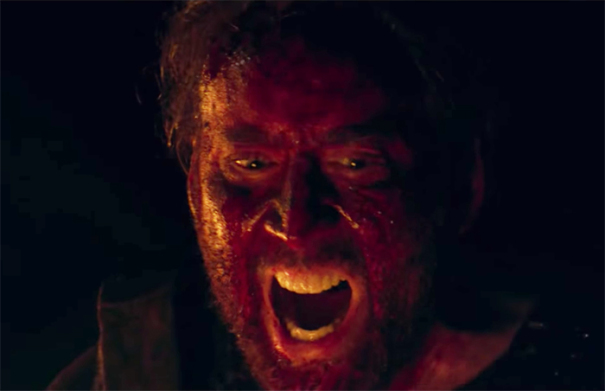
Directed by Panos Cosmatos and set in 1983, Mandy stars Nicolas Cage as wild-eyed, vengeful Red, who tracks down cult members responsible for the brutal murder of his lover, Mandy Bloom (Andrea Riseborough). The first quarter of the film takes its time establishing their relationship. They cuddle and watch movies together. They share the bizarre dreams they’ve had, and they seek refuge in the wooded Pacific Northwest, away from whatever is happening to the rest of the world, which we don’t know. The cinematography early in the film features a color palate of mostly greens and blues, reflective of Red and Mandy’s refuge. The colors and wooded scenery are inviting. How can anything bad possibly happen?

The rest of the movie, following Mandy’s murder, is awash in blood and various shades of red. Cage spends most of the film with a blood-splattered face. His facial expressions range from the maniacal to the hilarious to downright furious. The film is not without its one-liners, too. As he murders one of the biker demons summoned by the cult, he calls the creature a “vicious snowflake” and then quips, “you ripped my shirt!”

mandy-cage

Nicolas Cage as Red

Though she’s not in the film long before meeting her demise, Riseborough is noteworthy in her performance as Mandy, especially when she laughs in the face of Jeremiah Sand (Linus Roache),  a Charlie Manson knock-off who forces her to listen to his terrible music, which causes her to have a laughing fit. Mandy’s resistance shows just how absurd and fragile Sand’s masculinity is. You’re also left wondering if Mandy has some connection to a higher plane, due to the hallucinatory dreams she has and her interest in the occult.

Mandy1.jpg

Andrea Riseborough as Mandy

Mandy is not a perfect film, but my only real complaint is that it doesn’t take enough time building its world. What exists outside of Mandy and Red’s refuge, for instance, and what causes them to seek their own spot in nature? That gripe is minor, though. I assume that years from now, Mandy will be screened at midnight showings, earning applause during certain lines and scenes. There’s even a chainsaw battle in the last 1/3 of the film! Mandy has all the makings of a grind-house classic.


Halloween Trailer #2

With a little over a month until its release, David Gordon Green’s Halloween has a brand new trailer, featuring a hulking, brutal Michael Myers and a well-prepared Laurie Strode (Jamie Lee Curtis).
You can watch the new trailer by clicking here.
I first noticed the number of scenes that parallel scenes from the original film. For instance, in the first few seconds, we see that Michael Myers has returned to Haddonfield after escaping prison. He bumps into a trick-or-treater who is daunted by his size and shape, similar to the scene in the original Halloween when Tommy Doyle bumps into Michael and is taken aback. This happens early in the film, shortly after Michael escapes from the insane asylum and ends up in Haddonfield after stealing a car.
Another scene echoes a shot in the first film when Laurie Strode is babysitting and sees Michael standing in the yard behind sheets billowing on a laundry line. There is a similar scene in this new trailer, though it’s unclear whose house it is.
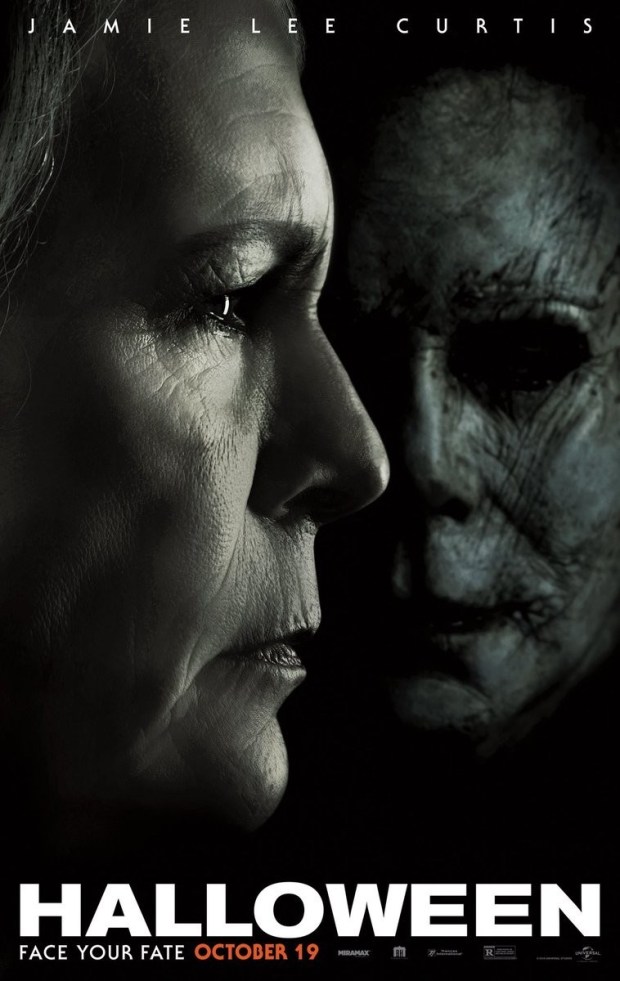
For the most part, this second trailer highlights Laurie Strode, specifically her ability to take charge. She screams at the costumed children and their parents to get off the streets and go home. In another scene, we see what I think is her house, fitted with flood lights and other high-wire alert systems. Clearly, she’s been planning for Michael’s return for decades. Additionally, the new trailer features Laurie’s voice-over. It’s probably safe to assume that the film will mostly focus on Laurie and Michael, as well as Laurie’s daughter and granddaughter. This is underscored by the new poster unveiled at the beginning of this month, featuring Michael and Laurie’s faces.
halloween-2018-poster-laurie-strode-michael-myers-1131805.jpeg
Finally, director David Gordon Green mentioned in this interview with Bloody Disgusting  that there is a continuous shot fairly early in the film that is supposed to be quite brutal. I am guessing that scene is featured in the trailer, after the costumed child bumps into Michael and the boogeyman then picks up a hammer and enters the houses of random neighbors for a killing spree. It’s in that same continuous shot that he trades the hammer for his trademark butcher knife.
Overall, the trailer has me even more excited for the film. If you have any comments or thoughts about the trailer, feel free to drop a line.

Review: Incident in a Ghostland (2018)

If you asked me to make a list of my favorite horror films of the 21st Century, I would certainly include Pascal Laugier’s Martyrs (2008) on that list, one of the most unrelenting and memorable films of the French Extremity wave that dominated the first decade of the 2000s. Needless to say, I was eager to see Laugier’s latest entry in the horror genre, this year’s Incident in a Ghostland. Like Martyrs, the film deals with trauma and toys with the conventions of the genre, specifically home invasion, but unlike Laugier’s previous film, Incident in a Ghostland’s major flaw is poor character development, especially regarding its villains.

Watch the trailer here:

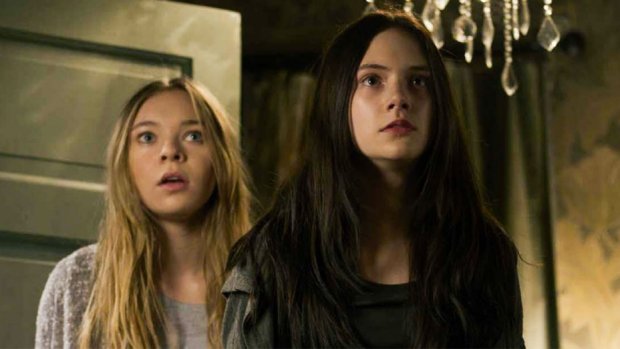
The plot of Incident in Ghostland is basic. A mother, Pauline (Mylène Farmer), moves her daughters, Beth (Emilia Jones) and Vera (Taylor Hickson), into a deceased aunt’s house. Before they finish unpacking, the family is terrorized by the Candy Truck Woman (Kevin Power) and the “Fat Man” (Rob Archer). The villains are the most problematic part of the film. Their motivation is totally absent. The Candy Truck Woman, a trans character, is a shadowy figure who is presented as threatening, but it’s unclear what motivates this character to brutalize the family and dress the girls up like dolls for the ogre to fondle.  Personally, I have no issue with creating a trans character who is a slasher, as long as the motivation is clear. The Silence of the Lamb’s Buffalo Bill is a trans character, but there is a speech in the film and novel by Hannibal Lector that makes clear Buffalo Bill does not murder or kidnap based on that, but rather, has other motives. Buffalo Bill was also based on Ed Gein. Here, it is unclear if the Candy Truck woman is menacing because of sexuality/fear of “the other.” The character is given no backstory and is usually only on screen when committing violence.

ghostland_still_1_-_publicity_-_h_2018

Beth (Emilia Jones) and Vera (Taylor Hickson)

Despite the problematic character development of the villains, the film is not without its strengths. The aunt’s house, filled with wide-eyed, creepy dolls and dusty antiques, creates a moody atmosphere. This is a house that lives and breathes, that has laughing dolls with glowing eyes in its closets. Vera, an aspiring horror writer obsessed with Lovecraft, loves it, while Beth, forced to leave her school and boyfriend behind, scoffs at the cobwebbed rooms.  The themes explored and narrative choices are worth mentioning, too. Like Martyrs, the film addresses the effects of trauma and bends reality. Vera can’t cope with what happened to her family, and as a result, she creates a separate reality for herself, one in which she’s an adult and an accomplished horror writer. This alternate reality creates some interesting narrative choices that upend the conventions of the slasher and home invasion sub-genres. Vera and Beth are tough gals worth rooting for, and they fight and endure, despite the utter cruelty they suffer. In terms of the gore level, a staple of French Extremity films, Incident in Ghostland feels restrained at times compared to Martyrs or other staples of that period, but the film is not always the easiest to watch, especially when the young women are groped by the Fat Man.

Incident in a Ghostland had a lot of potential. It has memorable actresses and establishes the right tone, atmosphere, and tension. However, its under-cooked villains are a glaring flaw, difficult to ignore.