At the Drive-in

Tucked in the foothills of Central Pennsylvania is the Mahoning Drive-in Theater, which has existed since the mid-20th Century and currently plays retro films on 35 mm. This past weekend, they hosted the second Universal Monster Mash, featuring Dracula, Creature from the Black Lagoon, Frankenstein, and Abbott and Costello Meet Frankenstein. Surprisingly, as a Scranton native, I’ve never been to the drive-in, but what I experienced this past weekend, part nostalgia, part community, part everyone unplugging, made me a fan of the classic drive-in movie experience.

Mahoning

(Photo credit Daryl Sznyter)

For each film weekend, the all-volunteer staff decorate the concession stand and grounds with props pertaining to the themed weekend. For Universal Monster Mash, they had a Gil-man prop, a six-foot coffin surrounded with garlic, a mummy, and Universal Monsters trading cards that you could purchase. Most impressive was the Frankenstein’s monster set-up outside, complete with a medical table and electrical towers that smoked. As fans dressed in black Universal Monster t-shirts awaited dusk, they snapped pictures next to the decorations or lingered over Screem magazine’s table, purchasing blu-rays of rare horror films. Families with children slipped on monster masks and posed for group photos, before lining up at the concession stand for popcorn, which, by the way, was only $4 for a large and included free refills.

creatureprop

(Photo credit Daryl Sznyter)

By the time night fell and the projector’s beam of light cut through night and shined on the screen, everyone planted their camping chairs in front of their cars or huddled in their vehicles. As I looked around, I didn’t see the glow of cell phones anywhere. Everyone’s gaze was focused on the big screen. We were treated to vintage movie trailers, including one for Jaws 3, before they screened an episode of “The Three Stooges.”

Finally, James Whale’s classic 1931 Frankenstein played. I have seen the film countless times, written about it, and have taught it as a companion to Mary Shelley’s novel. Yet, there was something about seeing it at the drive-in on 35 mm with other fans that made it all the more special. Its iconic scenes were so much more striking, especially when we first witness Karloff in the Frankenstein make-up, looking at the camera with those dead, sunken eyes. I was pleasantly surprised that no one whipped out their cellphone during the films, not even the children. Maybe no one wanted to be “that person,” or maybe they were as awe-struck by the experience as I was.
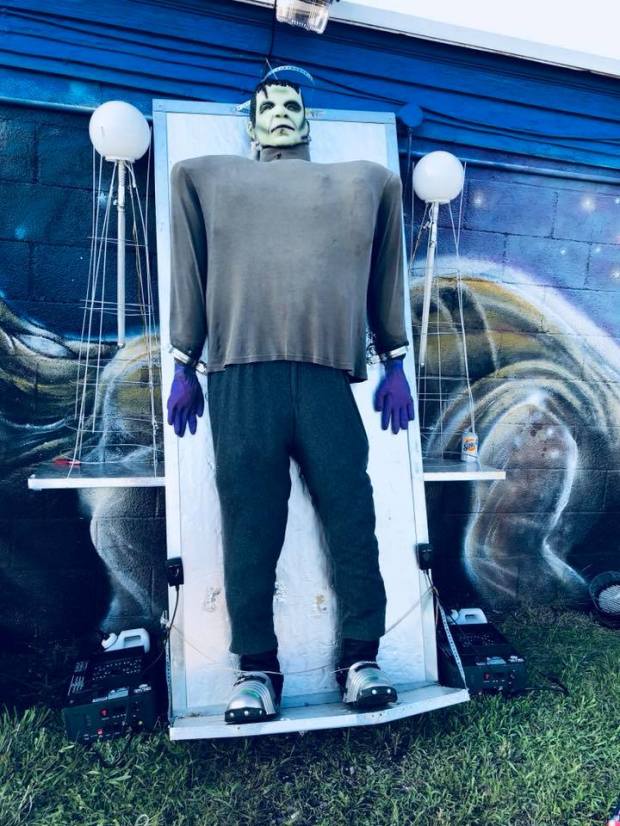
Frankieprop

(Photo credit Daryl Sznyter)

Before and between the films, my girlfriend and I talked to other moviegoers. Some were local and knew that for a few bucks, they could have a fun weekend with their family. Others were horror or drive-in fans that travel hours and hours to the Mahoning when they host the horror weekends. One gentleman encouraged us to attend a drive-in event in September outside of Pittsburgh, the Super Monster-Rama, and he assured us that many in attendance at the Universal Monster Mash would be in Pittsburgh, too. While I always knew that a horror film community existed, I didn’t know about its drive-in subculture. Looking around, though, I saw plates from NJ, MD, NY, just to name a few.

During intermission, one of the hosts said that at one time over 300,000 drive-ins existed in America. Now,  about 400 remain. I suppose it’s easier to download a film to your laptop or watch it on your smartphone, but there was something strangely rejuvenating about unplugging for an evening and watching those Universal films with other drive-in moviegoers. For a few hours, I didn’t check my email or latest headline. So much in or hyper-consumer culture feels disposable, but this experience didn’t. I came away from it wanting to attend another event soon.

For anyone interested in the Mahoning Drive-in, which plays all types of retro films, not just horror, check out their Facebook page for the most updated information

Review: Ghost Stories (2018)

Ghost Stories, written and directed by Jeremy Dyson and Andy Nyman, is a British anthology horror film based on their stage production, but the narrative outside of the three tales is the real highlight. The film poses questions about how society views those who claim to have supernatural experiences and why we sometimes turn to the belief in the paranormal while grieving. In questioning reality, the film makes the statement, the brain sees what it wants to see.

ghost-stories-cropped

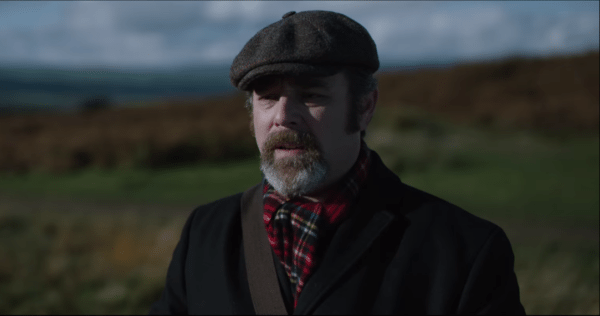
The film’s storyteller, so to speak, is the pompous Professor Goodman (Andy Nyman), who hosts a show called “Psychic Cheats” and discounts stories of the supernatural. After exposing a psychic as a fake, Goodman is summoned by his idol, reformed debunker Charles Cameron (Leonard Byrne), who hands him three case files and urges him to reconsider his world view.

ghost stories 2

Professor Goodman (Andy Wyman)

Accepting the offer, Goodman first interviews Tony (Paul Whitehouse), a former night watchman of an asylum who is haunted by what he saw one shift. This first story is a slow burn, one that relies on elements of a traditional ghost story, including late night bumps and sounds, shadows, and a gradual build-up to Tony’s encounter of a creepy ghost girl.

Tony’s character is one of the most interesting. In the story’s wrap-around, he expresses disdain towards Goodman and mocks his professor title. He also mentions that he’s been jobless, due to immigration, and eventually, he confesses that he’s suffered personal tragedy. Rather than really listen to Tony, Goodman is quick to discount his experience and blame it on his personal grief and unstable life.

The second story, “Simon Rifkind,” is similar to the first tale, meaning that it takes its time building to its final scare. Simon (Alex Lawther) claims to have seen an apparition late one night while driving home from a party. Simon’s performance makes up for the generally weak story, especially when he cries into a crumbled tissue and tells Goodman that he doesn’t want people to think there’s anything wrong with him. The final tale, “Mike Priddle,” is generally subdued and focuses on a rather mild poltergeist that knocks over knick-knacks in Priddle’s (Martin Freeman) home. The story concludes with an unsatisfying jump scare.

The three stories, overall, are mild and it’s the in-between that’s the most interesting, the blurring of reality with the supernatural. After the first tale, Goodman interviews Tony’s priest, who tells him, “How unfashionable it has become to believe in anything other than our personal gains.” This is a personal jab at Goodman who makes a living tearing apart people’s beliefs that can’t be reduced to quantifiable evidence.

The conclusion of the film takes a reality-bending turn, and we’re suddenly thrust into Goodman’s past, presented with a childhood memory of bullies who tormented him and called him “Jew face” before inflicting even worse torment upon another child who they lure into a cave and leave for dead. At its core, Ghost Stories poses questions about reality, while relying on one key element of traditional Gothic literature: the past’s influence on the present. Goodman is haunted by his childhood memory and the boy left for dead in the cave, and as a result, he spends his life denying that the supernatural can be plausible or even that the past can have serious baring on our present actions.

The film’s wrap-around is its real strength, specifically when Goodman’s cocksure reasoning is challenged. The three tales aren’t that scary. Rather, they serve and advance the interspersed, more interesting narrative surrounding Goodman’s beliefs. Unlike other anthology films, such as Creepshow, The ABC’s of Death, and Tales from the Darkside, Ghost Stories makes its storyteller the real focus, and his journey should be considered the fourth tale. It is the most engaging and most substantive aspect of the film.

One Sequel Worth Rewatching

Sequels are always a risky gamble, especially in the horror genre. In the case of The Exorcist, it was always going to be impossible for any sequel to be as ground-breaking as the original 1973 film. No film prior had shown such unspeakable evil befall a 13-year-old girl, from head spinning, to vomiting, to levitation, to strings of curses that would make a sailor blush. I’ve always felt that the real horror in The Exorcist occurs in the first act, when Regan (Linda Blair) talks about her friend Captain Howdy and claims to hear scratching in the walls of her bedroom. Those unseen elements and that creeping dread that something is not right still unnerve me whenever I re-watch the film.

The film was followed by the god-awful Exorcist II: The Heretic, one of the worst sequels in horror history, two prequels, and a recent TV series by Fox that was canceled after just two seasons. Recently, I re-watched The Exorcist III: Legion (1990) in preparation for watching and reviewing the Irish horror flick The Devil’s Doorway. The third film in the franchise, written and directed by William Peter Blatty, author of the novel The Exorcist and its sequel Legion, is really the only sequel in the franchise deserving of attention. It is drastically different than the original, but in some ways, far more haunting, philosophical, and interesting.

exorist3

When speaking about The Exorcist III, Blatty once said that he was more interested in creating “creaks and shadows” than the “head-spinning” elements of the original film. Set in Georgetown 15 years after the original film, Legion follows the story of hard-boiled detective Kinderman (George C. Scott), who is jaded from years of investigating murders. The only thing he’s sure of is that evil does indeed exist but it has no supernatural elements; rather, it exits in the cruel actions of humans. At one point, he tells his friend Father Dyer (Ed Flanders) that God can’t exist because there is too much suffering in the world and humans are too imperfect, prone to self-destruction and diseases, such as cancer.

Kinderman is called to investigate sacrilegious murders in Georgetown, which have some connection to his friend Damien Karras (Jason Miller), the priest from the first film who saves Regan by asking the demon to possess him in the film’s closing minutes, before lunging out the window and falling down a set of stairs.

Jason Miller returns in Legion and stars as the mysterious Patient X, who looks like Father Karras, but how can that be, Kinderman wonders, since Father Karrass died 15 years earlier. Miller’s role is juxtaposed with that of the Gemini Killer (Brad Dourif), who possessed the body of Karras and spent years regenerating his brain. Dourif, most famous for voicing Chucky, is phenomenal in this film. He verbally spars with Kinderman, recounting, in gruesome detail, the murders he committed, and then speaking of his “friend,” “the master,” who made all of the murders possible. Dourif is given long monologues when he’s on-screen. Spittle flies when he talks, and his eyes become wide and impassioned.

Initially, Miller was not available to shoot the film because he was on the West Coast, but once he returned East, the studio insisted that he be included in the film. Blatty did not want Miller in the film, and his director’s cut only features Dourif. That said, the film is much better for having Miller in it, whose sunken, sad eyes speak to the torment of Father Karras’ possession.

Unlike the original film, much of the horror happens off-screen, the “creaks and shadows” that Blatty mentioned. Most of the murders are recounted either through the Gemini Killer’s monologues or through Kinderman’s detective work. When the viewer is about to witness a murder happen on screen, the camera often pulls away and we’re only given the gory details once Kinderman arrives on the scene later and gathers the facts and evidence. This is effective because it leaves much to the imagination.

The Exorcist III also contains one of the greatest jump scares in cinema in the last third of the film. Without giving too much away, I’ll merely state that it involves a nurse and the angel of death. You’ll know it when you see it.

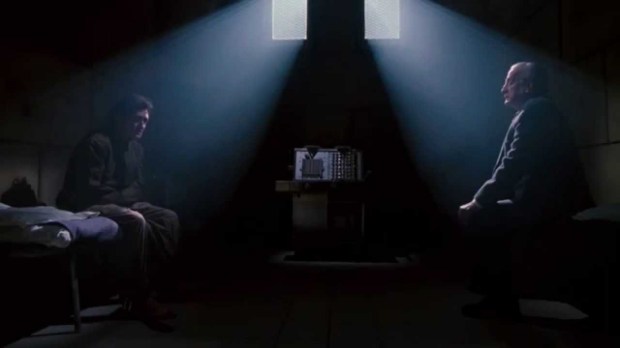
Blatty didn’t want an exorcism to occur at all in the film, but the studio demanded it. The exorcism occurs in the final act, and it feels rather silly and ham-handed compared to the rest of the film, which relies on atmosphere, mood, and tone to establish its unsettling horror. Legion varies so much from its original predecessor because of all it doesn’t show and the way it uses light and shadow. The scenes when Kinderman is alone in a cell with Karras/the Gemini Killer, specifically the use of light and shadow, are incredibly effective.

Exoristshadow

Patient X (Jason Miller) and Kinderman (George C. Scott)

Had the awful Exorcist II never been released, maybe The Exorcist III would have done better at the box office and garnered the attention it deserves. At least it currently has a cult following and has generally aged well. Miller and Dourif’s performances alone, coupled with the philosophical questions posed about the nature of evil, make it one of the best horror sequels.


Review: The Devil’s Doorway


Typically, I’m not a fan of the demonic possession movie. At this point, a lot of the tropes are overplayed and it’s hard to do something unique with the subgenre. Paul Tremblay’s novel A Head Full of Ghosts is an exception that I’ll make, but the book is also hyper-aware of the subgenre’s history. That said, I do recommend  The Devil’s Doorway, a rather unnerving film released by IFC Midnight and directed by Aislinn Clarke.

Set in 1960 at a home for unwed mothers, the film follows two priests who have been sent there to document a “miracle,” a Virgin Mary statue that bleeds from its eyes. Echoing The Exorcist, the film has two priests who are on the opposite sides of the belief spectrum. The young Father John (Ciaran Flynn) is a true believer, while the older Father Thomas (Lalor Ruddy) is a skeptic and is even called a “Doubting Thomas” at one point by his counterpart. Father Thomas reminded me of The Exorcist’s Damien Karras (Jason Miller), who was not initially convinced that Regan (Linda Blair) was possessed by a demon until the film’s final act. Father Thomas does not believe that evil takes a supernatural form. Rather, he sees evil in everyday human actions

This is one of the most interesting concepts of the film. We see the “evil” Father Thomas speaks of play out as the film progresses. The nuns, especially Mother Superior (Helena Bereen), abuse the women, especially physically. Yet, there is little faith to be had in the institution of the Catholic Church to remedy the situation. Early in the film, Mother Superior tells the priests that the Church will merely hide the abuses that the priests witness. They’ll sweep it under the rug as they’ve done with other scandals. Father Thomas knows that she’s right, and it’s probably another reason why he’s simply there to do a job, to prove that there is some rational explanation for the bleeding Virgin Mary statute. He does want to report the abuses, but he knows that it will most likely be fruitless.

Once the priests meet Kathleen (Lauren Coe), a pregnant teenager who the nuns have shackled and banished to the basement, the scares really ramp up. Some of them are typical of demonic possession movies, including levitation, contorted bodies, and ancient languages spoken in a gravelly demonic voice, but because the film employs the found footage technique, some of the scares are unique. For instance, when Father John films some of the events and loses light or the camera cuts off and then on again, it allows for unsettling close-ups of Kathleen in full-blown demon mode. This is the only praise I will give the found footage technique because I think it has been overdone at this point. How many shaky camera shots can we take?

The introduction of Kathleen and the supernatural events that unfold, including exploding Virgin Mary statues, allows for the growth of Father Thomas’ character, which is again somewhat similar to Damien Karass’ character arc. It causes Father Thomas’ seemingly sturdy belief system to be shaken and questioned, which makes him more vulnerable and human. Yet, beyond the film’s supernatural elements, there is something to be said about the everyday evil that Father Thomas speaks of early in the film, the fact that these young women are abused and forced to spend hours upon hours scrubbing floors, washing sheets, or doing other remedial tasks instead of being allowed an education. Even more horrifying is the introduction of Kathleen, with cuts and lashes on her arms and shackles on her wrists. The nuns see the unwed, pregnant women as sinners, undeserving of mercy or compassion. This, indeed, is evil.

Overall, The Devil’s Doorway is a solid entry in the demonic posession subgenre. It addresses belief and skepticism in an intelligent way. Some of its images are generally creepy and haunting, and perhaps, most importantly, it uses the trope of demonic possession to address issues of gender and mortality.

The Devil’s Doorway is currently in theaters and VOD.

Side note: I encourage anyone interested in this film to read this interview with Aislinn Clarke in which she talks about the real “Magdalane Laundries” in Ireland that inspired this film. Pretty scary and eye-opening bit of history.

A Little Bit of Poetry News/Hazleton Arts Fest

I’m taking a slight pause from my usual blogging about the world of horror films to announce a few poetry-related items.

First, Daryl Sznyter and I will be participating in the first ever Anthracite Arts Festival this weekend in Hazleton, PA. Most of the events will be taking place at the Hazleton Arts League. Check out the flyer below because all of the events sound unique and engaging. On Saturday, from 6-10, we’ll be hosting an open mic, and we’ll also be reading some poems and will have books for sale.

AnthraciteFestival

Second, I have two poems, “April Light,” and “What You Learn about the House,” in the new issue of Still: The Journal. They can be read here, and make sure to check out the rest of the issue, too.

Lastly, I have a review of Wendy Chen’s debut poetry collection, Unearthings, over at 4squarereview.com. You can check that out here. I can’t even begin to say how much I loved this book. Keep your eye out for her work. She’s a poet to watch.


The Zombie Is Dead, Long Live the Zombie!

The various sub genres of horror, like everything else, go in and out of fashion. The slasher. The possession movie. The ghost story. The monster movie. The zombie film. For much of the 2000s, the zombie dominated the horror genre. Think of the impressive box office success of films like 28 Days Later (2001), Dawn of the Dead (2004), Shaun of the Dead (2004) and the high TV ratings of AMC’s “The Walking Dead” (2010).

Yet, for the last few years, the zombie genre has waned. Lately, horror has focused more on the internal and the psychological, specifically films like Hereditary, A Quiet Place, Get Out, and to some extent, It. Frankly, I can’t even think of the last time that I saw a zombie film in the theaters. Even “The Walking Dead,” which was a ratings Juggernaut for so many years, may be facing its apocalyptic sunset since Andrew Lincoln, aka Rick Grimes, and Lauren Cohen, aka Maggie, have announced that this season will be their last season, and they will only appear in six episodes. How can the show function without Rick and Maggie? Like a staggering corpse, it needs to be put out of its misery. It had a long, good run.

The more recent horror films that are doing well deal with socio/political issues (Get Out), or deal with the terror that is bringing a child into this world, specifically A Quiet Place, and, to some extent Hereditary. This has been the trend of the last few years, and based upon the United States’ political turmoil and polarization, coupled with the threat of climate change and other big issues, it is not likely this trend is going to subside anytime soon.

This brings me to a newish zombie film that I recommend: Cargo, an Australian film directed by Ben Howling and Yolanda Ramke. Cargo is currently streaming on Netflix and well worth your time.

The plot of the film is rather simple. A father, Andy (Martin Freeman), tries to protect his infant daughter after an epidemic spreads and turns people into zombies. Yes, this formula has been done time and time again, but Cargo works so well because it focuses on character, on Andy’s anxieties of  raising a child in  an unforgiving, uncertain world.  The visuals of the film are striking, nightmareish, and sometimes surreal. The zombies are not your typical rotting flesh corpses; instead, they have green fungus growing from their skin. Read into that any environmental metaphor that you may.


Zombies have survived for decades and decades because they have managed to evolve. They started out on the silver screen as a monster that alluded to Haitian and West African voodoo lure/myths. They then became Romero’s slow-walking flesh-eaters, until they become something even more menacing, relentless, and faster in 28 Days Later and the Dawn of the Dead remake.

I am not saying that Cargo is going to remake the genre. It doesn’t have enough mass appeal to do that, but it does show that zombie films can still work and work well when they focus on character and a believable plot, like a father trying to protect his daughter. The fungus aspect gives the familiar monster a new angle that taps into deeper environmental concerns. As the zombie trend that dominated so much of the 2000s finally wanes, the creature will need to evolve again to suit the times and the larger global anxieties. Cargo provides a path forward for the flesh-eating, familiar creature.


Some Thoughts on The Halloween Trailer

For horror fans, today’s the day. The new Halloween trailer has dropped.

There is quite a bit to digest in this nearly three minute trailer, but here are some of my general thoughts.

  • Laurie Strode (Jamie Lee Curtis) is a badass. Much of the trailer shows Laurie Strode ready and eager to confront Michael Myers after her first encounter with him 40 years ago. She fires shotguns. She secures the house. She says, “I’ve been waiting for him.”‘
  • The film ignores all of the other Halloween movies, other than the original. This film is sort of a soft reboot, and it’s already been reported that it will be a direct sequel to John Carpenter’s 1978 film. At one point, a friend of Laurie’s granddaughter asks, “Wasn’t it her brother who murdered all of those babysitters?” The granddaughter counters, “No, that was something people made up.” So, there you have it. This film ignores the story-lines from all of the sequels, even the brother/sister story first introduced in Halloween II.
  • John Carpenter’s name is very present in the marketing. Early in the trailer, it is noted that the film was produced by John Carpenter. He also handled the score. It is likely they will continue to push and market his return to the franchise.
  • Several nods to the original. From the mental asylum story-line, to the scar on Laurie’s arm, to the closet scene at the end of the trailer, it is clear that this film will have  several nods to the original film.
  • Michael looks aged… but menacing. Just look at that mask! It is worn and tells its own story. Michael, meanwhile, looks hulking and menacing in every scene. It should be noted that Nick Castle, who played the original shape, has returned for this film.
  • Women, Laurie will face off with Michael again, but it’s clear her legacy/the plot of the first film will have a major impact on her daughter and granddaughter. At one point, her granddaughter says, “Everyone in my family turns into a nutcase during this time of year.” I hope this idea is explored, and I hope the other Strode women go toe to toe with the boogeyman.

So, there you have it. Our first glimpse at the new Halloween film is here. I am curious to what others think and what observations they may have. What are you expecting and hoping for with this film?

The Poetry of Oz’ Perkins’ Horror Films

After learning that Oz Perkins, son of Anthony Perkins, aka Norma Bates, was tapped to direct an adaptation of Paul Tremblay’s A Head Full of Ghosts, one of my favorite contemporary horror novels, I knew that I had to finally view his two previous films, The Blackcoat’s Daughter and I Am the Pretty Thing That Lives in the House. There are aspects of both films that frustrate me, especially the pacing of the later, but both films stayed with me days after their viewings. Both are slow-burns that feel like nightmares, heavy on atmosphere, mood, and tone. Both play out as visual poetry.

The Blackcoat’s Daughter primarily centers around two teens, Kat (Kiernan Shipka) and Rose (Lucy Boynton), left behind at an all-girls boarding school during a break.  As the film progresses, Kat becomes stranger and stranger. First, she thinks that her parents are dead, though she has no evidence to support the claim. Then, she acts out towards the nuns and staff members, and she becomes obsessed with Rose. The film also follows the story of Joan (Emma Roberts), an escaped mental patient. At first, it doesn’t seem like the stories of Joan, Katm and Rose are linked, but the narrative clarifies itself in the last 20 minutes or so, and the payoff is worth it.

The Blackcoat’s Daughter has few, if any, jump scares. In fact, it has one of the most low-key, understated exorcism scenes I’ve seen in any horror film. Instead, it relies on tone and mood, a bleak Canadian winter and a mostly gray and white color palate from scene to scene. As I said earlier, visually, the film feels like a long, slow nightmare.

I Am the Pretty Thing That Lives in the House is a film that draws much more from the Gothic tropes of literature, specifically the exploration of how the dead are  not really dead and the past is not really the past. The film has very few characters and focuses on Lily (Ruth Wilson), a hospice nurse charged with tending to Iris Blum (Paula Prentiss), a horror writer. Eventually, Lily starts reading Iris’ most acclaimed novel, The Lady in the Walls, about the ghost Polly (Lucy Boynton), who also haunts Iris’ house.

The film weaves poetry into the film through monologues and some of the visuals. Just check out the opening monologue by Lily:

I have heard myself say

that a house with a death in it

can never again be bought

or sold by the living.

It can only be borrowed from the ghosts

that have stayed behind

to go back and forth,

letting out and going back in again,

worrying over the floors

in confused circles,

tending to their deaths

like patchy, withered gardens.

They have stayed

to look back for a glimpse

of the very last moments of their lives.

But the memories of their own deaths

are faces on the wrong side

of wet windows,

smeared by rain,

impossible to properly see.


From there, the rest of the film serves as a meditation on death and the way that the past influences the present. As the film progresses, at a very slow pace, I might add, Lily becomes obsessed with the story of Polly and her influence on Iris’ novel. Polly is often shown visually in the present as a face seen through the wrong side of a wet window, something blurred, but still present, looming in the house, which in itself is quite a character in the film, a living, breathing thing with groaning floorboards and wide, darkened rooms.

Lily, meanwhile, is obsessed with the color white and often wears white through the duration of the film. Early on, she says, “I’m very seldom required to wear white by my employers. But, anyway, I always do. It;s always been that wearing white reassures the sick that I can never be touched even as darkness folds in on them from every side closing, like a claw.”

That white, however, is soiled as the film moves along, especially when Lily discovers a black, moldy substance growing on the wall where Polly was killed and buried by her husband years  earlier. Like The Blackcoat’s Daughter, I Am the Pretty Thing That Lives in the House is intentional in its color palate and visuals.  The growing darkness represents death, decay, and rot. At one point, Iris, who has dementia and constantly mistakes Lily for Polly says, “Even the prettiest things rot.”

The ending, like The Blackcoat’s Daughter, is a surprise and both Iris and Lily ultimately succumb to the rot that is Polly haunting the house. My main gripe with the film is the pacing. There are only so many scenes we can take of Lily or Polly walking across creaky floors  before it grows a bit tedious. This should have been a short film as opposed to a full-length.

A Head Full of Ghosts is a book that plays with traditional narrative structure and challenges it. The novel also takes the typical story of exorcism and turns it on its head. Perkins’ first two films challenge narrative expectations and conventions of the genre, so I’m excited to see what he does with the adaptation of Tremblay’s novel.

The Blackcoat’s Daughter is streaming on Amazon Prime, and I Am the Prettiest Thing That Lives in the House is streaming on Netflix.


Revenge and the Power of the Gaze

I wrote an article on the French film Revenge and the gaze. It was posted over at Horror Homeroom. You can check it out here.

While difficult to watch, Revenge is one of my favorite horror films of the year thus far, especially for what it does with narrative and the gaze. If you do check out the film, prepare yourself mentally. It’s not an easy film to watch. I also encourage you to follow Horror Homeroom. They do a great job covering the horror genre with a critical eye.