Quick Poetry Update

I mentioned a few weeks ago that in the new year, I would be writing poetry book reviews for 4squarereview.com and more essays for the Schuylkill Valley Journal. My first review for 4squarereview, on Aaron Coleman’s forthcoming book, Threat Comes Close, was published last week. You can read it here.  I also have an essay on Robert Bly and environmentalism in the new online edition of SVJ. This essay was a multi-month project, so I hope anyone interested in poetry or environmentalism takes the time to check it out. You can read it here.

This summer, I’ll be working on a new poetry manuscript, though I  feel no rush to publish it. I am merely going to start the process of ordering the poems. At least one section of the book will contain poems written in response to horror films. Three of those poems were published in the November issue of The Horror Zine and one was published in the debut issue of Rockvale Review. Check them out!

Aside from blogging about film, horror, and literature, I’ll still post poetry updates on here now and then.


The Truth Is Still Out There, Apparently

03-x-files.w710.h473.jpg


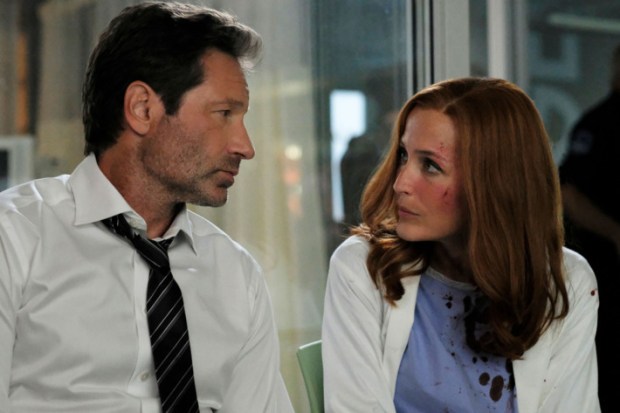
Last night marked the season 11 premiere of “The X-files,” which was brought back to life two years ago in a short, six-episode season that garnered mixed reviews and ended on a major cliffhanger, with the fate of Mulder and Scully uncertain, due to impeneding alien colonization. Thus far, this season has generated positive reviews and is slated for 10 episodes. Last night’s premiere was generally strong and marked the return of some other long-standing fan favorites.

There are some spoilers ahead, so you may want to avoid reading if you haven’t seen the episode yet but plan to.

The premiere was a mythology episode that generally focused on the ongoing alien invasion story line. Well, it turns out that the aliens are no longer interested in planet Earth, due to global warming and waning natural resources. With the alien invasion put on hold, the show’s long-standing big bad, the Cigarette Smoking Man (William B. Davis), plans to wipe out most of human kind with an alien plague and let the chosen few survive, thus essentially wiping the slate clean. The key to stopping him centers around Mulder and Scully’s son, William, who is poised to be a major figure this season. Near the end of the regular series, we learned that he is part alien and was hidden for his own protection.

The Cigarette Smoking Man had some of the best dialogue during last night’s premiere, dialogue centered around the Trump era. In a show that has thrived on the notion of conspiracy theories, the villain said how truth is now fluid, how nothing is crazy anymore, how it’s so easy to label truth and hard science as fake news. The opening moments of the show featured a relatively powerful voice over by the Cigarette Smoking Man talking about U.S. history and power. This voice over was juxtaposed with images of the moon landing, the JFK assassination, the Clintons, the violence in Charlottesville this past summer at the hands of neo-Nazis, and yes, Trump. The point of this seemed to be that events and politicians will pass, but there will always be a chosen few working behind the scenes to control the outcome of world events. This has generally been the long-standing premise of “The X-files.” The syndicate, a group of shadowy conspirators, were always the real enemy.

Last night’s episode felt fresh and new, while still maintaining general aspects of “The X-files” mythos. Gillian Anderson and David Duchovny were great in their reprisal of Mulder and Scully. I look forward to seeing them on screen more together this year.

My only real gripe about the premiere, and the show in general, is the way that its creator, Chris Carter, keeps rewriting the main story line. First, the aliens wanted to colonize Earth. Now, they suddenly aren’t interested in that. Is the Cigarette Smoking Man lying about this? Also, how is he still alive? He appeared briefly in season 10, but at the end of season 9, which was meant to be the show’s finale, he was blown up. How did he survive that? I always got the sense that the show’s writers had no idea where the alien mythos story line was going. I  still feel that way after watching the season 11 premiere. It often feels like the writers make up or change the mythos with each season, with no clear end in sight.

With that said, I’m eager to watch the remaining nine episodes, especially the monster-of-the week entries. Gillian Anderson recently said that she doesn’t plan to revive the role of Dana Scully after this season, so this season very well may be her “X-files” swan song. In the meantime, I’m going to enjoy watching Mulder and Scully search for the truth once again.


Political Predictions for 2018

Borowitz-Capitol-Citigroup


I’m taking a break from blogging about films, literature, and the horror genre to offer some political predictions for 2018. First, I will preface this post by reiterating what a news editor told me about 10 years ago when I worked as a full-time political beat reporter for a daily outside of Philly. Politics is fluid. Nothing is certain. Anything could change. If we’re talking about the 2018 mid-terms, which feel like the most consequential mid=terms in a long, long time, then we need to acknowledge that the 10 months that separate January and November is a very long time in politics. Anything can happen, and 2016 and 2017 certainly proved that.

1.The blue wave builds…. but when does it crest/peak? This is my biggest question heading into 2018. Just how big will the blue wave be? Any statistician or political junkie/pundit will tell you that there will be a blue wave next year. The Democrats lead on the generic ballot for control of Congress by about 15 points. Their margins are especially high among 18-34 year-olds and women. Their odds are split among independents. Meanwhile, The Hill and Politico reported last week that behind closed doors, Senate Majority Leader Mitch McConnell has been fretting that the GOP may lose control of the House and Senate. So yes, a blue wave is building, but we won’t know how big it is until November comes and goes.

2. The Democrats gain control of at least one branch of Congress. If I made a bet on Democrats regaining control of Congress, I would put most of my money on Dems retaking the House. They need to gain 20 plus seats to make this happen. Yes, a lot of the districts are heavily gerrymandered, but the Democrats are running an incredible amount of candidates next year, especially compared to the GOP’s numbers and the number of GOP reps retiring, probably because they know a wave is coming. Control of the House will come down to suburban Philadelphia districts, suburban DC districts in Virginia, and a few districts in CA where the Dems should be able to topple some moderate GOP reps. It is also likely the Dems will win some seats in districts they typically wouldn’t win in other years because though Trump will not be on the ballot, he will still be a drag on the ballot for the GOP. In 2010, the GOP netted 63 House seats and 6 Senate seats. They obliterated the comfy majority the Dems had in the House and nearly retook the Senate, which they’d do two years later in 2014. Historically, the party that occupies the White House loses a lot of seats in the first mid-term. So, if the Dems retake any branch of Congress, my money is on the House.

3. The Dems don’t retake the Senate. This is the prediction I feel most iffy about. Since Doug Jones won in Alabama and will keep that seat until 2020, the Senate is now within Democratic reach. However, it is still a major, major uphill slog, even though the Dems only need to flip two seats for control. This prediction comes down to basic math. The Democrats have to defend 25 seats this year. The GOP only has to defend 10. The Democrats best chance to flip a seat is to defeat Dean Heller in Nevada, a state that has been trending blue since at least 2010. The path to the majority for Dems cuts through pretty red states, including Tennessee, Arizona, Mississippi, and Texas. Doug Jones won, but he won because of the awfulness of Roy Moore and because of incredible black turnout. The Dems may be able to repeat a similar turnout pattern in a state like Mississippi, but Tennessee does not have the make-up that Alabama has. Meanwhile, Texas is the great big elephant, the state that the Democratic Party is sure will trend purple in a few election cycles, but so far, that hasn’t occurred or even come close to happening. If the Dems are going to win a Senate seat in Tx by defeating Ted Cruz, then they are really, really going to have to focus on getting out the Hispanic vote and focusing on turnout in major cities like Austin and San Antonio. Is Democratic control of the Senate possible? It is, but it’s still unlikely.  The path for Democratic control is extremely narrow, and meanwhile, there are  A LOT of deep red state Dems on the ballot next year, including in the states of West Virginia, Missouri, Indiana, and North Dakota. The Senate map will be far, far more favorable to Dems in 2020 and 2022.

I will note that the health of John McCain in Arizona and Thad Cochran in Mississippi, both Republicans, also factor into all of this.

4. Dems win big at the state level and gain control of more governor’s mansions. Again, this comes down to math. There are a lot of blue state Republican governors on the ballot this year, including in Maryland and Illinois. In purplelish Maine, the unpopular GOP governor, Paul LePage, will be termed out. The GOP won a whole lot of governors mansions and state legislatures over the last two mid-term election cycles. In fact, one of Barack Obama’s legacies is the fact that his party lost a historic number of state houses under his tenure. This should really be the year when Dems reverse that trend. In fact, Obama has stated he plans to grow the Democratic bench once out of office. The Dems won a lot of state races in 2017, including in places like Georgia, Oklahoma, and Virginia. The party is poised for a lot of pick-ups at the state level this year.

5. Dems win the House but DON’T move to impeach Donald Trump. I don’t find it likely that the Democratic Party will seriously move to impeach Trump, unless Mueller really uncovers something huge. If a Democratic House majority drafted articles of impeachment once the new Congress is sworn in come next January, nothing would happen. I say this because the Senate has to convict. The Democrats won’t have 60 plus votes at the beginning of next year to convict and impeach the current sitting president. Impeachment is a fantasy of the left, but I don’t see a path for that to happen. I also don’t think it’s the best move politically for the Dems.

6. Donald Trump’s approval numbers stay in the mid-low 30s. Simply put, Donald Trump’s base loves him. They will continue to love him in 2018. They make up about 1/3 of the country. Trump is losing independents and white, suburban women. I don’t see him changing in the new year. I don’t see anyone around him making him change. He is even presiding over a fairly strong economy, but that hasn’t helped his numbers. He is who he is.

7. Donald Trump pushes for an infrastructure bill. This is something that I assume Dems would like to work with Trump on, but they won’t work with him if the infrastructure plan involves a complete privatization of the nation’s highways. I predict Trump will push an infrastructure bill early this year, but it’s only happening if he is willing to move to the middle on this, along with Ryan and McConnell. Otherwise, it’s not happening.

8. McConnell and Ryan butt heads over “entitlement reform.” I hate using the term “entitlement reform,” so instead, I’m going to use the term cut to benefits. House Speaker Paul Ryan really, really wants to slash the social safety net and cut Medicare, Medicaid, and Social Security, programs we all pay into via our taxes. Along with lowering the corporate tax cut, Ryan has dreamed of burning the social safety net since he was a college student reading Ayn Rand. He probably has enough votes in the House to do this, but the GOP only has a one-seat majority in the Senate now, due to Doug Jones. It’s hard for me to imagine how they pass any major cuts to these benefits in the Senate, but hey, crazier things have happened.

7. A deal is reached on DACA before the March deadline. Are we really going to be a country that boots 800,000 Dreamers? I sure as hell hope not. Most Republicans are not for ending DACA and kicking people out of the country that have been here since they were children. I don’t think Trump really wants to end DACA, despite his anti-immigrant fervor. I assume the parties will come up with an agreement, maybe by mid-January, when they need to fund the government again, since they only passed a short stop-gap measure before Christmas. I predict the deal will include increased funding for border security. I sure hope I’m right that they come to some deal here and protect the Dreamers….

8. Climate change will continue to wreck havoc and cause extreme weather globally, but the U.S. will continue to do nothing and Trump will continue to deny science, slash the EPA, and keep dismantling Obama-era environmental policies. We may be past the point of no return regarding climate change. 2017 saw a lot of extreme weather, and that will continue in 2018. Countries like China, India, France, the UK, and others will continue to take the lead on this issue, since the U.S. has withdrawn from the Paris Agreement and has essentially given up being a leader on this issue under this administration

These are my predictions for 2018. Again, nothing in politics is certain, and 10 months is a very long time until the mid-term elections. That said, there are some trends from 2017 worth looking at, especially Democratic turnout and wins at the state level that are good indicators of where 2018 will go politically.

I hope that everyone has a safe, happy, and healthy New Year!


The Shape of Water: A Monster Movie/Love Story for the Trump Age


In a recent interview on NPR’s “Fresh Air,” director Guillermo del Toro said his latest creature feature, The Shape of Water, is a movie that on the one hand is a tribute to his love of monster movies, including Universal Studios The Creature from the Black Lagoon, and on the other hand a love story. The Shape of Water is indeed a love story between Elisa (Sally Hawkins), a mute cleaning lady at a Cold War-era government facility, and the Amphibian Man (Doug Jones). More impressive, though, is the way that the film rewrites some of the classic monster tropes while serving as a metaphor for the Trump age and xenophobia.

The film will probably draw some comparisons to The Creature from the Black Lagoon, one of the later installments of the Universal Monster films. The Amphibian Man looks incredibility similar to the Gil-man/Creature. In the NPR interview, del Toro states that he was drawn to some of the visuals of the 1954 film, especially the scenes of the Gil-man  under water, watching a young woman swim, unbeknownst to her. Like Frankenstein’s Monster, both Mary Shelley’s creation and director James Whale’s Universal Studios adaptation of the Monster, the Amphibian Man is a sympathetic creature, one pulled out of a river in South America by a misogynistic brute/government worker, Richard Strickland (Michael Shannon), and tortured by him throughout the film. However, unlike the Universal Monsters, the Amphibian Man never kills anyone or poses a threat. He is a creature of beauty with blue lights on his scales and the ability to heal wounds with his touch.

The real monster in the film is Richard Strickland. Not only does he constantly harm the creature using a taser/billy club that he refers to as his “Alabama stick,” he is also incredibly sexist. He silences his wife during sex and propositions Elisa, confessing it’s a turn- on that she can’t talk and that’s how he likes his women. When he isn’t trying to maintain power over women, he demeans the cleaning staff, who he deems as beneath him. Strickland is also like Sheriff Jim Clark, the baton-wielding segregationist who took pride in assaulting Civil Rights demonstrators during the march on Selma for voting rights. A few times, he makes racist comments towards Elisa’s friend, Zelda (Octavia Spencer), a black cleaning lady.

Those who help the Amphibian Man escape are also the Other. Elisa is mute. Zelda is an African American woman in the Cold War age, and Elisa’s neighbor/friend, Giles (Richard Jenkins), is a gay man. All of them relate to and show empathy towards the Amphibian Man because they know what it is like to be different, to be thought of as less than human by people like Strickland.

Though the film is set in 1962 and includes a Cold War subplot, the film, like much of del Torro’s work, is  metaphorical and can be read as a love story/monster movie for the Trump age. A lot of  Strickland’s dialogue could have been said at a  Trump campaign rally when he talks about Muslims,  immigrants, or anyone non-white, for that matter. del Torro takes the classic monster tropes and rewrites them so that the monster isn’t really the one we have to fear. The real bad guy is the man in power who wants to silence women and thinks that the Amphibian Man should be killed simply because it is different. As the film progresses, Strickland grows more monstrous and less human, both physically and mentally. The film is also unique because it tells the story from the perspective of the early 1960s help. It is their story as much as it is the monster’s story. It is likely that The Shape of Water will be an Oscar contender. It is visually striking and has a powerful story. It is appropriate for this current moment without being preachy.

For your holiday viewing pleasure


If you’re looking for a horror movie to watch during this holiday season, then let me recommend Black Christmas (1974), one of the most overlooked slasher movies that preceded Halloween but established a lot of the techniques that John Carpenter used in his much-acclaimed film.

The premise of Black Christmas is quite simple. Directed by Bob Clark, the Canadian horror flick focuses on a group of sorority sisters who are a tormented by anonymous phone calls that put them on edge when all they want to do is make plans for their holiday break. The film is loosely based on the urban legend of a killer who torments a babysitter and tells her to “check on the children,” and it is based on murders that occurred in Montreal.

So what makes Black Christmas different than other slasher films? For one, it predates the slasher wave that started in the late 1970s and peaked in the 1980s. It is generally a more innovative and unsettling film compared to all of the Friday the 13th, Nightmare on Elm Street, and Halloween sequels, too. Black Christmas is a film heavy on atmosphere, from the location of the house to the squeal of violins in the soundtrack. The sorority sisters are picked off one by one, but the gore is never gratuitous. More unsettling than the deaths are the unnerving phone calls that follow.

The film also established the technique of creating a point of view from the killer’s perspective, which has been used countless times since, most notably in John Carpenter’s Halloween, which opens with a shot from a young Michael Myers’ POV, as he is about to murder his older sister, Judith. Carpenter uses this technique several times throughout the film, as Michael stalks Laurie Strode (Jaimee Lee Curtis) and her friends.

If you’re looking for a horror movie this holiday season, then check out Black Christmas. The film still holds up well and is generally creepy, especially its conclusion. It plays on the worst fears of every babysitter, and it is a lot more original than the nauseating slasher wave that followed.

If you have any Christmas horror movie recommendations, feel free to share!


Reconciling the Past: Thoughts on the Last Jedi (MAJOR SPOILERS)


If Star Wars: The Last Jedi is about anything, it’s about the past and our relationship to it. This especially plays out through the story lines of Kylo Ren (Adam Driver), Rey (Daisy Ridley), and Luke Skywalker (Mark Hamill), who spends a majority of the film broken, analyzing his past actions and the legacy of his character. It is only in the third act that Luke wises up, after a visit from Yoda’s force ghost, and decides to join the Resistance as they make a desperate, final stand against the First Order on the planet of Crait.

Kylo Ren, meanwhile, son of Han Solo (Harrison Ford), who he killed in The Force Awakens, and Leia Oragana (Carrie Fisher), has more than one string of dialogue in which he renounces the past, saying, at one point, “Let the past die. Bury it if you have to.” When he tries to lure Rey to the dark side, almost echoing word for word Vader’s pitch to Luke in The Empire Strikes Back, he tells her to let go of her past in order to become who she’s meant to be. Ultimately, she refuses his offer and stays with the Resistance. It’s clear, however, that Kylo is going to be a different villain than Vader. Fairly early in the film, he even smashes the Vader-like mask he wore throughout The Force Awakens.

As I already noted,  Luke spends much of the film deconstructing the hero mythos of Luke Skywalker, even asking Rey when she first asks for his help if she really thinks it possible that he and his lightsaber can take down the entire First Order. The Luke Skywalker of this film is not the hero from the original films. Furthermore, his action scenes are few. In the last act, Luke, well a hologram/Force projection of Luke, battles Kylo Ren on Crait in order to save his friends and what remains of the Resistance, but that scene is pretty short and not that action packed compared to other lightsaber battles.

Luke and Kylo’s stories serve as a statement that it is time to allow the franchise to grow and stray from the original films. At this point, Han Solo is dead, Luke sacrifices himself at the end of The Last Jedi, and though Leia was set to have a large role in the third and final film of this trilogy, that is impossible now, due to Carrie Fisher’s death in 2016. Even Admiral Akbar  (the It’s a trap guy from Return of the Jedi) dies early in The Last Jedi, during a Resistance attack/space fight gone horribly wrong.

Last Jedi director Rian Johnson, who has been tapped to direct a completely new trilogy in the Star Wars universe, has made it clear that we can’t hold onto the past forever and there are plans to expand the universe. That said, there are plenty of nods to the original films in The Last Jedi. The battle of Crait, for instance, very much resembles the battle of Hoth at the beginning of Empire. There is snow and even bigger imperial walkers. The rebels are drastically out manned and outgunned and forced to escape. Some of the dialogue even overlaps dialogue from the originals films.  But as Luke and Leia acknowledge at the end of The Last Jedi, the Resistance will live on, but with new faces. Cue the close-up of Rey, Poe Dameron (Oscar Issac), and Finn’s (John Boyega) faces. This film very much serves as the passing of the baton to a younger cast and new characters.

The original films will always be there for us to watch and re-watch, but it is clear that Disney plans to take the franchise in new directions. We’ll see where they go after The Last Jedi. Here is a general list of what I liked and disliked about the film.

Likes:

  • The character development! Rey, Kylo Ren, and Luke were all multi-layered characters in this film, and to some extent, so was Poe and new Resistance fighter Rose (Kelly Marie Tan).
  • The humor! There are a lot of well-crafted jokes in this film, despite how dark it is at times. I laughed out loud more than once.
  • The porgs and snow wolves. They are cute, but they are not overly cutesy. The new creatures/animals also show the connection between nature/the Resistance and preserving the galaxy for all creatures.
  • The battle of Crait. This was my favorite battle in the film, and there are A LOT of battles. The battle between Kyle Ren and Luke is well worth the wait.
  • Mark Hamill and Carrie Fisher on screen for the last time together. What else do I have to say about this?
  • The fact that the major Resistance fighters are all ordinary people, not princesses or folks with Skywalker blood. Kylo even admits to Rey that her parents were nobodies, willing to sell her to a junkyard for cash. Finn was a Stormtrooper janitor before joining the Resistance. Rose also comes from an incredibly humble background. The new films are very much the 99 percent against the elite.
  • The number of women in the Resistance. 2017 was the year of the woman/the women’s march/the silence breakers, and women occupy top leadership roles in the Resistance. That’s great to see. Luke also tells Kylo near the end of the film that the Jedi will live on, through Rey.

Dislikes:

  • Some of the plot holes. If Supreme Leader Snoke is so powerful, how did Kylo Ren kill him so easily? What IS Snoke’s story anyways? Now that he is dead, we shall never know. He was quite the big bad in The Force Awakens, only to be sliced in half fairly easily in The Last Jedi.
  • Luke’s sacrifice. I get why this had to be done, but the way it was done still has me scratching my head. Luke does not actually fight Kylo. He projects a hologram and meditates during the projection. Yet, he is killed? How is this possible? How can you kill a hologram? Does he decide to just sacrifice himself to the Force? Will he be a Force ghost in the next film like Yoda? I have no idea.
  • The pace at which Disney is releasing these movies. One Star Wars movie per year is a lot! At one point will there be burnout?

If you saw The Last Jedi and want to comment, feel free!


The direction of this blog

If anyone reads this blog regularly, they may have noticed that over the last six or seven months, I’ve mostly written about horror on the small and big screens. Heading into 2018, that will continue. This blog has shifted its focus from poetry-related content to horror. Am I ditching poetry? Heck no! However, I have two main outlets for writing about poetry critically: Schuylkill Valley Journal, where I am focusing on essay writing, and 4 Square Review, where I’ll be a staff reviewer starting this January, when the site launches. I am grateful to write for both of those outlets and to give poetry its due there. I love writing about poetry in the essay form, and of course, I will continue writing and publishing my own poetry. Look for a new essay I have on Robert Bly and environmentalism coming out in SVJ this January.

Heading into the new year, this blog will mostly focus on horror-related content, from film, to TV, to books. I’m sure I’ll write a political post now and then, too, especially heading into the mid-term elections in the U.S. When it seems appropriate, I’ll post events happening in the Scranton area, too, especially the Writers Showcase readings.

Anyways, thanks for reading!

TWD’s Unexpected Death

rickandcarl


Typically, “The Walking Dead” has followed the general arc of the comic, especially under show runner Scott Gimple, who, at times, would have been far better off allowing the scriptwriters to stray more from the source material. Last night’s mid-season finale, however, took a drastic shift from the comic in one of the most jaw-dropping reveals. Carl (Chandler Riggs) has been bitten by a walker. Yep. Carl is going to die, probably no later than the first episode of the second half of the season. This is a major shift from the comics. Following the All Out War arc between Rick’s group and Negan’s Saviors, there is a time jump of a few years. Carl is older and more confident in making strategic decisions in times of crisis. Since Rick is nearly killed by Negan at the end of the war, Carl assumes a leadership position, and to this day,  he takes on some of the most interesting story lines. That won’t be happening on the show, however.

It is unclear why the scriptwriters decided to kill of Carl. Maybe, Chandler Riggs wants to attend college and move on from a show that has consumed nearly half of his life. Maybe, the writers wanted to shake things up and show the audience that indeed no one is safe, including original cast members. Maybe, they wanted Rick’s character to go in a new direction.

Will all hope be lost for Rick Grimes after losing his only son? I don’t think so. Unlike the comic, he still has his daughter Judith to raise. He still has his friends, and it is likely he will be even more emboldened to wipe out the Saviors, who he will probably blame for Carl’s tragic fate, despite the fact that Carl suffered the bite while saving a new character named Siddiq and bringing him back to the community, thus giving him a chance to survive. This happened a few episodes ago when they were in the woods and Carl was ambushed by a walker and knocked to the ground. The bite was not revealed in that particular episode, but there is a reason that the camera didn’t show Carl’s lower half when he was knocked over by a walker. He was bitten, and they kept the fact a secret for a few more episodes.

My main hope for “The Walking Dead” at this point is that it will wrap up the All Our War arc soon, no later than the second half of this season. At one point during last night’s mid-season finale, Carl tells his father that they have to start rebuilding, that they can’t keep feuding with various factions. In other words, there has to be some other purpose to their existence. “The Walking Dead” used to be about the idea of humanity in the face of a collapsed society, but for the last season and a half or so, it’s been one battle after another, an action show with some zombies in the mix. You would think that the bullets would run out at some point!

Carl risked his life to save Siddiq, someone he barely knows, because he didn’t want a human being trying to survive alone in a zombie apocalypse. At one point, when Negan and his goons are about to bomb Alexandria with grenades, Carl asks him, “Is this who you really wanted to be?” Those moments have always been the strength of the show, especially during those first few season, its prime. Maybe, after Carl’s death and after All Out War, the show can shift back to the idea of trying to rebuild and maintain humanity in such a brutal world. That should be the focus again, especially now that Rick is going to lose his only son.


Can Get Out Snag an Oscar?


It’s rare for horror movies to be in the running for an Oscar.  The genre has been around since the early stages of film and underwent its first Golden Age during the 1930s Universal Studios run, which were films heavily influenced by the 1920s German Expressionist films like Nosferatu. Yet, despite its connection to film history, it has largely been shut out of the Oscars. IMDB has a list of horror/suspense films that have been nominated over the years, and less than 50 films make the list. Some of the films do not fall directly into the genre of horror, since the list combines horror with suspense, and some of the films, like Frankenweenie, are questionable. The only horror film to win for Best Picture was Silence of the Lambs. The Exorcist was nominated, but it didn’t win.

There is a chance that Get Out can change the trend and snag a possible Best Picture nomination and win. Some buzz has already been building, including this recent article by Slate. Directed by Jordan Peele, the film grossed over $200 million worldwide and analyzes thorny racial issues in the U.S. It is the perfect movie for the era of the NFL protests and Black Lives Matter. Beyond that, the film rewrites a lot of the horror tropes and conventions.

The film centers around college students Chris (Daniel Kaluuya) and his girlfriend, Rose (Allison Williams), as they travel upstate to visit her parents in rural America. On the surface, Rose’s parents act progressive and appear happy that their white daughter is dating a black guy. Her father says more than once that he voted for Obama, as though that absolves him of any racial prejudices. The film is unique in the sense that Peele takes supposedly affluent progressive liberals to task for claiming to be social justice warriors, but harboring their own prejudices. The film has its comedic elements, too, especially through Chris’ best friend, Andrew (Lakeith Stanfield), who constantly warns Chris that a black man visiting a white girl’s parents in rural America is a recipe for disaster. Andrew also reiterates a lot of the horror movie tropes, namely that the black characters are often the first picked off, especially in the 1970s and 80s slasher films. More importantly, the film shows how the past constantly  haunts the present, which is a fundamental element of Gothic literature and film. The plantation-like setting and one of the film’s main plot points showcases that idea.

The film has a methodical pace, building tension scene by scene, from the beginning, when Chris and Rose are pulled over by a white officer  who questions Chris for no reason, to the jarring conclusion that echoes a greater fear that police officers can kill young black men without penalty.

I can’t think of a film that better addresses the current racial tensions than Get Out. Great horror films serve as a metaphor for our social anxieties and the cultural fears. Peele’s film does just that, while adding some humor. Get Out is a film that should be analyzed and addressed for years, just like James Whale’s Frankenstein, John Carpenter’s Halloween, Tobe Hooper’s Texas Chainsaw Massacre, and William Friedkin’s The Exorcist. All of those films rewrote the genre, and Peele’s film does that, especially the  conclusion. Normal order is not necessarily restored, a tradition common to horror films, especially during the first wave or two. It is also a film that calls out the progressive left as much as it does the right.

In general, the Academy has had a disdain for horror. IMDB’s list proves that. But every now and then, a film comes along that draws mass appeal and becomes part of the broader conversation. Get Out is such a film.


Has The Resistance Pondered Its Next Steps?

womensmarch

Anyone who was dismayed by the election of Donald Trump last year should feel at least a little better at the end of 2017. If I had any say in picking Time Magazine’s Person of the Year, I would name the organizers of the Women’s March, who I credit for kicking off a major year of new activism and resistance. 2017 started with the Women’s March, a global rallying cry the likes of which we’ve not seen before. I marched on the streets of DC, and personally, I have never seen anything as massive and inspiring as the Women’s March (and I’ve been to a lot of protests in DC and other major East Coast cities).  The march unified the left and featured third wave feminist activists like Angela Davis and millennial organizers.

Following the Women’s March, there were several town hall speak outs, phone banks, and rallies to stop the repeal of the ACA. That worked. Then came the #MeToo Movement and the outcries against sexual assault. Lastly, there were the elections in November, with Democrats nearly flipping Virginia’s General Assembly, winning a historic number of seats, and winning governor races in NJ and VA, too. Dems even won state races in deep-red districts in Oklahoma, Montana, and Georgia. Dems are winning in places they shouldn’t be winning, which should be an indicator that a wave is coming next year and the House and maybe the Senate could flip. As I write this, Dems even have a decent shot at turning an Alabama Senate seat blue, due to the allegations against Roy Moore.

All of this has been inspiring. There is a level of civic engagement and awareness that has not been seen since the 1960s. Now, with that said,  what are the next steps for The Resistance? The right-wing is striking back. For one, Trump has gutted the EPA, State Department, and other government agencies. He is stacking federal courts with far-right candidates that can easily overturn civil rights. I also predict that by the end of his first term, he will get at least one more Supreme Court pick. I doubt Ginsburg or Kennedy will last three more years, thus establishing a conservative majority on the nation’s highest court.

I am not optimistic that Muller is going to bring down the entire administration within the next few months. Obstruction of Justice is not easy to prove, and if he can make the case, it won’t happen overnight. Watergate took over two years. Also, what would happen exactly if Trump is charged?  What would his supporters do? What would it do to this country? Trumpism is not going away. It is a symptom of a much deeper problem.

More concerning is the fact that it has become clear the GOP no longer cares about angry phone calls, speak outs, or the unpopularity of its agenda. As I write this, the GOP’s tax bill looks more and more likely to pass. Yesterday, it moved forward out of committee and will soon come to the Senate floor for a full vote, probably this week, and if it passes, it goes back to the House. One of the GOP holdouts, Bob Corker, voted to advance the bill out of committee. Yesterday, The Daily Kos reported that Republicans Susan Collins and Lisa Murkowski are likely to vote for it because they’ve secured deals they have wanted. If Corker, Collins, and Murkowski are all yes votes, then it is hard to see how the bill fails.

In short, the GOP needs a win desperately, and they very well may get one, at the expense of the working and middle classes, teachers, anyone on the ACA (the current tax plan would repeal the mandate, which may lead to the collapse of the ACA), graduate students, etc. If the bill passes, it means that the GOP, including so-called moderates like Murkowski and Collins, really no longer care about dissent and outcry. They care most about their donors, who have threatened to cut off funds for 2018 if they do not get their tax cuts.

So what is The Resistance’s answer to all of this? What if organizing, phone banking, and canvassing no longer can sway one of the two political parties? Furthermore, how will The Resistance organize if net neutrality is gutted? Net neutrality ensures that internet providers, like Verizon and Comcast, can’t charge more for certain websites. If the FCC undoes net neutrality rules, which seems likely, then it is probable that big telecom will charge more for certain services, including  social media. All of the major movements over the last few years have largely been organized online, from Occupy Wall Street, to Black Lives Matter, to the Women’s March. Without the ability to do that, The Resistance is in major trouble. As it stands, there really is no plan for a post-net neutrality world. Dissent could be crushed, and here will be a crackdown on information because not everyone will be able to afford several internet packages to secure fast internet speeds that they enjoy now at one package and one price.

2018 is a major year. The Senate, House, state races, and governors mansions are all at play. If there is indeed a blue wave, then the Trump agenda will be stymied. Democrats have a better shot at winning the House than Senate, where they have to defend 25 seats, compared to the GOP’s 10, but even flipping one branch of Congress would break the GOP’s lock.  Voter registration and outreach needs to be the most important issue that The Resistance focuses on in the coming year, and it needs to figure out how to organize beyond social media because net neutrality is in peril.

2017 was a year of civic engagement, and now the movements that sprang up this year, going back to the Women’s March, need to figure out next steps, especially since the right has reacted to organizing tactics and will circumvent them at every turn. The push to pass the tax bill proves that.