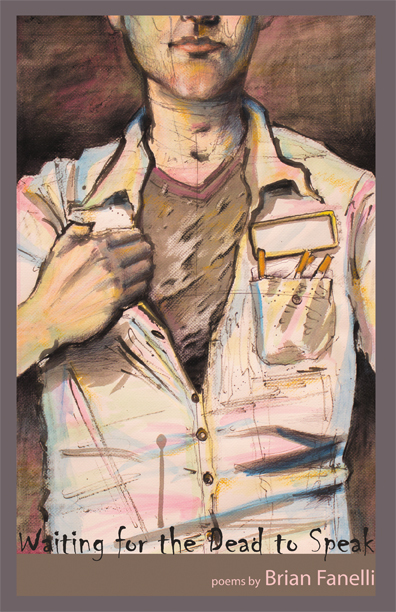
Publication Day!

Waiting for the Dead to Speak, my new book of poems, is now out in the world. I have a lot of people to thank for helping me along the way with these poems, offering feedback, making them the best that they could be. I am grateful to the tight-knit writing community at Wilkes, at Binghamton, and in NEPA. I am grateful for my friends in writing communities who I have met at various readings and stayed in touch with. I’m glad these poems are out, and I’m eager to share them.

If you can’t make any upcoming readings, you can get the book online here. 

Spin Mischief Brew this Labor Day

Every Labor Day, I spin Mischief Brew albums. I can’t think of another band to listen to today.  Right now, I am listening to a 3-hour PunkNews.org podcast about the band’s legacy and front man Erik Peterson’s passing a few weeks ago. Here is something I wrote immediately after I learned about Erik’s death.

Over the years, especially when I lived outside of Philly, I saw Erik’s various projects, including his first band, The Orphans, his solo work, and of course, Mischief Brew. Only a few months ago, I saw Mischief Brew play a basement show in Allentown. By that point, the band was a three piece that included Erik’s brother on drums. In that cramped basement, still decorated with white Christmas lights, Mischief Brew tore through song after song. Erik’s power chords echoed from stacked amps, as he howled into the mic.  By the time the show concluded and we were done dancing and fist-pumping to Erik’s rasp, we eventually found our away outside, into the raw January weather. Our hair matted with sweat, we trudged through half a foot of snow on the sidewalk, back to our cars.

That show reminded me of the first time I heard his music. It was another basement show, at the First Unitarian Church in Philly. With just an acoustic guitar, he opened for former Avail front man Tim Barry. Though Erik was the opener, the crowd swayed and sang along with their home town boy. After the show, I bought some of his music on wax, and he just nodded and smiled, handling his own merch.

On the drive back from the Allentown show, I played some of Mischief Brew’s earliest tracks. The quiet chords of “’Ol Tyme Memory” and “Dirty Pennies” carried us home, while our ears still rang. I was certain, however, that I would see the band again. In fact, I had planned to see them this month in Philly. Erik Petersen always represented the best aspects of punk rock. He engaged the audience, be it solo or with whatever band he fronted. He hung around after shows to talk to the kids. He was socially engaged, not only in his lyrics, but through the number of benefits he played over the years for Food Not Bombs, Occupy Philadelphia, and a number of other organizations.

Thanks for the memories and the music, Erik.

For your Labor Day listening:


Trumpism Post-Election

Since the RNC and DNC concluded a few weeks ago, Hillary Clinton has continued to maintain a lead in the polls. She  has led from anywhere to 10 to six points. Her lead has shrunk somewhat in recent polls, but it is still healthy, especially in PA, VA, and other crucial swing states. Trump has since reorganized his campaign staff, flip-flopped on immigration, and tried to reach out to black voters. So far, however, his minority outreach has moved the needled little. An article published yesterday by The Morning Consultant points out that Trump has cut into Clinton’s lead nationally, but about 79 percent of black voters plan to vote for her. Meanwhile, Trump also signifigantly trails Clinton when it comes to female voters. He lags by nine.

Since the 1960s, when LBJ, pushed by the Civil Rights movement, passed sweeping civil rights legislation, including the Voting Rights Act, black Americans have predominantly stuck with  the Democratic Party. On the one hand, Trump should get some credit for trying to broaden the GOP’s base, but as the Wall Street Journal pointed out recently in this article, Trump has mostly been making this appeal to white audiences, not in black churches or before the NAACP. When speaking about black voters, Trump does so in the context of high crime and high unemployment, as though that’s all that exists in black communities, thus feeding upon racial stereotypes held by some of his supporters.

With about 10 weeks to go until the election, it is likely the race will tighten somewhat. However, Trump’s massive deficit with black, female, and Hispanic voters will make it very difficult for him to win the general election. The question now becomes, what happens to Trumpism post-election? Trump is now trying to paint Hillary Clinton as so crocked that she’ll steal the election. Will that taint the early stages of her presidency? Will it make it more difficult for her to govern? It is likely Dems will win back the Senate and make gains in the House, but not win back the House. How will Trump’s recent depictions of her affect her ability to work with a GOP-controlled House? Will his supporters even let their GOP congressman/woman work with her, or will the unprecedented obstruction seen during the Obama presidency continue?

Furthermore, what happens to some his base? The white working-class anger over bad trade deals and a loss of manufacturing jobs is justifiable. They feel abandoned by the GOP and by the Democratic Party, who passed NAFTA and the WTO under President Bill Clinton, and meanwhile, President Obama is still pushing the TPP, which Clinton opposes. In addition, what long-term impact will Trump’s blatant race-baiting have, especially all of the comments he made about Muslims, promising to not allow them into the U.S., and Hispanic immigrants, calling them “rapists” and “drug dealers.” What does it mean that people like David Duke, former grand wizard of the KKK, said he’s been inspired by Trump to run for the Senate? Trump’s candidacy has put forth some of the ugly aspects of American history and politics, so how do we heal when this is over?

Right now, the Clinton camp has an election to win, but once it’s over, she, as well as the larger Democratic Party and the GOP, need to figure out how to heal the divisions that have worsened because of Trump’s candidacy.

Down the Dog Hole We Go!

I have been sitting on this news for weeks and weeks now, but I am happy to announce that Scranton-based poet Tom Blomain and I recently edited an anthology called Down the Dog Hole, featuring 11-NEPA based poet writing about the greater Scranton region. The book will be out in the coming weeks through Nightshade Press of Keystone College. On Sept. 22, we will have a book launch at Keystone College, and we have a scheduled Scranton launch for Oct. 14 at the Library Express.

The featured poets include: David Elliott, Dawn Leas, Craig Czury, Erin Delaney, Jane Honchell, Susan Luckstone Jaffer, Nancy Dymond, Laurel Radzieski, Amanda J. Bradley, Tom Blomain, and I.

Here is a picture of the front cover. I will post a pic of the back cover, too, once I have a high res copy.

down_dog_hole_cover_highres (1).jpg

Gearing up for fall

There are still weeks of summer left, but with August halfway over, I am looking towards fall. I’ll be on the road, doing a lot of readings for Waiting for the Dead to Speak, which comes out Sept. 12 through NYQ Books.  I will have the pleasure of reading at the Jersey Shore, Philly, Boston, Ithaca, Binghamton, Lancaster, York, and a number of other spaces and communities. When the fall is a little closer, I will post a list of full reading dates here and on my social media accounts.

I am also thrilled to announce a special Writers’ Showcase at The Scranton Fringe Festival during the first weekend of Oct. This is a wonderful line-up.

ws promo EC copy.jpg


Preorder of Waiting for the Dead to Speak Now Available!

My new book, Waiting for the Dead to Speak, (NYQ Books), is now available! The book will officially be released on Sept. 12, but you can order today. Here is the link.  You have the option of ordering from a number of different places, including Barnes n Noble, Small Press Distribution, and elsewhere. If you want to preorder from Amazon, you can do that too. Here is the link.

Every writer hopes to grow in time and strengthen his/her craft, and I will state that I am eager to share these poems with the world. They are much different than Front Man and All That Remains. I hope that readers like them, and I will be doing  A LOT of readings throughout the fall. More details to come on that when the fall is closer.

WaitingforDeadtoSpeakCover


Two New Reviews

I had the chance to review two new collections of poetry for At the Inkwell and TheThePoetry, George Wallace’s A Simple Blues with a Few Intangibles (FootHills Publishing) and Stay with Me Awhile by Loren Kleinman (Winter Goose Publishing).

Checkout the review of Wallace’s book here, and check out the review of Kleinman’s new collection here.

Come Celebrate the Re-Launch of Word Fountain

I’ve been saying for years that northeastern, Pennsylvania has a vibrant art community and literary scene. Those scenes have just become stronger thanks to the re-launch of the literary magazine Word Fountain, which makes its return to the world this Friday, via a launch party.Check out the Facebook event page here. The reading will be from 7-8 p.m. at the Osterhout Library in Wilkes-Barre.

As a preview, here is an image of the new cover!

Owl

Where the Revolution Goes from Here and How Bernie Lands the Plane

Following a string of victories last night in New Mexico, New Jersey, and California, Hillary Clinton made history by clinching the Democratic nomination for president. Less than a 100 years after women earned the right to vote, she became the first female presidential candidate of a major political party. Despite one’s feelings about Hillary, this moment deserves its spotlight. Following the wins, Clinton said, “It may be hard to see tonight, but we are all standing under a glass ceiling right now. But don’t worry, we’re not smashing this one…It’s the first time in our nation’s history that a woman will be a major party’s nominee.”

She also noted that her mother was born on the day that Congress passed the 19th Amendment, giving women the right to vote. She then remarked that the first convention dedicated to women’s rights happened in the state where she stood that evening: New York, at Seneca Falls in 1848.

Browsing my social media accounts, I noticed that some Sanders supporters griped that Hillary was anointed the nominee and did no win it fairly. Putting the super delegate issue aside, Clinton had a few more million votes than Sanders, and for that matter, she earned more votes than any of the presidential nominees thus far, including Trump. The question now becomes where does the Sanders campaign go from here? Last night, he vowed to keep fighting until the convention in Philly at the end of July, and I’ve said all along that he should do so. At this point, Sanders has no chance to be the nominee, other than the very remote possibility that Hillary will be indicted over the e-mail saga. That said, Sanders’ campaign has been about remaking the Democratic Party, so that it resembles the party of FDR or LBJ rather than a party led by the DNC or Clintons. So far, Sanders has had some major successes. He got the chance to appoint five members to the DNC platform committee. Clinton appointed six, and the DNC appointed four. His picks have included African American scholar Cornel West and environmental activist Bill McKibben. On the campaign trail, he has forced Hillary to make income inequality a major part of her platform, which will most likely last through the fall, since Trump has been successful, in part, by tapping into white working-class anger. Now that the general election match-up is clear, Clinton can’t ignore the issues that Sanders made relevant.

If Sanders manages to unite the party, while continuing to push for the issues that matter to him, it is likely that he will return to the Senate as one of its most powerful members, and most likely the chair of the banking committee, if the Democrats retake the Senate, which seems likely, considering the map and Trump’s recent self-implosion over the judge remarks and Trump University scandal.

Following the age of Occupy and increasing anger directed at Wall Street, it is unlikely that the Democratic Party will continue to resemble  a party of triangulation. The financial crisis of 2008 and the bank bailouts that followed have made it impossible for the Democratic Party to not address economic inequality and the working-class anger that Trump has managed to tap into when he talks about the devastating effect of some Clinton-era policies, specifically NAFTA, and the gross effect of big money on politics.

As the convention draws closer, Bernie and his supporters need to make a $15 minimum wage, a major jobs plan, universal healthcare part, and campaign finance reform part of the platform. They should also push to rework the primary rules, even the order of states that votes and open primaries v. closed primaries.

Yes, another Clinton will is now the Democratic nominee for president in 2016, but this Clinton has made economic inequality a major part of her platform, and in doing so, she has had to address her husband’s legacy, including the loss of manufacturing that came as a result of her husband’s free trade policies. The Democratic Party is undergoing a major change, and if Bernie and his supporters seriously organize and continue what they started, it is possible policies he advocated will come to fruition. If his supporters remain engaged and come into the fold more, then perhaps next time around, a candidate like Bernie Sanders will win the nomination.