I had the opportunity to write about my experience getting a Ph.D. after an M.F.A. The article was published in The Write Life, a publication that is part of Wilkes University’s M.F.A. program. More and more, I have friends with an M.F.A. pondering whether or not they should get a Ph.D. in order to get out of adjunct limbo. My article goes into the pros and cons, including the tough job market for the Humanities. That said, getting my Ph.D. at Binghamton University was one of the most rewarding, enriching experiences of my life. It challenged me intellectually and allowed me to befriend other writers and academics that will probably be life-long friends and colleagues. With that said, there are serious considerations for anyone thinking about a Ph.D., including the job market. There are so few tenure-track positions, and openings attract hundreds of applicants. I feel fortunate for the job I have, but I always adjuncted at the institution prior to landing the job. I had other teaching experience, too. For anyone considering a Ph.D., I want to stress the importance of getting work experience, including as a teaching assistant. I don’t advise anyone to take out debt to complete the degree because finishing it doesn’t necessarily mean a tenure-track job afterwards.
Inside Higher Ed’s Tips for Summer
Inside Higher Ed just posted this helpful article for educators regarding how to make the most of summer vacation. I am already taking stock in some of what is proposed in the article, namely to do most of the prep work for the fall in the early part of the summer, including syllabus revisions or new course development. The article theorizes that doing this in the beginning of the summer will declutter the mind and leave more time for writing and research during the rest of the summer. In addition, the article also suggests keeping a shadow syllabus throughout the semester to write down what worked and didn’t work in a class, so changes can be made early in the summer, while the comments are still fresh. I have never kept a shadow syllabus, but I do take notes regarding what worked and didn’t work, especially if I need to change an exam or change some of the readings, based on student response.
Lastly, the article stresses the importance of setting realistic goals for writing and publishing and ensuring to plan vacation time to reset and recharge the batteries. It’s worth a read! Anyone else have any helpful suggestions regarding how to make the best use of summer?
A Little Preview
I don’t want to give too much away about my forthcoming book of poems with NYQ Books entitled Waiting for the Dead to Speak, but it will drop in September. I’m doing a lot of readings for it. Stay tuned, and bam, here is the cover art! Thanks to Mikayla Lewis for the cover image!


Writers’ Showcase for May!
I just wanted to spread the word that the next edition of the Writers’ Showcase reading series in Scranton will be held on Saturday, May 7 from 7-9 p.m. at the Old Brick Theatre in Scranton. We have five wonderful readers lined up. This event is also special because for the first time in this reading series’ history, we have an all female line-up!
Check out the flyer here:

A Fractured Left
After Hillary Clinton’s double digit win in New York last night, the path for Bernie Sanders to win the Democratic nomination for president is impossible. The delegates aren’t there for him. Even more so, Clinton is ahead of him by double digits in a number of the states that vote next Tuesday, including delegate-rich Pennsylvania. I will state for the record that I have always liked Bernie Sanders. He has been preaching about money in politics for years. That said, I have been appalled by what I have seen on social media, especially after Clinton’s victory last night. The Democratic primary has turned into name calling and growing divide between Clinton and Bernie supporters. Some of his supporters feel as though she has not won any of the races legitimately, as though there is some big DNC conspiracy to ensure she’s the nominee. Meanwhile, I have seen some of his supporters declare that they will vote for Trump or Cruz because they can’t stomach voting for Clinton in the fall. This especially boggles my mind. Hillary never would have been my first choice for the Democratic nominee. That said, the Democratic bench was never going to be that deep because in the last few mid-term elections, Dems got obliterated, thus they don’t have a farm league at the state or national levels to groom into major presidential contenders, unlike the GOP, who controls majority of state legislatures, the House, and the Senate. With that said, there is a major difference between Hillary and Trump and Cruz. On women’s issues, Hillary has always been pro-choice and a supporter of equal pay. She is also more liberal on immigration than Obama. In addition, she favors a major raise in the minimum wage, to at least $12. Trump, meanwhile, runs around the country talking about a wall, banning Muslims, and punishing women for having an abortion. Cruz is even more extreme. So while Hillary may not be my first pick, I understand that the differences between she and whomever the GOP nominee will be, most likely Trump, are quite stark.
My fear right now is that this election, on the Democratic side, is going to be a redux of 1968 or 1980, when the party was so fractured that it handed the White House to the GOP. Recent polling shows that between 25-35 percent of Bernie supporters state that they won’t back Hillary Clinton if she is the nominee. Now, I will point out that in the heat of the 2008 primary between Obama and Clinton, polling showed that about half of her supporters said that they would not support him if he won the nomination. Ultimately, the party came together. However, this feels… different. Some Bernie supporters feel as though Clinton is everything wrong with the system, everything Bernie has been railing against. To them, she represents big money in politics, someone who can be bought and sold and changes positions when it is best for her to do so.
I also question if Bernie supporters will back her because some of them have no loyalties to the Democratic Party. Their man is not even a Democrat. He was always registered independent in Congress, called himself a Democratic Socialist, but caucused with the Democrats. During this campaign cycle, meanwhile, he hasn’t done much for Democrats down ballot, even though the “revolution” he speaks of would only be possible with a Congress far, far more progressive than its current make-up.
In 1968, at the height of Vietnam, the Democratic Party was split in SO many different ways. Eugene McCarthy, a socialist, ran. Bobby Kennedy ran, and establishment candidate Hubert Humphrey ran and ultimately won the nomination after Bobby Kennedy was gunned down. Humphrey ultimately lost the race to Richard Nixon, but it was one of the closest elections in our country’s history. Nixon ran on a platform of law and order and ending the Vietnam War, even though he escalated it once in power. However, after major riots, blood shed, and heads cracked with billy cubs at the Democratic Convention that summer, it’s no surprise Nixon won. The country yearned for some type of stability after a turbulent decade and an especially turbulent year. It also didn’t help that the Dem party was split so much, between three candidates initially and then two after Bobby was gunned down. In 1980, meanwhile, Ted Kennedy challenged Jimmy Carter in a primary and seriously hobbled him in the general election. As a result, Ronald Reagan was elected.
I would like to see the Bernie people get seriously engaged, long-term in the process. That means voting for Hilary if she is the nominee, but keeping pressure on her to pull her to the left and propose progressive solutions to get money out of politics, create a more stable Middle East, and create more economic equality, ideas that are central to Bernie’s campaign and his supporters. In addition, I want to see his supporters get active in grassroots activism, such as unionism and the fight for $15 campaign. I want to see them more beyond presidential politics and work to seriously remake the Democratic Party in the image of FDR, Bobby Kennedy, LBJ, and some of its other leaders of the past. That also requires working for down ballot candidates and reshaping Congress.
Writing with Teens
I want to give a shout out to the fine folks at the Osterhout Library for letting me teach a poetry workshop for teens last week, in honor of National Poetry Month. The workshop was just what I needed, as the semester winds down and I, like my college students, start to feel the burnout that comes with a waning school year. At first, I was unsure if the workshop would be successful, since every teen wrinkled their noses confessed to me that they dislike poetry and don’t want to write it.
However, I first wanted to share with them contemporary poets and ideas that I thought they could relate to. I handed them a packet containing poems about teen/parent relationships and poems about place/location. We launched into Maria Mazziotti Gillan’s poem “Betrays.” After I read the poem out loud, I was surprised by the number of comments. In fact, their comments were on the same level as some of my college literature courses. We probably could have spent the entire workshop discussing their poems and their reaction, but I wanted them to write. I wanted them to overcome that hurdle and their disdain for the genre. I gave them a simple prompt, in response to Maria’s poem. Write about your parents or a specific childhood memory.
At first, 20 minutes passed, and then 30. They barely looked up from their paper. By the end of the block of time, they each had a solid draft. One teen told me that he never tried writing before, but now he wants to start a writing group! Another teen mined his memory to address the day his dad left. Heavy stuff! We went over one more poem and did one more prompt. By the end, their minds opened to poetry, and I committed to doing another poetry workshop with them at some point, most likely over the summer. This is what National Poetry Month should be all about, not worrying so much about publication credits, but reaching communities that need poetry as a means of expression and communities that may not be that exposed to the art form.
Upcoming Poetry Events/Readings
If you live around NEPA and you’re looking for some upcoming literary events, then you’re in luck! April is National Poetry month, and here are some events happening in the region:
Sunday, April 3 6-9 p.m.
Jazz/Poetry Reading
Featuring: Lawrence Pugliese, Amanda J. Bradley, Brian Fanelli, and the Doug Smith group
The Olde Brick Theatre
126 W. Market Street, Scranton
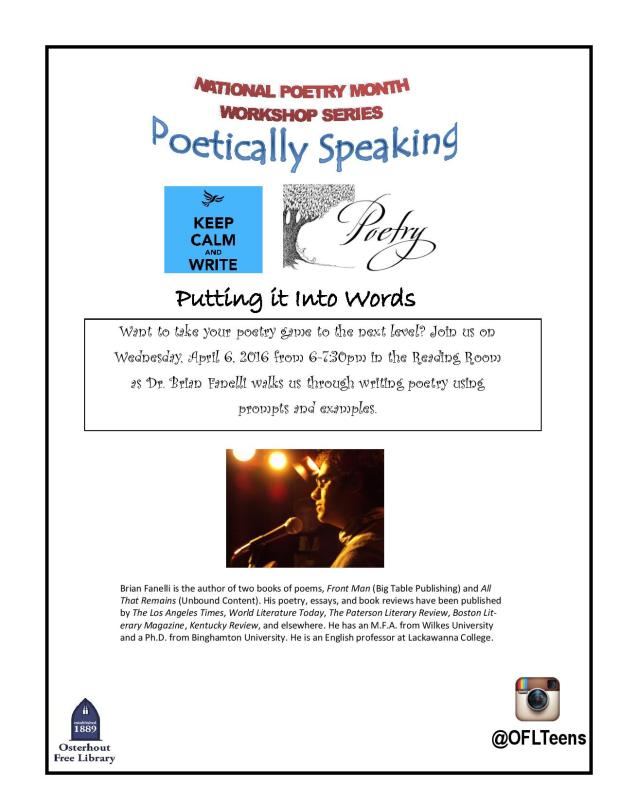
Wednesday, April 6, Wednesday, April 13, Wednesday, April 20 6-7:30
Poetically Speaking Poetry Workshops
This is a three-part workshop series for teens. I will host a writing workshop on April 6. Alicia Grega will host a performance/public speaking workshop on April 13, and the workshops will conclude with an open mic night on April 20! This event is free for teens.
Osterhout Free Library
71 S Franklin St, Wilkes-Barre, PA
Saturday, April 9
Scranton Radical Bookfair
The bookfair will feature a number of vendors and talks. The poetry reading will run from 6-7 p.m. and feature Daryl Sznyter, Amanda J. Bradley, Maggie Gilbertson, Sarah Zane Lewis, and I. The event is free.
Nazareth Student Center, Marywood University

If you know of any other upcoming literary events in the area, feel free to comment and let us know about them!
Understanding the Trump Phenomenon
By now, the rest of the world must be looking at the United States, baffled that the Republican Party is most likely going to nominate Donald Trump as its presidential nominee. After his Super Tuesday wins, Trump has the momentum, and he is ahead in the delegate count. It is possible that Cruz or Rubio could still stop him, but that would be very, very difficult. Part of the reason Trump has had so much success and has secured so many delegates is because SO many Republicans ran for president this year, and so many of them were considered establishment candidates. First, the establishment pumped money into Jeb Bush, and then John Kasich for a brief period, and then most recently, Marco Rubio. Because the votes have been so divided among the anti-Trump, establishment contenders, it has made it impossible for one anti-Trump candidate to emerge. They are all splitting the votes.
However, Trump’s rise goes deeper than that, at serious ills facing the country, exacerbated by the Republican Party’s rhetoric over the last several years. Essentially, in the age of Obama, the GOP has made itself the anti-immigrant, very, very white party. In a time of rising economic inequality, and both political parties’ refusal to do much about it, the GOP has successfully scapegoated another group of people, primarily immigrants, turning white, working-class, Reagan Democrats against them. This idea is nothing new. In fact, African American scholar W.E.B. Du Bois talked about this very tactic in his 1903 book The Souls of Black Folk, in which he analyzed the way Southern, one percenters pitted white, Southern, working-class Americans against African Americans in the Jim Crow South.
It is no surprise then that Donald Trump first made national headlines this campaign cycle by referring to Mexican immigrants as “rapists” and “drug dealers” over the summer, while promising to build a wall along the border and have Mexico pay for it. This should have immediately ended his campaign, but it didn’t. The rhetoric only gained him more supporters, and since then, his hateful language continued, as he promised to ban all Muslims from entering the country and said that a Black Lives Matter protestor deserved to be “roughed up.” Meanwhile, in the last week, a Time magazine reporter was choke slammed at one of his rallies, black students were removed from a rally in GA, and on and on. His rhetoric is indeed inciting violence and worsening divisions in this country.
Only VERY recently have GOP leaders seriously started to speak out against Trump. Former presidential candidate Mitt Romney gave a speech denouncing Trump as a fraud and phony. Sen. John McCain said Trump would pose a danger to America’s national security, and House Speaker Paul Ryan criticized Trump’s refusal to distance himself from David Duke, former KKK Grand Wizard who endorsed Trump.
Time ran one of the best editorials against Trump I have seen so far, focused on his bigotry. Perhaps the GOP bigwigs are FINALLY speaking out against Trump because his racism has become so old-fashioned and utterly apparent. The editorial states, “It’s easy to condemn Trump and Duke, and to be self-righteous in doing so. It allows us to point to the bad people over there while protecting our illusory innocence. We should have been outraged by Trump from the very beginning. But that would’ve required that we confront the ugliness in ourselves. Americans aren’t too keen on that. We prefer our illusions straight no chaser.”
Does Time magazine have a point there? Why was the David Duke incident what made GOP stalwarts like Joe Scarborough, Paul Ryan, and others finally denounce him? Why did they not do so over Trump’s comments about Mexican immigrants or plans to ban Muslims from entering the country? Were those comments what much of the GOP base wanted to hear all along? Do they only condemn Trump now because he is on the verge of being racist in “the old, American way of being racist?”
Trump is a result of the GOP’s increasing shift to the right over the years, its failure to diversify the party, and its willingness to coalesce around older, white, working-class voters. Yet, it’s important to note that these voters have legitimate gripes, namely that the system is rigged, politicians are bought, and working-class jobs are gone. However, immigrants are not to blame. Bad trade deals, like NAFTA, are to blame for shipping those working-class jobs overseas, and there, both parties are at fault. Citizens United is one of the main factors that created such an influx of corporate money into our political system.
So now, it seems, it will be up to establishment candidate Hillary Clinton to stop Trump. Clinton better think long and hard, however, about the direction of the Democratic Party. It can no longer be complicit in dealing with economic inequalities that deepen the country’s racial divides. Though she has high unfavorables, it is likely Clinton will mobilize the Latino vote and black vote in the fall, thanks to Trump’s ascension. She will owe them if she wins the White House. A clear, progressive economic plan and a serious immigration reform bill would be a good start. Trump’s rallies have given us a glimpse of how anyone different would be scapegoated and treated in his America. That indeed is a horrifying thought.
Capitalism, Climate Change, and The X-Files
As a kid, I stayed up on Sunday nights to watch “The X-files” with my dad. Some of the episodes spooked me so much that I wouldn’t sleep in my bedroom because I had fears I’d be abducted. I still find the notion that an intelligent life form could invade our bedrooms and snatch us in the middle of the night to be terrifying. I remember an opening from one of the mid-season episodes in which a father is returned after an alien abduction. His family finds him, pale and motionless, outside of a field, and to this day, I find it one of the most chilling scenes that I can think of in any sci-fi or horror production. I’ve also written about “The X-files” a few times in poetry, especially that skeptic/believer, Scully/Mulder dynamic that drives the show.
And while I enjoyed the monster of the week episodes, I always enjoyed the alien conspiracy arc that factored into each season. The new season, which, at only six episodes long, was really a mini-series, only featured two alien/conspiracy arc episodes, the opener, “My Struggle” and the finale, “My Struggle II,” which aired last night. I liked the season opener quite a lot and after a 14-year hiatus, I was surprised how well the show writers adapted the series to fit the age of Obama. A new character was introduced, Tad O’Malley, who could be any right-wing conspiracy nut, such as Glenn Beck or Alex Jones. On his internet talk show, he parrots right-wing conspiracies about the government coming to take everyone’s guns and eventually putting us all in white tents. However, he succeeds at convincing Mulder that the aliens aren’t the real bad guys, and the much hyped alien colonization that was supposed to happen in 2012, according to the show’s arc, was all just a smokescreen, a way for the elite to acquire more power by lessening the human population.
This same storyline picks up in the season finale, when the audience learns that the show’s main villain, the Cigarette Smoking Man, did indeed infect the human population with a disease. Only those he gave a vaccination to will be protected, so essentially the elite get to decide who lives and who dies. Even Mulder starts to succumb to the disease, and his fate is uncertain by the season’s final moments. When Mulder confronts him, in an last-ditch effort to save the human race, the Cigarette Smoking Man tells him that mankind is ultimately doomed and the way we’ve sucked dry natural resources, killed off half the rainforest, and wiped out species through climate change is evidence of that. In his view, he is saving us from ourselves by speeding up our extinction, but it’s more likely he just wants to obtain ultimate power by lessening the population and subjugating the few that survive.
This new conspiracy arc is good stuff, and in the backdrop of Occupy Wall Street, divisions between the rich and poor, civil unrest, and dire climate change reports, it fits. The aliens aren’t the bad guys. The elite in power are the real bad guys.
The season finale and the new conspiracy arc resonated with me in light of two recent books on the fate of human kind and climate change, The Sixth Extinction, by Elizabeth Kolbert and This Changes Everything: Capitalism and the Climate by Noami Klein. Both books detail the serious consequences humans have created because of climate change and our quest to suck up all of the resources we can because we assume we’re entitled to dominate the Earth and everything on it. Each chapter in Kolbert’s book focuses on a different part of the world and one or two species that have gone extinct or are near extinct as a result of humans. The book also details the severe consequences, including possible human extinction, that will come as a result of warming temperatures and carbon we are trapping in the atmosphere and oceans. Klein’s book is more of a critique of capitalism, and its main thesis is that despite the overwhelming science, humans have been reluctant to do anything about climate change because those in power know that it would lead to a profit loss. It would fundamentally challenge the “I” structure of capitalism. We would have to live in a more shared, conscious society. We simply can’t consume like we do now.
The outcome of all this won’t be good. It will lead to strained resources, probably more warfare over such resources, including water, and it will allow the elite to acquire more power, which is what the new X-files arc is getting at.
The new series ends with a metaphor very reflective of our times, an era in which Donald Trump could end up president of the U.S. because he is playing on the current divisions, paranoia, and strife that exist. By the closing frame of the season, Mulder and Scully are on a bridge, surrounded by hundreds of infected Americans, struggling to flee the nation’s capital. Mass panic! Meanwhile, Mulder is dying of the virus the Cigarette Smoking Man unleashed, and though Scully’s DNA seems to be a cure, we don’t know if she has enough time to save him. The episode ends with a shot of a UFO hovering over Mulder and Scully, and it is unclear if the craft is there to save them or just wipe out the sorry human race.
Scully’s belief in science and resolve to find a cure before it’s too late resembles Klein and Kolbert’s belief that in the most dire circumstances, human beings can pull through to find solutions to major problems, including climate change, which, like the alien virus, poses a major threat, one that could eradicate human beings and continue taking down a bunch of other species in the process. The series ends with a question mark. Will Scully’s belief in science save Mulder and her fellow humans? Will aliens intervene and save humans from themselves, or will a more intelligent life form just let us die off, and would the Earth be better off without us?
We’ll have to wait until next season to find out.
Winter Edition of The Writers’ Showcase
If you’re looking to shake the winter blues, then come out to the winter edition of The Writers’ Showcase on Feb. 27 at the Old Bricke Theatre in north Scranton. My co-host, Dawn Leas, and I are proud of the line-up that we have in store for the audience. Here is a flyer with all of the information.

 Brian Fanelli