Upcoming Poetry Events/Readings

If you live around NEPA and you’re looking for some upcoming literary events, then you’re in luck! April is National Poetry month, and here are some events happening in the region:

Sunday, April 3 6-9 p.m.

Jazz/Poetry Reading

Featuring: Lawrence Pugliese, Amanda J. Bradley, Brian Fanelli, and the Doug Smith group

The Olde Brick Theatre

126 W. Market Street, Scranton

Facebook event page

Wednesday, April 6, Wednesday, April 13, Wednesday, April 20 6-7:30

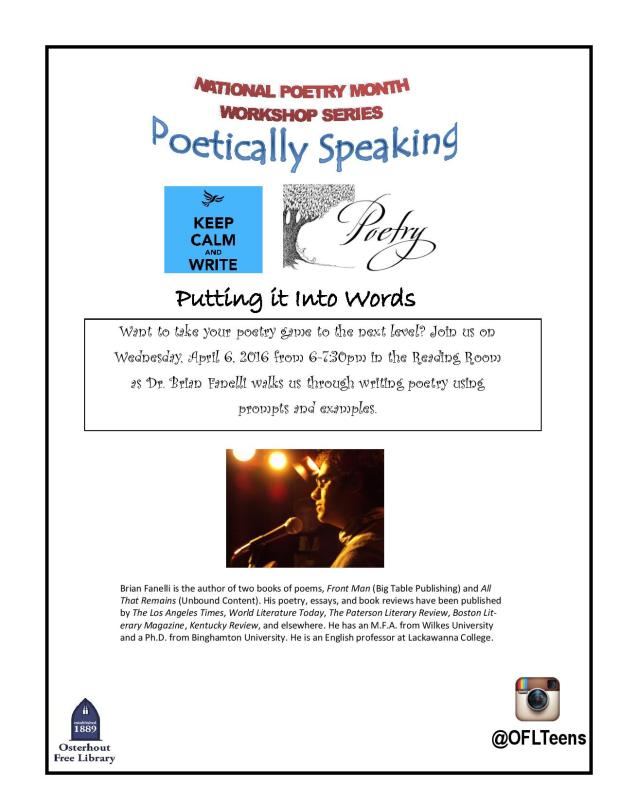
Poetically Speaking Poetry Workshops

This is a three-part workshop series for teens. I will host a writing workshop on April 6. Alicia Grega will host a performance/public speaking workshop on April 13, and the workshops will conclude with an open mic night on April 20! This event is free for teens.

Osterhout Free Library

71 S Franklin St, Wilkes-Barre, PA

Flyer (1) (1)-page-001.jpg

Saturday, April 9

Scranton Radical Bookfair

The bookfair will feature a number of vendors and talks. The poetry reading will run from 6-7 p.m. and feature Daryl Sznyter, Amanda J. Bradley, Maggie Gilbertson, Sarah Zane Lewis, and I. The event is free.

Nazareth Student Center, Marywood University

Facebook event page

2016 Scranton radical book fair flier-page-001.jpg


If you know of any other upcoming literary events in the area, feel free to comment and let us know about them!


Understanding the Trump Phenomenon

By now, the rest of the world must be looking at the United States, baffled that the  Republican Party is most likely going to nominate Donald Trump as its presidential nominee. After his Super Tuesday wins,  Trump has the momentum, and he is ahead in the delegate count. It is possible that Cruz or Rubio could still stop him, but that would be very, very difficult. Part of the reason Trump has had so much success and has secured so many delegates is because SO many Republicans ran for president this year, and so many of them were considered establishment candidates. First, the establishment pumped money into Jeb Bush, and then John Kasich for a brief period, and then most recently, Marco Rubio. Because the votes have been so divided among the anti-Trump, establishment contenders, it has made it impossible for one anti-Trump candidate to emerge. They are all splitting the votes.

However, Trump’s rise goes deeper than that, at serious ills facing the country, exacerbated by the Republican Party’s rhetoric over the last several years. Essentially, in the age of Obama, the GOP has made itself the anti-immigrant, very, very white party. In a time of rising economic inequality, and both political parties’ refusal to do much about it, the GOP has successfully scapegoated another group of people, primarily immigrants, turning white, working-class, Reagan Democrats against them. This idea is nothing new. In fact, African American scholar W.E.B. Du Bois talked about this very tactic in his 1903 book The Souls of Black Folk, in which he analyzed the way Southern, one percenters pitted white, Southern, working-class Americans against African Americans in the Jim Crow South.

It is no surprise then that Donald Trump first made national headlines this campaign cycle by referring to Mexican immigrants as “rapists” and “drug dealers” over the summer, while promising to build a wall along the border and have Mexico pay for it. This should have immediately ended his campaign, but it didn’t. The rhetoric only gained him more supporters, and since then, his hateful language continued, as he promised to ban all Muslims from entering the country and said that a Black Lives Matter protestor deserved to be “roughed up.” Meanwhile, in the last week, a Time magazine reporter was choke slammed at one of his rallies, black students were removed from a rally in GA, and on and on. His rhetoric is indeed inciting violence and worsening divisions in this country.

Only VERY recently have GOP leaders seriously started to speak out against Trump. Former presidential candidate Mitt Romney gave a speech denouncing Trump as a fraud and phony. Sen. John McCain said Trump would pose a danger to America’s national security, and House Speaker Paul Ryan criticized Trump’s refusal to distance himself from David Duke, former KKK Grand Wizard who endorsed Trump.

Time ran one of the best editorials against Trump I have seen so far, focused on his bigotry. Perhaps the GOP bigwigs are FINALLY speaking out against Trump because his racism has become so old-fashioned and utterly apparent. The editorial states, “It’s easy to condemn Trump and Duke, and to be self-righteous in doing so. It allows us to point to the bad people over there while protecting our illusory innocence. We should have been outraged by Trump from the very beginning. But that would’ve required that we confront the ugliness in ourselves. Americans aren’t too keen on that. We prefer our illusions straight no chaser.”

Does Time magazine have a point there? Why was the David Duke incident what made GOP stalwarts like Joe Scarborough, Paul Ryan, and others finally denounce him? Why did they not do so over Trump’s comments about Mexican immigrants or plans to ban Muslims from entering the country? Were those comments what much of the GOP base wanted to hear all along? Do they only condemn Trump now because he is on the verge of being racist in “the old, American way of being racist?”

Trump is  a result of the GOP’s increasing shift to the right over the years, its failure to diversify the party, and its willingness to coalesce around older, white, working-class voters. Yet, it’s important to note that these voters have legitimate gripes, namely that the system is rigged, politicians are bought, and working-class jobs are gone. However, immigrants are not to blame. Bad trade deals, like NAFTA, are to blame for shipping those working-class jobs overseas, and there, both parties are at fault. Citizens United is one of the main factors that created such an influx of corporate money into our political system.

So now, it seems, it will be up to establishment candidate Hillary Clinton to stop Trump. Clinton better think long and hard, however, about the direction of the Democratic Party. It can no longer be complicit in dealing with economic inequalities that deepen the country’s racial divides. Though she has high unfavorables, it is likely Clinton will mobilize the Latino vote and black vote in the fall,  thanks to Trump’s ascension. She will owe them if she wins the White House. A clear, progressive economic plan and a serious immigration reform bill would be a good start.  Trump’s rallies have given us a glimpse of how anyone different would be scapegoated and treated in his America. That indeed is a horrifying thought.


Capitalism, Climate Change, and The X-Files

As a kid, I stayed up on Sunday nights to watch “The X-files” with my dad. Some of the episodes spooked me so much  that I wouldn’t sleep in my bedroom because I had fears I’d be abducted.  I still find the notion that an intelligent life form could invade our bedrooms and snatch us in the middle of the night to be terrifying. I remember an opening from one of  the mid-season episodes in which a father is returned after an alien abduction. His family finds him, pale and motionless, outside of a field, and to this day, I find it one of the most chilling scenes that I can think of in any sci-fi or horror production. I’ve also written about “The X-files” a few times in poetry, especially that skeptic/believer, Scully/Mulder dynamic that drives the show.

And while I enjoyed the monster of the week episodes, I always enjoyed the alien conspiracy arc that factored into each season.  The new season, which, at only six episodes long, was really a mini-series, only featured two alien/conspiracy arc episodes, the opener, “My Struggle” and the finale, “My Struggle II,” which aired last night. I liked the season opener quite a lot and after a 14-year hiatus, I was surprised how well the show writers adapted the series to fit the age of Obama. A new character was introduced, Tad O’Malley, who could be any right-wing conspiracy nut, such as Glenn Beck or Alex Jones. On his internet talk show, he parrots right-wing conspiracies about the government coming to take everyone’s guns and eventually putting us all in white tents. However, he succeeds at convincing Mulder that the aliens aren’t the real bad guys, and the much hyped alien colonization that was supposed to happen in 2012, according to the show’s arc, was all just a smokescreen, a way for the elite to acquire more power by lessening the human population.

This same storyline picks up in the season finale, when the audience learns that the show’s main villain, the Cigarette Smoking Man, did indeed infect the human population with  a disease. Only those he gave a vaccination to will be protected, so essentially the elite get to decide who lives and who dies. Even Mulder starts to succumb to the disease, and his fate is uncertain by the season’s final moments. When Mulder confronts him, in an last-ditch effort to save the human race, the Cigarette Smoking Man tells him that mankind is ultimately doomed and the way we’ve sucked dry natural resources, killed off half the rainforest, and wiped out species through climate change is evidence of that. In his view, he is saving us from ourselves by speeding up our extinction, but it’s more likely he just wants to obtain ultimate power by lessening the population and subjugating the few that survive.

This new conspiracy arc is good stuff, and in the backdrop of Occupy Wall Street, divisions between the rich and poor, civil unrest, and dire climate change reports, it fits. The aliens aren’t the bad guys. The elite in power are the real bad guys.

The season finale and the new conspiracy arc resonated with me in light of two recent books on the fate of human kind and climate change, The Sixth Extinction, by Elizabeth Kolbert and This Changes Everything: Capitalism and the Climate by Noami Klein. Both books detail the serious consequences humans have created because of climate change and our quest  to suck up all of the resources we can because we assume we’re entitled to dominate the Earth and everything on it. Each chapter in Kolbert’s book focuses on a different part of the world and one or two species that have gone extinct or are near extinct as a result of humans. The book also details the severe consequences, including possible human extinction, that will come as a result of warming temperatures and carbon we are trapping in the atmosphere and oceans. Klein’s book is more of a critique of capitalism, and its main thesis is that despite the overwhelming science, humans have been reluctant to do anything about climate change because those in power know that it would lead to a profit loss. It would fundamentally challenge the “I” structure of capitalism. We would have to live in a more shared, conscious society. We simply can’t consume like we do now.

The outcome of all this won’t be good. It will lead to strained resources, probably more warfare over such resources, including water, and it will allow the elite to acquire more power, which is what the new X-files arc is getting at.

The new series ends with a metaphor very reflective of our times, an era in which Donald Trump  could end up president of the U.S. because he is playing on the current divisions, paranoia, and strife that exist.  By the closing frame of the season, Mulder and Scully are on a bridge, surrounded by hundreds of infected Americans, struggling to flee the nation’s capital. Mass panic! Meanwhile, Mulder is dying of the virus the Cigarette Smoking Man unleashed, and though Scully’s DNA seems to be a cure, we don’t know if she has enough time to save him. The episode ends with a shot of a UFO hovering over Mulder and Scully, and it is unclear if the craft is there to save them or just wipe out the sorry human race.

Scully’s belief in science and resolve to find a cure before it’s too late resembles Klein and Kolbert’s belief that in the most dire circumstances, human beings can pull through to find solutions to major problems, including climate change, which, like the alien virus, poses a major threat, one that could eradicate human beings and continue taking down a bunch of other species in the process. The series ends with a question mark. Will Scully’s belief in science save Mulder and her fellow humans? Will aliens intervene and save humans from themselves, or will a more intelligent life form just let us die off, and would the Earth be better off without us?

We’ll have to wait until next season to find out.

The Truth Is Still Out There

Last night, I waited in anticipation for the return of the beloved 90s sci-fi show “The X-files.” The first of six new episodes did not disappoint, and in many ways, it set the show’s central mythology on its head. The show also transitioned well to the present time, which I’ll get to later in this post. Warning: major spoilers ahead.

The show picks up years after series finale, which found Mulder and Scully kicked out of the FBI and on the lamb. Since the final episode of season 9, Scully returned to medicine and Mulder, well,  remained Mulder, convinced that the truth is still out there. A right-wing pundit, conspiracy nut, played by Joel McHale, summons the FBI agents back to action when he introduces them to a young woman who claims she has been abducted multiple times and that her babies have been taken by some unknown force. At first, it seemed like the show went back to the basics: an alien abduction story, just like the pilot episode.

There were several wonderful moments in the episode. Despite the writers’ decision to use the opening credits from the 1990s, the show seamlessly transitioned to 2016. Even more so, the writers showed an awareness of the show’s legacy. Early in the episode, Mulder is watching a YouTube clip of President Obama joking with Jimmy Kimmel about big government conspiracy theories and alien cover-ups. Mulder responds, “My life’s become a punchline.”

The episode also blasts right-wing zealots and conspiracy nuts, even taking a shot at Bill O’Reilly. Joel McHale’s character could be Alex Jones, Glenn Beck or any other right-wing nut who has ranted during the Obama administration about big government taking everyone’s guns and putting us all in white tents.  The irony of this is not lost, considering the Fox empire was essentially built because of the success of two major 90s shows, “The Simpsons” and “The X-files.”

At the heart of the show’s return episode is the idea that the elite in power are the ones we should really fear, not bright lights in the sky. It is also possible that the return episode has flipped the show’s entire mythology. By the end of the episode, Mulder is convinced that the shadowy men/conspirators are ones who need to be feared and fought, that their ultimate aim is full-blown control and subjugation. This idea harkens back to the show’s first two seasons, in which the conspirators were the real villains and the threat of alien existence was never certain. In the later seasons, the aliens took focus and planned a colonization of Earth. The mythos became so ridiculous that there was even a story arc about an alien civil war. Last night’s episode felt a little more grounded in reality.

This possible change/direction for the new season makes sense, considering the show has returned in the age of mass economic inequality and growing global tensions. It’s also possible that the writers realized how bloated the alien mythology had become and they wanted to strip things back to the basics. We have five more episodes to find out!

Here are some basic questions I would also like to see answered.

  1. How/why is the cigarette smoking man still alive, considering his fate in the final episode of season 9?
  2. Whatever happened to William, Scully and possibly Mulder’s son? He was briefly mentioned in the episode, but where has he been?
  3. Does Scully have alien DNA?


Accessing Obama’s Legacy

Last night, President Obama gave his final State of the Union speech. I want to take some time to reflect on his seven years in office, as he nears the finish line and the country readies itself to elect someone in November to succeed him. Confession: I have always been an Obama supporter. I was a canvasser on his 2008 campaign and a canvass director for his 2012 campaign. I made lifelong friends through both campaigns, and generally, I think that he has governed with an even hand and level-headed temperament. That said, there are certainly mistakes he made during both terms, and at the end of his speech, he acknowledged one of his biggest regrets, which I’ll address later in this post.

First, it is important to consider where the country was when President Obama was sworn in in January 2009. Unemployment was around 10 percent. The country was bogged down in Iraq, and Wall Street crashed the world economy. (Please, go see The Big Short!) Obama’s campaign caught fire because the country was wary of George W. Bush, who left office with an approval rating in the 30s.  The genius of Obama’s first campaign could be found in its main slogan, “Yes, we can.” Simple, right? The country desperately needed optimism at the time, and here was a freshman senator from Illinois who toppled the establishment candidate in the primaries, Hillary Clinton. Here was  a fresh young voice who promised to govern differently and change politics as usual. It was a message that resonated, and Obama had a sweeping victory in 2008, one which increased the Democratic Party’s majorities in the Senate and House.

Obama’s promise to change politics and heal the divide harkened back to his 2004 Democratic Convention keynote address, in which he said that America shouldn’t be divided by red states and blue states. At the time, I was in college and wrote for the student newspaper. After the convention, I penned an editorial stating that Obama was a rising star in the party, presidential material. Four years later, he ran and won.

Yet, perhaps it can be said that President Obama’s promises of change and altering the political landscape to bring the parties together was naïve. In 2012, it was reported that on the day of President Obama’s first inauguration, Republican leaders, including  Senate Majority Leader Mitch McConnell, new House Speaker Paul Ryan, former House Leader Eric Cantor, former House Speaker Newt Gingrich, and others met to discuss how best to counter Obama. So just as his first term was beginning, the opposing party was deciding how best to stop his agenda.

The Republican’s main defense against the Obama Administration has been utter gridlock, especially after the 2010 and 2014 mid-term elections, when they won control of Congress and a majority of state legislatures.  Congress has not done much and has a dismal approval rating. By doing nothing, the GOP-led Congress has made it seem like government is totally inefficient.  This has impacted the president, pulling down his approval rating, which has not climbed out of the 45 percent range much at all during both terms.

Still, the president managed to get re-elected again in 2012, by quite a large margin. If you look back on his seven years in office, there are a number of accomplishments. Unemployment is now around 5 percent. Gas prices are falling under $2 a gallon. Two progressive justices have been appointed to the Supreme Court. Don’t Ask, Don’t Tell was repealed. More Americans have health insurance. The auto industry is alive. Gay marriage is now legal, and recently, through executive action, new gun laws are on the books, including stronger background checks, which most Americans, including gun owners favor.

Last night, the president’s final SOTU address was meant to counter the pessimism and sour mood plaguing the country. Despite lower unemployment, Americans don’t feel like they’re getting a fair shake. The economic crash and the bailout proved just how rigged the game is. Meanwhile, wages have remained stagnant since the Reagan years. This is why Bernie Sanders has so much support on the left and why Trump is so popular on the right. People are mad, feeling as though the change the president promised in 2008, the message of “Yes, we can” never panned out.

Yet, Obama’s legacy is quite impressive. Still, though, Obama was naïve to think dissolving the divide in Washington would be easy, or even possible. Near the end of his speech last night, he admitted that one regret he has is that the political environment is just as bad or even more toxic than when got to the White House. He offered some solutions, such as campaign finance reform to get big money out of politics and ending gerrymandering. However, it’s not likely any of that will happen soon, especially in an election year.

Right now, the country is mad as hell and doesn’t want to take it anymore. This is an election year in which anything could happen. Trump may very well be the Republican nominee and Sanders could beat Clinton. Latest polling shows him close to her in Iowa and beating her in New Hampshire, the first two primary states. Yet, voters would do well to remember where the country was in 2008. Certainly, we’re better off than where we were. Still, there is work to be done, especially on fairer wages and boiling racial tensions. The president also reminded Americans that in a Jeffersonian, representative democracy, citizen participation is a must. That is what the whole “Yes, we can” slogan was all about. In 2008, too many voters thought that electing one candidate who promised change would quell all of the country’s woes, but it’s more complicated than that. No candidate elected this November will be able to fix everything. That requires real citizen engagement, which is work. Is the country up to the task, or do citizens just want to be angry, vote for the loudest candidate, and then go back to being unengaged the day after the election?


Some Reflections on 2015

With the year waning, it’s that time to reflect on where we’ve been and where we’re going. My 2015 was pretty good. At the beginning of the year, I pulled myself out of a long-term relationship and have reconnected with old friends and made some new ones throughout the year. We had some beautiful experiences together. Over the summer, I hiked A LOT, biked, and traveled. I wrote poems. I gave some readings. I got to teach some different literature courses for the first time and thoroughly enjoyed it. I really had some wonderful students this year. At the end of the year, I finished my doctorate and also signed the contract with NYQ Books for my third poetry collection, which will be out fall 2016. Yep, it was a good year, and I’m grateful for my family, friends, colleagues, and my good health.

Here are some of my favorite books/music/films from 2015:

favorite poetry books of 2015:Notes on the Assemblage by Juan Felipe Herrera. I must confess I didn’t really discover his work until more recently, but this book deserves praise for its wide range of forms, everything from prose poems, to sonnets, to collages, which, like his other work, capture the migrant worker experience. With the county still reeling from the recession, and with the continuing economic divided, coupled with the increasing xenophobia, Herrera is the poet laureate this country needs right now.

Application for Release from the Dream by Tony Hoagland: This book is Hoagland’s most biting and attacks hyper consumerism more than his last book. Still, it’s not without its humor. Oh, and there’s a dog poem!

How to Be Drawn by Terrance Hayes: Hayes’ work just feels so relevant right now, and this book is less narrative than his earlier collections and at times, even more experimental than Lighthead, while still addressing issues of race.

Nonfiction: Patti Smith’s M Train. The passages about her writing process and dreams are simply beautiful.

Fiction: Purity by Franzen. I haven’t read a novel this year that better addresses the issues we face today, everything from social media making us more isolated to Homeland Security and NSA surveillance.

Favorite films of 2015:Spotlight and The Big Short. If you see The Big Short, I guarantee you will laugh throughout the movie, but by the end, you will feel immense anger that NO ONE was thrown in jail for the economic crash/Wall Street hijinks that went on in 2007/2008. If you want to better understand the simmering anger this country is experiencing right now and some of the root causes, go see The Big Short. You will remember that countless people lost their homes, savings, and jobs, and we, the taxpayers, bailed out the banksters after their behavior crashed the world economy. And the cast…. what a cast!

Favorite album of 2015: Jeff Rosenstock’s second solo album, We Cool? which just felt really poignant to me this year and where I’m at in my life. It’s an album about “adulthood,” about being in your 30s, whatever that means.


No, I did not include The Force Awakens on the list. Yes, it earned uber positive reviews and felt like a Star Wars film, but it was also a very safe film, which walked in the footsteps of the old.

In the new year,  I hope for less comic book movies. Aren’t we sick of those yet? I hope poetry will continue to address the rising race and class tensions, but more people need to read and listen. Poets need to be less insular

Here’s to 2016. Cheers, friends!

A Lit Mag Lives On!

A few months ago, I shared news on this blog that [PANK] was shutting down, after its editors, M. Bartley Seigel and Roxane Gay, announced the news about the cutting-edge mag via social media. The announcement sent ripples through the literary world. New York Times Magazine called PANK “a raft of experimental fiction and poetry.” Travis Kurowski, editor of Story Magazine and columnist for Poets & Writers, said, “Like McSweeney’s was nearly 20 years ago (and The Paris Review 40 years before that), PANK has been one of those lit mags that seemed to represent the zeitgeist of a generation—a literary turn towards diversity, queerness, raw authenticity.”

These quotes come from the introduction to an interview Electric Lit just published with outgoing editor M. Bartley Seigel, and the interview contains some huge news about the fate of the magazine. It’s going to live on! It has been purchased by John Gosslee of Fjords Review.

The interview features a lot of other interesting tidbits. For instance, Seigel states that he and Roxane Gay decided to step away from the magazine because they are in their mid-40s now and have too many projects happening.

Here is what he said about his time editing [PANK] and the state of American literature:

Overall, I ended my tenure at PANK in a very, positive place. American literature is robust, vibrant, and very much kicking and screaming. Reading and editing and publishing PANK only drove home for me that the foundational world of American letters, underpinning the big publishing houses, the major awards, the world of literary magazine and small and independent presses, is wide and deep and teeming with the most amazing publishers, editors, writers, writing, and readers. If I have a critique of American letters, it’s that the average American doesn’t read broadly enough, not enough work in translation, that we’re too isolated, too narrow in our reading habits, still too locked into boxes like the one built out of white male heteronormativity.

I encourage anyone to read the full interview. It provides a lot of insight into the contemporary literary landscape and the future of one of America’s most important lit mags.

Museum of Americana

If you haven’t checked out the online literary journal Museum of Americana, I encourage you to do so. The journal publishes all things Americana, hence the title. The new issue, for instance, features poems that address everything from baseball to the military. My poem, “Lady Day Sings the Blues on YouTube,” is featured in the new issue, so check it out here! Read the rest of the issue, too, as well as the archives. The editors do an excellent job maintaining the theme issue to issue and selecting fiction, essays, and poetry.