Recap of Conversations and Connections Conference

This weekend, I spent my time in Washington, DC for the Conversations and Connections Conference, held at John Hopkins University and sponsored by Barrelhouse Magazine and The Potomac Review.

The conference has several benefits. For one, the price of registration is only $70, and you get a lot of free stuff, including a book and  subscription to a literary journal, among other items. Beyond the cool free stuff, Conversations and Connections is less daunting than some of the larger conferences, such as AWP, especially since it’s only one day long. Furthermore, the event organizers do a fine job ensuring fiction, poetry, and creative non-fiction are well represented on the panels. The conference does a good job too of balancing craft talk with practical advice on writing, such as how to write an engaging cover letter for a journal or whether or not to enroll in an M.F.A. program.

I was part of a poetry publishing panel late in the day, and the audience was attentive and had a lot of questions. Because Conversations and Connections isn’t so massive, there’s a chance to chat more with the panelists throughout the day and during the after parties. It’s a great way to meet other writers and editors, and that alone is worth the price of admission.


d564733_10100769432727758_4493520018518843302_n
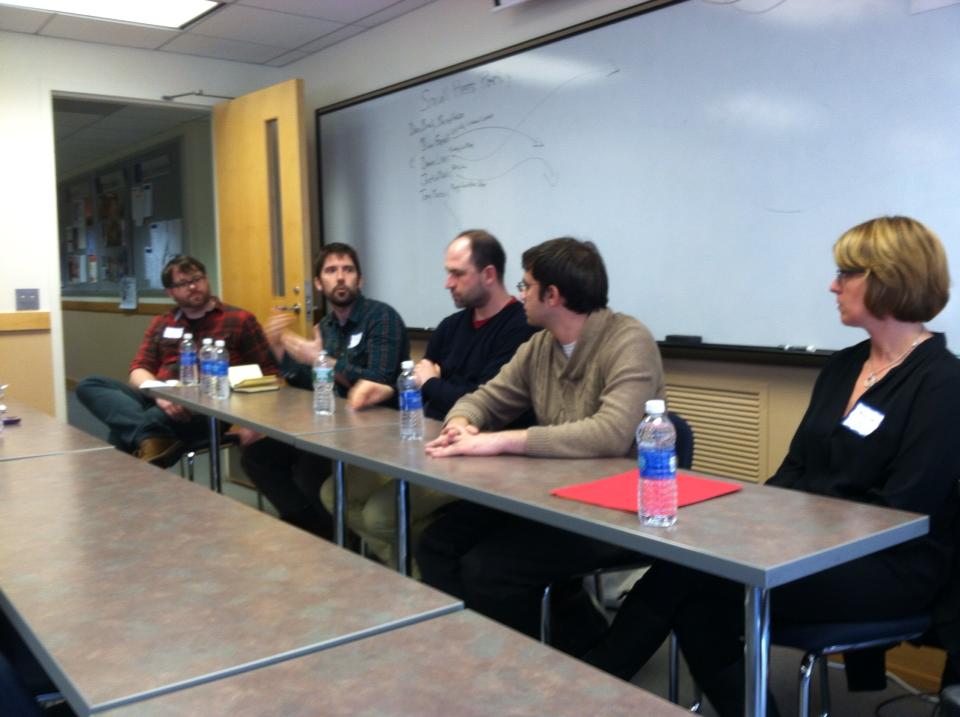
Our panel on working with small poetry presses.
1939655_10100769432428358_3655905922572606004_n

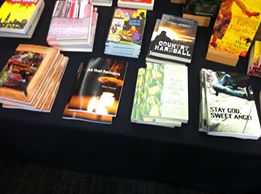
My book All That Remains at the conference.
10155937_10100769431799618_5972466986511965320_n

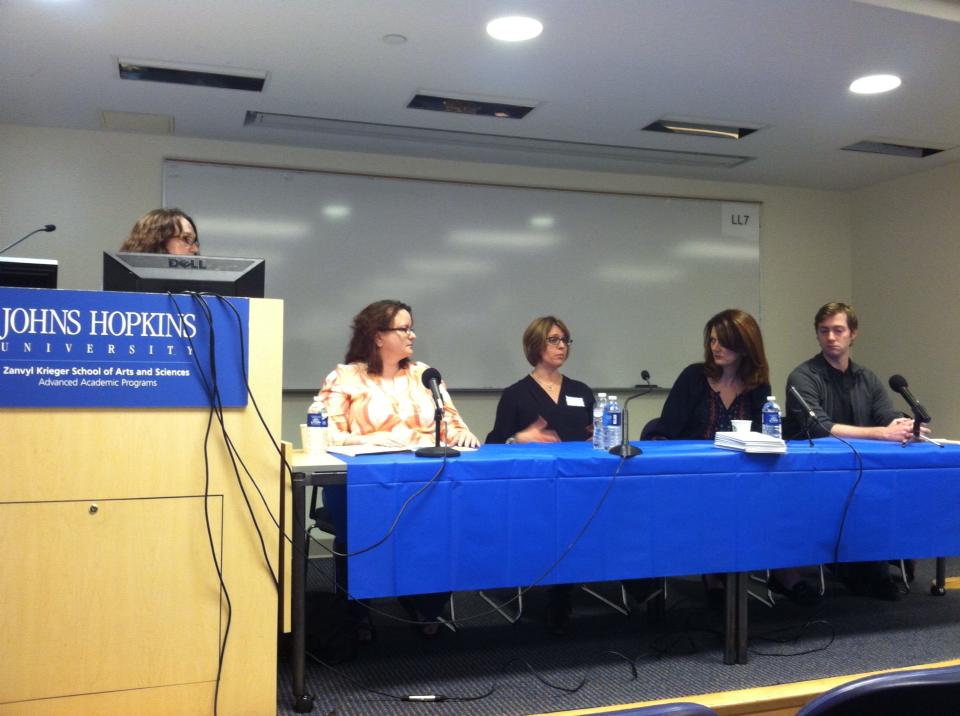
My friend/fellow poet Dawn Leas on a panel about M.F.A. programs. The panel was moderated by another friend, Shelia Squillante, an associate editor for PANK and associate director of Chatham University’s low-res M.F.A. program.

Conversations and Connections Conference

This weekend, I’m heading to Washington, DC to present at the Conversations and Connections Conference, held at John Hopkins University and sponsored by Barrelhouse Magazine and The Potomac Review.

I’ll be part of a panel entitled “Think Small: The Benefits of Working with a Small Poetry Press,” and I’ll be sharing my experience publishing two books of poetry with indie presses. My co-presenters are Dawn Leas and Tony Mancus, one of the co-founders of Flying Guillotine Press. If you’re looking for a good writing conference that is affordable, I suggest heading to Conversations and Connections on Saturday. The registration information and panel descriptions are listed on the website.  There will also be speed dating with editors of literary magazines and publishers, which is a great chance to make connections and share your work.


Some Reading for National Poetry Month

Happy April 1! In honor of National Poetry Month, I thought I’d re-post Charles Bernstein’s essay “Against National Poetry Month,” an essay that is quite sarcastic at times, especially in the last paragraph, but an essay which  addresses the ways in which poetry has been under house arrest over the last few decades, to use a phrase from Adrienne Rich. Sometimes, I find Bernstein to be too over the top, but here, I agree with  few of his points.

One of his main gripes is that National Poetry Month promotes what he dubs safe, mainstream, anti-intellectual, non-challenging poetry. To quote from his essay, “Promoting poetry as if it were an ‘easy listening’ station just reinforces the idea that poetry is culturally irrelevant and has done a disservice not only to poetry deemed too controversial or difficult to promote but also to the poetry it puts forward in this way.” There I agree with him.

He also makes a good point about poetry and capitalism when he states that a lot of the major corporate sponsors and chain bookstores that push National Poetry Month are also the ones who limit poetry’s accessibility by refusing to carry books by small poetry presses. He even calls out the New York Times for being a sponsor of National Poetry Month in the past but not giving any serious space for poetry book reviews or poetry itself.

I am not against National Poetry Month as much as Bernstein, and I am happy I have four or so events this month and tend to have a busy April every year, but I do think poetry should hold importance year round, and there are countless writers, conferences, small presses, editors, and book reviewers who try to ensure poetry is relevant beyond the month of April.

I am hoping some other folks will read Bernstein’s essay and offer comment.

AWP Seeks Proposals on the Adjunct Plight

The Association of Writers and Writing Programs Conference  (AWP) is seeking panel proposals on the topics of interest to adjuncts and non-tenure track faculty, including adjunct unionization. Here’s a link with more information on what they’re looking for and the proposal guidelines. I commend AWP for seeking out proposals like this and the organization’s willingness to address this issue. However, it may be difficult to acquire a number of panel proposals from adjuncts because anyone trying to cobble together a paycheck on an adjunct salary will not be able to afford the conference registration, costs of travel, or costs of a hotel. I hope, though, that adjuncts teaching in Minneapolis, with easier access to the conference, will consider sending in a proposal. I also hope that AWP accepts some panel proposals on the issue of cuts to education, which in turn leads to the creation of more adjuncts and less full-time faculty. I’ve been to the AWP Conference three times, in Chicago, Denver, and Boston, and I’ve never seen any panels that address these issues, so kudos to AWP for actively seeking out such proposals now.

Meanwhile, The New York Times just published an article this week about an adjunct professor in NY who took direct action to raise awareness about the low cost of living adjuncts face. Check out the article here.

New Interview/Lancaster Reading

Poet and HuffingtonPost blogger Loren Kleinman just published an interview with me on her website, which you can read here.  I also suggest checking out her new collection of poems, The Dark Cave Between My Ribs. It’s  great read.

I also wanted to mention that I am reading at the Barnes & Noble in Lancaster this weekend with Dawn Leas as part of the Lancaster Poetry Exchange. The reading starts at 7, so if you’re in the area, come by!

I also have some events coming up in April for National Poetry Month, but I’ll post those closer to the dates.

New Review/New Poems

TheThePoetry has posted a new review of my collection All That Remains written by Scott Thomas. In the review, Thomas writes, “Fanelli’s work is approachable. He does not brandish his technical prowess with intimidating sestinas. There is no pandering to theory, nor does he flaunt his erudition by quoting obscure thinkers or having his characters speak in Latin. (Though there are some well-placed references to Bob Dylan and horror movies.) What we do find are rusting towns and their hard-working denizens, whose horizons are limited through no fault of their own. We also catch moments of tenderness and regret and glimpses of youth with chances seized or lost.”

He concludes the review with the line, “Fanelli writes about fates that he himself has escaped, but he is unwilling to turn his back, to say: ‘I’m out of here. You’re on your own.’”

If you haven’t checked out TheThePoetry, I suggest bookmarking it and visiting frequently. They run several reviews a month, as well as interviews, essays, and spotlights on different poetry communities across the nation.

In addition, I have three new poems in the new issue of Fledging Rag, which is only available in print through Iris G. Press. The issue is impressive and features a wide range of forms and voices, including three poems by my friend and fellow Wilkes M.F.A. alum Chris Bullard.

Upcoming Literary Events in NEPA

Many, many thanks to Harold Jenkins for putting the time and effort into creating another calendar of local literary events happening in northeastern, PA. Harold posted the events on the Northeastern Pennsylvania Writers’ Collective blog, and I’m posting them here so more people can see all that’s happening.

I just want to add one event not on the calendar. On Thursday, March 20 from 5-7 p.m., The Valley Community Library in Peckville is hosting its third annual Local Author Night, featuring book signings and readings by local authors. The event is free, and I’ll be there, so come say hello!

Here is a list of other local events:

Thursday, March 20 – Scranton
Third Thursday Open Mic at the Vintage, 326 Spruce Street, sponsored by the Northeastern Pennsylvania Writers’ Collective. Sign-ups begin at 8:00, poetry at 8:30. This month’s host will be Alvin K. Nurse. Come celebrate the first day of spring with poetry! This is a free event, but donations to support the Vintage are encouraged and appreciated.

Friday, March 21 – Wilkes-Barre
Third Friday Spoken Word featuring the Breaking Ground Poets at Art Seen On The Square, 21 Public Square, Wilkes-Barre. Open mic beforehand. Hosted by Sarah Scinto from The Times Tribune. Sign-ups begin at 7:30 (or whenever the sign-up sheet goes out, no less than 5-10 minutes before the readings), readings begin at 8:00.

Friday, March 21 – Tunkhannock
Open Mic Night at the Dietrich Theater, 60 E Tioga Street, Tunkhannock. Open mic, followed by a performance by the Terry Wayne Goodholm band. Sign-ups begin at 6:30, performances at 7:00. Open to audiences and performers of all types.  Call the Dietrich at 570-996-1500 for details. Hosted by Laurel Radzieski.

Sunday, March 23 – Scranton

A Lie is a Venial Sin (VT Stage Reading Series) The Vintage Stage Reading Series will kick off with a reading of a work by local playwright Ted LoRusso.

The Vintage is proud to kick off its 2014 stage reading series (in conjunction with its newly established resident ensemble) with a live stage reading of Ted LoRusso’s engaging work A Lie Is a Venial Sin .

March 23rd / 4:00 pm @ The Vintage

Free & Open to all (donations are encouraged to support The Vintage and continue its artistic programming and outreach).

The playwright will be in attendance for a Q&A discussion following the reading. The facilitator for this reading is Maggie A. O’Brien, who also serves as the resident ensembles producing director.

*NOTE: Due to strong language and content this reading is recommenced for mature audiences only.

There are a few more events scheduled for the end of March, including three events on March 28! For the rest of the events, check out the NEPWC blog.

Sometimes You Just Have to Say No

The nonfiction journal Brevity has a great blog post about ways to avoid overbooking yourself as a writer. The guest author, Lev Raphael, admits that most young writers say yes to everything for the exposure. However, there is  a danger to that because committing to so many engagements pulls a writer from the daily work schedule. Raphael shares some useful advice he learned from another writer during an engagement at a Jewish Community Center. “It’s not just the day you’re there, she (the other author) said, if it’s only a day.  It’s the day before, getting ready, and then at least one day of re-entry into your regular schedule, sometimes more, depending on how complicated your visit was.”

Raphael also notes that writers should consider whether or not the gig will be fun or challenging, and whether or not the compensation, if there is any, is worth it. Raphael’s post made me reflect upon all of the writing engagements and readings I’ve done in the last few years, which has probably neared 100 or so. More recently, most of them have been worth it and have led to book sales and networking with different writers and literary communities. However, when I first started doing this, I said yes to everything. I’ve driven a few hundred miles round trip to read before five or six people. Looking back, I would have said thanks, but no thanks to some of those engagements. Like Raphael advises, guard your time and worry about the work first and foremost.  Research the conference or reading series. Make sure the drive or air travel is worth it.

Why Cover Letters for Lit. Journals Matter

Here’s a little secret. At any given week of the year, I usually have poetry or critical essays in limbo at a dozen or so academic literary journals and magazines, waiting to be rejected or accepted. And, as well all know, writers recieve far more rejections than acceptances. This is all part of being a working writer. However, there are things that can be done to ensure your work recieves careful consideration by the editors and is not just disregarded in the large slush pile. First of all, the work has to count, obviously. It should be polished and revised. Second, there is the issue of the cover letter and writing a good cover letter. There are ways to ensure you’re not just sending the same letter off to every magazine and journal.

Kelly Davio, poetry editor for Tahoma Literary Review, has some excellent advice about what she looks for in cover letters, and she makes some points that I’ve never considered as a writer.  In a blog post,  she notes that editors do indeed look at the biographical information of the writer to ensure they have a diverse range of voices each issue.  So yes,   biographical information in a cover letter counts. For instance, if you’ve worked a number of odd jobs and you’re not an academic, that may be something to put in a cover letter, since most literary journals recieve hundreds and hundreds of submissions from M.F.A. students or tenure-track poetry professors.

She also notes that it’s important to reference how you heard of the journal. This so something I always try to do. Even if I heard of the journal on Facebook or at a conference and have never met the editors, I still mention how I learned of the publication. It’s even better, however, to actually buy an issue to get a better sense of what they publish. Then you can point to a particular writer or work they’ve published that you like.

Finally, like any cover letter, be brief and to-the-point, and don’t assume that prior accomplishments mean the editors will definitely publish your work.

More Upcoming Events

March is shaping up to be a busy month for me, with  some readings booked over the next few weeks, leading to some larger events for National Poetry Month. This Friday, March, 7, I’m reading in historic Gettysburg for  the first time ever. The reading will be at  7 p.m. at the Ragged Edge Café, 110 Chambersburg St.  I’m thrilled to take part in this long-running series and read in front of a different audience.

Fanelli_RagEdge_2014

If you can’t make that reading, but you’re in Scranton this weekend, then you should check out Micah Towery’s reading Saturday at 3 p.m. at Library Express in the Steamtown Mall. Micah  is the editor of TheThePoetry blog and the author of the new book of poems, Whale of Desire.

Then on Thursday, March 20, from 5-7, the Valley Community Library is hosting Local Author Night. Along with authors, I’ll be having a book signing and reading.