Reasons Why Book Marketing Campaigns Fail

The Best Damn Creative Writing Blog ran a wonderful article over the weekend talking about book marketing and why some campaigns to get new readers fail. The first issue the article raised is social media. Certainly social media has changed the landscape in regards to marketing. If used well, social media makes it far easier for writers to market their book or manuscript in progress. But the article makes some valid points in regards to social media. First, it mentions that some writers simply don’t use this tool. I’m always surprised by this. Nowadays, especially in the world of poetry, presses and publishers simply don’t have the funds to launch advertising campaigns for writers. So why not make use of the free services blogs, Facebook, and Twitter offer in regards to promoting a new chapbook or full-length collection? Social media provides the opportunity to gain new readers and have open discussions with other writers.

However, the article also points out that a writer needs to be careful how he or she uses social media services. Don’t just use the tools to push your work or sell your book.  As the article points out, the goal of social media should be to provide potential readers with a level of engagement. Convince them you are interesting. Pique their interest, and that should help get your work read by others. But remember no one wants to get bombarded with messages regarding where to buy your book or where to read your work.

The article also mentions that it’s crucial to invest time in one’s self. I think I underestimated this point prior to the release of my chapbook, Front Man.  I didn’t realize how much time I would spend marketing the book, setting up readings, sending the book out to reviewers. As I had mentioned earlier, presses and publishers simply don’t have the funds to launch marketing campaigns for most writers anymore. So, it’s mostly up to the writer to do the hard work. The book won’t sell if no readings are booked. It’s as simple as that. Make time for these marketing strategies. It’s also a great way to build further connections.
Hardheaded Weather

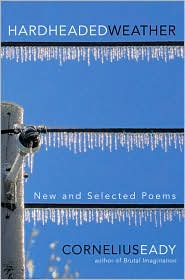
I finally picked up a copy of Cornelius Eady’s Hardheaded Weather: New and Selected Poems. Thanks to Anthology New and Used Books for ordering a copy for me!

Eady has been a staple of the contemporary American poetry scene for the last few decades, landing poems in The New Yorker and Best American Poetry. He also earned a National Book Award nomination in 2001 for his collection Brutal Imagination. I have some of Eady’s full-length collections sitting on my bookshelf, but it’s nice to now own selected poems from every book, including the unpublished manuscript, The Modern World.

If you’re a fan of Eady’s work and hesitant to buy this latest collection because you own his previous full-length volumes, I still recomend purchasing this book. Besides the unpublished manuscript, this volume holds some other unseen work, including the collections Hardheaded Weather and The Way a Long Dress Turns a Corner.

In my opinion, the newer poems from Hardheaded Weather are alone worth the cost of the volume. In the opening pages, Eady presents narrative poems about a newlywed couple moving into a new house. But even early on in this collection, as the couple celebrates a new, blissful marraige, there are signs of troubled times to come, and troubled times the country itself will go through, including the war in Iraq. In the poem “Honeymoon,” the husband mentions the radical right wing group The John Birch Society has “adopted our section of the highway.” That same persona confesses a few pages later that he still doesn’t know “what to do/with the hammer/In my hands/it feels like/my tongue/looking for/the right way to say please/or don’t shoot.”

The political undertones grow stronger, especially throughout the poem “Pre-War,” where “An American flag, left behind by previous owners/stutters on the pole.” There’s constantly something threatening the couple throughout the poems, including house repairs, frost, storms, and even cancer. But the couple somehow manages to pull through, much like the country did after various wars and other foreign policy and domestic blunders.

What’s the literacy health of your city?

The Best Damn Creative Writing Blog recently posted the results of a study done by Central Connecticut State University analyzing the “literacy health” of major American cities. It’s a cool study, so I thought I would post some of the results here. The study focuses on several key indicators of literacy, including number of bookstores, library resources, educational attainment, and newspaper circulation.

Here are the top five cities for literacy health:

1 Washington, DC
2 Seattle, WA
3 Minneapolis, MN
4 Atlanta, GA
5 Pittsburgh, PA

What surprised me most is that NYC is number 26 on the list! Philadelphia is 31, Chicago 28, and Boston 12.  Some other categories exist, and those results can be read here.

more readings!

This month, I’m doing several readings to promote Front Man even more, and I’m especially excited about these events because of the other poets on the bill.

On Friday, January 21 at 7 p.m., I’m going to read with Dawn Leas, author of the chapbook I Know When to Keep Quiet, available from Finishing Line Press. The reading will be held at the Barnes & Noble in downtown Wilkes-Barre (7 S. Main Street). Dawn holds an M.F.A. from the Wilkes University Graduate Creative Writing Program, and her work has appeared in a variety of journals, including goldwakepress.org, Willows Wept Review, and Writers’ Bloc.

On Friday, January 28 at 7 p.m., I’m the featured reader at Anthology New and Used Books in Scranton (515 Center Street). I’ll read for about 20 minutes, and then a limited open mic will follow.

On Saturday, January 29 at 6:30 p.m., I’m heading up to Ithaca, NY to read with two wonderful poets. The poets I’m sharing the stage with are  Jaime Warburton, an associate professor of writing at Ithaca College and author of the chapbook Note That They Cannot Live Happily, and Charles G. James, who lives in Elmira, NY and does all of his work on a typewriter. How cool is that? The reading will be held at the Owl Cafe,  located on the second floor of the Autumn Leaves Bookstore in the Ithaca Commons.

More info about the Ithaca reading is available by clicking on the link to the flyer below! All of these events are free.

Owl_Cafe_Reading_flyer[1]

Listen to This

My friend and fellow Wilkes University alum, Dawn Leas, author of the poetry chapbook I Know When to Keep Quiet, was recently interviewed on the local  WVIA radio station for a program called “The Art Scene.” The interviewer, Erika Funke, did a great job with the questions and covered everything from Dawn’s writing process to creating a narrative arc for her book.

There’s a lot about the interview I liked, including the portion where she talked about revision/the writing process. She mentioned that while attending the Wilkes University Graduate Creative Writing Program, she had trouble parting with some lines in her poems based on feedback given by her mentors and peers. Anyone who writes knows how hard it is to sometimes axe lines or even whole pages, but ultimately, we come to trust the advice of our fellow writers and our work ends up stronger.

Dawn also read a few poems during the interview and discussed some of the poets she studied that influenced the central theme of family/place that fill the poems.

To listen to the full interview, click here.

Also, I will be reading with Dawn on Friday, Jan. 21 at the Barnes & Noble in downtown Wilkes-Barre  (7 S. Main Street) at 7 p.m. Her chapbook and my chapbook, Front Man, will be available for sale there.

Missing You, Metropolis

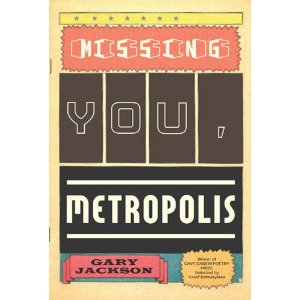
A few posts ago, I mentioned the latest Poets Roundup in the new issue of Poets & Writers.  One poet mentioned in the section that caught my attention is Gary Jackson, author of Missing You, Metropolis. The blurb mentioned that throughout his debut collection, Jackson blends autobiographical elements of his life growing up Kansas with references to comic books. I wanted to see how well Jackson pulled off the pop culture references in his poetry, so I ordered a copy of his collection from my favorite used bookstore, Anthology New and Used Books.

Besides the nice write-up in Poets & Writers, Jackson also received accolades from Yusef  Komunyakaa, who selected the book as the winner of the latest Cave Canem Poetry Prize. In his introduction to the book, Komunyakaa says, “This persona has been forged in the cauldron of popular iconography, especially in the culture of the comic book. Anything is possible in such created time and space; immediate tension exists in a climate where otherworldly figures are defined by earthly matters and concerns.”

What impresses me most about this collection is the range of voices Jackson showcases in his debut. The personas in the book include superheros such as Ironman, as well as friends, family, bystanders, and comic book readers. Jackson also proves he has an appreciation for both tradition and pop culture, as shown by the book’s opening poem “The Art of Reading the Comic Book,” dedicated to W.H. Auden.

While not all of the poems work and some may not push a working  metaphor quite far enough, the poems soar when they do more than namedrop various issues of Spiderman. At their best, Jackson’s poems blend pop culture and comic book references with observations and commentary on complex issues such as race, evolving friendships, family, and ambition.

In the poem “Stuart,” Jackson presents the commentary and pop culture references well, painting a picture of two childhood friends who bonded over comic books, or maybe more than that. “Comics bonded us/Or perhaps it goes further back?/Blacks were still rare/on our street, while whites/filled the neighborhood like dead/leaves in water.’

After winning the Cave Canem prize and gaining so much attention already, it’s likely Jackson will have a long career in poetry. Check out his debut collection, Missing You, Metropolis, out now from Graywolf Press.


Poet Carolyn Forché coming to Scranton

I just received word yesterday that poet/writer/human rights activist Carolyn Forché is coming to the University of Scranton in February. Here is the press release that was shared with me. This event is going to be free and well-worth checking out, considering Forché is one of the biggest names in the contemporary American poetry scene.

As part of its 2010 – 2011 Education for Justice theme of peace and reconciliation, The University of Scranton will welcome Carolyn Forché — an award-winning poet, essayist and human rights activist — for a lecture on Wednesday, Feb. 16. The event, which is free and open to the public, will take place at 7 p.m. in the Pearn Auditorium of Brennan Hall.

No stranger to the University, Forché received an honorary degree following her inspiring speech at Scranton’s 2010 undergraduate commencement. She told graduates that they “have the potential to be noble of spirit” and that they may “become the most important generation that has ever lived.” At the ceremony, Rev. Scott R. Pilarz, S.J., president of The University of Scranton, said, “The witness of her words and example resonates with the University’s commitment to promote justice in the Jesuit tradition.”

Titled “The Voice of Witness,” the lecture will focus on ways in which warfare, imprisonment and other forms of suffering are given voice by writers around the world.

Forché has commented on some of the most devastating social events of the 20th century. Her first book of poetry, “Gathering the Tribes,” won the 1975 Yale Series of Younger Poets Award. The recipient of a Guggenheim Fellowship, Forché traveled as part of Amnesty International to El Salvador, where she witnessed a civil war — an experience that inspired her to write “The Country Between Us,” a book of poems that was named the 1981 Lamont Poetry Selection and became a rare poetry bestseller.

A noted translator and a teacher of poetry and literature for 35 years, she holds and directs the Lannan Chair of Poetry and Poetics at Georgetown University. Forché has received three fellowships from the National Endowment for the Arts, a John Simon Guggenheim Fellowship, a Lannan Foundation Fellowship and other literary and teaching awards — including the Robert Creeley Award in 2005 and The Golden Rose from the New England Poetry Club in 2008. In 1998, she was presented the Edita and Ira Morris Hiroshima Foundation Award for Peace and Culture in Stockholm, Sweden, for her work on behalf of human rights and the preservation of memory and culture.

The Education for Justice Office promotes justice throughout The University of Scranton community through various programs, lectures and activities. The office wishes to educate students on the importance of justice, so they may act

new year, new journals, new blogs

Happy New Year everyone!

In the spirit of the new year and new possibilities, I want to share an interesting blog/journal I discovered recently that may appeal to some of the fellow writers who read my blog. The journal I’m talking about is titled Young American Poets. Check it out here. I’m especially impressed with this site because the editors publish a poem every few days, except when they shut down for a few weeks during the holidays. The site is also unique because the editors only publish poets born on or before July 20, 1971 from all 50 states.

So, if you’re looking to get your work out there, you may want to check their submission guidelines, since they’ll be open for submissions again soon. I just sent them work a few weeks ago.

Good luck, and happy new year!

Some reasons to pick up latest Poets and Writers

The latest issue of Poets & Writers is now in bookstores.  For anyone interested in strengthening their writing and learning more about the poetry business, this magazine should be a standard. But I think the current issue is a little more special than others. It features the 6th Annual Debut Poets Roundup, meaning it contains blurbs on several poets who released debut poetry collections recently. Each featured poet also provides advice on writing/publishing.

Unforutnately, Poets & Writers’ content is only available in print, so I can’t post a link to the section, but I will share some helpful advice .

J. Michael Martinez, author of Heredities, published by Lousiana State Unviversity Press, says, “I’d recomend poets focus on the actual act of writing. It is easy to get preoccupied with the fetishizing of publication and lose sight of why we do what we do.”

Here’s some good advice on publishing from Keetje Kuipers, author of Beautiful in the Mouth, published by BOA Editions.

“Good poems are good poems, and they’ll find a home somewhere. But when you’re sending your manuscript out to contests and publishers, you know that your work is going up against a whole lot of good poems. That’s why structure and order and cohesion of a collection are all so important.”

Finally, I’ll end with some advice by John Murillo, author of Up Jump the Boogie, one of my favorite collections of the last year.

“Take as long as you need to write the best book you can, work hard until you are generally satisfied. Then send it out and hope for the best. Second, know that what’s meant for you will find you; what isn’t, won’t. It’s a waste of both time and energy worrying about where this person publishes or what this person wins… Don’t hate, hustle.”

Christmas Verse

Happy Holidays everyone! Since it’s Christmas Eve, I thought I would post a holiday poem- “Christmas Trees” By Robert Frost. Enjoy!

Christmas Trees  
by Robert Frost
 
A Christmas Circular Letter

The city had withdrawn into itself
And left at last the country to the country;
When between whirls of snow not come to lie
And whirls of foliage not yet laid, there drove
A stranger to our yard, who looked the city,
Yet did in country fashion in that there
He sat and waited till he drew us out
A-buttoning coats to ask him who he was.
He proved to be the city come again
To look for something it had left behind
And could not do without and keep its Christmas.
He asked if I would sell my Christmas trees;
My woods—the young fir balsams like a place
Where houses all are churches and have spires.
I hadn't thought of them as Christmas Trees.
I doubt if I was tempted for a moment
To sell them off their feet to go in cars
And leave the slope behind the house all bare,
Where the sun shines now no warmer than the moon.
I'd hate to have them know it if I was.
Yet more I'd hate to hold my trees except
As others hold theirs or refuse for them,
Beyond the time of profitable growth,
The trial by market everything must come to.
I dallied so much with the thought of selling.
Then whether from mistaken courtesy
And fear of seeming short of speech, or whether
From hope of hearing good of what was mine,
I said, "There aren't enough to be worth while."

"I could soon tell how many they would cut,
You let me look them over."  

                                    "You could look.
But don't expect I'm going to let you have them."
Pasture they spring in, some in clumps too close
That lop each other of boughs, but not a few
Quite solitary and having equal boughs
All round and round. The latter he nodded "Yes" to,
Or paused to say beneath some lovelier one,
With a buyer's moderation, "That would do."
I thought so too, but wasn't there to say so.
We climbed the pasture on the south, crossed over,
And came down on the north. 

                                    He said, "A thousand."  

"A thousand Christmas trees!—at what apiece?"  

He felt some need of softening that to me:
"A thousand trees would come to thirty dollars."  

Then I was certain I had never meant
To let him have them. Never show surprise!
But thirty dollars seemed so small beside
The extent of pasture I should strip, three cents
(For that was all they figured out apiece),
Three cents so small beside the dollar friends
I should be writing to within the hour
Would pay in cities for good trees like those,
Regular vestry-trees whole Sunday Schools
Could hang enough on to pick off enough.
A thousand Christmas trees I didn't know I had!
Worth three cents more to give away than sell,
As may be shown by a simple calculation.
Too bad I couldn't lay one in a letter.
I can't help wishing I could send you one,
In wishing you herewith a Merry Christmas