Frankenstein production skill of Oscar Isaac as Victor Frankenstein

Review: Guillermo del Toro’s Frankenstein (2025)

Writer/director Guillermo del Toro has declared himself a proud monster kid over the years in a number of interviews. His obsession with classic monsters and their representation of the “other” is well-known. He even has a massive collection of props from the films that influenced his career, including James Whale’s iconic 1931 take on Mary Shelley’s Frankenstein for Universal.

With this in mind, it’s no surprise that he’s finally adapted Shelley’s novel. This is the movie he always wanted to make. For the most part, and for better or worse, del Toro remains incredibly faithful to Shelley’s text, including the shifting narrations between Victor Frankenstein (Oscar Isaac) and the Monster (Jacob Elordi). Yet, he does make some radical changes to the book, especially regarding Elizabeth (Mia Goth) and the final face-off between creator and creation. Such changes, though, enhance and serve this particular adaptation.

This latest rendition of Shelley’s tale begins in the Arctic, just like the novel. Here, we find the Monster, who rages and hunts down his maker. Victor is on the cusp of death and saved by a group of explorers, led by a sympathetic Captain Anderson (Lars Mikkelsen), a stand-in for Captain Walton from the novel, who, like Victor, pushes the limits of knowledge and exploration until it nearly causes his own undoing and that of his crew.

del Toro kicks off his lengthy film with high-octane action. The Monster Hulks out, downing one man after the other, throwing them against the ship or into the ice. It looks a bit silly, but it does underscore the Monster’s rage. After that action-heavy opening, we’re introduced to Victor’s tale, which lasts for about half of the runtime.

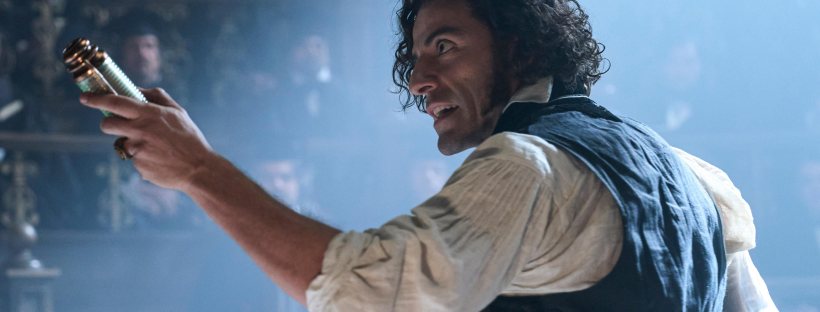
There are some high notes in the film’s first half and also some bloat. Isaac relishes playing the cocksure scientist, refusing to listen to his colleagues about the dangers of his experiments. This is most apparent during a trial among his peers when he expresses his desire to conquer death itself and unveils a half-animated corpse, a preview of his larger experiment to come. Of course, this draws disdain from his peers and his expulsion from his teaching gig. Isaac really shines in this sequence, and his eyes contain a fervency that matches Victor’s mighty ambitions. At his best moments, the actor exudes Victor’s all-consuming passion to defeat death. It wouldn’t surprise me if he earns an Oscar nomination for this performance.

Additionally, del Toro handled well the father/son thread that’s apparent in Shelley’s novel, the constant conflict between maker and son. Even at a young age, Victor wants to escape his father’s shadow and push the Frankenstein name to new heights. Later on, he separates himself from his younger and more morally-sound brother, William (Felix Kammerer), who is much older than the child William that’s strangled to death by the Monster in Shelley’s text. I do think William’s death in the novel has far more weight because by murdering a child, it shows how far the Monster will go to unleash misery upon Victor. Even today, that death remains quite shocking.

The creation scene comes a bit too late in the runtime, and the first half tends to drag, but the set designs of Victor’s laboratory are quite breathtaking and give a nice nod to some of Whale’s most iconic moments in his 1931 rendition. I have no doubt the set and costume designs will earn Oscar nominations. del Toro’s always great at making his visions come to life for the screen. The film’s first half also centers around the relationship between Victor and Elizabeth, who, in this take, is slated to marry William, not Victor.

Adorned in flowing 19th Century Gothic dresses, Goth gives Elizabeth a confidence and willingness to challenge Victor that’s not evident in the novel or earlier adaptations. Here, Elizabeth plays a much more active role. It both frustrates Victor and causes him to fall in love with her. She tries to pull him back from the brink, but we all know how the tale ends.
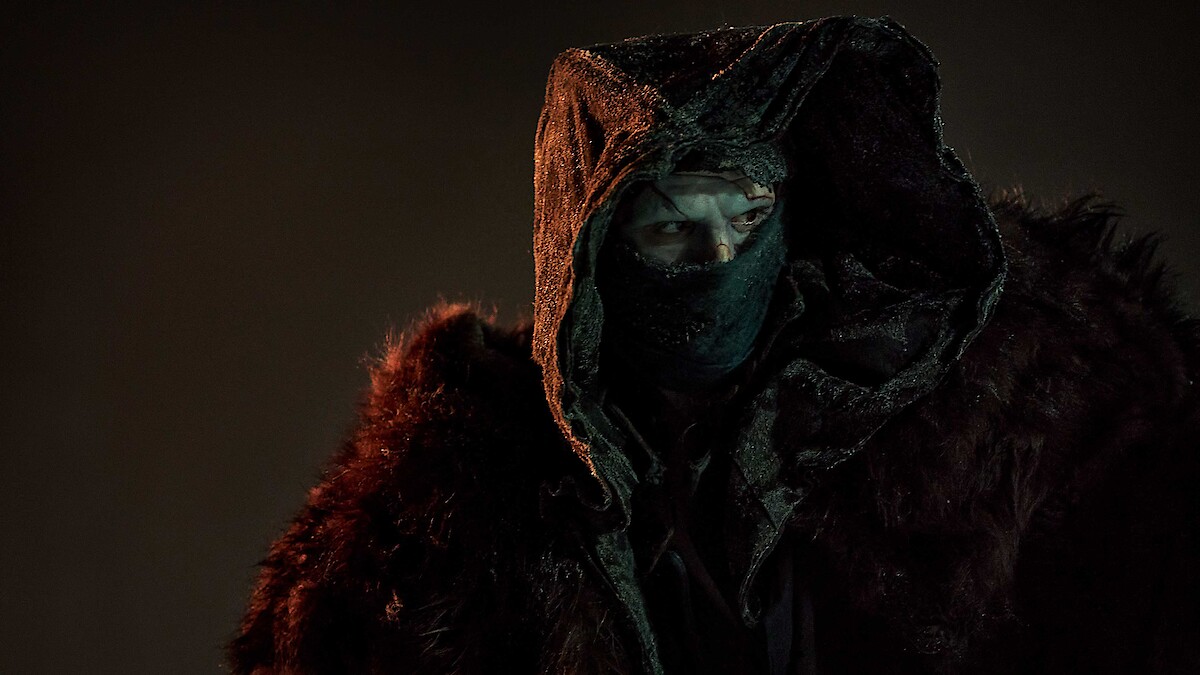
Jacob Elordi as the Monster in Frankenstein

Eventually, the Captain invites the Creature to share his tale, once he boards the ship, eager to snuff out his maker’s waning breaths. The film’s second half is much more powerful and richer in terms of its storytelling. We learn why and how the Monster transformed into the raging brute seen in the first few moments of the film.

Elordi gives the Monster the complexity and knowledge that exists within Shelley’s novel. He learns language. He reads classic literature with a blind man, his only friend, but he also learns about violence and humankind’s capacity to destroy each other. Elordi really carries much of this film, and though his performance isn’t as iconic as Boris Karloff’s, it’s still quite noteworthy. He conveys the Monster’s softer side and also his rage. He also develops a touching friendship with Elizabeth, a major shift form Shelley’s novel, but one that adds more weight and stakes to del Toro’s film. Once Victor denies the Creature a mate, the Monster fully transforms into a character driven by vengeance.

All of this circles back to the Arctic, to the final confrontation between the maker and the creation. The last ten minutes mark the most radical shift from Shelley’s novel and a far more optimistic conclusion. Without spoiling anything, I will say that del Toro reminds us to lean into sunlight, appreciate natural beauty, and feel grateful for each day we’re given. This is a far softer ending than we’re given in the text, but at this moment, with the world on fire, maybe this is the ending we need. It’s a celebration of life itself, punctuated with a gorgeous and poetic final shot of the Monster.

It feels like del Toro’s entire career has led to this film. All around, Frankenstein contains strong and compelling performances. Isaac, Goth, and Elordi clearly understood the assignment of inhabiting such iconic characters and bringing the director’s passion project to life. Like all of del Toro’s work, the feature contains stunning visuals that animate the Victorian setting. The first half of the film does feel a bit too long, but it’s worth the wait for the Monster to finally tell his tale.

Frankenstein is currently playing in limited theaters and will stream on Netflix starting November 7.

Leigh Whannell’s Wolf Man Doesn’t Respond to Much of Anything (And That’s Its Central Flaw)

Let me preface this by stating that I’m never a fan of tearing down movies. A lot of time, work, and money goes into filmmaking. The intention of this post isn’t to shred the latest reimagining of a classic Universal Monster, that being The Wolf Man, directed by Leigh Whannell. Rather, I’m more interested in exploring why Whannell’s film just didn’t work for me, especially when compared to his 2020 remake of The Invisible Man. While The Wolf Man certainly maintained the tragic aspect of the character, especially through the earnest performance of Christopher Abbott, who plays Blake, the film falls flat because, well, it doesn’t respond to anything. It’s a major missed opportunity to tap into at least some deeper cultural and social anxieties.

Whannell’s film is set in Oregon, and Abbott stars alongside Julia Garner, who plays his wife Charlotte, and Matilda Firth, who plays their daughter Ginger. Oregon, with its deep forests and lush greenery, is the perfect setting for this film. The state, especially its natural landscapes, just has a strangeness to it. Heck, think of the opening credits of “Twin Peaks.” It’s a great setting for a werewolf movie.

Initially, the film sets up a promising concept, that of generational trauma. The opening introduces us to a very young Blake and his domineering father, Grady (Sam Jaeger). Grady frequently snaps at his son, all in the name of protecting him from what’s essentially a werewolf lurking in the woods, which, for whatever reason, can also attack and lurk during the day, without a full moon. Yes, Whannell changes up some of the werewolf lure, but that’s fine. Let him do his own thing.

This interesting opening, however, never fully blooms into a more interesting storyline. In the present day, 30 years after the opening scene, Blake and his family leave NYC and trek to his father’s farm, after Blake receives notice that his father is likely dead. Blake does exhibit flashes of his dad’s anger and temper, lashing out at Ginger and Charlotte a few times, but again, this is an underutilized character point. There are hints that Blake’s dad was at least verbally and mentally abusive, and we do see some of that in the opening, but again, it’s never fleshed out.

What I had really hoped for, and what the trailer sort of hinted at, was a deeper exploration of masculinity. There are shades of it with the poor relationship between father and son, but it’s terribly underwritten. We’re currently living in a time where everyone is asking what’s wrong with young men, why they’re socially isolated, why they’ve drifted hard right, why they helped propel Trump back to the White House, etc., etc. The werewolf is a great metaphor and vehicle to explore this very issue, but Whannell doesn’t do much of anything with it.

This marks quite a contrast from his take on The Invisible Man, a film that fully tapped into the anxieties of the #MeToo/Women’s March era, a film that also addresses rapid advances in technology, much like James Whale’s 1933 film. In contrast, The Wolf Man just feels so culturally and socially impotent.

Even the toxic father/son dynamic is weak. The father/son werewolves even come to blows at one point, but that’s another part of the script that feels way too undercooked. I don’t blame any of the actors in this film. As already stated, Abbott does a fine job in the lead role, giving his character the sort of pathos and tragedy that Lon Chaney J. had in the 1941 film. There’s a sense that Garner wanted to give more to her character, but there’s just not much in the script.

The initial Wolf Man holds up for so many reasons, including Chaney Jr.’s performance, the awesome Gothic set designs, and most importantly, because it’s a response to the anxieties of WW II. I just wrote about this for 1428 Elm, but the film’s writer, Curt Siodmak, was a Jewish man, forced to flee Germany in the 1930s to escape the Nazis. The parallels between his story and Larry Talbot’s (Chaney Jr.) are obvious. Even the werewolf mark that afflicts Talbot resembles the Star of David.

While Whannell’s Wolf Man is a decent monster movie, it’s just not much more than that. It falls flat because it doesn’t respond to anything, be it otherness, masculinity, or any other issue, really. It feels like a rushed script with too many underbaked elements.

Why the Wolf Man (1941) remains a sympathetic symbol of otherness

***This essay was first published at 1428 Elm. You can read it in full here.***

While other Universal Monsters have sympathetic stories, especially Frankenstein’s Monster, few convey otherness as much as Larry Talbot, also known as The Wolf Man (Lon Chaney Jr.). With Leigh Whannell’s Wolf Man set to howl in theaters this weekend, now’s a great time to revisit the 1941 film and explore its themes of otherness, including the impact of WWII on its writer, Curt Siodmak, a Jewish man who fled to the U.S. to escape persecution.

From the outset, the parallels between what Jewish people faced in Nazi Germany and Larry’s plight are evident. The film opens with a close-up of an ancient text detailing the mark of the werewolf. It includes a five-pointed star, similar to the Star of David. When Larry is bitten early in the film, he eventually bears the mark on his chest, making him an outcast and drawing the townspeople’s suspicion.

Even prior to the bite, Larry is associated with the symbol. While flirting with his love interest, Gwen (Evelyn Ankers), at an antique shop, he purchases a cane with the wolf symbol. Gwen warns him that the image is associated with the werewolf, but he doesn’t care and dismisses it.

The Wolf Man‘saddress of otherness is no coincidence. Siodmak’s New York Times obituary includes a quote from him that states, “I am the Wolf Man,” before adding, “I was forced into a fate I didn’t want: to be a Jew in Germany. I would not have chosen that as my fate. The swastika represents the moon. When the moon comes up, the man doesn’t want to murder, but he knows he cannot escape it, the Wolf Man destiny.”

Siodmak’s quote is interesting because it depicts the Wolf Man as both victim and murderer. Larry Talbot can’t escape his fate, nor can he quell his murderous impulses. Even before he transforms into a wolf, he kills a Romani fortune teller named Bela (Bela Lugosi) by brutally bludgeoning him with the cane, which causes the bite. To be fair, Bela was in wolf form, but the scene is prolonged and quite shocking.

Unfortunately, there is no escape for Larry Talbot. His story begins and ends in sorrow. He only returns to his family’s estate because his older brother died in a hunting accident, so the care of the estate falls upon him. At one point, Gwen’s actual fiancé, Frank Andrews (Patric Knowles), notes that there’s something very tragic about Talbot. He also refuses to shake his hand, again othering Larry, before he tells Gwen that he couldn’t help but notice the wolf handle and star on Larry’s cane.

Larry’s fate only worsens when the townspeople hunt him down in the woods, in true Universal Monsters fashion. He dies at the hands of his very own father (Claude Rains), who doesn’t know that the Wolf Man is his son. Larry’s struck down by the same cane that he used to kill Bela. It’s a haunting, poetic, and sad ending for one of Universal’s most well-known monsters.

Besides Larry’s association with otherness, there’s also the depiction of the Romani people. As soon as they’re introduced, they’re linked to the Old World and superstitions. In fact, the set design changes from city streets to a foggy landscape with gnarled trees and stunning gothic backdrops. Larry then meets Bela and his mother, Maleva (Maria Ouspenskaya), who eventually explains the werewolf curse.

Like Larry, the Romani people are scorned by some townspeople, who decry their traditions. Similar to the Jewish people, Nazis targeted the Romani people for extermination. According to the Holocaust Encyclopedia, a resource of the United States Holocaust Memorial Museum, beginning in 1933, the Nazis started persecuting the Romani people in Germany, forcing them into internment camps. It’s estimated that the Nazis murdered at least 250,000 European Roma, but the number could be as high as 500,000.

Considering these facts, it’s no surprise that Siodmak created Romani characters and used them as an integral part of the story. Larry Talbot eventually has more in common with them than his flesh-and-blood family. He learns the full extent of the curse and his otherness through them. Meanwhile, Maleva, more than any other character, tries to protect and save Larry, giving him a pendant at first to break the curse before encouraging him to run. She understands the danger Larry poses but also how their society shuns anyone deemed different.

Lon Chaney Jr.’s performance as the Wolf Man remains a horror staple because he’s a tragic figure who embodies otherness. The film works well because it draws upon Siodmak’s lived experience as a Jewish man living during World War II. Larry Talbot’s story and curse is heartbreaking, and Chaney Jr. plays it perfectly with great pathos.

Favorite black and white horror movies

For 1428 Elm, I shared a list of my favorite black and white horror movies, a mix of new and old. It got me thinking about why I enjoy such movies so much, especially at the start of September, as we get closer and closer to Halloween. Upon reflection, I realize that it traces back to my bad, as does my general love for horror.

I’ve said this before, but growing up, my dad took me to the local video store. He was a genre fan, but in particular, he dug the movies that he grew up with, such as Psycho, The Birds, and Night of the Living Dead. Yep, my dad came of age during horror’s second gold age in the 60s and into the early 70s. Though my dad also rented the latest Friday the 13th with me, these classics are some of the first movies I recall seeing with him. They held a strange sort of power that still resonates with me today, especially watching them with the lights out.

Besides those iconic 60s film, we also watched the Univeral Monsters. Though my memory may be a little faulty at this point,, I do recall watching some of the Frankenstein movies with him, Creature from the Black Lagoon, and The Wolfman. Something about those Gothic settings simply fascinated me, and I still hold dear those great Universal films. I remember watching the Gil-man swim just beneath Kay (Julia Adams), or feeling empathy with the Wolfman and Frankenstein’s Monster, both tragic characters in their own right.

A few of these films I share with my students, and though we’re living with 21st Century standards now, there’s still an alure, a strange sort of power that these films have. I have my dad to thank for my love of them and those gateway horror rentals.

Celebrating Queer Horror During Pride

Horror has a long, rich history of celebrating queerness. This dates back to its 19th Century foundation in Gothic literature, specifically the famous story of the friendship among Mary Shelley, Percy Shelley, and Lord Byron, all sexually fluid writers whose work, especially Mary Shelley’s, explores themes of Otherness. Meanwhile, her hubs, Percy, was an anarchist who advocated for the rights of the marginalized. Queerness extends to other Gothic writers, including Oscar Wilde, author of the Portrait of Dorian Gray. Wilde is an important figure because he was put on trial in the late 19th Century for “gross indecency,” after the details of his homosexual affair with a British aristocrat became public. Needless to say, this profoundly negatively impacted the writer’s career, but he was unashamed of who he was and his sexuality.

Queerness extends to horror’s earliest film adaptations, too, including Nosferatu by gay director F.W. Murnau, and some of the most famed early Universal movies, specifically those by openly gay director James Whale, including Frankenstein, The Invisible Man, The Old Dark House, and most notably, Bride of Frankenstein, a campy feature that includes many theater actors who worked with Whale.

While horror does have some problematic depictions of the LGBTQ community, such as Buffalo Bill in Silence of the Lambs, and the “bury your gays” trope that became all too prevalent in slashers of the 1980s, the genre has become more and more inclusive, with recent examples being Freaky, Attachment, Let the Right One In, Spiral, Bodies, Bodies, Bodies, and the haunting and mesmerizing I Saw the TV Glow, by non-binary director Jane Schoenbrun. These are just a few examples in an ever-growing canon.

Horror has and always will have a relationship to Otherness and by an extension queerness. In celebration of Pride Month and my love of horror, I wanted to share two lists I composed for 1428 Elm. The first is a list of classic queer horror movies, and the second is a list of more contemporary queer horror films.

Enjoy, and Happy Pride!

A Rebirth of the Classic Universal Monsters?

invisible-man-1

(Photo Courtesy of Blumhouse/Universal)

Now that Leigh Whannell’s The Invisible Man (Read my review at Signal Horizon) grossed nearly $50 million at the box office this weekend, it seems likely Universal will green-light other reboots/remakes of their classic monsters. Unlike 2017’s The Mummy, Whannell’s film was a huge success, especially when you factor in that it had a budget of only $7 million. There are several reasons why I think this project worked.

  • It was a single, self-contained story. Unlike The Mummy, The Invisible Man didn’t try to launch an entire Dark Universe. It simply focused on one main character, Cecilia Kass (Elisabeth Moss), and her abusive ex, aka The Invisible Man.
  • It updated the story. The movie resonates because it feels timely in the age of the MeToo movement and powerful men going to jail or abusing women.
  • It was actually…. scary and suspenseful. What’s more terrifying than an unrelenting ex who you can’t see? The score helped, too.
  • Moss’ performance was stellar. Enough said.

Whannell just signed a first-look deal with Universal/Blumhouse, meaning they’ll most likely have him direct other projects, which could mean other reiterations of the classic monsters. The Invisible Man contains a formula for successful reboots of other classic monsters, namely, keep the story simple. Don’t try to build some grandiose universe. Give us a monster. Give us victims.

Which monsters would you like to see hit the big screen next?

At the Drive-in

Tucked in the foothills of Central Pennsylvania is the Mahoning Drive-in Theater, which has existed since the mid-20th Century and currently plays retro films on 35 mm. This past weekend, they hosted the second Universal Monster Mash, featuring Dracula, Creature from the Black Lagoon, Frankenstein, and Abbott and Costello Meet Frankenstein. Surprisingly, as a Scranton native, I’ve never been to the drive-in, but what I experienced this past weekend, part nostalgia, part community, part everyone unplugging, made me a fan of the classic drive-in movie experience.

Mahoning

(Photo credit Daryl Sznyter)

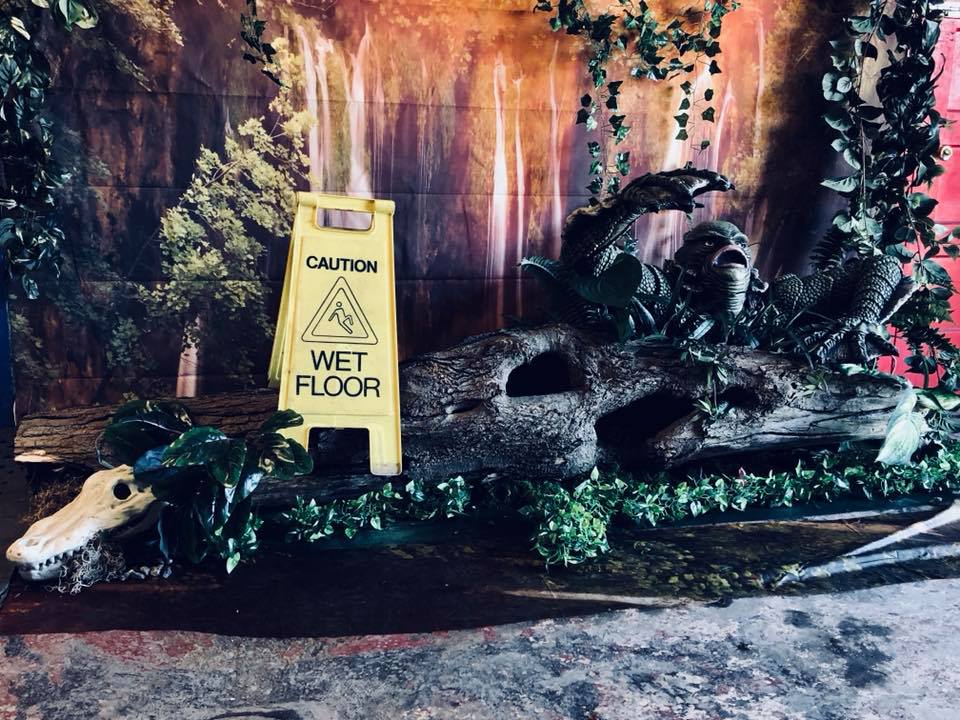
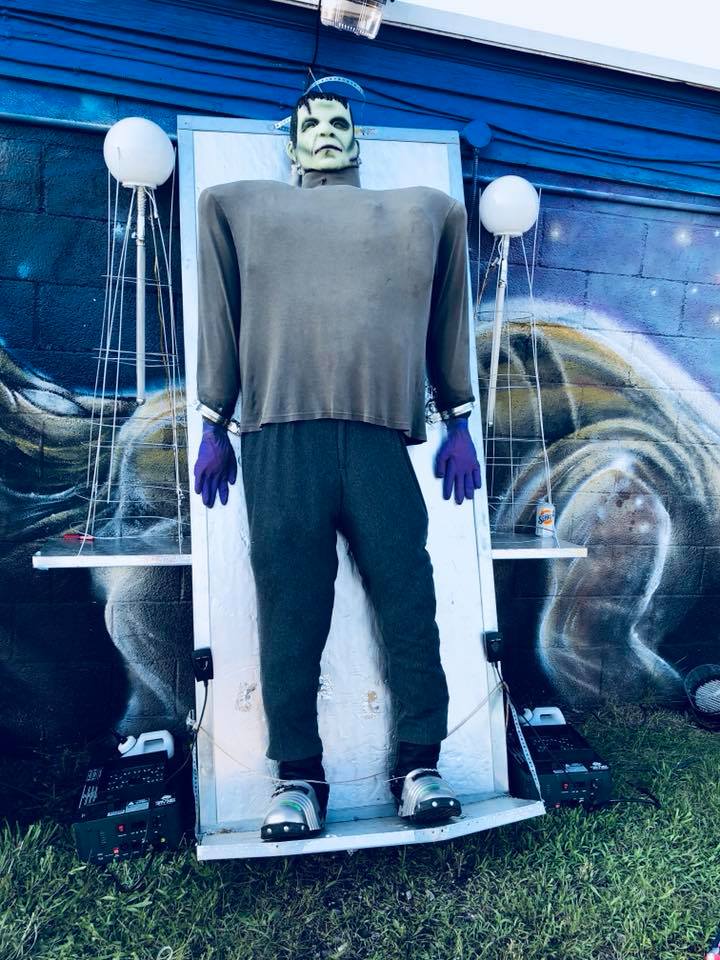
For each film weekend, the all-volunteer staff decorate the concession stand and grounds with props pertaining to the themed weekend. For Universal Monster Mash, they had a Gil-man prop, a six-foot coffin surrounded with garlic, a mummy, and Universal Monsters trading cards that you could purchase. Most impressive was the Frankenstein’s monster set-up outside, complete with a medical table and electrical towers that smoked. As fans dressed in black Universal Monster t-shirts awaited dusk, they snapped pictures next to the decorations or lingered over Screem magazine’s table, purchasing blu-rays of rare horror films. Families with children slipped on monster masks and posed for group photos, before lining up at the concession stand for popcorn, which, by the way, was only $4 for a large and included free refills.

creatureprop

(Photo credit Daryl Sznyter)

By the time night fell and the projector’s beam of light cut through night and shined on the screen, everyone planted their camping chairs in front of their cars or huddled in their vehicles. As I looked around, I didn’t see the glow of cell phones anywhere. Everyone’s gaze was focused on the big screen. We were treated to vintage movie trailers, including one for Jaws 3, before they screened an episode of “The Three Stooges.”

Finally, James Whale’s classic 1931 Frankenstein played. I have seen the film countless times, written about it, and have taught it as a companion to Mary Shelley’s novel. Yet, there was something about seeing it at the drive-in on 35 mm with other fans that made it all the more special. Its iconic scenes were so much more striking, especially when we first witness Karloff in the Frankenstein make-up, looking at the camera with those dead, sunken eyes. I was pleasantly surprised that no one whipped out their cellphone during the films, not even the children. Maybe no one wanted to be “that person,” or maybe they were as awe-struck by the experience as I was.

Frankieprop

(Photo credit Daryl Sznyter)

Before and between the films, my girlfriend and I talked to other moviegoers. Some were local and knew that for a few bucks, they could have a fun weekend with their family. Others were horror or drive-in fans that travel hours and hours to the Mahoning when they host the horror weekends. One gentleman encouraged us to attend a drive-in event in September outside of Pittsburgh, the Super Monster-Rama, and he assured us that many in attendance at the Universal Monster Mash would be in Pittsburgh, too. While I always knew that a horror film community existed, I didn’t know about its drive-in subculture. Looking around, though, I saw plates from NJ, MD, NY, just to name a few.

During intermission, one of the hosts said that at one time over 300,000 drive-ins existed in America. Now,  about 400 remain. I suppose it’s easier to download a film to your laptop or watch it on your smartphone, but there was something strangely rejuvenating about unplugging for an evening and watching those Universal films with other drive-in moviegoers. For a few hours, I didn’t check my email or latest headline. So much in or hyper-consumer culture feels disposable, but this experience didn’t. I came away from it wanting to attend another event soon.

For anyone interested in the Mahoning Drive-in, which plays all types of retro films, not just horror, check out their Facebook page for the most updated information