Pyewacket and the Horror of Our Parents’ Imperfections

2018, like 2017, is shaping up to be a strong year for the horror film, especially with the upcoming release of A24 Studio’s Hereditary and the reboot of Halloween. Horror is poised to do well at the box office again this year, but some attention should be given to the independent films that have already been released this year, including Pyewacket, written and directed by Adam MacDonald and released by IFC Midnight.


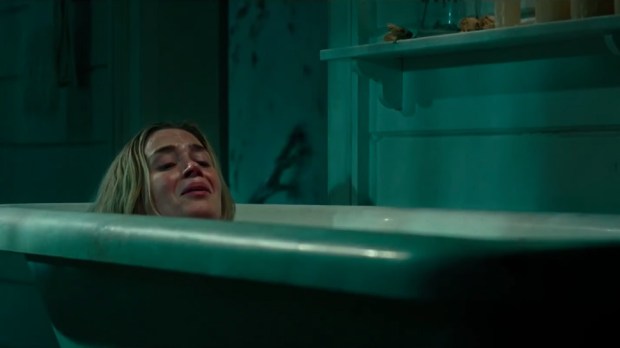
The film stars Nicole Munoz as Leah, a rebellious teenager who listens to heavy metal and has a fascination with the occult. Leah may sound like a one-dimensional, cliche character, but she is not, mainly because of the story given to her. The central conflict revolves around Leah’s fragile relationship with her erratic mother, Mrs. Reyes, played by Laurie Holden (“The Walking Dead,” “The X-Files”). Holden’s performance is stellar. Her moods change from scene to scene and showcase Holden’s range as an actress. One minute, she is curled up on the bed, crying, and by the next scene, she is cooking pancakes for her daughter, trying to ease the tension with a smile. Mrs. Reyes is grief-stricken after losing her husband, and she wants to move away in order to move on, which puts her at odds with her daughter, who has found her place among fellow Goths at school.

Eventually, Leah dabbles with rituals and tries to summon a demon to punish her mother. In the hands of a less skilled director, this familiar plot line of a teenager in conflict with her mother would be yawnsome, but MacDonald makes it work. This is not a fast-paced film heavy on jump scares. Instead, it builds slowly and the viewer spends a lot of time getting to know Mrs. Reyes, Leah, and her friends, which makes the audience generally concerned for their well-being. The scares build slowly, from creaks in the house, to unnerving footsteps on the roof, to a rather memorable and startling conclusion.

More so, Pyewacket falls in line with recent horror movies that interrogate the imperfections of parents and also the lofty expectations placed on parents, especially mothers, to fulfill their role. The Babadook comes to mind. Mrs. Reyes, like the frazzled mother in The Babadook, Amelia (Essie Davis), tries to do her best but can only take on so much. The children in both films don’t make it easy on their mothers, either. Leah immediately protests the decision to move, discounting her mother’s grief.  However, Pyewacket is a little more direct in questioning the ways that we idolize parents, especially mothers, and whether or not that’s healthy.  In one of the early scenes, Leah’s friend Janice (Chloe Rose), asks, “Do you think our parents will always be our parents? We’re supposed to look up to them, but they’re just people. They fuck up. They make mistakes. Really, they’re just people.”

Mrs. Reyes is never depicted as the perfect mother. In fact, in one scene, she says to Leah, “Your friends are losers  just like you’re becoming,” before adding that it’s impossible for her to move on when she sees her husband every day in her daughter’s face. Her mood swings display the effects of her grief and her newfound role as a widowed and single mother.  It takes much longer in The Babadook for Amelia’s tension with her son to come to a head, though both mothers try to maintain their sanity, despite the demands of their children.

The fraught relationship between Leah and Mrs. Reyes and the strong performances by Holden and Munoz make Pyewacket one of this year’s most compelling horror films so far. The scares that ramp up by the film’s second half are an added bonus.

Pyewacket is currently available to rent on Amazon, YouTube, and other streaming services.


Halloween 2018 (What We Know So Far)

Without a doubt, one of the most anticipated horror films of 2018 is Halloween. Instead of another unnecessary sequel, Halloween 2018 is going to follow only John Carpenter’s original film, thus wiping the universe clean and placing us back to the beginning. With John Carpenter returning as executive producer and with Jamie Lee Curtis returning to play Laurie Strode 40 years after the original, there is reason to be excited. So far, some minor details about the film have leaked, after  Jamie Lee Curtis introduced the first trailer at CinemaCon in Las Vegas a few days ago. Based on reporting, the trailer begins with a true crime documentary team investigating Michael Myers’ murders from the first film. The investigators visit Myers, who’s been held in a facility for years; obviously, something goes wrong and Myers returns to Haddonfield. Curtis has said  that this time, Laurie Strode is ready for Michael, meaning she has stockpiled guns for the day he returns. This is quite a contrast to the 1978 Laurie Strode, who was a quiet, bookish teenager who outlived her friends by following the typical tropes of final girls in slasher films (innocence, being a virgin, etc). Seeing a more confident version of the character has peeked my interest as much as the description of the trailer.

It has also been reported that Carpenter will score the film, and Laurie’s daughter will be played by Judy Greer. Her granddaughter will be played by Andi Maticha. So far it is unclear what role they will play in the film, but let’s hope that the plot centers around the Strode family, specifically each generation of women, facing off against the Boogeyman.

myers mask.jpg

There is much to be said about the first poster of the film, too. It clearly shows a mask that is aged, perhaps one that Michael has worn while rotting away in a facility years after the first film. The mask is dominant on the poster, which may indicate that the film intends to make Michael the ever-present force that he was in Carpenter’s original story, a type of evil that can be present anywhere at anytime, behind a bush, in a yard, in a house. That is what truly made him the Boogeyman in the first place. Lastly, the text at the bottom of the poster somewhat reassembles the text from the first film, which is another indication that this film intends to have more in common with the original than the many sequels.

Halloween0

Halloween is slated to be released on Oct. 19. It will be directed by David Gordon Green.


Is “The Walking Dead” Getting a Soft Reboot?”

landscape-1523363600-the-walking-dead-finale-battle

After “Fear the Walking Dead” cleaned house and essentially changed its writing staff for season 4, there has been speculation about the fate of “The Walking Dead.” While the show still occupies the public imagination, it has faced a ratings decline over the last two seasons, as the All Out War arc has gone on too long. Season 8’s finale, “Wrath,” marked the conclusion of that arc. Negan (Jeffrey Dean Morgan) and the Saviors were at long last defeated by Rick Grimes (Andrew Lincoln) and company. Based on some of the dialogue from the season finale, it is possible that the show may see a soft reboot in season 9, and hopefully one that focuses less on a villain like Negan and more on the characters trying to rebuild civilization and retain their humanity, while fending off zombies. Zombies! Remember those?

As far as season finales go, “Wrath” was not that bad. It had far less action sequences and gunfire fights than the first half of season 8. None of the violence was gratuitous, unlike the season 7 premiere when Negan had his full introduction by using his beloved barbed wire baseball bat Lucille to bludgeon the heads of fan favorites Glenn (Steven Yeun) and Abraham (Michael Cudlitz). Additionally, the finale successfully concluded a tiresome arc, while opening up some intriguing possibilities for the show moving forward. At the center of “Wrath” was the idea that Rick and his crew are moving on from the past. After slicing Negan’s throat and nearly killing him, he talks to his people and the Saviors about how it’s time to rebuild civilization, that the days of one group opposed to another group are over. In one of the last scenes, Rick and Michonne (Dania Gurira) tell Negan that they let him live so he can “rot” in a jail cell and serve as an example of a rebuilt civilization where peace and justice rule. This follows his comic fate post-All Out War.

Maggie (Lauren Cohan), meanwhile, asserts herself in another scene by telling Daryl (Norman Reedus) and Jesus (Tom Payne) that Rick and Michonne need to pay for allowing Negan to live. This dynamic should return the show to character arcs and development. It opens up the potential for a good story-line heading into season 9. There is also the unknown story-line of Negan and what purpose he will serve moving forward. In the comic, post-All Out War, he has an important story-line that deals with Carl, but since Carl (Chandler Riggs) has been killed off on the show,, that will allow the TV writers to take a different path with Negan, which again opens new possibilities.

gallery-1523362669-rick-carl-the-walking-dead.jpg

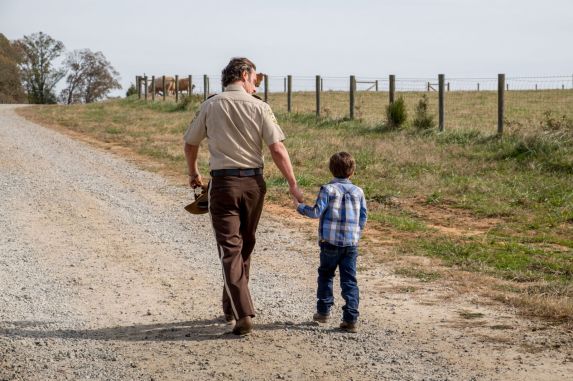
Recently, former show-runner Scott Gimple has said that the season 8 finale serves a conclusion to the first eight season and the writers plan to do something different moving forward. That idea was at the center of “Wrath.” Rick’s speech can be seen as a metaphor for the show up until this point and the need to move on from what was. Additionally, the show opened and concluded with an image/flashback of Rick and a young Carl walking on a quiet countryside road, so maybe Carl’s vision for a peaceful future will start to come to fruition and the surviving groups can focus on rebuilding. Perhaps the main conflict will be the inner workings of this new world, including Maggie versus Rick’s dueling visions. That would move the show away from the stale formula of a bad guy v. Rick and company.

Based on this week’s “Fear the Walking Dead” season 4 premiere, it is evident that you can give a show a soft reboot and reinvigorate it by hiring new writers. Recently, “The Walking Dead” hired a new show-runner, Angela Kang. Hiring a new show-runner is a positive step forward, since “The Walking Dead’s” decline came under Scott Gimple’s run. The season 8 finale opened the door to some potential interesting story-lines. In the hands of the right writers, the show may find its footing again.


AMC’s “The Terror,” Bone-Chilling Horror

terror1


At the halfway point of its first season, AMC’s “The Terror” is one of the most bone-chilling series on television of the last few years. Produced by Ridley Scott, the director behind Alien, the show is an adaptation of Dan Simmons’ nearly 800-page novel of the same name, which fictionalizes the doomed expedition of a Royal Naval crew that was charged with finding the Arctic’s treacherous northwest passage in the mid-19th Century.

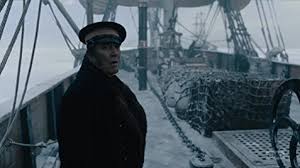
“The Terror” follows the crews of the HMS Terror and the HMS Erebus and the stories of Francis Crozier (Jared Harris) and Captain John Franklin (Ciaran Hands), two men with different views on how to survive brutal conditions. Crozier has more experience navigating the Arctic and has both a respect for its raw conditions and its native people, while Franklin is a foolhardy man who thinks that God and religious belief will be their salvation. Frequently, he ignores the advice of Crozier, who is far more seasoned in his exploration of the Arctic. He also expresses disdain towards the few native people/Eskimos that the crews encounter. Instead of working with them to better understand their dire situation, he boots them off the ship and treats them as the Other. Only a few episodes in, Franklin meets the fate that he deserves, thus leaving Crozier in command.

terror2

(Captain Franklin in AMC’s “The Terror”)

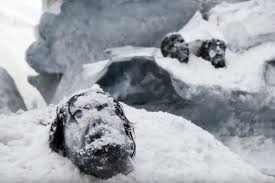
Simmons did draw on history to pen the novel, and the real terror is the long, agonizing deaths that the crews face from starvation, bitter temperatures, and cannibalism. Simmons embellished the story by creating a monster that stalks and kills the men. So when they’re not worried about starving to death, they have to worry about losing limbs to some beast that is never fully seen in the TV show, at least not yet, and is only described in brief flashes in the novel.

“The Terror” has several parallels to Ridley Scott’s Alien. The film’s now infamous xenomorph is not seen until the film’s final act, which leaves more to the viewer’s imagination. It stalks the crew members on the ship and picks them off one by one, similar to the beast/demon in “The Terror.” There is also an immense sense of isolation in both “The Terror” and Alien. In the Arctic, no one can hear you scream. No one comes to save the crew, nor does anyone come to save the doomed mining expedition in Alien. Space is as cruel and indifferent as the Arctic. Visually, “The Terror” is one stunning TV adaptation, with long-shot views of walls of ice and white landscapes, to the close-ups of ice shards on the ships and the worried looks of the men when they’re alone in their cabins, wondering how they’ll possibly survive. The visuals are on par with some of Scott’s best work behind the camera.

It is unclear at this moment if “The Terror” will have a second season, but there is much left of the novel to adapt, including Cozier’s relationship with a native Eskimo, Lady Silence (Nive Nielsen), which stands in stark contrast to the colonizing attitudes of Franklin and some of the other men. Hickey (Adam Nagaitis) has yet to fully transform into a monstrous villain, and the friendship between Crozier and Captain James Fitzjames (Tobias Menzies), Franklin’s next in line,  will need more than a few remaining episodes to develop.

For now, there are still a handful of episodes left to enjoy of season 1.

A Quiet Place: Masterfully Suspenseful Mainstream Horror

A-quiet-place-super-bowl.jpg


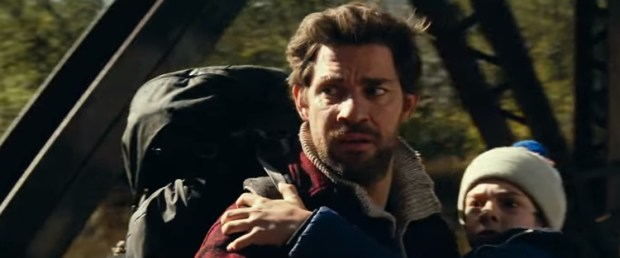
John Krasinski is not the first name that comes to mind in the horror genre. Yet, A Quiet Place, which he directed, is one of the most memorable mainstream horror films of the last few years. The film stars Krasinski as Lee and his real life wife, Emily Blunt, as Evelyn. Together, they exist in a post-apocalyptic world and try to protect their children from monsters that are blind but have a heightened sense of sound.

The film handles suspense masterfully, especially in the first 15 minutes, when the family hunts an abandoned store for medicine. Evelyn needs pills for her sick son, and she slowly has to turn the bottles on the shelf to read the labels. One little sound, and she knows her family will be meat for the monsters. After exiting the store, the family walks barefoot on trails of sand so their footsteps don’t echo and alert the monsters. You hope that all of them will make it home.

The rest of the film is relentless in its use of suspense, sound, and silence. Any wrong move, like the creak of a floorboard or a scream, will doom the family. The monsters, meanwhile, break the silence with their screeches and loud thumps when they invade the family’s home.

Like any good horror film, A Quiet Place serves as a metaphor for a larger issue: parenting and the dread that you can’t protect children from a world that can be unbearably cruel. At one point, Evelyn asks Lee, “Who are we if we can’t protect them?”. Blunt and Krasinski are stellar on screen together, especially in one of the early scenes where they share earbuds, cling to each other, and slow dance. You root for this family and want them to survive, but their pained facial expressions and the threat of a monster that is always lurking in the cornstalks surrounding their farmhouse make you wonder if they’ll last until morning.

A-Quiet-Place-review-featured.jpg

Emily Blunt’s performance as Evelyn is fantastic. She has one of the most terrifying birthing scenes I’ve ever seen on screen. It is visceral and jarring. Her character gradually transitions to a mother who will do whatever needs to be done to protect her children. In a movie that relies so much on silence and has so little dialogue, Blunt pulls off much of her performance through body language and facial expressions.

Krasinski has a mainstream horror hit on his hands. He may be new to the genre, but he certainly understands that character development and suspense that doesn’t rely too heavily on gore are elements that make a good horror film. Blunt, meanwhile, is emotional and powerful. A Quiet Place is the best mainstream horror film of 2018 thus far.

Why I’m Okay with This Latest “X-Files” Ending

xfiles


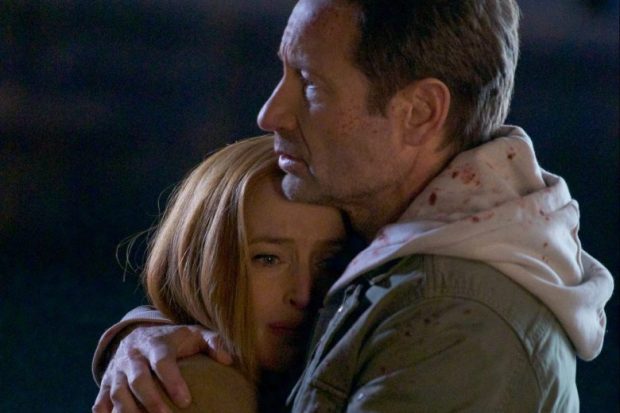
Last week, FOX premiered what may be the finale of the “X-Files,” a one-hour episode entitled “My Struggle IV.” If last week’s episode is indeed the swan song for the show, I’m okay with that. Gillian Anderson  insists that she is done with the show.

The episode, written and directed by Chris Carter, focused on the ongoing alien mythology arc, specifically Scully and Mulder’s attempts to track down their son, William, and prevent an alien virus from wiping out humanity. William, it seems, is the key, hence why Mulder and Scully’s longtime foe the Cigarette Smoking Man (William B. Davis) has been tracking him for years.

I give the episode a B/B-. On the plus side, Mulder has a touching scene with William when he finds him on the run from Syndicate thugs. William showcases his awesome powers, including the ability to make heads explode. However, the episode doesn’t make clear if Skinner (Mitch Pileggi) is dead after getting mauled down by a car. William, meanwhile, re-emerges from the river in the final scene after the Cigarette Smoking Man thought that he killed him. If William is still alive, then what does that mean for the alien virus?

The story concludes when both Scully and Mulder find out he’s not really their son, but instead some lab experiment and an alien/human hybrid creature. Instead, we learn that Scully is pregnant by Mulder, so, at long last they can be together and raise their own child. The Cigarette Smoking Man’s story comes to a conclusion, too, after Mulder pumps his chest with a round of bullets and he falls into a river.

smokingman

“My Struggle IV” is not as satisfying of a finale as season 9’s two-parter entitled “The Truth,” which featured the return of David Duchovny, who was MIA for the previous two seasons. “The Truth” also featured several “X-files” fan favorites who made one more appearance, and it concluded with Mulder and Scully on the run, but ready to face whatever may come next. That said, “My Struggle IV” does provide a decent ending point. Mulder and Scully can be together.  The Cigarette Smoking Man is dead, though, to be fair, he was torpedoed in “The Truth” and somehow survived. The alien virus is thwarted.

Chris Carter recently said he is unsure as to the fate of the show, but “The X-files” is not going to work without Gillian Anderson. “My Struggle IV” should be its swan song.


A Little Netflix Horror

As Netflix moves closer and closer to essentially becoming a streaming service that offers its own content, it can be hard to find good films that don’t hold the Netflix title, and films that are not Netflix content sometimes don’t stay on there for very long.

That said, there are two films recently added to Netflix that are worth any horror movie fan’s time. The first is a Korean movie entitled The Wailing. Directed by Hong-jin Na, this 2016 film clocks in at nearly three hours, but very few scenes feel like they drag. The film follows a police officer who investigates bizarre murders caused by a mysterious disease. People start to wonder if a Japanese stranger is the source of the village’s ills. Eventually, the officer’s daughter succumbs to the disease, and well, I don’t want to give away much more of the plot or spoil anything. The film is atmospheric, heavy on Biblical imagery, and generally unnerving. In fact, it’s the first horror film in quite a while that got under my skin and stayed with me for days after my initial viewing. The film’s use of A-horror tropes, especially the idea of ghosts and the past manifest in the present, is well done. It also has one of the best exorcism scenes I’ve ever seen on film, if you can even call it an exorcism scene.

My second recommendation  is the 2017 French-Canadian film Ravenous. Directed by Paco Plaza, this film generally plays with the zombie genre. At this point, I can understand why people would be tired of the endless barrage of zombie flicks, but this one works. Like 28 Days Later or Dawn of the Dead (2004), these zombies are more threatening. They run. They charge. They seem to be everywhere. The film follows a group of survivors in a remote, wooded town. The use of sound is the film’s most effective technique. This is a low-budget film, but one that employs sound in such a way that it makes it stand apart and above a lot of other recent zombie flicks. You can hear people crying off-screen, either survivors devoured by zombies or people turning into zombies. You can hear the thump, thump of an axe or a pipe wielded by a survivor as they kill one of their best friends who just turned. Unlike other zombie flicks, the movie isn’t as heavy on guts and gore and instead uses sound to establish it scares. When it does use gore, it feels breathtakingly real and gritty, streaked on the face of the survivor’s after they kill one of their friends, for instance. Furthermore, the shots of zombies standing on their porch stoops or standing in fields are just as unsettling. The film is well-worth the time.


Some Poetry News

I’m breaking briefly from the blog content I’ve been posting lately to share a little bit of poetry news.

First, I am happy to announce that I have two poems in the new issue of Ovunque Siamo: New Italian-American Writing. You can read the poems, “Praise Poem for After the Storm,” and “Punk Goes Acoustic,” here.  The entire issue is worth a read and features  poetry, nonfiction, fiction, and book reviews.

Another poem, “Praising the Familiar,” was recently featured as the poem of the week by Zingara Poetry Review. You can read that here.

Over at 4squarereview, I had the chance to review Amy Lawless’ new collection, Broadax. This is a book I highly recommend. It is fierce and funny.  You can read the review here.

Lastly, I will be taking part in the release party for the anthology Misrepresented People: Poetic Responses to Trump’s America on Sunday, March 18 at the Bowery Poetry Club in NYC.  The reading begins at 3:30 pm. All proceeds from the anthology benefit the National Immigration Law Center. You can check out the Facebook event page here.


TWD’s Big Send-Off

Carl and Judith.png


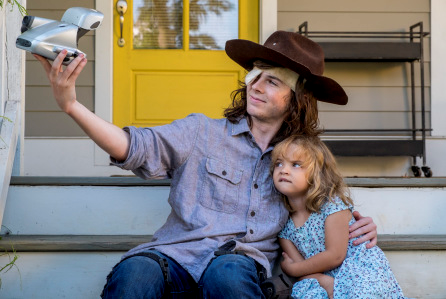
“The Walking Dead” returned last night for the second half of its eight season, and SPOILER, it featured a major character death: Carl, Rick Grimes’ (Andrew Lincoln) son. Actor Chandler Riggs has been on the show for nearly half of his life, so seeing Carl written off, after succumbing to a walker bite in the first half of season 8, is probably still difficult for fans to process. The opening minutes featured Carl writing letters to everyone he loves and snapping photos with baby sister Judith, so she’ll remember him. It was a nice tribute to his character, and the rest of the episode was packed with emotional weight that provided some glimmer of hope that the show can rights its course. Question still remain, though.

For the entirety of TWD, be it the comic or TV show, most of the decisions that Rick made were based on what’s best for his son. Removing Carl from the show makes it unclear what role/purpose Rick will now have. It also needs to be said that Carl has some of the most important story arcs in the comic after the All Out War/Negan/Saviors arc draws to a close. What does that mean for the future writing and main plot points of the show? That remains unclear. On the show, Rick still has Judith, but he doesn’t even know if she is his kid or Shane’s, and Judith never occupied as large of a role as Carl.

The 90-minute episode  focused on two plot points: Carl saying goodbye to everyone, especially Rick and Michonne (Dania Gurira), and Morgan (Lennie James) losing his pacifism and ethics by slaughtering Savior after Savior. The juxtaposition illustrated two very different ideals. As Carl was dying, he pleaded with his father to build a better world and “make it real.” The rest of the narrative focused on Morgan resorting to violence, even ripping out the entrails of a Savior, thus raising a question that the TWD has always raised: is peace in a post-apocalyptic world even possible?

Carl’s death also showed the randomness and violence inherent in such a world. Early in the episode, Carl told Rick and company, “It wasn’t a Savior. It just happened. I got bit.”  For a moment, at least, it made the walkers the villain again and showed they are still a threat and can take down one of the main characters. It also showed that you can do everything right and do your best to survive, but that doesn’t mean you’ll make it. The world is random, and in a setting like TWD, it is also cruel, cruel, cruel.

The episode was rich on character, and at times, it felt like earlier seasons of TWD, when we had a reason to care about the characters. However, the few scenes of gunfire between Rick’s group and the Saviors served as a reminder that we still have to deal with the guns, explosions, and war arc at least until the end of the season. These long, drawn-out action sequences can be numbing, frankly, and have taken the show away from what it used to be. Last night’s episode was a reminder that TWD does best when it focuses on character and the relationships these survivors have with each other. It may be best for the writing when the war arc draws to a close, perhaps allowing the show to find its footing again, as it did during last night’s episode.