In his essay, “Can Poetry Matter,” Dana Gioia talks about ways to make poetry readings more accessible. He has a lot of suggestions, including adding music to a reading, combining the literary arts with the visual arts, among other ideas. I’ve tried a lot of these in the past, and they do indeed work as a way to broaden the audience for poetry. He also stresses the importance of sharing poetry other than your own and reading a poem or two by someone else as a way to keep tradition alive.
While thinking about ways to do something different for National Poetry Month, some of my friends and I were approached by The Hoyt Library in Kingston, PA about doing an event for them. So, we decided that we’re going to do a panel/reading. As part of the panel, we’ll read/discuss two or so poems by some of our favorite poets and then share a few of our poems inspired by those poets. This is a way for us to give away and share poets that we love.
So, if you’re in the area and want to celebrate National Poetry Month, then come to the Hoyt! The event will be this Thursday, beginning at 6 p.m. and held in the reading room. The other poets involved are Dawn Leas and Scott Thomas. We’re looking forward to the event and would appreciate a strong turnout to ensure the Hoyt continues having events like this in the future.
As a break from blogging about poetry, I wanted to write about something different, and share my enthuasiasm for the upcoming X-men: Days of Future Past movie, directed by Bryan Singer, who directed the first two X-men films. There are a number of reasons to be excited about this film if you have any interest in the X-men or comic book movies in general. For one, Bryan Singer directed it. As a long-time fan of the X-men comic franchise, I’ve always felt that Singer got it right with the first two X-men movies, especially the feel of the comics and the theme of the X-men being outsiders. The comic started in the early 1960s, during the civil rights movement, and the mutant/outsider trope worked well as a metaphor for civil rights and later on gay rights. Singer did a great job capturing that aspect in the first two films and showing the divide between mutants and some of the more small-minded humans.
Furthermore, perhaps no story better sums up the mutant as outsiders trope better than the two-part story line of Days of Future Past, issues 141 and 142 of Uncanny X-men, which you can read for free here. The war between humans and the mutant outcasts escalates to the point that humans create a line of robots, the sentinels, to hunt down and kill all mutants, which, in the dystopian future, they succeed at doing. There was something so horrifying and menacing about the sentinels in the comic, especially since they eventually turn on humans and not even the X-men can stop them. As a little kid, I had nightmares about these robots stalking my neighborhood. This arc too represents the line between militancy and peaceful activism, mutants that do not want to co-exist with humans and mutants that believe peace is possible, essentially.
Finally, some clips in the trailer have me excited as an X-men fanboy, including Iceman’s ice slide, Magneto ripping apart a sports stadium, Colossus going toe-to-toe with the sentinels, and seeing the origional cast from the first two films reunited. It’s evident some of the material from the comics is changed. For instance, Wolverine is the one going back in time in the film instead of Kitty Pyrde to try to prevent the dystopian future, but it should be a good summer blockbuster anyways. Other than The Walking Dead, the X-men franchise has been the only comic book/comic movie series I’ve cared about. It’s always been about more than action, and Days of Future Past is comic book writing as its best, a combinition of action, strong story, and a great political and social undertone. This movie should show too how the X-men comics have always interwoven U.S. history with the comic story.
About a month ago, I read at the Ragged Edge Cafe in Gettysburg, and if you live anywhere near central of southeastern, PA, I suggest checking out their poetry series, which runs every First Friday of the month. The event is half open mic and half feature, and the open mic only includes poetry, so writers don’t have to worry about competiting with musicians. The event organizers work hard at promoting the event, and when I read, my audience consisted of a few dozen people. Not bad for a cold night in early March! Futhermore, the open mic was a great mix of local college students and poets that have done several readings throughout Pennsylvania. The writing community there is encouraging and supportive, and I hope their events continue to grow well into the future.
Ian Falcone, a son of one of the regular poets/open micers, recorded a video of me reading. I’ve done a lot of readings, but few videos have surfaced, so, I thought I’d share.
During the month of April, I’ve been asked to select poems of the week for TheThePoetry blog, and doing so has been an honor and treat so far. As a way to celebrate National Poetry Month, I’ll post my selections here. All of the selections I’ve made so far are by poets whose work I deeply admire and poets who have been supportive of me in my career as a poet.
The first selection, which ran last week, is the poem “Bliss” by Christine Gelineau, which you can read here. The most recent poem of the week is “Watching the Pelican Die” by Maria Mazziotti Gillan, which you can read here. I am lucky and fortunate enough to know both poets. Christine was one of my mentors during my time spent completing my M.F.A. at Wilkes University, and Maria is currently one of my professors in my Ph.D. program at SUNY Binghamton. Both poets are strong supporters of their students and wonderful writers. I hope you enjoy ther work.
The website also just published an interview with Maria, some of which I want to quote here as a way to think about poetry, especially the narrative form that she and I use most often.
In regards to the narrative form, she says, “My vision of poetry is that it should be based on some essential truth about what it means to be human and I think narrative poetry gets at those truths more directly and effectively than many other types of poetry. I want to give people permission to tell their own stories and to look at the world unflinchingly through the their own eyes rather than worrying about what critics or literary theorists say about writing. Like Faulkner, I believe literature is about the truths of the human heart and not about intellectual analysis.”
Later in the interview, she says of the writing process, “I think it is unfortunate that so much of our education trains us to subdue all that is wild and primitive and honest inside ourselves and in our writing. I think that we have to be willing to let go, to ignore our intellect and allow instinct to take over. In revision, we can use our intellects, but in writing the poem we need to believe that this instinctive voice knows what we need to write and as soon as we look that very middle-class,suburban inside voice, we lose the energy and vitality in our work. Even in revision, we have to be careful, to prune the work with delicate hands.”
The conference has several benefits. For one, the price of registration is only $70, and you get a lot of free stuff, including a book and subscription to a literary journal, among other items. Beyond the cool free stuff, Conversations and Connections is less daunting than some of the larger conferences, such as AWP, especially since it’s only one day long. Furthermore, the event organizers do a fine job ensuring fiction, poetry, and creative non-fiction are well represented on the panels. The conference does a good job too of balancing craft talk with practical advice on writing, such as how to write an engaging cover letter for a journal or whether or not to enroll in an M.F.A. program.
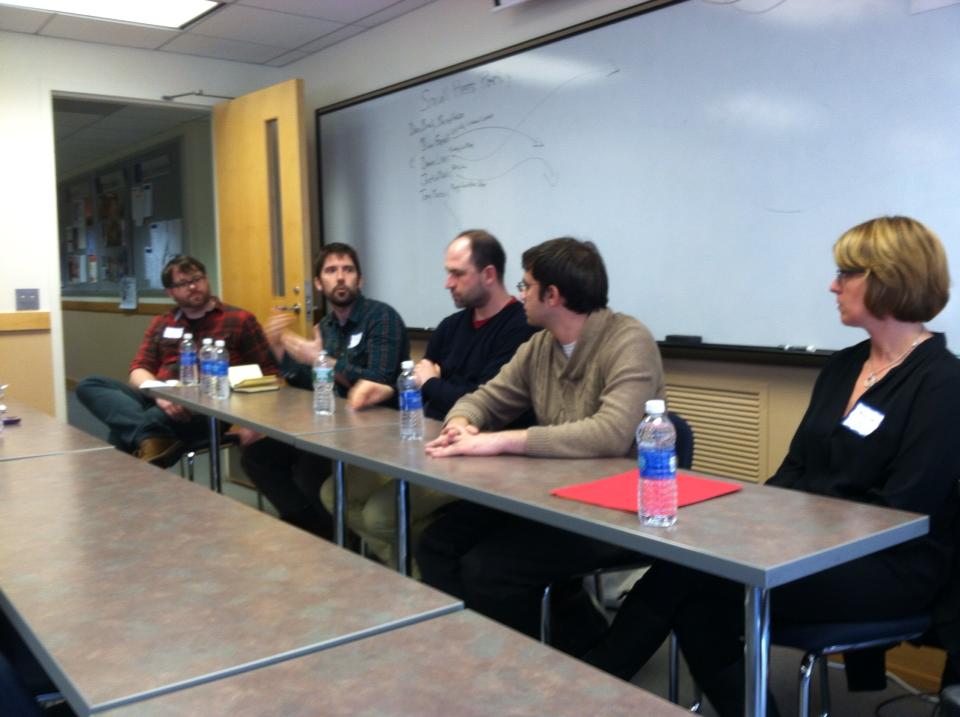
I was part of a poetry publishing panel late in the day, and the audience was attentive and had a lot of questions. Because Conversations and Connections isn’t so massive, there’s a chance to chat more with the panelists throughout the day and during the after parties. It’s a great way to meet other writers and editors, and that alone is worth the price of admission.
d
Our panel on working with small poetry presses.
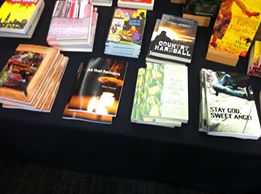
My book All That Remains at the conference.
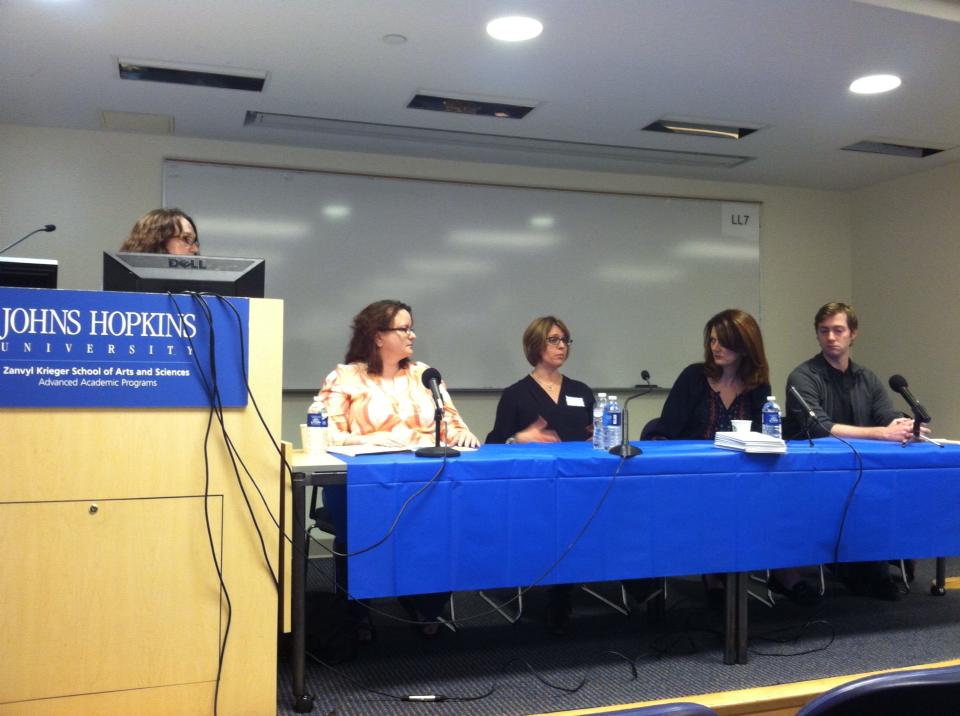
My friend/fellow poet Dawn Leas on a panel about M.F.A. programs. The panel was moderated by another friend, Shelia Squillante, an associate editor for PANK and associate director of Chatham University’s low-res M.F.A. program.
I’ll be part of a panel entitled “Think Small: The Benefits of Working with a Small Poetry Press,” and I’ll be sharing my experience publishing two books of poetry with indie presses. My co-presenters are Dawn Leas and Tony Mancus, one of the co-founders of Flying Guillotine Press. If you’re looking for a good writing conference that is affordable, I suggest heading to Conversations and Connections on Saturday. The registration information and panel descriptions are listed on the website. There will also be speed dating with editors of literary magazines and publishers, which is a great chance to make connections and share your work.
Happy April 1! In honor of National Poetry Month, I thought I’d re-post Charles Bernstein’s essay “Against National Poetry Month,” an essay that is quite sarcastic at times, especially in the last paragraph, but an essay which addresses the ways in which poetry has been under house arrest over the last few decades, to use a phrase from Adrienne Rich. Sometimes, I find Bernstein to be too over the top, but here, I agree with few of his points.
One of his main gripes is that National Poetry Month promotes what he dubs safe, mainstream, anti-intellectual, non-challenging poetry. To quote from his essay, “Promoting poetry as if it were an ‘easy listening’ station just reinforces the idea that poetry is culturally irrelevant and has done a disservice not only to poetry deemed too controversial or difficult to promote but also to the poetry it puts forward in this way.” There I agree with him.
He also makes a good point about poetry and capitalism when he states that a lot of the major corporate sponsors and chain bookstores that push National Poetry Month are also the ones who limit poetry’s accessibility by refusing to carry books by small poetry presses. He even calls out the New York Times for being a sponsor of National Poetry Month in the past but not giving any serious space for poetry book reviews or poetry itself.
I am not against National Poetry Month as much as Bernstein, and I am happy I have four or so events this month and tend to have a busy April every year, but I do think poetry should hold importance year round, and there are countless writers, conferences, small presses, editors, and book reviewers who try to ensure poetry is relevant beyond the month of April.
I am hoping some other folks will read Bernstein’s essay and offer comment.
The Association of Writers and Writing Programs Conference (AWP) is seeking panel proposals on the topics of interest to adjuncts and non-tenure track faculty, including adjunct unionization. Here’s a link with more information on what they’re looking for and the proposal guidelines. I commend AWP for seeking out proposals like this and the organization’s willingness to address this issue. However, it may be difficult to acquire a number of panel proposals from adjuncts because anyone trying to cobble together a paycheck on an adjunct salary will not be able to afford the conference registration, costs of travel, or costs of a hotel. I hope, though, that adjuncts teaching in Minneapolis, with easier access to the conference, will consider sending in a proposal. I also hope that AWP accepts some panel proposals on the issue of cuts to education, which in turn leads to the creation of more adjuncts and less full-time faculty. I’ve been to the AWP Conference three times, in Chicago, Denver, and Boston, and I’ve never seen any panels that address these issues, so kudos to AWP for actively seeking out such proposals now.
Meanwhile, The New York Times just published an article this week about an adjunct professor in NY who took direct action to raise awareness about the low cost of living adjuncts face. Check out the article here.
Poet and HuffingtonPost blogger Loren Kleinman just published an interview with me on her website, which you can read here. I also suggest checking out her new collection of poems, The Dark Cave Between My Ribs. It’s great read.
I also wanted to mention that I am reading at the Barnes & Noble in Lancaster this weekend with Dawn Leas as part of the Lancaster Poetry Exchange. The reading starts at 7, so if you’re in the area, come by!
I also have some events coming up in April for National Poetry Month, but I’ll post those closer to the dates.
TheThePoetry has posted a new review of my collection All That Remains written by Scott Thomas. In the review, Thomas writes, “Fanelli’s work is approachable. He does not brandish his technical prowess with intimidating sestinas. There is no pandering to theory, nor does he flaunt his erudition by quoting obscure thinkers or having his characters speak in Latin. (Though there are some well-placed references to Bob Dylan and horror movies.) What we do find are rusting towns and their hard-working denizens, whose horizons are limited through no fault of their own. We also catch moments of tenderness and regret and glimpses of youth with chances seized or lost.”
He concludes the review with the line, “Fanelli writes about fates that he himself has escaped, but he is unwilling to turn his back, to say: ‘I’m out of here. You’re on your own.’”
If you haven’t checked out TheThePoetry, I suggest bookmarking it and visiting frequently. They run several reviews a month, as well as interviews, essays, and spotlights on different poetry communities across the nation.
In addition, I have three new poems in the new issue of Fledging Rag, which is only available in print through Iris G. Press. The issue is impressive and features a wide range of forms and voices, including three poems by my friend and fellow Wilkes M.F.A. alum Chris Bullard.