And Time’s Person of the Year Goes To…..

This is the first time in a long time I’ve agreed with Time Magazine’s decision for its annual Person of the Year story/cover. This year, the magazine has chosen “the protestor” as its 2011 Person of the Year.

The article regarding the magazine’s decision can be read here, and it gives a comprehensive overview of the year of protest in the Arab world, the U.S., and mostly recently Russia. As the magazine points out, the year of protest was ignited on Dec. 17, 2010 when Mohamed Bouazizi, a street vendor in Tunisia, was hassled by police. He walked to the capital building to complain and got no response. So, he drenched himself in paint thinner and lit a match that ignited the Arab Spring. His action came after the country’s dictator continued power grabbing moves and a high cost of living.

The focus of the Arab Spring, though, mostly happened in Egypt, where, after months of protests and complaints about a fraudulent 2010 national election, thousands of young activists were able to topple a dictator, Hosni Mubarak. Since then, the military has taken power, and lately, Tahir Square has been flooded with protestors again, as the country’s citizens complain that the military is refusing to give up power.

Meanwhile, while the Arab spring was forming, thousands flooded the capitals of rust belt states, including Ohio and Wisconsin, especially Wisconsin, to protest restrictions on unions, especially the right for public employees to collectively bargain. Despite the massive protests, the governors in Ohio and Wisconsin still signed anti-union bills. However, in Ohio, citizens voted overwhelmingly in November to restore the union rights. And WI Gov. Scott Walker is likely to face a recall election. The move to collect enough signatures to get him on the ballot is now underway, and activists in that state are already close to getting enough signatures.

All of this preceded the largest protest movement the U.S. has seen in decades- Occupy Wall Street. What started as a dozen or so kids coming to Zuccotti Park on Sept. 17 has now blossomed into a national movement. Across the country during the fall, tents sprang up in nearly every major U.S. city. Since then, the police have shut down most of the tent cities, but the marches and protests continue.

2012 will reveal what’s next for OWS. This Sunday in NYC, the organizers are meeting to discuss where the movement goes from here. But OWS has been mighty successful in the sense it has totally changed the national conversation. Now everyone is talking about the fact the U.S. has the highest rate of economic inequality since the 1920s. President Obama has pivoted towards a more populist tone, and last week, during a speech in Kansas, he said this is a “make or break moment for the middle class.” He has co-opted some of the language of the OWS movement, and the movement has given him the space to be able to address much needed economic reforms and regulation of Wall Street.

OWS dominated the news in the last few months of 2011. The image of students getting pepper sprayed in the face at UC Berkley was all over the news, as well as images of standoffs between the NYPD and protestors in Zuccotti Park and thousands marching across the Brooklyn Bridge and also circling the New York Stock Exchange, nearly shutting it down.

I’ve worked with several OWS activists in the Scranton area, and I’ve visited sites in Philly and Boston. I’ve had my disputes with some activists over the use of tactics, and I would like to see the movement grow into real legislative reforms and people running for office, but while involved, I felt like something really profound is happening in this country and in the world. People have finally had enough, and for the first time in decades, they are finally protesting and getting involved in politics. It’s so inspiring to see young people across the globe speaking out.

Kudos to Time Magazine for acknowledging that 2011 was a year of mass protest, and since it is more than likely 2012 will feature more economic uncertainty and continued assaults on the middle class, the protests will continue.
Some Positive News for Bookstores

The New York Times published an article today with some surprising news regarding bookstores. Their holiday sales have been far better than expected, which could be a sign that bookstores will somehow find a way to survive in the age of the e-reader. According to the article,”Barnes & Noble, the nation’s largest bookstore chain, said that comparable store sales this Thanksgiving weekend increased 10.9 percent from that period last year. The American Booksellers Association, a trade group for independents, said last week that members saw a sales jump of 16 percent in the week including Thanksgiving, compared with the same period a year ago.”

The article also points out that books still make appealing presents, despite the growth of the e-reader, though it does state Barnes & Noble and Amazon are expected to have enormous sales for new e-readers and tablets.

For me, this article was unexpected good news. I’ve always been a fan of going to a bookstore and browsing for new purchases. I like plucking a book of poetry off the shelf and being able to turn the pages to get a sense of the writer’s style and form. Furthermore, I enjoy the community aspect bookstores hold, how familiar customers often stop at the cafes to chat with each other or read. A lot of my writing in the past has been done at bookstore cafes, and I’d like to see them stick around for the long haul.

Announcements

Last night, I was told by a  friend via Facebook that I won the category of “Best Local Author” in the Electric City/Diamond City’s year-end best of list.  I then ran out to grab a copy of the paper and found out it’s true. Thank you to anyone who voted for me! This news came as a wonderful surprise! To see the full list of winners, pick up a copy of the paper, or visit the website here and click on each category.

I also want to mention that this Tuesday, Dec. 13 at 6:30 pm, the Osterhout Library in Wilkes Barre (71 S. Franklin St.) is hosting a poetry reading. It will feature instructors and students that took part in the poetry workshops the library ran during the fall. I’ll be reading, and I’ll be joined by some friends. There will also be an open mic. This event is free, so stop by!

Shoutouts to Two Venues

Over the last few weeks, I’ve been doing some more readings out of the area as 2011 winds down. It’s been a year filled with readings for me, and I’ve trekked across various pockets of the tri-state area to share my work. Some of my favorite spots have included the Bowery Poetry Club and the KGB Bar in NYC and the Owl Cafe in Ithaca, NY, one of my favorite towns.

Recently, I read at two new venues for me that I encourage people to check out. The first is the Doylestown Bookshop in Doylestown, PA, not terribly far from where I spent a long time living when I was in the Philly area. They have a wide section of books in all genres and a slew of different  events. The staff is friendly, and the website allows you to check out their events and browse their catalog.  If you do travel to visit the bookshop, hang out in Doylestown, which has several boutiques and restaurants.

Last night, I traveled to Canadensis, PA to read at the Frog Town Inn with my friend Reena Ranells. This too is another unique venue, one that is cozy and set in the bucolic mountains of the Poconos. There is a restaurant, saloon, and lodging, and it has a great dinner atmosphere and would be a good place to take a date. The audience in the saloon was receptive to us, and one couple even stayed for a while to chat and buy us a few drinks.

I have a few readings left to close out the year, and then I’m going to finish my new manuscript. It’s only two pages shy of meeting the requirements to be a full-length collection. Then I’ll be out on the road again, discovering some new venues that I’ll share here.

What’s Next for OWS?

Last night, Occupy protestors in Philly and LA were evicted. According to an article posted on MSNBC this morning, about 200 protestors are being held in LA, though police did say the arrests were mostly peaceful. In Philly, meanwhile, the police issued three warnings that the protestors would have to leave, and nearly all did so, according to the article. But then they started marching through the streets, disrupting traffic at times, and even halting some of the city’s mass transit system.

Now that these two sites have been evicted, there are very few large cities left with ongoing occupation encampments. NYC was dismantled  a while ago, though they still have been meeting at Zuccotti park, though without tents. Occupy Chicago was also evicted a while ago. Occupy Boston still has an encampment, but for how long?

These evictions pose a question for the Occupy movement: what comes next? The encampments were successful in the sense that they changed the national dialogue and sparked conversations among Americans and in the media about economic inequality. They also helped create a community of diverse people that have been exchanging ideas about how to fix this country.

However, it’s my belief after visiting occupation sites in Philly and Boston and working with some local activists that for this movement to succeed, it has to grow beyond encampments. The Tea Party succeeded in   a sense that people within the movement ran for office, and about two dozen Tea Party members now occupy the federal House of Representatives. They’ve been able to derail legislation and push their agenda. At some point, the Occupy movement needs to consider running people for office, working with the system, and coming up with clear legislative goals. So far, the movement has been against creating clear demands, but there has to be more than just protest. The Civil Rights movement succeeded in getting desegregation legislation passed. The 1930s labor movement succeeding in getting FDR to pass the New Deal programs and creating Social Security. Occupy can push for certain legislative goals, including a constitutional amendment to ban the notion of corporate personhood, which would counter the Supreme Court ruling of Citizens United in 2010, which made it possible for corporations to funnel an unlimited amount of money into politics. The movement can also push for even greater regulation of Wall Street and lobbyists, a higher tax rate for millionares, and a more comprehensive jobs bill than what Obama has offered.

OWS is about three months old now, a very new movement. But for it to stay relevant and continue getting media coverage beyond arrests of protestors, it should move beyond encampments. Recently, the encampments have created issues between police and protestors, and how sustainable will encampments even be when winter comes?

Free Poetry Workshop

If you’re looking for something to do this week, this Tuesday, at 6 p.m., I’m teaching a free poetry workshop at the Osterhout Library, 71 S. Franklin Street in Wilkes-Barre. The workshop will focus on poetry of place and home.  The idea of home and place has been central to the work of several well-known poets. Robert Frost often wrote about New England farm land. Our current Poet Laureate Philip Levine has made his hometown of Detroit a key focus to his work. During this workshop, we’ll look at how poets depict home and place in their work and write about our own hometowns.

Beat Poets, not beat poets

Over the last few days, there have been countless clips on the news and videos that have gone viral of Occupy Wall Street protestors getting arrested, pepper sprayed, and hit with clubs in various cities across the country. Today, I came across an article in the New York Times written by former U.S. Poet Laureate Robert Hass about how he was at the University of California, Berkley late last week, when he witnessed the police assault some of the protestors, and he, his wife, and another poet/professor were also assaulted, according to his first hand account. In the article, which you can read here, he states, “They had hit me hard enough so that I was sore for days, but not hard enough to leave much of a mark. I wasn’t so badly off. One of my colleagues, also a poet, Geoffrey O’Brien, had a broken rib. Another colleague, Celeste Langan, a Wordsworth scholar, got dragged across the grass by her hair when she presented herself for arrest.”

That same university was also in the news because a group of protestors were sitting on the campus, linking arms, when a police officer in riot gear walked in front of them and sprayed pepper spray in their faces. You can see that video here.  After that happened, the chancellor of the university forced that officer to take a leave of absence, while the school investigates whether or not excessive force was used. Students have also called for the chancellor’s resignation.

These mass arrests and the video of protestors getting pepper sprayed marks a week in which NYC Mayor Michael Bloomberg evicted protestors from Zuccotti Park, but then allowed them to return, but without tents. The irony is that after he did that, the protestors had a large day of action on Thursday, one capped with a march across the Brooklyn Bridge.

In Berkley, the Occupy Movement continues, even after police tried to evict the protestors.  Hass sums this up beautifully at the end of his New York Times article:

“On Thursday afternoon when I returned toward sundown to the steps to see how the students had responded, the air was full of balloons, helium balloons to which tents had been attached, and attached to the tents was kite string. And they hovered over the plaza, large and awkward, almost lyrical, occupying the air.”

 We’ll have to see what the next page in the history of this movement will be, but every time the police try to crack down on it, it just seems to get bigger; however, the Occupy Wall Street Movement does need to ensure that the police crackdowns and mass arrests don’t overshadow the overall message of income inequality. That’s the real danger.

I was at Occupy Philly this weekend, after I had a reading at the Doylestown Bookshop Friday. I saw a few hundred tents surrounding City Hall, but very few police officers. The officers I did see were talking to some people on the street, and there was generally little tension. Maybe the organizers in that city have done a good job reaching out to police, communicating with them, and making clear they are not the enemy. Maybe Occupy Philly has been strictly non-violent. I don’t know, but I wish and hope the issues of economic inequality, high unemployment, and corporate money in politics all become more of  focal point than mass arrests.

Upcoming Readings

Over the next few weeks, I have some readings coming up around Scranton and various pockets of Pennsylvania.

Thursday at 8:30 pm, I’m reading at The Vintage Theater in Scranton, located on Penn Avenue, near the movie theater. Following my reading, an open mic will follow. This is a great arts/music venue in the downtown, and I hope people can come out.

 Friday at 7 pm, I’m reading at the Doylestown Bookshop, located at 16 S. Main Street in Doylestown. I’ll be reading with fellow poet Dawn Leas.

Saturday, Dec. 3 at 8:30 pm, I’m reading at the Frog Town Inn, located on Route 390 North in Canadensis, PA. I’ll be joined by fellow poet Reena Ranells.

I’ll also be reading on Saturday Dec. 10 at 4 pm at Sellers Books & Fine Art, located at 101 Broadway Street in Jim Thorpe.

I have a few other readings and workshops coming up. For a full list, check my events page of my website here.

A Wonderful Weekend Reading

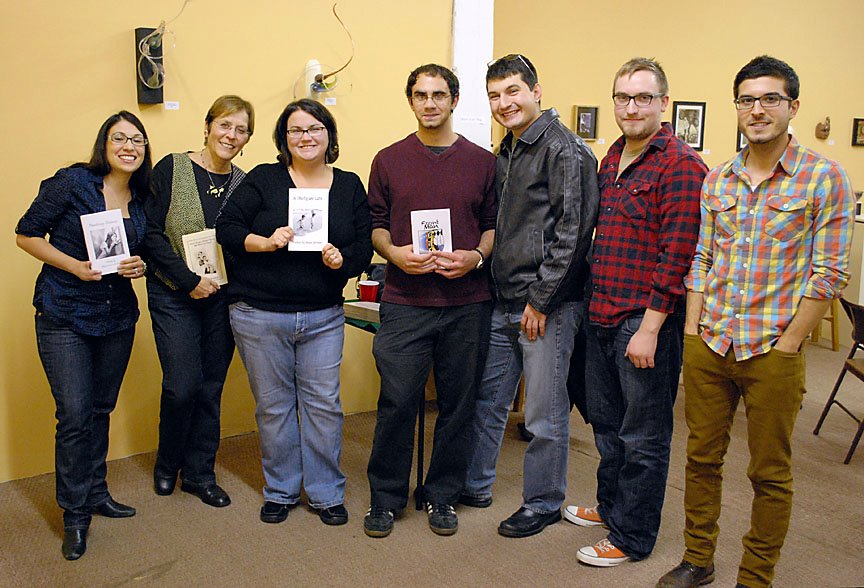
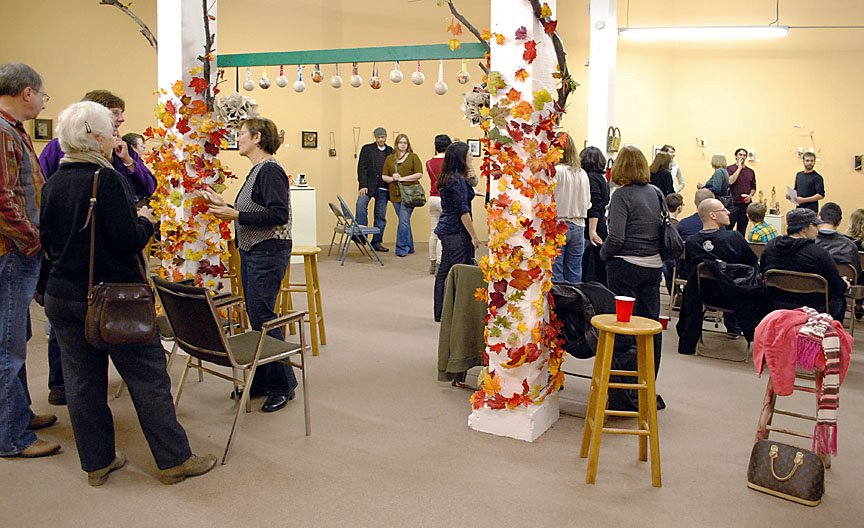
This weekend,  I hosted a mixed genre reading at New Visions Studio and Gallery in Scranton with my friend and fellow writer Jason Lucarelli.We launched the reading not only to showcase local writrs, but also to get people in  New Visions, a quaint space about two blocks down from Lackawanna College. The owners host music shows, comedy acts, and an array of art shows. But this was the first literary event they’ve had.

 Our other featured readers, Amye Archer, Tom Borthwick,Norma Bernstock, Alexis Czencz Belluzzi, and Steve Keating, all did a fantastic job, earning laughs and OOOs from folks in the audience.  The audience itself was also very receptive and attentive, and a wide range of different ages. I hope they continue to support the gallery and its various events.

Because the first event was successful, we decided to schedule another reading for Saturday, January 14 at 7 pm. We are currently in the process of booking the readers. Like the first showcase, the next one will feature a mix of genres.

Writers Showcase Event

This Saturday, Nov. 12, I’m co-hosting a writers showcase event at New Visions Studio and Gallery, located at 201 Vine Street in Scranton.  The event begins at 7 pm and is free, though donations to New Visions are encouraged. I’m co-hosting this with Jason Lucarelli, a fiction writer and M.F.A. student  I met a while ago at The Vintage Theater, another solid Scranton arts/music venue.

We had talked for a while about hosting a reading, and once we had the time, we finally planned and organized it. The other writers featured include Dawn Leas, Tom Borthwick, Alexis Czencz Belluzzi, Steve Keating, Amye Archer, and Norma Bernstock. This event will feature poetry, fiction, and non-fiction.

Go Lackawanna ran a preview article about the reading, which you can read here. The Abington Journal also did an article and published it today. Check it out here.

If this event goes well, Jason and I are considering organizing future readings at New Visions. We’d like to continue having a mix of genres and at least one undergraduate student per reading. So come out Saturday and show some support for our writing community here!