Completed Summer Reading

In a mere week and a half, the fall semester begins, and I’ll return to my normal teaching schedule. This summer consisted of preparing a second MS of poems, camping, traveling, and teaching two poetry classes.  I also hit up a few different towns/cities for poetry readings, and I still have two left before summer concludes– one in South Sterling, PA this Saturday and one in Lewisburg, PA next Saturday.

Summer also provided the chance to get a lot of reading done, and I thought I’d post what I read over the summer. Also, feel free to comment and share what you read this summer.

Drama:

I was on a Greek mythology kick and re-read the Oedipus trilogy by Sophocles. I still like it just as much as I did when I was in college.

I also re-read Prometheus Bound by Aeschylus. Is there a greater rebel in ancient Greek literature than Prometheus?

 Fiction:

The Corrections by Jonathan Franzen.  After hearing hype about Franzen for years and reading him in the New Yorker, I finally gave in and read The Corrections, the novel that won him the National Book Award. Yes, he is worth reading, and yes, he is probably one of the most important American writers alive today, due to the way he addresses a slew of contemporary social/political issues.

Mickelsson’s Ghosts by John Gardner. This is Gardner’s last novel, released shortly before he died in a  motorcycle accident in the early 1980s. This is a great, fat American novel, and I love the way he wove supernatural elements into this novel, and the way he poked fun at the politics of academia.

Collected Stories by Gabriel Garcia Marquez. So glad he’s still alive and publishing sometimes.

Rabbit is Rich by John Updike. I love the way in which Updike captured periods of American history through the “Rabbit” novels, in this case the Carter/early Reagan years.

The Centaur by John Updike. This novel won Updike the National Book Award in 1961. It’s a moving story about father and son, and it also retells the myth of Chiron.

Terrorist by John Updike. I guess I was on an Updike kick this summer. This is a powerful novel, one whose main character is an Islamic fundamentalist. This is one of the most interesting post-9/11 novels I’ve read, one that points out the hypocrisy of certain U.S. actions regarding the Middle East and the dangers of Islamic fundamentalism.

Poetry

Poets in their Youth by Eileen Simpson. This is a fantastic memoir written by a woman who was married to John Berryman for a while. It offers a glimpse into the lives of some of the mid-20th Century’s most important American poets, including Berryman, Robert Lowell, Randal Jarrell, and Delmore Schwartz.

Angle of Ascent: New and Selected Poems by Robert Hayden. I think readers sometimes forget he wrote more than “Those Winter Sundays.”

T.S. Eliot: Selected Prose and Essays.  I tend to revisit Eliot’s essays every now and then as a refresher.

The Shadow of Sirius by W.S. Merwin. It took me a while, but I’m finally getting into Merwin’s work.

Collected Poems by Joseph Brodsky. He is one of the 20th Century’s most non-political Russian poets. Compare him to Mayakovsky and notice the difference. Brodsky wrote such beautiful love poems.

Here, Bullet by Brian Turner. This is a great collection of poems written by an Iraq war veteran. I’m amazed at the scope of voices in this collection. Turner succeeded in capturing the complexity of the second Iraq war.

World Tree by David Wojahn.  Anything Wojahn releases is worth checking out. Here, he continues writing about music, pop culture,and politics, while displaying a  wide range of forms. My review of the book will be published by PANK sometime soon.

Sailing Around the Room: New and Selected Poems by Billy Collins. There’s a reason Billy Collins is a bestseller. I can’t think of a contemporary American poet who’s wittier.

Reading Now:

Tar by C.K. Williams. I’ve read his collected poems, but never a collection as a whole.

The Eye of a Poet. This is a collection of essays on poetry, featuring Billy Collins, Yusef Komunyakaa, Maxine Kumin, and others.

How to be Alone: Collected Essays by Jonathan Franzen. I guess I’m on a Franzen kick now. I also plan to read his latest novel, Freedom, soon.

So what did you read over the summer?  What are you reading now?

New U.S. Poet Laureate

A new U.S. Poet Laureate has just been named, and that honor goes to Philip Levine, who follows W.S.  Merwin  in the role. Upon learning the other day that Levine has been named poet laureate, I was surprised he never has been so before. He has been publishing for decades now, and it seems that at least one or two of his poems appear in every creative writing/poetry textbook or contemporary American poetry anthology.

Levine is one of my favorite contemporary American poets, and I’m so glad he got the honor. I first discovered his work through the anthology we used in my undergraduate poetry workshop courses. I then purchased his collecton of new and selected poems. Levine is a native of Detroit, and though he spent years working at prestigious colleges, he never stopped writing about his working-class roots. That’s what I’ve always liked about his poetry-how he focuses on the marginalized and the working-class, honoring such folks.

Despite the rough characters in his poems, there’s always tenderness to his work, no matter the labor the characters in his poems perform. One of my favorite Levine poems is “You Can Have it,” which is about the loss of his brother, who is “hard and furious, with wide shoulders and a curse for God and burning eyes that look upon/all creation and say, ‘You can have it.'” Like a lot of Levine’s work, that poem features direct, blue-collar language and description, but there’s a real tenderness and sorrow to it. The speaker is crying out for his brother, who died young, due to hard labor jobs.

The New York Times, Washington Post, and other publications ran nice articles about Levine this past week. But I especially like the Philadelphia Inquirer’s article. The article has nice background info about Levine, as well as a decent analysis of some of his poems and some strong quotes from the poet. I especially like that Levine promises  he will use the role of poet laureate as a bully pulpit for the kinds of characters that fill his poems– the working-class and marginalized.

Check out his work by clicking here.  And you should also check out the work of W.S. Merwin, the last poet laureate. He’s another great contemporary poet.

Best Election Money Can Buy

Last night, I stayed up late streaming news channels on my computer to find out the result of the recall elections in Wisconsin. Though I don’t live in Wisconsin, I had a heavy interest in the recall election because I feel it may be a preview of the 2012 elections, as well as a test of how Democrats now compete in a political climate in which corporations can now dump as much money into elections as they want, thanks to a 2010 Supreme Court ruling called Citizens United, which basically gave corporations unlimited spending power in our election cycles. Furthermore, the election was also a test of organized labor, which normally helps Democrats. This whole recall election began in March, when Republican Gov. Scott Walker and his Republican allies in the state legislature succeeded at stripping most public employees of their right to collectively bargain. This attack on unions drew massive protests in Madison. After Walker succeeded, progressives pushed back and organized recall elections to try to gain control of the state Senate and halt Walker’s right-wing agenda

Like other progressives, I was optimistic Democrats would win 3 out of the 6 races, oust the GOP incumbents, and restore public employees right to collectively bargain. Unfortunately, the Democrats only won 2 out of the 6 races and did not flip the majority in the state Senate.  There are several thoughts I have about the importance of this race.

I want to point out this election may go down in history as the most expensive state race in the country’s history. So far, about $35 million has been spent on these recall elections, according to the Milwuakee-Wisconsin Journal Sentinel, which quotes the Wisconsin Democracy Campaign, an organization that tracks campaign money. Unions poured millions into these campaigns, but so did right-wing organizations and right-wing billionaires like the Koch brothers. This race was a real test of the power of unions and progressive groups to compete with right-wing funding in the post-Citizens United world. Unfortunately, unions and progressives lost, no matter how they spin this.

It’s true Dems were fighting on the GOP’s turf, against GOP incumbents, and in districts that are generally Republican, but progressives had the momentum on their side. What’s alarming is that grassroots action, which was seen in Wisconsin, simply may not be enough to compete with right-wing funding and the ability of people like the Koch brothers to pour millions and millions into campaigns, thanks to the Citizens United ruling.  This race is only a preview of the money that will be spent in 2012. And I’m starting to believe our elections are indeed now bought by the highest bidder.

What will the left’s solution be going forward? This race was a test of organized labor’s power to organize and spend money to compete with right-wing groups. Organized labor and progressives lost, no matter how Dems may try to spin this story. They lost. What does the left have that can compete with the money spent by the right? How will Obama and Democrats running for House and Senate seats survive against the millions, possibly billions that will be spent by right-wing millionaires and billionaires to defeat them next year?  What answer do they have to that? Unions have always been the Democrats’ greatest fundraising tools, but unions are now being outspent drastically, as seen in Wisconsin.

What’s even more unsettling about the results of last night is the fact that Gov. Walker’s war on the middle class will not stop, and it’s likely to inspire other right-wing legislatures, especially in Michigan, Ohio, Pennsylvania, and Florida. The Republicans in some of those states, especially in Ohio ad Michigan,  have already cracked down on unions, and now they’ll see that the recall elections in WI didn’t give Democrats enough needed victories. These are also generally swing states that Democrats must win in 2012 if they want to do well overall.

Democrats need an answer to Citizens United, the Tea Party, and the general energy on the right. A movement did grow in Wisconsin, and the fact these grassroots organizers were able to even force recall elections and take away two seats from the GOP is remarkable, but there still needs to be more. There needs to be a greater pushback against Citizens United and the fact corporations now can dump unlimited funding into our election cycles. Progressives need a movement and fundraising efforts that can compete with the right. I hope what happened in Wisconsin over these last several months sparks a larger movement. And I doubt the fight in Wisconsin is over yet. There are two more recall elections next Tuesday in the state, both against Democrats. Next year, it’s likely there will be more recall elections against other Republican state Senators, and eventually Scott Walker.  Victory may come at some point against Walker’s agenda, but how much damage will be done prior to that?

good news all around

I want to pass along some positive news about my poetry. First, another review of my chapbook, Front Man, was just published by the journal Blood Lotus. You can read the review by clicking here and flipping to page 56 of the journal.  You can also read the review by visiting the blog of the reviewer, Kacy Muir. Click here to do so (this option is probably the easiest).

I also recieved word yesterday that three of my poems, “What They Forgot by Morning,” “Late Night Stop,” and “Remembering Names,” were accepted for publication by the NYC-based journal Yes, Poetry. They will be released in the October issue, the same time frame another new poem, “How She Hides Her Age,” will be published by the California-based journal the San Pedro River Review.

Finally, I want to announce that my friend and fellow writer, Amye Archer, just released a chapbook, A Shotgun Life, with Big Table Publishing, the same folks who released my book. Buy a copy and help support another local writer! You can get a copy by clicking here, or by seeing her read at Prose in Pubs on Jack’s Draft House in Scranton on  Sunday, Sept. 25 at 7 pm.

Return of HWM

One of my all-time favorite bands, Hot Water Music, has reunited (again) to release new music and hopefully launch a proper tour. HWM has always fascinated me because I’ve always found them to be one of the more interesting bands in the punk rock/post-hardcore genre circa late 1990s/early 2000s. What makes them especially unique is the fact they have two vocalists, Chuck Ragan and Chris Wollard, which has always created some pretty awesome dueling vocal parts in their songs. They also stand out because of their rhythm section. Bassist Jason black and drummer George Rebelo grew up studying jazz music, so they add  technicality and intricacy to the music that most bands in their genre lack.

A few years ago, the band played a series of one-off reunion shows, and I had a chance to catch them in New Jersey and Atlanta. I have NEVER seen a crowd so into a band before. As soon as the first power chord blasted through the speakers, the crowd surged forward and sang along to every song throughout the show. But after those reunion shows, the band never released any proper new music, and even after I interviewed Wollard and Ragan for a music zine I ran at the time, I was still skeptical they’d release a proper full-length album again and do a tour, despite their promises about new HWM material.  The guys were also busy with their own new projects. Chuck Ragan has a successful solo career now, and Chris Wollard has a new band-Chris Wollard and the Ship Thieves. Both acts stray far from the post-hardcore roots of HWM. Chuck Ragan’s solo act is built on the folk revival movement, and the Ship Thieves is mellow rock ‘n roll/indie rock.

So when I found out the band was going to release a new album in 2012, I couldn’t wait to hear some new tracks. Luckily, the band has already released new tracks via a brand new 7-inch. The songs, “The Fire, the Steel, the Tread” and “Adds Up to Nothing,” are available via Itunes, and the physical release of the 7-inch is slated for September. I’m waiting to buy that, especially so I can marvel at the cover, which is done by Scott Sinclair, the same artist HWM has used for every single one of their album covers/7-inches.

Of course, some long-time fans will complain that the new album or the new 7-inch doesn’t sound like the tracks on No Division or Forever and Counting, or even some of the band’s later albums, like Caution, but so what?  I’m just happy to hear Chuck Ragan’s trademark raspy vocals over electric guitar again and to have new music from one of my all-time favorite bands of the genre. That’s enough to be thankful for.

Cut, Cut, Cut

It seems unlikely now that the U.S. government is going to default, which would have led to a major spike in interest rates, possibly higher taxes, and a load of other economic woes. On Sunday, Congressional leaders and the Obama White House announced that a debt deal has been reached. It will face a vote in the House and Senate today. The deal would essentially cut $2 trillion over a decade, and it will create a bipartisan committee to determine what should be cut after the initial round of cuts occur.

The Democrats mostly lost everything they had hoped to get in a deal, especially raising revenue to stimulate the economy by restoring tax rates to what they were during the Clinton years for millionaires and billionaires only. They did, however, get to postpone debate about raising the debt ceiling again until 2013, after the president’s re-election campaign. The deal would also create cuts to defense spending, something some Dems have wanted to do for a while.

But it seems clear here that the Republicans have mostly controlled the narrative of the debate because members of the House, mostly freshman Tea Party backed folks, were utterly willing to let the U.S. default and crash the economy if they didn’t get their way. They didn’t even listen to House Speaker John Boehner when he told them to “get their asses in line” and vote for his bill a few days ago that failed. I hope that during the 2012 elections voters will remember that these Tea Party members were totally willing to crash the economy. The GOP no longer has a center or middle. The party has gone SO far to the right.

Americans should breathe a little easier knowing the U.S. is not likely to default now; however, the fact so much is going to be cut as the economy is still weak is rather alarming. Famed economist and New York Times columnist Paul Krugman has a great article about this out today. Check it out here. In it, he basically argues that deep cuts are the last thing you want to do in an economy. When the economy is weak, it’s better to create stimulus packages to put more money in people’s pockets that will cause them to spend. Stimulus also gives more money to businesses and allows them to hire. Krugman points out that the economy is still “deeply depressed” and is likely to remain that way until at least 2013. The debt deal, he argues, could also lead to higher unemployment rates and major changes or elimination to social safety net programs.

What Krugman fails to point out, though, is the possibility that things could really change after 2012. The Democrats, if they play this right, can take back the House and defeat a lot of these Tea Party members. A lot of the House seats the GOP won in 2010 were in swing districts. If the Dems regain their majorities, that would make it easier to create more jobs programs. Furthermore, the Bush era tax cuts for the wealthy are set to expire in 2013, and if the Dems succeed at letting them expire, that would create much needed revenue for the economy.

Perhaps the Democrats are living to fight another day.

Weekend Readings

I have two upcoming readings that I’m especially excited about. One is tonight, at the KGB Bar in New York City, located at 85 East 4th Street. I’ll be sharing the stage with one of my friends from graduate school, Monique Lewis, a writer who runs fiction workshops in the city. We’ll be joined by two other writers, and you can read our bios here.  

I’ve only read in NYC one other time- a few months ago at the Bowery Poetry Club with other members of the Mulberry Poets & Writers Association. That was one of my favorite readings simply because the event already had a built-in audience that already cared a lot about poetry and was attentive. I hope the same will be true for tonight’s reading. Most of all, I’m excited to share poems from Front Man and my nearly completed second manuscript with an unknown audience.

On Sunday, I’m joining local writers Matt Hinton, Mischelle Anthony, and Jennifer Diskin to read at Jack’s Draft House in Scranton for the Second Prose in Pubs. The event starts at  7 pm. There’s a good interview with event organizer, Amye Archer, in the current issue of Electric City. Check it out here.  Prose in Pubs really has the potential to be a strong, long-running series that features writers of various genres showcasing their work in  a really cool venue. What I like about Jack’s is the fact it’s not grimy or dingy like some other Scranton bars. It has a nice, intimate feel, and it makes for a great hang out once the reading concludes.

If you’re in NYC, come to the KGB Bar tonight at 7, and if you’re in Scranton, come to Jack’s Draft House Sunday at 7 to support a new reading series.

Yes, Poetry Matters

Over the last few years, and especially this year, there have been HUGE cuts to the arts in state and federal budgets, as this country tries to pay for two wars (even if they’ve been “scaled down”), and tax cuts for the wealthy.  Since these cuts started, I haven’t come across a lot of articles that make a solid defense for the importance of the arts, especially for poetry. However, a friend posted on Google + yesterday an article published at the Huffington Post by poet/book reviewer Roger Housden, who makes the case for poetry. Read the article here. In the article, Housden points out that we may never be the same again after reading poetry, that poetry “calls to us” and can ignite a fire within us. I agree with this theory. When I had my first poetry workshops as an undergrad at West Chester University, I was never really the same again. I felt that fire he mentions in the article, and I started writing poetry, thinking about it, and organizing readings. I hope other students have this same opportunity and schools don’t do away with such classes because of budget retraints.

Poetry is also important, he writes, because it “uses the common currency of our daily speech. It uses words that are known to all of us, but in a sequence and order that surprises us out of our normal speech rhythms and linear thought processes.”

Above all, poetry nourishes the imagination through surprising language and imagery, a point made well in the William Carlos Williams poem “Of Asphodel, That Greeny Flower,” also quoted in the article.

It is difficult
To get the news from poems
Yet men die miserably every day
For lack
Of what is found there.

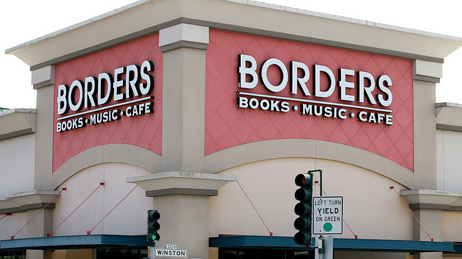
Bye, Bye, Borders

News broke this week that Borders is closing all of its remaining stores by September at the latest.  As I write this blog post, I’m currently sitting at the Borders cafe in Dickson City, PA, and I was informed by a cafe worker that the cafe will close tomorrow, but the store may remain open for a month or so.

However, it’s clear as soon as you walk into the store that it’s closing. Outside of the main entrance, there are boxes and racks of books on sale, and other discount racks are located throughout the store. It’s only a matter of time before the rest of the merchandise is deeply discounted.

 Though I never bought many books here (I always like to shop at indie bookstores or order through presses directly), I have frequented the cafe quite often. Over the years, I’ve written MANY poems at the Borders cafe. It served as my place to go to write, free of distraction. A good chunk of the poems in my chapbook were drafted or revised at the cafe. I also used the cafe to read the latest issues of Newsweek, the New Yorker, Time, and other favorite social/political/writing magazines. I just don’t have the money to subscribe to all of these.   Borders also served as a place to get grading and lesson planning done once I started teaching.

What’s especially unfortunate for residents in the Scranton area is the fact they no longer have any bookstores. Anthology New and Used Books, a wonderful indie bookstore, closed a few months ago. Now, Borders will be gone. There are two Barnes & Noble stores in Wilkes-Barre, but for a lot of people, that’s too far to drive. Perhaps people will start using libraries more, but libraries don’t have the cafes that Borders stores have to allow for socialization.

There are also far-reaching consequences of Borders closing, and this NPR article points them out. First and foremost, there’s the fact that 10,700 employees will now be out of work, during a time when the economic recover has been anemic and unemployment is still around 9 percent. The article also points out that the closing of Borders will have a direct impact on book sales and jobs within publishing companies. Some publishers have whole wings dedicated to working with Borders and promoting books through the chain. What will happen to those workers? Also, Borders provided opportunities for writer events and readings. In fact, when my poetry chapbook was released, one of the first readings I did was at a Borders in Boston, where my publisher is located.  Poets especially rely on readings to sell books. The loss of Borders equals a loss of jobs and a serious loss of book sales.

I’m hopeful that another bookstore will take Borders’ place here. Maybe Barnes & Noble will open here. Or better yet, maybe another indie bookstore will open in the Scranton area. But, as the NPR article points out, for any bookstore to survive in the age of the E-reader, it’s going to have to be incredibly innovative.

Farewell, Harry

As everyone knows, this weekend marked the end of the Harry Potter franchise because the final film, Harry Potter and the Deathly Hallows pt. 2, was released in theaters across the world. It seems a little surreal that his billionaire dollar franchise is now at its end. After seeing the film yesterday on its opening day in the states, I started to reflect on why the series has been such a phenomena. I have to warn readers that if you haven’t read the last novel or watched the last film, this post does reveal some of what happens at the end of the series.

I will admit that when the first two books were released in the states in the late 1990s, I had no interest in reading them. The hype was impossible to escape, but I wasn’t much interested in fantasy stories. However, a few years later, I had to read the first book for  my pop culture writing class during my freshman year of college. After reading the first book, I was intrigued by Ron, Hermione, and Harry’s story.  I then read each book in the series up to that point, and when the last few books in the series came out, I read them as soon as they were released.

The more I learned about literature as an undergraduate, the more I learned why the Harry Potter novels had such a massive, worldwide appeal and the way in which Rowling borrowed classic and key concepts of literature . First, you have to give credit to JK Rowling for creating such an enchanting, magical world. But despite the fact the novels contain such fantastical elements, she bases the books in reality. The characters are relatable to most kids. Harry Potter, for instance, is NOT your typical hero. He doesn’t possess astonishing might or incredible wit and smarts.  Furthermore, he doesn’t come from great circumstances. He is essentially an orphan, since his parents were murdered when he was young, and he’s abused by the family who raises him-the Dursleys. He also ponders all of the things typical kids ponder, including his classes at Hogwarts, friendships, and romantic relationships later on. He also has to deal with bullies constantly at school, especially Draco Malfoy and his lackeys.

Rowling also created a series of complex characters. A lot of the key characters are not black and white, or totally good or bad. Professor Snape is a prime example of that, and his history is rich, only fully revealed toward the end of the final novel/film. Even the  most powerful wizard and mentor to Harry, Albus Dumbledore, is not without his flaws or past mistakes, as also revealed in the seventh novel/film.

Rowling also borrows a lot from classic literature, especially Greek mythology. Harry Potter, for instance, completes the journey of a hero, a concept that dates back to Homer’s Odyssey, at least. In the Odyssey, Odysseus must make a trip to the Underworld and reunite with deceased loved ones before completing his journey and returning to Ithaca. Harry Potter also visits his deceased loved ones and does indeed take a trip to the Underworld when he allows his arch nemesis, Voldermort, to kill him at one point in the final book and final film. However, like Odysseus, upon taking that trip to the Underworld, Harry has the option to keep going or to stay dead. He picks the first option.  The Underworld also serves as a way for the heroes to get key pieces of advice. Achilles, dead, tells Odysseus how much better it is to be alive than to be dead when he says he would rather be a lowly slave alive than rule over all the dead in the Underworld. Harry, too, gets advice upon his trip. It’s given by Dumbledore, who tells him it’s wiser to pity the living than the dead, especially the living who live without love. The living are the ones who still have to face obstacle after obstacle in life, and life is indeed often harsh, especially in Harry’s case.  This idea of the journey of the hero is found in other parts of Greek mythology, including the story of Hercules.  There are also other references to classic literature in the Harry Potter novels, including a few nods to Tolkien.

I think the Potter novels also deserve credit for the way women are treated throughout the series. One of the key characters, Hermoine Granger, is a good role model for young women. It’s doubtful Harry and his friends would win in the end without Hermoine’s smarts. She’s often the one who develops their plans and bails Harry and his best friend Ron out of trouble.  There are other parts of the novels and films where women play assertive roles. Mrs. Weasley certainly asserts herself in the last pages of the final novel against one of the key villains, Bellatrix Lestrange.  It’s also important to note that Rowling made on of the most prominent villains in the novel a woman-Bellatrix. And by the time the novels/films conclude, her body count is quite high.

Finally, there’s one last layer of the novels/films worth addressing, and that is the way Rowling addresses the classicism and racism issue. She does this by through the concept of pure breed wizards and characters in the book that are only part wizard. Some of the villains in the book despise those who are not pure wizards and refer to them as “mudbloods.” When Voldermort returns and builds up his massive army, he begins killing off mudbloods and tries to build a perfect race of wizards.

There are, of course, some flaws with the Harry Potter novels. A few years ago, Stephen King  joked that Rowling never met an adverb she didn’t like in her writing. He also said that he was sick of the way Rowling crafted the beginning of the novels because most of them begin the same exact way, with Harry suffering through time with the Dursleys, until it’s time to go to the magical world of Hogwarts. But King does state that despite some of the flaws in the writing, it’s likely the Harry Potter novels will be read years from now, just like other famous “children stories,” including Lord of the Rings, Alice in Wonderland, and the Wizard of Oz.

As for the final film, it is one of the best in the series, if not the best. It’s a great balance of emotion and action, and it does not cut out any of the final key scenes in the last novel.  It serves as a fitting end to a wildly successful franchise that will most likely live on years and years from now.