I have two upcoming readings that I’m especially excited about. One is tonight, at the KGB Bar in New York City, located at 85 East 4th Street. I’ll be sharing the stage with one of my friends from graduate school, Monique Lewis, a writer who runs fiction workshops in the city. We’ll be joined by two other writers, and you can read our bios here.
I’ve only read in NYC one other time- a few months ago at the Bowery Poetry Club with other members of the Mulberry Poets & Writers Association. That was one of my favorite readings simply because the event already had a built-in audience that already cared a lot about poetry and was attentive. I hope the same will be true for tonight’s reading. Most of all, I’m excited to share poems from Front Man and my nearly completed second manuscript with an unknown audience.
On Sunday, I’m joining local writers Matt Hinton, Mischelle Anthony, and Jennifer Diskin to read at Jack’s Draft House in Scranton for the Second Prose in Pubs. The event starts at 7 pm. There’s a good interview with event organizer, Amye Archer, in the current issue of Electric City. Check it out here. Prose in Pubs really has the potential to be a strong, long-running series that features writers of various genres showcasing their work in a really cool venue. What I like about Jack’s is the fact it’s not grimy or dingy like some other Scranton bars. It has a nice, intimate feel, and it makes for a great hang out once the reading concludes.
If you’re in NYC, come to the KGB Bar tonight at 7, and if you’re in Scranton, come to Jack’s Draft House Sunday at 7 to support a new reading series.
Over the last few years, and especially this year, there have been HUGE cuts to the arts in state and federal budgets, as this country tries to pay for two wars (even if they’ve been “scaled down”), and tax cuts for the wealthy. Since these cuts started, I haven’t come across a lot of articles that make a solid defense for the importance of the arts, especially for poetry. However, a friend posted on Google + yesterday an article published at the Huffington Post by poet/book reviewer Roger Housden, who makes the case for poetry. Read the article here. In the article, Housden points out that we may never be the same again after reading poetry, that poetry “calls to us” and can ignite a fire within us. I agree with this theory. When I had my first poetry workshops as an undergrad at West Chester University, I was never really the same again. I felt that fire he mentions in the article, and I started writing poetry, thinking about it, and organizing readings. I hope other students have this same opportunity and schools don’t do away with such classes because of budget retraints.
Poetry is also important, he writes, because it “uses the common currency of our daily speech. It uses words that are known to all of us, but in a sequence and order that surprises us out of our normal speech rhythms and linear thought processes.”
Above all, poetry nourishes the imagination through surprising language and imagery, a point made well in the William Carlos Williams poem “Of Asphodel, That Greeny Flower,” also quoted in the article.
It is difficult
To get the news from poems
Yet men die miserably every day
For lack
Of what is found there.
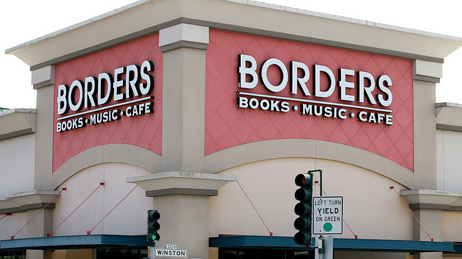
News broke this week that Borders is closing all of its remaining stores by September at the latest. As I write this blog post, I’m currently sitting at the Borders cafe in Dickson City, PA, and I was informed by a cafe worker that the cafe will close tomorrow, but the store may remain open for a month or so.
However, it’s clear as soon as you walk into the store that it’s closing. Outside of the main entrance, there are boxes and racks of books on sale, and other discount racks are located throughout the store. It’s only a matter of time before the rest of the merchandise is deeply discounted.
Though I never bought many books here (I always like to shop at indie bookstores or order through presses directly), I have frequented the cafe quite often. Over the years, I’ve written MANY poems at the Borders cafe. It served as my place to go to write, free of distraction. A good chunk of the poems in my chapbook were drafted or revised at the cafe. I also used the cafe to read the latest issues of Newsweek, the New Yorker, Time, and other favorite social/political/writing magazines. I just don’t have the money to subscribe to all of these. Borders also served as a place to get grading and lesson planning done once I started teaching.
What’s especially unfortunate for residents in the Scranton area is the fact they no longer have any bookstores. Anthology New and Used Books, a wonderful indie bookstore, closed a few months ago. Now, Borders will be gone. There are two Barnes & Noble stores in Wilkes-Barre, but for a lot of people, that’s too far to drive. Perhaps people will start using libraries more, but libraries don’t have the cafes that Borders stores have to allow for socialization.
There are also far-reaching consequences of Borders closing, and this NPR article points them out. First and foremost, there’s the fact that 10,700 employees will now be out of work, during a time when the economic recover has been anemic and unemployment is still around 9 percent. The article also points out that the closing of Borders will have a direct impact on book sales and jobs within publishing companies. Some publishers have whole wings dedicated to working with Borders and promoting books through the chain. What will happen to those workers? Also, Borders provided opportunities for writer events and readings. In fact, when my poetry chapbook was released, one of the first readings I did was at a Borders in Boston, where my publisher is located. Poets especially rely on readings to sell books. The loss of Borders equals a loss of jobs and a serious loss of book sales.
I’m hopeful that another bookstore will take Borders’ place here. Maybe Barnes & Noble will open here. Or better yet, maybe another indie bookstore will open in the Scranton area. But, as the NPR article points out, for any bookstore to survive in the age of the E-reader, it’s going to have to be incredibly innovative.
As everyone knows, this weekend marked the end of the Harry Potter franchise because the final film, Harry Potter and the Deathly Hallows pt. 2, was released in theaters across the world. It seems a little surreal that his billionaire dollar franchise is now at its end. After seeing the film yesterday on its opening day in the states, I started to reflect on why the series has been such a phenomena. I have to warn readers that if you haven’t read the last novel or watched the last film, this post does reveal some of what happens at the end of the series.
I will admit that when the first two books were released in the states in the late 1990s, I had no interest in reading them. The hype was impossible to escape, but I wasn’t much interested in fantasy stories. However, a few years later, I had to read the first book for my pop culture writing class during my freshman year of college. After reading the first book, I was intrigued by Ron, Hermione, and Harry’s story. I then read each book in the series up to that point, and when the last few books in the series came out, I read them as soon as they were released.
The more I learned about literature as an undergraduate, the more I learned why the Harry Potter novels had such a massive, worldwide appeal and the way in which Rowling borrowed classic and key concepts of literature . First, you have to give credit to JK Rowling for creating such an enchanting, magical world. But despite the fact the novels contain such fantastical elements, she bases the books in reality. The characters are relatable to most kids. Harry Potter, for instance, is NOT your typical hero. He doesn’t possess astonishing might or incredible wit and smarts. Furthermore, he doesn’t come from great circumstances. He is essentially an orphan, since his parents were murdered when he was young, and he’s abused by the family who raises him-the Dursleys. He also ponders all of the things typical kids ponder, including his classes at Hogwarts, friendships, and romantic relationships later on. He also has to deal with bullies constantly at school, especially Draco Malfoy and his lackeys.
Rowling also created a series of complex characters. A lot of the key characters are not black and white, or totally good or bad. Professor Snape is a prime example of that, and his history is rich, only fully revealed toward the end of the final novel/film. Even the most powerful wizard and mentor to Harry, Albus Dumbledore, is not without his flaws or past mistakes, as also revealed in the seventh novel/film.
Rowling also borrows a lot from classic literature, especially Greek mythology. Harry Potter, for instance, completes the journey of a hero, a concept that dates back to Homer’s Odyssey, at least. In the Odyssey, Odysseus must make a trip to the Underworld and reunite with deceased loved ones before completing his journey and returning to Ithaca. Harry Potter also visits his deceased loved ones and does indeed take a trip to the Underworld when he allows his arch nemesis, Voldermort, to kill him at one point in the final book and final film. However, like Odysseus, upon taking that trip to the Underworld, Harry has the option to keep going or to stay dead. He picks the first option. The Underworld also serves as a way for the heroes to get key pieces of advice. Achilles, dead, tells Odysseus how much better it is to be alive than to be dead when he says he would rather be a lowly slave alive than rule over all the dead in the Underworld. Harry, too, gets advice upon his trip. It’s given by Dumbledore, who tells him it’s wiser to pity the living than the dead, especially the living who live without love. The living are the ones who still have to face obstacle after obstacle in life, and life is indeed often harsh, especially in Harry’s case. This idea of the journey of the hero is found in other parts of Greek mythology, including the story of Hercules. There are also other references to classic literature in the Harry Potter novels, including a few nods to Tolkien.
I think the Potter novels also deserve credit for the way women are treated throughout the series. One of the key characters, Hermoine Granger, is a good role model for young women. It’s doubtful Harry and his friends would win in the end without Hermoine’s smarts. She’s often the one who develops their plans and bails Harry and his best friend Ron out of trouble. There are other parts of the novels and films where women play assertive roles. Mrs. Weasley certainly asserts herself in the last pages of the final novel against one of the key villains, Bellatrix Lestrange. It’s also important to note that Rowling made on of the most prominent villains in the novel a woman-Bellatrix. And by the time the novels/films conclude, her body count is quite high.
Finally, there’s one last layer of the novels/films worth addressing, and that is the way Rowling addresses the classicism and racism issue. She does this by through the concept of pure breed wizards and characters in the book that are only part wizard. Some of the villains in the book despise those who are not pure wizards and refer to them as “mudbloods.” When Voldermort returns and builds up his massive army, he begins killing off mudbloods and tries to build a perfect race of wizards.
There are, of course, some flaws with the Harry Potter novels. A few years ago, Stephen King joked that Rowling never met an adverb she didn’t like in her writing. He also said that he was sick of the way Rowling crafted the beginning of the novels because most of them begin the same exact way, with Harry suffering through time with the Dursleys, until it’s time to go to the magical world of Hogwarts. But King does state that despite some of the flaws in the writing, it’s likely the Harry Potter novels will be read years from now, just like other famous “children stories,” including Lord of the Rings, Alice in Wonderland, and the Wizard of Oz.
As for the final film, it is one of the best in the series, if not the best. It’s a great balance of emotion and action, and it does not cut out any of the final key scenes in the last novel. It serves as a fitting end to a wildly successful franchise that will most likely live on years and years from now.
I have a slew of upcoming events, so I wanted to post some info about them here.
This Friday, July 15, I will be reading at the Art Scene Gallery, located at 21 Public Square in Wilkes-Barre. I’ll share the stage with NYC-based poet Angela Alaimo O’Donnell. The reading starts at 8 pm. A limited open mic will follow. We’ll both have books for sale/signing.
On Thursday, July 28, I’m reading at the KGB Bar, located at 85 East 4th Street in NYC. The reading starts at 7 pm, and I’ll share the stage with my friend Monique Lewis, a fiction writer. We’ll be joined by two other writers. Check out our bios here.
On Sunday, July 31, I’m the featured reader at the second Prose in Pubs. This will take place at Jack’s Draft House in Scranton at 7 pm. Other readers include Matt Hinton, Mischelle Anthony, and Jennifer Diskin.
On Saturday, August 20, I’m hosting a reading to benefit 4H at a farm on Osborne Road in South Sterling. The details for that are still in the works, but I know I’ll be joined by poets Dale Wilsey Jr. and Alexis Czencz Belluzzi, as well as fiction writer Bridget McIntyre. The reading should start around 4ish.
And on Saturday, August 27, I’m reading at the Cherry Street Cafe, located at 21 N. 3rd Street in Lewisburg, PA. The reading starts at 7 pm. I’ll be joined by Alexix Czencz Belluzzi.
More info about these readings can be found on the events page of my website.
Finally, I want to announce that one of my poems, “How She Hides Her Age,” was accepted for publication by the California-based journal SanPedro River Review. It will appear in the fall issue.
Recently, former New York Times columnist Frank Rich wrote a compelling article about the Obama Administration, specifically the faults of the administration in dealing with the economy and of selecting a poor financial team, specifically Tim Geithner.
Rich does make great points, and he’s right to argue that if reelected, Obama needs to get rid of his financial team and have a laser-like focus on creating jobs and doing something more to stimulate the economy, since unemployment is still around 9 percent.
But I also understand the dire consequences of NOT voting for Obama. If the GOP maintains the House and wins back the White House and Senate, this country is in serious trouble. This GOP has pivoted so far to the right that after the 2010 mid-term elections they have succeeded at stripping collective bargaining rights in some states, creating deep cuts to education (especially in PA), rolling back abortion rights in several states, and pushing forward new voter laws that would disenfranchise minority voters. Just imagine what would happen if the party controls all branches of the federal government after the 2012 elections. This is the party that is seriously willing to crash the economy because they refuse to tax the super-rich as part of debt ceiling negotiations. This is all a real possibility, and unfortunately, the Obama Administration’s failure to address the economy early on has made GOP super majorties a real possibility. I just hope he gets some sense before 2012 is closer and realizes what his party is supposed to stand for.
Tonight, the second poetry workshop I taught at the Vintage Theater is coming to a close, concluding with a free, public reading of student work from 7-9 pm. A limited open mic will follow.
I’m eager to hear my students get up on that stage and share the work they’ve drafted and revised over the last month. I especially liked this group because of the mix of styles, talent, and various writing levels. I had two adults in the group that have been writing and reading for a while, and I had three college students eager to hone their craft. We had one young man who barely had any experience writing poetry and has written more prose in the past. But I’ve seen him make such progress over the last few weeks, and it’s been exciting to watch him develop his skills drafting a clear narrative, concrete imagery, and similes and metaphors. I hope he continues to sharpen his skills, especially as he takes an advanced poetry writing class with me at Keystone starting in a week and a half.
I was also impressed with this group because of the comments and debates they offered for nearly every single poem I brought in to teach them various elements of poetry. Some of the discussions got a little heated at times, but if a piece of writing or art can draw such a reaction from a group of people, that’s only a good thing.
I hope there will be more workshops at the Vintage Theater. I’m certainly willing to teach them. And if you want to hear some of the students share their work, then come to the reading tonight. It starts at 7 pm. The Vintage Theater is located a 119 Penn Avenue in downtown Scranton. The reading is free and open to the public. I’ll also be reading a few poems with my students.
The journal PANK just published a positive review of my chapbook Front Man. You can read the review online here. You should also check out the website of Gretchen Primack by clicking here. She wrote the review.
I had a blast reading at the Wilkes University Maslow Reading Series the other night, as part of alumni night. I was especially happy to share the stage with fellow alums Jennifer Diskin, Taylor Polites, Chris Bullard, and Laura Baudo, not to mention award-winning writers William Heyen and William Kennedy.
Everyone did a good job reading, I thought, and the poets were well represented! I’m glad I got the chance to read a few poems from my chapbook Front Man, considering most of those poems were drafted and revised while I was in the MFA program at Wilkes. But reading a few new poems was even more refreshing. I also enjoyed hearing Heyen read, especially his last poem of the night, a new poem that addresses how print is used less and less. Before he started reading, he handed out small postcards to folks in the audience with one of his poems. Long live print!
I also picked up a slew of books at a sale held by the Osterhout Free Library in Wilkes Barre. During the $3 bag day, I managed to pick up Elizabeth Bishop’s complete poetry collection, as well as works by Russian poet Joseph Brodsky, Randall Jarrell, Robert Lowell, Marvin Bell, Robert Bly, and a slew of other stuff. But I’m most excited to read a memoir by Eileen Simpson called Poets in Their Youth. She was married to John Berryman for a while, and her memoir also includes accounts that feature other big-named mid-20th Century American poets, including Robert Lowell, Delmore Schwartz, and Randal Jarrell. Should be a great read.