Review: Hold the Dark (2018)

In Green Room, director Jeremy Saulnier uses the tight confines of a dingy punk rock club in rural America to create isolation and tension as a band is besieged by neo-Nazis. At one point, the group is hauled up in the confines of a sound check room with no access to the outside world. Sauldnier’s latest film, Netflix’s Hold the Dark, contains sprawling Alaskan landscapes and stunning cinematography that creates bleakness and despair. The violence is as brutal and sudden as some of the scenes in Green Room. However, the film strays into too much ambiguity near the halfway point and sinks beneath its own weight.

Hold the Dark is based on the 2014 novel by William Giraldi, and it traces the journey/mission of writer Russell Core (Jeffrey Wright), who is summoned by Medora Slone (Riley Keough) to investigate the loss of her son, who was allegedly killed by a pack of wolves. The animals are also blamed for the death of other children in the village. The opening act  is the strongest, especially the scenes between Wright and Keough, whose acting is top notch. The dialogue is well-crafted and builds a foreboding sense of darkness that can’t be kept at bay, especially when Medora says, “The wilderness here is inside us…Inside everything.” The early scenes are isolating and often feature long shots of the all-consuming Alaskan wilderness, sometimes with the characters set small against the backdrop. One of the most tense scenes occurs when Core stumbles down a snowy hill and encounters the pack of wolves, their snouts bloodied after devouring one of their own, a cub. It’s a survival of the fittest/kill or be killed type of world.

Holdthedark

Russell Core (Jeremy Wright) and Medora Slone (Riley Keough)

Following the opening act, once Medora flees the scene and after it’s discovered that she may have been the one who killed her son, the rest of the film loses its momentum and veers off track, especially once her husband, Vernon Slone (Alexander Skarsgård), returns home from Iraq after getting shot in the neck. He kills and kills some more, as he searches for his wife. There were several missed opportunities and potential story lines left uncharted. The idea of isolation and loneliness caused by Vernon Slone’s Iraq tour is generally unexplored. Imagine being a military spouse, left to raise your child alone in Alaska. The tension between what the Native people believe about nature and the wolves and what police believe, mainly that there is no greater, metaphysical force at work, is interesting and deserved far more attention. Early on, the idea that there is some connection between Medora Slone and the wolves is lightly introduced but also underdeveloped. I had hoped the film would have explored some connection between the feminine and nature and how Medora is viewed by the villagers and the police.

Watch the trailer for Hold the Dark:


The film’s final act, when Core eventually confronts Vernon Slone, is the most frustrating. Yes, they come face to face and one walks away, so to speak, but the film’s conclusion is utterly ambiguous. Nothing is really resolved. It takes over two hours to build to such a climax, only to veer off into a strange direction with no finality.

The acting and cinematography are the highlights of Hold the Dark, and fans who liked the level of gore and violence in Green Room won’t be disappointed with some of the brutal scenes in Saulnier’s latest effort. However, the film’s plot comes unglued around the halfway point, and anyone who sticks around for the ending will probably find it underwhelming.


Happy October! Favorite Horror Podcasts

Happy October! Finally, the Halloween season has arrived. On the East Coast, the temperatures have dipped and pumpkin flavored food and drinks are ever-present. I write a lot about horror films on this blog, but I thought I would share a list of some of my favorite horror-themed podcasts. For the most part, all of these deal with the horror film, but they also touch upon Gothic and horror literature and other forms of media.

In the coming days, I’ll also share a list of some of my favorite horror films that are currently streaming on Netflix, Amazon Prime, and Hulu, just as I did last year. For now, here’s my list of horror podcasts I think you should check out.

Faculty of Horror: Hosted by Andrea Subissati and Alexandra West, Faculty of Horror is one of my favorite podcasts. Primarily, it looks at horror films through an academic lens, but the content is generally accessible, engaging, and interesting. The podcast has over 60 episodes, and all of them are achieved on the website.  Films covered include classics like Psycho and The Thing to more recent films such as Funny Games and The Witch. The show notes include a reading list, featuring the articles and books mentioned in the show.

Hellbent for Horror: This podcast is hosted by S.A. Bradley, a self-proclaimed “champion” of the horror genre in all of its forms. What makes this podcast unique is that Bradley typically picks a theme, such as the woods/nature, family relations/bad blood, religion, and applies it to various horror films. This podcast is less “academic” than some of the others on my list, but it includes a nice analysis of the genre. Some episodes feature interviews with authors, fans, and experts, thus giving space to other voices.  With over 70 episodes archived to date, there is a lot to listen to.

Horror Pod Class: I discovered this podcast recently, and it’s one of my favorites. It features two high school teachers talking about the genre as a whole. They’re knowledgeable and passionate. Show notes include titles of the articles/films/books discussed during each episode.

Final Girls Horrorcast: This podcast is really unique because it only features reviews of horror films available on streaming services. The reviewers, Aimee and Carly, are funny and offer interesting takes on some well-known and lesser-known genre films. This is a great podcast to check out when you’re looking for something to stream.

Inside the Exorcist: Hosted by Mark Ramsey, the dude who hosts LORE, “Inside the Exorcist” is a multi-part podcast that digs deep into the layered story behind The Exorcist. The first few episodes focus on the 1940s case of the Georgetown boy who was allegedly possessed and served as the inspiration for William Peter Blatty’s novel. The rest of the episodes focus on the stories behind the filming, including casting, and the cultural legacy of the film. This is one of the best behind-the-scenes accounts I’ve encountered on one of the most canonized films of the genre. Ramsey also created podcasts about Psycho and Jaws, so check those out as well.

Happy listening!


Candyman Reboot?

The horror world has been abuzz over the news that Jordan Peele is interested in remaking Candyman, the 1992 film about a murdered slave, Candyman (Tony Todd), who will appear if you repeat his name in the mirror. It’s unclear if Peele would actually direct the film or produce it, but regardless, though Candyman is not that old, its themes of gentrification and the past never staying dead are deserving of an update. After the success of Get Out, Peele is the right person to  oversee the project if it moves forward.

Candyman is a film that I really like and recently re-watched. Directed by Bernard Rose and based on Clive Barker’s short story “The Forbidden,” it is  atmospheric and haunting. Set in Chicago’s Cabrini-Green Housing project, as opposed to Liverpool, the setting of Barker’s story, the film is moody and deals with issues of class, race, and gentrification without being preachy or over-the-top. Of the filming location and housing project, Rose said that it is “an incredible arena for a horror movie because it was a place of such palpable fear.” Yet, who and what are we supposed to fear? These are questions the film asks. The protagonist, Helen Lye (Virginia Madsen), is a white graduate student interested in researching folk tales and myths, which brings her to the housing project and the history of the Candyman myth. Her arrival poses a lot of questions. Is she merely using the housing project and its impoverished residents to further her own agenda? Would she bother to care about any of the residents if not for her research and her personal goal of academic noteriety? Regardless, Helen forces her way into the housing project, snapping photo after photo, taking what she needs in the process. Residents clearly know that she doesn’t belong, but that doesn’t stop her from invading their space. At one point, she literary crawls through a hidden hole to enter another apartment where a murder occurred.

Helen

(Helen played by Virginia Madsen)

Candyman’s story, meanwhile, uses tropes found throughout African American literature and film. He is a murdered slave who fell in love with a white woman and was brutally killed as a result. The past, so to speak, never really stays dead, and once Candyman is summoned, he seeks revenge with a bloody hook hand, while speaking in suave Victorian language.  Tony Todd’s performance is one of the real highlights of the film, and it would be hard to find someone to top him.


candyman-movie.jpg

(Candyman played by Tony Todd)

It is unclear how quickly production will move forward with a Candyman remake, if it happens at all; however, Jordan Peele is the right person to produce or direct the project. Get Out shows that he has a clear understanding of class and race, specifically how they are intertwined. Candyman does not necessarily need a remake, but I would be interested to see Peele’s take.


Review: Mandy (2018)

Imagine a film that contains the Cenobites from Hellraiser, the costumes of Mad Max, and the goriness of Evil Dead. Combine those elements and you have Mandy, a film that is a fun and wild romp, complete with blood-soaked cinematography that feels like a fever-dream and LSD trip through the various layers of hell.

Directed by Panos Cosmatos and set in 1983, Mandy stars Nicolas Cage as wild-eyed, vengeful Red, who tracks down cult members responsible for the brutal murder of his lover, Mandy Bloom (Andrea Riseborough). The first quarter of the film takes its time establishing their relationship. They cuddle and watch movies together. They share the bizarre dreams they’ve had, and they seek refuge in the wooded Pacific Northwest, away from whatever is happening to the rest of the world, which we don’t know. The cinematography early in the film features a color palate of mostly greens and blues, reflective of Red and Mandy’s refuge. The colors and wooded scenery are inviting. How can anything bad possibly happen?

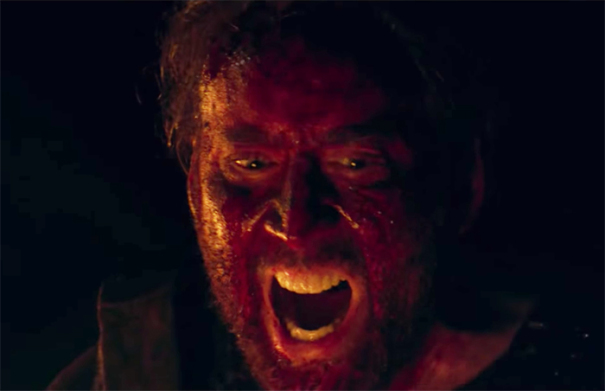
The rest of the movie, following Mandy’s murder, is awash in blood and various shades of red. Cage spends most of the film with a blood-splattered face. His facial expressions range from the maniacal to the hilarious to downright furious. The film is not without its one-liners, too. As he murders one of the biker demons summoned by the cult, he calls the creature a “vicious snowflake” and then quips, “you ripped my shirt!”

mandy-cage

Nicolas Cage as Red

Though she’s not in the film long before meeting her demise, Riseborough is noteworthy in her performance as Mandy, especially when she laughs in the face of Jeremiah Sand (Linus Roache),  a Charlie Manson knock-off who forces her to listen to his terrible music, which causes her to have a laughing fit. Mandy’s resistance shows just how absurd and fragile Sand’s masculinity is. You’re also left wondering if Mandy has some connection to a higher plane, due to the hallucinatory dreams she has and her interest in the occult.

Mandy1.jpg

Andrea Riseborough as Mandy

Mandy is not a perfect film, but my only real complaint is that it doesn’t take enough time building its world. What exists outside of Mandy and Red’s refuge, for instance, and what causes them to seek their own spot in nature? That gripe is minor, though. I assume that years from now, Mandy will be screened at midnight showings, earning applause during certain lines and scenes. There’s even a chainsaw battle in the last 1/3 of the film! Mandy has all the makings of a grind-house classic.


Halloween Trailer #2

With a little over a month until its release, David Gordon Green’s Halloween has a brand new trailer, featuring a hulking, brutal Michael Myers and a well-prepared Laurie Strode (Jamie Lee Curtis).
You can watch the new trailer by clicking here.
I first noticed the number of scenes that parallel scenes from the original film. For instance, in the first few seconds, we see that Michael Myers has returned to Haddonfield after escaping prison. He bumps into a trick-or-treater who is daunted by his size and shape, similar to the scene in the original Halloween when Tommy Doyle bumps into Michael and is taken aback. This happens early in the film, shortly after Michael escapes from the insane asylum and ends up in Haddonfield after stealing a car.
Another scene echoes a shot in the first film when Laurie Strode is babysitting and sees Michael standing in the yard behind sheets billowing on a laundry line. There is a similar scene in this new trailer, though it’s unclear whose house it is.
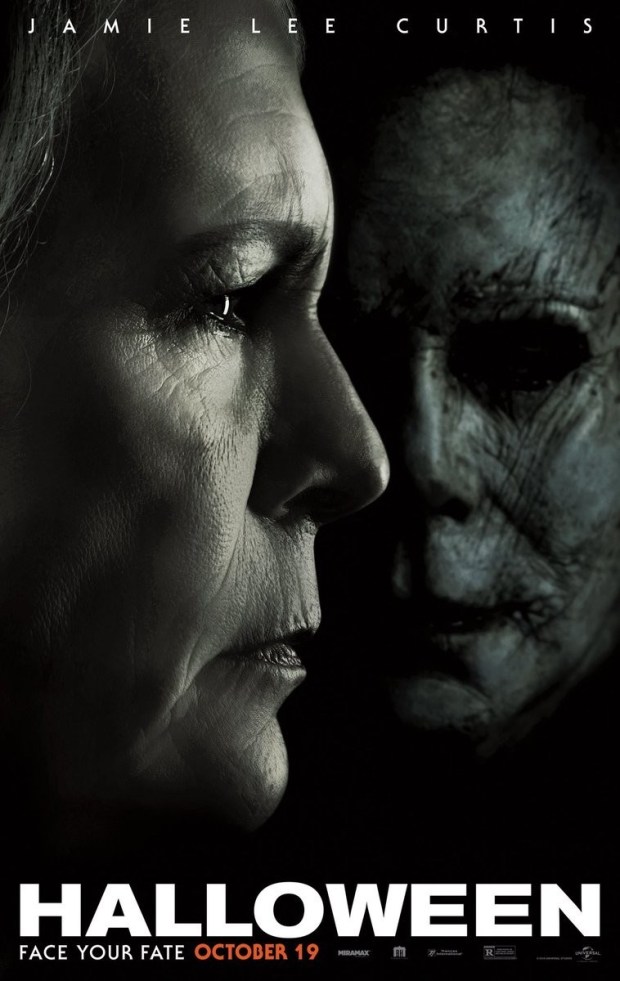
For the most part, this second trailer highlights Laurie Strode, specifically her ability to take charge. She screams at the costumed children and their parents to get off the streets and go home. In another scene, we see what I think is her house, fitted with flood lights and other high-wire alert systems. Clearly, she’s been planning for Michael’s return for decades. Additionally, the new trailer features Laurie’s voice-over. It’s probably safe to assume that the film will mostly focus on Laurie and Michael, as well as Laurie’s daughter and granddaughter. This is underscored by the new poster unveiled at the beginning of this month, featuring Michael and Laurie’s faces.
halloween-2018-poster-laurie-strode-michael-myers-1131805.jpeg
Finally, director David Gordon Green mentioned in this interview with Bloody Disgusting  that there is a continuous shot fairly early in the film that is supposed to be quite brutal. I am guessing that scene is featured in the trailer, after the costumed child bumps into Michael and the boogeyman then picks up a hammer and enters the houses of random neighbors for a killing spree. It’s in that same continuous shot that he trades the hammer for his trademark butcher knife.
Overall, the trailer has me even more excited for the film. If you have any comments or thoughts about the trailer, feel free to drop a line.

Dark Ink: A Poetry Anthology Inspired by Horror

The fine folks at Moon Tide Press  have put together an anthology entitled Dark Ink: A Poetry Anthology  Inspired by Horror, set for release in October. The collection includes 66 poets overall, including yours truly. If interested in pre-ordering a copy,  just click here. Scroll to the bottom of the page to see the link.

The official book launch is scheduled for Saturday, November 3rd at the Whittier Museum in Whittier, CA. Readers from the anthology will share their poems and the work of others in the book. Copies will be available. Complimentary refreshments and food will be provided.

William Friedkin’s Second Dance with the Devil

Decades after The Exorcist’s release in 1973, its Oscar-winning director William Friedkin returned to the subject matter for a documentary entitled The Devil and Father Amorth, now streaming on Netflix. Set in Georgetown, where The Exorcist was filmed, and Italy, the documentary features a real-life exorcism performed by Vatican-sanctioned Father Amorth.

Raised Roman Catholic, I was generally unnerved after first watching The Exorcist. I was less terrified by Regan’s (Linda Blair) head-spinning and vomiting scenes and more spooked by the idea that some demonic presence would chose to possess an innocent 13-year-old girl for no apparent reason other than it wanted a showdown with a priest, a battle of good versus evil. The film was an adaptation of the novel by William Peter Blatty, who based the novel and screenplay on accounts of a Georgetown boy who was allegedly possessed in 1949. Blatty believed that something supernatural was at work, and Friedkin’s new documentary contains two old interviews with Blatty that restate his belief in the story.

While Friedkin never comes out in the documentary and fully says that he believes in the possibility of demonic possession, he does acknowledge that it’s possible there is another dimension to this world that we can’t comprehend. Yet, Friedkin never fully analyzes or acknowledges the cultural impact of his 1973 film. There are featurette-like scenes where he returns to the location of filming, including the famous staircase that’s such an important part of the film’s iconic ending, but he doesn’t acknowledge that maybe the belief in demonic possession exists because of films like Rosemary’s Baby and The Exorcist, which were released at the height of the “God Is Dead” moment and got people back to church.

Fredkin1

(William Friedkin and Father Amorth)

Early in the documentary, Friedkin says that there are over 60 million citizens in Italy and about 500,000 have seen an exorcist. Let that statistic sink in for a moment. Roughly half a million Italians have seen an exorcist.

The exorcism that Friedkin films, his first time ever doing so, was performed on 40-something Cristina. It was her ninth exorcism. As Father Amorth tries to banish the demons, Cristina writhes in her seat, held down by family members and friends. She speaks in a gravelly voice not that much different from Regan’s. When I watched this scene, I had two questions: did Friedkin do something with the audio and was Cristina acting like she thinks a possessed person should behave?

In an interview with NPR, Friedkin said of Cristina:

She was an architect, and a very attractive, intelligent, soft-spoken, wonderful woman. And when she came into the room, I wondered: What is she doing here? What’s this woman doing here? She seems to me to be totally together. And then during the exorcism, she completely unraveled. She spoke in a voice that was completely different from her own. She had what I would say was an unnatural amount of strength for a woman of her size and age. And her entire personality had altered.

I was scared, seriously scared. I was two feet away from them … And it was terrifying. Gradually my fear turned into empathy for her. She was in seemingly unnatural and total pain.

The exorcism runs for about 15 minutes, and at times, it is quite dull. For most of it, Cristina squirms in the chair and growls in a trance-like state, while friends and family around her pray. It would have been more interesting if we actually knew more about Cristina and cared about her fate. Yet, the documentary never dives into her story.

Fried2.jpg

(Cristina and Father Amorth)

The director then shows the footage to neurologists at UCLA and Columbia. They admit that they can’t pinpoint what’s causing her behavior and they don’t debunk the footage. However, one of the specialists at Columbia says that if Cristina and her loved ones generally believe in the supernatural and the possibility of demonic possession, and if that is part of their reality, then an exorcism may be the best medicine for her behavior. I wish that Friedkin asked Cristina if she ever watched The Exorcist because I kept wondering how much popular culture has impacted her belief in the supernatural.

Sadly, Father Amorth, who was in his 90s, passed away not long after Friedkin finished the documentary. He was one of the warmest and funniest aspects of the film. He even had a ritual of literally thumbing his nose at the devil before performing an exorcism. Friedkin tried to reach out to Cristina again but had no luck. Her symptoms, however, did not end after the exorcism. Could there have been other reasons for her distress, financial or personal even? We’ll never know.

Even though The Devil and Father Amorth features footage of a real exorcism, it feels rather hollow. Friedkin is an accomplished filmmaker, and yet his characters in the documentary feel flat. Why didn’t he explore Father Amorth’s theories about evil and exorcisms, for instance? Why no serious interviews with Cristina? The film does raise some thought-provoking questions about belief in the supernatural, but The Exoricist makes a better case for real, raw evil because it contains characters that are fleshed out and well-developed. When a single mother watches her child succumb to the demon, we care what happens to them because we’ve gotten to know them. I can’t stay I know anything about Cristina after watching Friedkin’s documentary. Fans of The Exorcist should still check out the film because it may be the last time that Friedkin returns to the subject matter.

Poetry, Independent Horror, and August announcements!

Two announcements:

I’ve been trying to give some attention to independent horror films that I think are worth the watch. In that spirit, I’m happy to share this post over at Horror Homeroom on Mohawk and Downrange. Neither film is perfect, but both films feel especially relevant in 2018, Mohawk for the ways that it deals with the Other and Downrange for the way it addresses gun violence. Mohawk is currently streaming on Netflix, and Downrange is streaming on Shudder. Check them out! If anyone has seen the films, please share your thoughts.

Second, this Wednesday, August 8, Daryl Sznyter and I are teaching a writing workshop  and giving a reading at the Barron Arts Center in Woodbridge, NJ. The workshop is at 7, and the reading starts at 8. It will be followed by an open mic. The event is free. I’ll be reading a few horror film-themed poems that are part of a new manuscript in progress.

The Zombie Is Dead, Long Live the Zombie!

The various sub genres of horror, like everything else, go in and out of fashion. The slasher. The possession movie. The ghost story. The monster movie. The zombie film. For much of the 2000s, the zombie dominated the horror genre. Think of the impressive box office success of films like 28 Days Later (2001), Dawn of the Dead (2004), Shaun of the Dead (2004) and the high TV ratings of AMC’s “The Walking Dead” (2010).

Yet, for the last few years, the zombie genre has waned. Lately, horror has focused more on the internal and the psychological, specifically films like Hereditary, A Quiet Place, Get Out, and to some extent, It. Frankly, I can’t even think of the last time that I saw a zombie film in the theaters. Even “The Walking Dead,” which was a ratings Juggernaut for so many years, may be facing its apocalyptic sunset since Andrew Lincoln, aka Rick Grimes, and Lauren Cohen, aka Maggie, have announced that this season will be their last season, and they will only appear in six episodes. How can the show function without Rick and Maggie? Like a staggering corpse, it needs to be put out of its misery. It had a long, good run.

The more recent horror films that are doing well deal with socio/political issues (Get Out), or deal with the terror that is bringing a child into this world, specifically A Quiet Place, and, to some extent Hereditary. This has been the trend of the last few years, and based upon the United States’ political turmoil and polarization, coupled with the threat of climate change and other big issues, it is not likely this trend is going to subside anytime soon.

This brings me to a newish zombie film that I recommend: Cargo, an Australian film directed by Ben Howling and Yolanda Ramke. Cargo is currently streaming on Netflix and well worth your time.

The plot of the film is rather simple. A father, Andy (Martin Freeman), tries to protect his infant daughter after an epidemic spreads and turns people into zombies. Yes, this formula has been done time and time again, but Cargo works so well because it focuses on character, on Andy’s anxieties of  raising a child in  an unforgiving, uncertain world.  The visuals of the film are striking, nightmareish, and sometimes surreal. The zombies are not your typical rotting flesh corpses; instead, they have green fungus growing from their skin. Read into that any environmental metaphor that you may.


Zombies have survived for decades and decades because they have managed to evolve. They started out on the silver screen as a monster that alluded to Haitian and West African voodoo lure/myths. They then became Romero’s slow-walking flesh-eaters, until they become something even more menacing, relentless, and faster in 28 Days Later and the Dawn of the Dead remake.

I am not saying that Cargo is going to remake the genre. It doesn’t have enough mass appeal to do that, but it does show that zombie films can still work and work well when they focus on character and a believable plot, like a father trying to protect his daughter. The fungus aspect gives the familiar monster a new angle that taps into deeper environmental concerns. As the zombie trend that dominated so much of the 2000s finally wanes, the creature will need to evolve again to suit the times and the larger global anxieties. Cargo provides a path forward for the flesh-eating, familiar creature.


The Poetry of Oz’ Perkins’ Horror Films

After learning that Oz Perkins, son of Anthony Perkins, aka Norma Bates, was tapped to direct an adaptation of Paul Tremblay’s A Head Full of Ghosts, one of my favorite contemporary horror novels, I knew that I had to finally view his two previous films, The Blackcoat’s Daughter and I Am the Pretty Thing That Lives in the House. There are aspects of both films that frustrate me, especially the pacing of the later, but both films stayed with me days after their viewings. Both are slow-burns that feel like nightmares, heavy on atmosphere, mood, and tone. Both play out as visual poetry.

The Blackcoat’s Daughter primarily centers around two teens, Kat (Kiernan Shipka) and Rose (Lucy Boynton), left behind at an all-girls boarding school during a break.  As the film progresses, Kat becomes stranger and stranger. First, she thinks that her parents are dead, though she has no evidence to support the claim. Then, she acts out towards the nuns and staff members, and she becomes obsessed with Rose. The film also follows the story of Joan (Emma Roberts), an escaped mental patient. At first, it doesn’t seem like the stories of Joan, Katm and Rose are linked, but the narrative clarifies itself in the last 20 minutes or so, and the payoff is worth it.

The Blackcoat’s Daughter has few, if any, jump scares. In fact, it has one of the most low-key, understated exorcism scenes I’ve seen in any horror film. Instead, it relies on tone and mood, a bleak Canadian winter and a mostly gray and white color palate from scene to scene. As I said earlier, visually, the film feels like a long, slow nightmare.

I Am the Pretty Thing That Lives in the House is a film that draws much more from the Gothic tropes of literature, specifically the exploration of how the dead are  not really dead and the past is not really the past. The film has very few characters and focuses on Lily (Ruth Wilson), a hospice nurse charged with tending to Iris Blum (Paula Prentiss), a horror writer. Eventually, Lily starts reading Iris’ most acclaimed novel, The Lady in the Walls, about the ghost Polly (Lucy Boynton), who also haunts Iris’ house.

The film weaves poetry into the film through monologues and some of the visuals. Just check out the opening monologue by Lily:

I have heard myself say

that a house with a death in it

can never again be bought

or sold by the living.

It can only be borrowed from the ghosts

that have stayed behind

to go back and forth,

letting out and going back in again,

worrying over the floors

in confused circles,

tending to their deaths

like patchy, withered gardens.

They have stayed

to look back for a glimpse

of the very last moments of their lives.

But the memories of their own deaths

are faces on the wrong side

of wet windows,

smeared by rain,

impossible to properly see.


From there, the rest of the film serves as a meditation on death and the way that the past influences the present. As the film progresses, at a very slow pace, I might add, Lily becomes obsessed with the story of Polly and her influence on Iris’ novel. Polly is often shown visually in the present as a face seen through the wrong side of a wet window, something blurred, but still present, looming in the house, which in itself is quite a character in the film, a living, breathing thing with groaning floorboards and wide, darkened rooms.

Lily, meanwhile, is obsessed with the color white and often wears white through the duration of the film. Early on, she says, “I’m very seldom required to wear white by my employers. But, anyway, I always do. It;s always been that wearing white reassures the sick that I can never be touched even as darkness folds in on them from every side closing, like a claw.”

That white, however, is soiled as the film moves along, especially when Lily discovers a black, moldy substance growing on the wall where Polly was killed and buried by her husband years  earlier. Like The Blackcoat’s Daughter, I Am the Pretty Thing That Lives in the House is intentional in its color palate and visuals.  The growing darkness represents death, decay, and rot. At one point, Iris, who has dementia and constantly mistakes Lily for Polly says, “Even the prettiest things rot.”

The ending, like The Blackcoat’s Daughter, is a surprise and both Iris and Lily ultimately succumb to the rot that is Polly haunting the house. My main gripe with the film is the pacing. There are only so many scenes we can take of Lily or Polly walking across creaky floors  before it grows a bit tedious. This should have been a short film as opposed to a full-length.

A Head Full of Ghosts is a book that plays with traditional narrative structure and challenges it. The novel also takes the typical story of exorcism and turns it on its head. Perkins’ first two films challenge narrative expectations and conventions of the genre, so I’m excited to see what he does with the adaptation of Tremblay’s novel.

The Blackcoat’s Daughter is streaming on Amazon Prime, and I Am the Prettiest Thing That Lives in the House is streaming on Netflix.