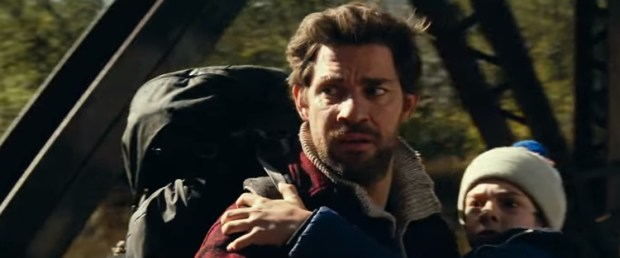
John Krasinski is not the first name that comes to mind in the horror genre. Yet, A Quiet Place, which he directed, is one of the most memorable mainstream horror films of the last few years. The film stars Krasinski as Lee and his real life wife, Emily Blunt, as Evelyn. Together, they exist in a post-apocalyptic world and try to protect their children from monsters that are blind but have a heightened sense of sound.
The film handles suspense masterfully, especially in the first 15 minutes, when the family hunts an abandoned store for medicine. Evelyn needs pills for her sick son, and she slowly has to turn the bottles on the shelf to read the labels. One little sound, and she knows her family will be meat for the monsters. After exiting the store, the family walks barefoot on trails of sand so their footsteps don’t echo and alert the monsters. You hope that all of them will make it home.
The rest of the film is relentless in its use of suspense, sound, and silence. Any wrong move, like the creak of a floorboard or a scream, will doom the family. The monsters, meanwhile, break the silence with their screeches and loud thumps when they invade the family’s home.
Like any good horror film, A Quiet Place serves as a metaphor for a larger issue: parenting and the dread that you can’t protect children from a world that can be unbearably cruel. At one point, Evelyn asks Lee, “Who are we if we can’t protect them?”. Blunt and Krasinski are stellar on screen together, especially in one of the early scenes where they share earbuds, cling to each other, and slow dance. You root for this family and want them to survive, but their pained facial expressions and the threat of a monster that is always lurking in the cornstalks surrounding their farmhouse make you wonder if they’ll last until morning.
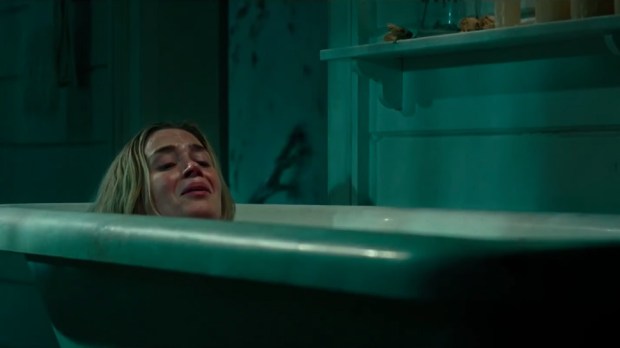
Emily Blunt’s performance as Evelyn is fantastic. She has one of the most terrifying birthing scenes I’ve ever seen on screen. It is visceral and jarring. Her character gradually transitions to a mother who will do whatever needs to be done to protect her children. In a movie that relies so much on silence and has so little dialogue, Blunt pulls off much of her performance through body language and facial expressions.
Krasinski has a mainstream horror hit on his hands. He may be new to the genre, but he certainly understands that character development and suspense that doesn’t rely too heavily on gore are elements that make a good horror film. Blunt, meanwhile, is emotional and powerful. A Quiet Place is the best mainstream horror film of 2018 thus far.
As Netflix moves closer and closer to essentially becoming a streaming service that offers its own content, it can be hard to find good films that don’t hold the Netflix title, and films that are not Netflix content sometimes don’t stay on there for very long.
That said, there are two films recently added to Netflix that are worth any horror movie fan’s time. The first is a Korean movie entitled The Wailing. Directed by Hong-jin Na, this 2016 film clocks in at nearly three hours, but very few scenes feel like they drag. The film follows a police officer who investigates bizarre murders caused by a mysterious disease. People start to wonder if a Japanese stranger is the source of the village’s ills. Eventually, the officer’s daughter succumbs to the disease, and well, I don’t want to give away much more of the plot or spoil anything. The film is atmospheric, heavy on Biblical imagery, and generally unnerving. In fact, it’s the first horror film in quite a while that got under my skin and stayed with me for days after my initial viewing. The film’s use of A-horror tropes, especially the idea of ghosts and the past manifest in the present, is well done. It also has one of the best exorcism scenes I’ve ever seen on film, if you can even call it an exorcism scene.
My second recommendation is the 2017 French-Canadian film Ravenous. Directed by Paco Plaza, this film generally plays with the zombie genre. At this point, I can understand why people would be tired of the endless barrage of zombie flicks, but this one works. Like 28 Days Later or Dawn of the Dead (2004), these zombies are more threatening. They run. They charge. They seem to be everywhere. The film follows a group of survivors in a remote, wooded town. The use of sound is the film’s most effective technique. This is a low-budget film, but one that employs sound in such a way that it makes it stand apart and above a lot of other recent zombie flicks. You can hear people crying off-screen, either survivors devoured by zombies or people turning into zombies. You can hear the thump, thump of an axe or a pipe wielded by a survivor as they kill one of their best friends who just turned. Unlike other zombie flicks, the movie isn’t as heavy on guts and gore and instead uses sound to establish it scares. When it does use gore, it feels breathtakingly real and gritty, streaked on the face of the survivor’s after they kill one of their friends, for instance. Furthermore, the shots of zombies standing on their porch stoops or standing in fields are just as unsettling. The film is well-worth the time.
I thought I would follow up my recent post about contemporary American horror movies by sharing this new list from Lit Hub called “10 Works of Literary Horror You Should Read.” The author, Emily Temple, doesn’t really try to define the term “literary horror” and admits it may not be possible. She mentions the importance of elevated prose, but even that term can be hard to define.
A number of books that made the list I’ve read, and I ordered a few that I haven’t, including A Head Full of Ghosts, which is on my list to read next. Of this list, Let the Right One In and House of Leaves (which I just finished) are my favorite. Let the Right One In Takes every single vampire trope and turns it upside down. The book, like a lot of great horror, deals with otherness even more so than the film adaptation, which I also recommend. I’m teaching the book and film when I teach Horror Film and Lit next academic year.
House of Leaves reminds me of Infinite Jest in so many ways. Like David Foster Wallace’s work, it has so many fractured narratives and tells even more of the story through exhaustive, extensive footnotes. However, unlike Infinite Jest, House of Leaves really plays with the physical structure of a book, what it looks like, how we read it, how text and white space are used. The book is challenging, but well worth the read. It’s a post-modern ghost story that plays with all of the conventions, but it’s also a love story.
I would add one more book to this list,, Ring by Koji Suzuki, which spawned the very famous movie and the J-horror trend. The book differs in many ways from the American film adaptation. It deals a lot more with how we share information and what effect that has, beyond the distribution of a disturbing video tape that is one of the main narrative arcs. The novel offers a broader critique of 24-7 news cycles, tabloids, and consumer culture. Though the book was published in 2004, it feels increasingly relevant for the social media age that we live in.
Over the last several months, I’ve been working on curriculum for a horror literature and film adaptation class, so I’ve been revisiting a lot of film theory articles and essays on horror, and while doing so, I’ve been musing about all of the recent interesting, memorable horror movies that have come out in the last two-three years. There is the old theory that horror does well during periods of national anxiety. Stephen King talks about this in his collection of essays on the genre entitled Danse Macabre. Probably the easiest example of think of is the last great period in American horror, the 1960s/1970s, which saw the releases of Night of the Living Dead, Last House on the Left, Halloween, The Exorcist, Jaws, Texas Chainsaw Massacre, among others. Out of all the films, I find Texas Chainsaw the most interesting, and upon re-watching it recently, I found it even more brilliant and more disturbing. I also realize now why the film is cited so much in countless essays on the genre. The low-budget film has no soundtrack, so instead, the viewer is confronted with sounds of flies buzzing, reports of violent stabbings or shootings that come through the radio in various scenes, and of course, Leatherface’s chainsaw. It is one of the most apocalyptic films I can name, and one that upends the norms for the horror genre, in that the traditional social order is not re-established by the conclusion. Sure, Sally lives, but Leatherface is not conquered, nor is his sadistic family. They all live, and the end shot is Leatherface doing a mad, frantic dance with his chainsaw beneath a blazing Texas sun. If there ever was an apt metaphor for the violence, upheaval and chaos of the 1960s/1970s, that film is it.
This brings me to the point I want to make: the American horror film genre is undergoing a renaissance right now, and it’s worth attention. Like Texas Chainsaw, Halloween, and Night of the Living Dead, many of the more interesting contemporary American horror films are indies. Specifically, I am thinking of It Follows, The Witch, Get Out, and the latest, It Comes at Night.
Like their predecessors from the 1960s and 1970s, the films also have social and political undercurrents. 2014’s It Follows deals with the perils of adolescent sex, and it can be viewed through a conservative or liberal lens, depending on your own personal political bend. 2015’s The Witch, set in Puritan New England, feels even more relevant in the era of Trump and the Women’s March because it deals with the power of female sexuality. Beyond that, however, it is one of the most atmospheric films I have seen in recent memory. This year’s Get Out is the biggest success of any of these films, and it smashed records for a black director. It deals with race in a nuanced way and addresses the hypocrisy sometimes evident in white progressives who often fashion themselves open-minded and liberal.
This brings me to the newest film of the bunch, It Comes at Night. After viewing it last night, I’m still thinking about it and frustrated by aspects of it. The film was released by A24 studios, which also released The Witch and 2016’s The Green Room, which I should include on this list, because, like the other films, it deals with the horror that comes from within/humanity. Like those other films, It Comes at Night is atmospheric and does not rely on blood and guts. The film is primarily set in a house and follows a family of three in a post-apocalyptic world. They wear gas masks, though we’re never sure why, if there is some contagion in the air. We don’t even know why society collapsed. We’re dropped in the middle of of everything. The family encounters another family of three, and by the conclusion, everyone turns on each other, raising questions about human nature and if we’d be able to pull together and survive if there was some global disaster. Parts of the film do capture the current moment in American society, especially our fear of the other, be it immigrants or people who may hold different viewpoints than us. You can even view the symbolism of the gas masks as a warning of some climate change catastrophe that is yet to come.
The film does not rely on gotch-ya scares, but instead the tone is set through creaky floorboards, sprawling shots of the forest surrounding the house, which also feels suffocating, and repeating images of a red door, which seems to symbolize the bridge between death and life. For the most part, we see everything through 17-year-old Travis’ (Kelvin Harris Jr.) eyes. We also witness his dreams, which are visceral and include boils and puss on his hands, black goo spewing from his mouth, and visions of his dead grandfather, Bud. This calls to question whether or not Travis is infected, and whether or not there is actually an illness, or if Travis’ father, Paul (Joel Edgerton), merely uses that fear to keep everyone in line.
It Comes at Night is a film that will stay with you after the credits conclude, and it is forceful in its statements about human violence. That said, I did need a little more to go on, especially regarding the contagion, if it was even real. The conclusion, meanwhile, can be interpreted in a number of ways, and I’m not going to give it away here because the film builds to it so well, beat by beat.
It Comes at Night follows a pattern, a new wave in American horror, one that doesn’t rely on blood, guts, and gore, but rather on establishing tone, mood, and atmosphere and not having a huge budget to do so. All of these films have a social and political undercurrent, and in that regard, they also mirror the last great wave of American horror cinema. There is something happening right now in the American horror film genre, and it’s worth paying attention to, especially since the future of the American political system, or the planet, for that matter, is uncertain.
I’ve been living with Waiting for the Dead to Speak for the last several months, doing readings for the book, sometimes with other NYQ authors and friends. It’s been a blast, but now, with the spring term in full force, I’ve been focused on teaching and writing new work. I’m also putting together a new class, slated to run next fall: horror literature and film! Because of this, I’ve immersed myself in film theory essays again, in particular ones about the horror genre. Because of that research, new poems arose, first a piece about my Catholic guilt and watching The Exorcist, then one about Boris Karloff as Frankenstein, and then one about Jason, and so on and so on. I don’t typically write a series of poems about one subject. I haven’t done that in years, since I worked on my chapbook Front Man, which is about the punk rock scene. That said, horror movies, when done well, do a great job at addressing society’s larger anxieties. Due to the uncertainties we’re living in, it just feels like I need to be working on these poems right now. It also allows me to process what is happening in the current geo-political landscape, while also removing myself from it somewhat. A few of the poems have been confessional, like some of what’s found in Waiting for the Dead to Speak, but for the most part, I use the poems to explore a number of horror films and what’s at stake in them, be it environmental disasters, end of the world scenarios, class issues, or feminist undertones.
Who knows how many of these I’ll write, but after publishing some book reviews and a few essays lately, it feels good to really dive into poetry again.
I’m straying a little bit from the usual poet-oriented posts to offer some criticism on the horror film It Follows, one of the best horror films I’ve seen in a few years. If you’ve seen the film, I hope that you enjoy this read.
John Carpenter, director of the original Halloween, The Thing, and other iconic horror movies, states in the documentary American Nightmares in Red, White, and Blue that American horror movies are very much about our fear of “the other,” something or someone different that will threaten our tribe. His own movies very much deal with this theme. In his remake of the The Thing, the monster is a shape shifter/parasite/alien that infects a group of scientists working in Alaska. In Halloween, Michael Myers terrorizes a quiet, sleepy suburban Illinois town and picks off teenagers one by one.
It Follows is very much a movie that plays with the trope that Carpenter mentioned, fears of “the other,” and like Halloween, it raises questions about where the other comes from. The opening shot establishes the setting and resembles some of the early shots in Halloween in that we see big houses and tree-lined streets, thus establishing the setting of what should be a safe suburban town. However, in both films that sense of security that suburbia should provide, specifically keeping bad things out, is shattered. In the opening scene of Halloween, the initial camera sequence is from Michael Myers’s point of view, as he roams through the rooms of his house, picks up a butcher knife and kills his sister as she’s having sex. In those first few moments of the film, however, the viewer has no idea that the killer is a child, a young Michael Myers, until a few shots later, when the camera angle shifts to third person, and we see him standing on the lawn, dressed in a clown costume, holding a bloody knife. Terror doesn’t come from the outside, but rather, it comes from the inside. About 20-30 minutes into the film, once Michael Myers is grown up and escapes from a mental hospital, he returns to his hometown to kill off teenagers.
After the opening shot of tree-lined streets and nice houses in It Follows, the viewer then sees a teenager, Annie, run out of her house, screaming, before she drives to a beach,where she leaves a panicked message for her father. As the film progresses and moves towards the opening shot, we learn the source of her terror.
Early in the film, the protagonist, Jay, has sex in a car with a boy older than her. He goes by the name of Hugh, but viewers later learn that his real name is Jeff. At first, little is known about him, but it can be assumes that he’s from the rougher side of the tracks, since he tells Jay that he doesn’t want to go back to his place because he doesn’t want to show her where he lives. After they have sex, he tells her that he passed on something to her, which he inherited from his last sexual partner. He then tells her that this thing can come in any form and can be someone she knows or someone she doesn’t know, but if it touches her, she’ll die.
During the rest of the film, Jay spends her time fleeing this creature in various forms, a creature that only she can see. She and her friends also visit Detroit, and in one scene, the friends chat about how their parents always told them to stay away from the city and stay in the suburbs. During their attempts to locate Jeff in the city, the viewer sees shots of bombed out buildings, which reinforces the idea of “the other,” that everything bad came from the city, including the man that Jay encountered and the sexual partner who passed down the evil to him.
However, the friends eventually learn that Jeff was not from the city, but rather, he attended high school in the suburbs, and they find him hiding out at his parents’s safe suburban home. He faked his name, though, and rented a house in the city to lure in a young woman and pass down the evil. His true identity is important, however, because it shows that the real terror lurks in the suburbs, not in the inner-city. It didn’t come from outside, but rather from within.
In this regard, the nameless, shape-shifting villain in It Follows is similar to other iconic horror movie villains, including Michael Myers, a boy from the suburbs, who, for seemingly no reason, kills his sister as a boy and returns to his hometown to commit additional murders. The evil is similar to Freddy Kreuger, a child molester who was burned to death by the townspeople and then returns as a supernatural entity to kill, in dreams, the children of the suburban parents who burned him alive. Even in Poltergeist, the evil does not come from outside, but from within. A family moves into a home in a development, and are terrorized by poltergeists. About mid-way through the film, the father learns that the development was built on an Indian burial ground, thus the cause of the haunting.
It Follows also gives a nod to another horror trope: sex and consequence. In the Friday the 13th movies, any teenagers who have sex are murdered by Jason. In American Dreams in Red, White, and Blue, Jason is even compared to a vicious, Old Testament kind of figure, eager to butcher anyone who strays from the straight and moral path. It is indeed significant that the creature in It Follows is passed down through sex. However, It Follows is a little more liberal in its treatment of teenage sex, or perhaps it lies somewhere in the middle of Friday the 13th and David Cronenberg’s 1970s film Shivers, which is about blood parasites that make their hosts hyper-sexual. There are some scenes of It Follows that resemble Shivers. In one of the final scenes, Jay and her friends hide out at a public, indoor pool. They hope to trap the creature in water and electrocute it, using lamps, TVs, and other appliances they lugged from their suburban homes. The pool itself and the colors in the shot, especially all of the yellow, resemble the closing scene in Shivers, when the creature/parasite infects the last person who doesn’t have it, and essentially, the film ends in an orgy, thus making a statement that sexual desires are impossible to avoid.
That scene in It Follows is different, however. Jay doesn’t succumb to the shape-shifting creature. Instead, she resists it, fights it, and flees from it yet again. Furthermore, throughout the film, Jay’s childhood friend, Paul, pleads with her to have sex with him to pass it on. She refuses, however, especially after she has sex with another character and the creature kills him. Ultimately, though, Jay does have sex with Paul, and the closing shot shows them walking down their suburban street, holding hands, while someone walks feet behind them. It’s not clear, however, if the person following them is the creature in yet another form, or someone normal. The viewer is left to guess.
It Follows makes a middle-ground statement regarding sex. Jay and Paul have sex and aren’t killed off Jason-style. Even Jeff doesn’t die, despite his confession that he contracted the evil after a one-night stand with a woman he met in the bar. However, it can be interpreted that only once Jay has sex that is meaningful, with someone who cares about her, is she safe. She survives and is no longer running by the closing shot.
In many ways, It Follows is about the old classic horror trope of the other. In the film, the other takes the shape of the inner-city creeping into the suburbs, an American fear that stems back to the great white flight of the 1950s and 1960s and has returned in the age of Occupy, a bankrupt Detroit, and class inequality/racial tensions. But the other also takes the shape of teenage sex. The creature literally stalks characters because it is passed down through sex. Yet, in the end, Jay has sex, and survives. So sex becomes less threatening.
There are other aspects of the film to note. Its music and even some of its set design/displays, such as the lamps, station wagons, and even a typewriter, resemble 1960s/1970s America, a time period that was iconic for American horror film. Yet, the film is supposed to be set in present day Detroit ‘burbs. There is a wonderful scene too, when Jay is sitting in a college classroom, listening to a professor read Eliot’s “The Love Song of J. Alfred Prufrock,” a poem all about “the cry of the occasion,” sex, the consequences of sex, and death. Prufrock ponders sex, women, and fears that he is getting old. Like “The Love Song of J. Alfred Prufrock,” It Follows is a film that analyzes the consequences of sex and how our past partners shape us and carry us to the present. We can’t run from it or avoid it. It follows.
Every October, I try to make the most of Halloween because it’s my favorite holiday. This weekend, I plan to purchase pumpkin ale and watch some horror movies on NetFlix that I have yet to see, including Lovely Molly and Insidious, both of which are contemporary films that have gotten positive reviews. If you are looking for horror movies to watch on Netflix, there are several to choose from. If you want something classic, Netflix offers a slew of Vincent Price films, including The Masque of Red Death, House on Haunted Hill, and others. They also have some of the universal monster horror movies, including The Creature from the Black Lagoon.
Out of all the horror options on Netflix, I recommend Masters of Horror, a series that features 45-minute films by several well-known horror directors, including John Carpenter, Joe Dante, Dario Argento, Tobe Hopper, and others. Both seasons are available for streaming. Check out “Cigarette Burns,” “Jennifer,” and “Imprint.” Those were my favorite in the series.
If you want to watch something from the 1970s/1980s (the best era in American horror cinema, in my opinion), check out AMC’s 24-hour horror movie marathon that runs from now until Halloween. They’ll be playing The Exorcist, Friday the 13th, and a lot of the Halloween movies, as well as reruns of The Walking Dead, with a new episode to debut Sunday night.
If you want something spooky to read, check out this column in Electric City. I mentioned in the column “cemetary Nights V” by Stephen Dobyns as a good read for this time of year, but I also recommend Charles Simic and Mark Strand as some other poets to check out. They have plenty of work with unsettling, eerie, deep images.
As we await for the Frankstorm to hit the East Coast, there’s plenty of movies to watch and books to read to celebrate Halloween.
 Brian Fanelli